
Electric wheelchairs use rechargeable batteries to supply electrical power to drive motors, electronic controllers, user interfaces, and auxiliary equipment.
Battery selection is part of electric wheelchair design because the battery must support the required operating voltage, driving current, travel range, charging system, and installation conditions.
Electric wheelchairs may operate indoors, outdoors, or across different surfaces. Their battery systems must be evaluated according to the equipment’s mechanical structure, electrical requirements, and intended operating environment.
东莞一展电子科技有限公司 provides OEM and ODM custom lithium battery pack development and manufacturing services for electric mobility and industrial equipment applications.
This article explains the technical considerations involved in custom lithium battery packs for electric wheelchairs, including battery chemistry, voltage, capacity, discharge current, Battery Management System (BMS) protection, charging, mechanical integration, and applicable standards.
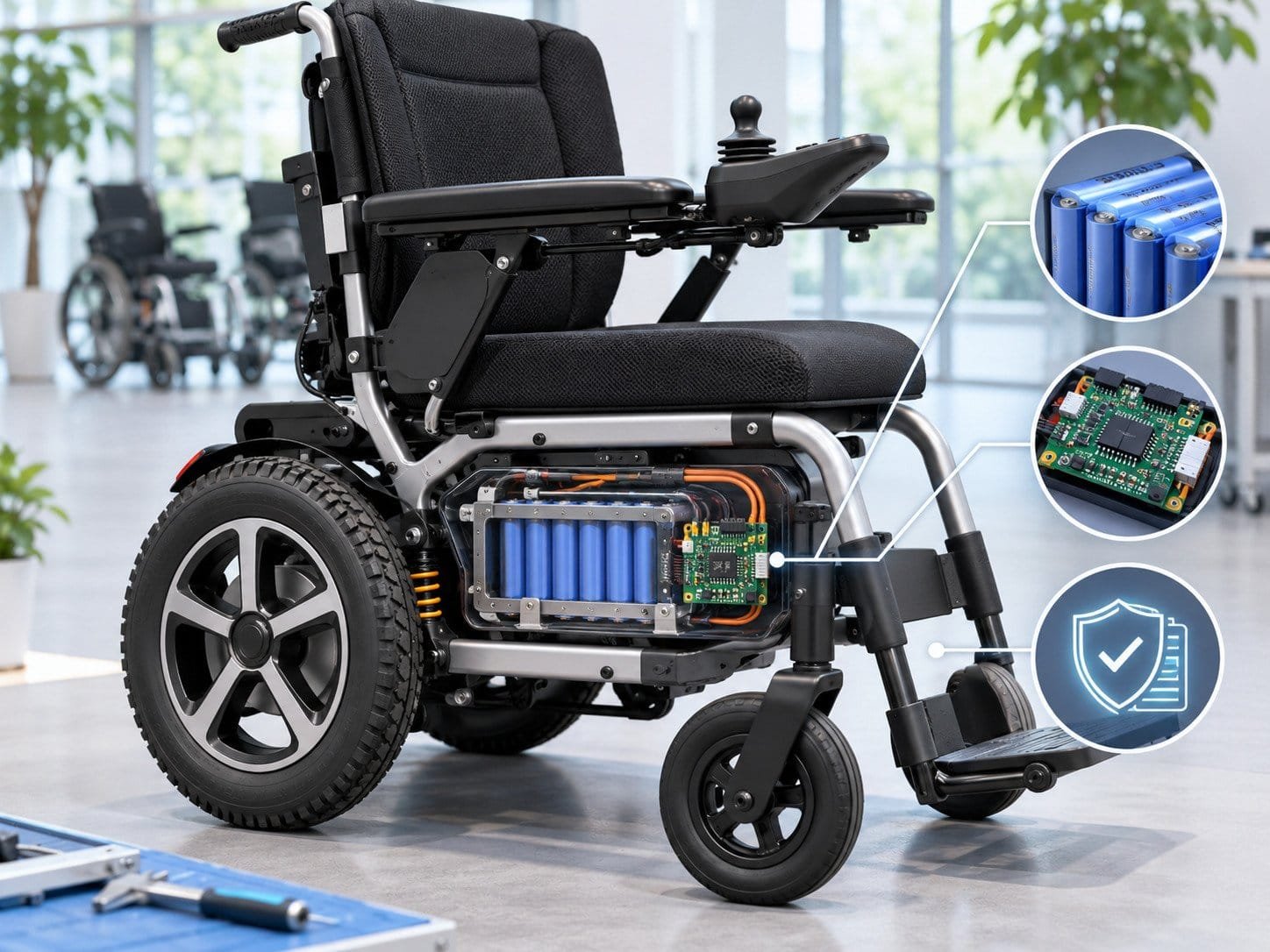
1. Battery Applications in Electric Wheelchairs
Electric wheelchairs are available in different mechanical and electrical configurations.
Standard Powered Wheelchairs
Powered wheelchairs use electric drive motors controlled through a joystick or another user interface.
The battery supplies power to the traction motors, control electronics, and other electrical components.
Battery design should account for the wheelchair’s motor specifications, total operating load, and required travel distance.
Folding Electric Wheelchairs
Folding electric wheelchairs incorporate mechanical structures designed for transportation and storage.
Battery pack dimensions, mass, connector placement, and removal mechanisms may influence the wheelchair’s folding arrangement.
Some models use removable batteries that can be disconnected from the equipment.
Outdoor Electric Wheelchairs
Outdoor electric wheelchairs may operate on pavements, ramps, and other surfaces within the equipment’s approved operating conditions.
Battery requirements depend on the drive motors, equipment mass, operating surface, gradients, and travel profile.
Electric Wheelchairs with Powered Seating Functions
Some electric wheelchairs include electrically powered seat adjustment, tilt, recline, or lifting mechanisms.
The battery may supply electrical power to these functions in addition to the drive system.
The energy and current requirements of auxiliary mechanisms should be included during battery selection.
2. Selecting Battery Voltage for Electric Wheelchairs
Battery voltage must match the wheelchair’s electrical system.
Some powered wheelchairs use a nominal 24V electrical architecture, while other designs use application-specific configurations.
The selected battery must remain compatible with the wheelchair’s motor controllers, charging system, and permitted operating voltage range.
Lithium Battery Voltage Configurations
Examples of lithium battery configurations include:
| 电池配置 | 化学 | 额定电压 |
|---|---|---|
| 6S | Ternary Lithium-Ion | 21.6V |
| 7S | Ternary Lithium-Ion | 25.2V |
| 8S | 磷酸铁锂 | 25.6V |
| 10S | Ternary Lithium-Ion | 36.0V |
The values assume nominal cell voltages of 3.6V for ternary lithium-ion and 3.2V for LiFePO4 cells.
These are illustrative configurations and do not represent specific production battery models.
Voltage Compatibility Requirements
Before selecting a custom battery configuration, wheelchair manufacturers should confirm:
- 额定系统电压
- Maximum permitted battery voltage
- Minimum operating voltage
- Motor controller input range
- Battery undervoltage behavior
- Charger voltage
- Electrical protection requirements
For example, a 7S ternary lithium-ion battery has a nominal voltage of 25.2V and a full-charge voltage of 29.4V when using cells with a specified maximum charging voltage of 4.2V each.
An 8S LiFePO4 battery has a nominal voltage of 25.6V and may have a maximum charging voltage of 29.2V when using cells with a specified maximum charging voltage of 3.65V each.
The final charging limits must follow the selected cell manufacturer’s specifications.
A nominal 24V designation does not establish compatibility between different battery chemistries, controllers, and chargers.
3. Calculating Battery Capacity and Travel Range
Battery capacity should be determined according to the wheelchair’s electrical energy consumption and required travel range.
Battery capacity is commonly expressed in ampere-hours (Ah), while electrical energy is expressed in watt-hours (Wh).
Battery Energy Calculation
Nominal battery energy is calculated using:
Battery Energy (Wh) = Nominal Voltage (V) × Capacity (Ah)
For example, a theoretical 25.6V 20Ah battery has:
25.6V × 20Ah = 512Wh
A theoretical 25.6V 40Ah battery has:
25.6V × 40Ah = 1,024Wh
These values represent nominal battery energy rather than verified usable energy.
Estimating Wheelchair Travel Range
Travel range can be estimated when energy consumption per kilometer is known.
Estimated Range (km) = Usable Battery Energy (Wh) ÷ Average Energy Consumption (Wh/km)
Assume the following illustrative conditions:
| 参数 | Example Value |
|---|---|
| Battery Nominal Voltage | 25.6V |
| 电池容量 | 20 安培 |
| 标称能量 | 512Wh |
| Assumed Usable Energy Fraction | 90% |
| Average Energy Consumption | 30Wh/km |
Estimated usable energy:
512Wh × 0.90 = 460.8Wh
Estimated travel range:
460.8Wh ÷ 30Wh/km = 15.36km
The result is a theoretical calculation.
Actual travel range depends on wheelchair mass, user and carried load, motor characteristics, speed, gradients, surface conditions, temperature, battery condition, and permitted battery discharge limits.
The 90% usable energy fraction and 30Wh/km consumption are illustrative assumptions rather than verified wheelchair performance values.
Calculating Required Battery Capacity
When the target travel distance is known, the required nominal battery capacity can be estimated using:
Required Capacity (Ah) = [Target Range (km) × Energy Consumption (Wh/km)] ÷ [Nominal Voltage (V) × Usable Energy Fraction]
The calculation should use a measured or validated energy consumption value for the intended wheelchair application.
4. Continuous and Peak Discharge Current
Wheelchair battery packs must supply the current required by the drive motors and associated electrical equipment.
Continuous and peak discharge current should be specified separately.
连续放电电流
Continuous discharge current refers to the electrical current required during sustained operation.
It influences:
- 电池单元的选型
- Parallel cell configuration
- BMS current rating
- Cable specifications
- Connector selection
- 热管理
峰值放电电流
Peak current may occur during wheelchair startup, acceleration, gradient climbing, or changes in drive load.
The peak current specification should include current amplitude, pulse duration, and repetition frequency.
Example Electrical Requirements
| 参数 | Illustrative Value |
|---|---|
| 额定电压 | 25.6V |
| 电池容量 | 30 安培 |
| 连续放电电流 | 30A |
| 峰值放电电流 | 60A |
| Peak Duration | 3 seconds |
These values are illustrative project specifications, not verified product ratings.
The actual battery current requirements must be determined from the wheelchair controller, motors, and operating load profile.
Current Protection and Wheelchair Operation
Battery current protection requires consideration of the complete wheelchair electrical system.
A sudden battery power interruption may affect movement, braking, or powered seating functions.
The wheelchair manufacturer must evaluate battery protection behavior together with the equipment’s braking system, electrical architecture, and functional safety requirements.
The BMS does not replace wheelchair-level safety controls.
5. LiFePO4 and Ternary Lithium-Ion Cell Selection
Custom electric wheelchair battery packs may use LiFePO4 or ternary lithium-ion cells according to the equipment’s technical requirements.
磷酸铁锂(LiFePO4)电池电芯
LiFePO4 cells are used in electric mobility and industrial battery applications.
Relevant cell specifications include:
- 额定电压
- 额定容量
- 连续放电电流
- Pulse discharge capability
- 充电电流
- 工作温度
- 细胞尺寸
- Terminal configuration
- Manufacturer cycle life specifications
LiFePO4 cell selection should consider the wheelchair’s electrical architecture, current requirements, and available installation space.
Ternary Lithium-Ion Battery Cells
Ternary lithium-ion cells, including NMC chemistry, may be used in electric wheelchair battery configurations.
Cylindrical cells such as 18650 and 21700 formats can be evaluated according to their capacity, electrical current capability, dimensions, and operating specifications.
Battery Cell Configuration
Series connections determine battery voltage.
Parallel connections determine combined nominal capacity and contribute to current capability.
The final cell arrangement should account for electrical insulation, mechanical support, cell matching, and thermal conditions.
Battery chemistry should be selected according to the intended wheelchair design rather than voltage or capacity alone.
6. Battery Management System Requirements
The Battery Management System monitors battery conditions and provides protection functions according to its hardware and firmware configuration.
A custom electric wheelchair battery may require:
- 电池电压监测
- 过充电保护
- 过放电保护
- 过流保护
- 短路保护
- Charging temperature protection
- Discharging temperature protection
- 细胞平衡
- Battery fault monitoring
额定电流
The BMS current rating should be evaluated according to the wheelchair’s continuous and peak discharge requirements.
Protection thresholds should be coordinated with the motor controller’s operating characteristics.
State of Charge Monitoring
Some powered wheelchairs require State of Charge (SOC) information for the user display or equipment controller.
SOC reporting may be available through a compatible BMS interface.
The estimation method and required accuracy should be defined during development.
温度保护
NTC temperature sensors may be installed at selected locations within the battery pack.
Charging and discharging temperature thresholds should be established according to the selected cell specifications.
Fault Behavior
The battery manufacturer and wheelchair OEM should define the required response to protection events.
This includes evaluating potential power interruption during movement and the resulting effects on the complete wheelchair system.
7. Battery Communication and Controller Integration
Electric wheelchair battery systems may use electrical status signals or communication interfaces to exchange information with the equipment controller.
Depending on the project, interfaces may include CAN, UART, or SMBus.
Battery Information
A compatible BMS may provide:
- 电池电压
- 电池电流
- State of Charge
- 温度
- Protection status
- 故障信息
The available data depends on the selected BMS hardware and firmware.
CAN通信
For CAN-enabled projects, the wheelchair manufacturer should define:
- CAN bit rate
- CAN message identifiers
- 数据格式
- Required battery parameters
- Transmission intervals
- Connector pin assignments
CAN monitoring does not automatically provide control of battery charging or discharging.
Additional functions must be defined and implemented according to the agreed electrical architecture.
Controller Compatibility
Battery information reporting and power delivery are separate integration requirements.
A custom battery should be evaluated with the actual wheelchair controller before production approval.
8. Charging System Requirements
Electric wheelchair battery packs must be compatible with the specified charging system.
Depending on the wheelchair design, charging may use an external charger or an integrated charging arrangement.
充电电压
Charging voltage depends on the selected battery chemistry and series configuration.
For example, a battery using eight LiFePO4 cells in series may require a maximum charging voltage of 29.2V when the cell manufacturer’s charging specification is 3.65V per cell.
The approved charging profile must be confirmed for the actual cell model and battery design.
充电电流
Charging current should be selected according to:
- 电池芯规格
- 电池容量
- BMS charging current rating
- Connector ratings
- Cable specifications
- 工作温度
- Required charging schedule
Charging Connectors
Wheelchair charging connectors must match the equipment’s electrical and mechanical interface requirements.
The manufacturer should confirm connector type, polarity, pin assignments, current rating, and protective arrangements.
Charging Safety
The battery pack and charger must be evaluated together.
The system should account for charging protection, battery temperature, connector integrity, and fault behavior.
A charger intended for a lead-acid battery system should not be assumed compatible with a lithium battery without technical verification.
9. Removable Battery Packs and Folding Wheelchairs
Some electric wheelchair designs use removable batteries to support transportation, maintenance, or equipment packaging requirements.
A removable battery pack requires specific mechanical and electrical design considerations.
机械要求
The wheelchair manufacturer should provide:
- 电池仓尺寸
- Installation orientation
- Mounting and locking arrangement
- Battery mass requirements
- Handle or removal mechanism
- 连接器位置
- 电缆布线
- Service access
Connector Design
Removable battery systems require compatible electrical connectors.
Connector selection should account for current rating, voltage, polarity, mating cycles, mechanical retention, and protection against accidental contact.
Battery Removal
The battery removal procedure should be defined by the wheelchair manufacturer.
Electrical isolation and protection against unintended activation or short circuits must be considered.
A removable battery is not automatically suitable for replacement while the wheelchair is powered.
10. Airline Travel Considerations for Electric Wheelchair Batteries
Some powered wheelchair users travel by air.
Airline transportation requirements depend on the battery type, battery installation, protection against damage, and applicable dangerous goods regulations.
Lithium Battery Transportation Documentation
Lithium battery transportation may require documentation demonstrating compliance with the applicable UN38.3 testing requirements.
Battery identification and watt-hour information may also be relevant to airline handling procedures.
Installed and Removable Batteries
Air transportation rules distinguish between lithium batteries that remain installed and batteries that must be removed because of the mobility aid’s design or protection arrangements.
For certain removable battery situations, watt-hour limits apply.
These limits should not be interpreted as a universal 300Wh restriction on every powered wheelchair battery.
Airline and Operator Requirements
Airline procedures, jurisdictional rules, and the battery’s installation arrangement must be reviewed for the intended journey.
For wheelchair OEM projects involving air transportation, the manufacturer should define the transportation requirements during product development.
11. Mechanical and Environmental Battery Pack Design
Battery dimensions, mass, mounting, and enclosure construction are part of wheelchair integration.
Battery Compartment Dimensions
The equipment manufacturer should provide the maximum allowable:
Length × Width × Height
The available space should also account for connectors, cables, mounting components, and service access.
Battery Mounting
The battery should be secured according to the wheelchair’s mechanical design.
The mounting structure should be evaluated for movement, vibration, and the specified operating environment.
Weight Distribution
Battery mass and installation position may influence wheelchair stability, handling, and structural loading.
The wheelchair manufacturer should evaluate these factors as part of the complete equipment design.
Environmental Protection
Electric wheelchairs may encounter dust, humidity, water splashes, and outdoor environmental conditions.
The battery enclosure and electrical connectors should be selected according to the installation environment.
Any required Ingress Protection (IP) rating should be defined and verified under the applicable test conditions.
热管理
Battery cells and electrical connections generate heat during charging and discharging.
Thermal design should account for current demand, enclosure structure, available heat dissipation, and ambient temperature.
12. Battery Testing and Applicable Standards
Electric wheelchair battery development may require electrical, mechanical, environmental, and system integration testing.
The applicable standards depend on the battery configuration, wheelchair design, intended market, and regulatory classification.
电气测试
测试可能包括:
- Voltage verification
- 能力测试
- Continuous discharge testing
- Peak current testing
- Charging evaluation
- BMS保护测试
- Insulation assessment
Mechanical and Environmental Testing
测试可能包括:
- Enclosure inspection
- Mounting verification
- 振动测试
- Mechanical shock testing
- 温度测试
- Ingress protection testing, where applicable
Wheelchair Integration Testing
System-level testing may include:
- Drive motor operation
- 控制器兼容性
- Battery status reporting
- Charging system compatibility
- Braking and shutdown behavior
- Operating range evaluation
Applicable Standards and Requirements
| Standard / Requirement | General Scope |
|---|---|
| ISO 7176-14 | Power and control systems for electrically powered wheelchairs and scooters |
| ISO 7176-25 | Lead-acid batteries and chargers for powered wheelchairs; applicability to lithium battery projects must not be assumed |
| IEC 62133-2 | Safety requirements for portable sealed secondary lithium cells and batteries within its scope |
| UN38.3 | Lithium battery transportation testing |
| IEC 60529 | Enclosure ingress protection classification |
| Applicable Medical Device Regulations | Requirements determined by equipment classification and destination market |
The applicable standards, editions, and regulatory requirements should be confirmed for each project.
Battery-level testing does not automatically establish compliance for the complete powered wheelchair.
13. Information Required for a Custom Electric Wheelchair Battery Quotation
Electric wheelchair manufacturers requesting custom lithium battery packs can provide the following information.
| 项目 | Required Information |
|---|---|
| Wheelchair Type | Standard, folding, outdoor, or powered seating wheelchair |
| 额定电压 | Required battery voltage |
| Operating Voltage Range | Minimum and maximum voltage |
| 电池容量 | Ah or Wh |
| Required Travel Range | km or miles |
| Average Power Consumption | W or Wh/km |
| 连续放电电流 | A |
| 峰值放电电流 | A and duration |
| 电池化学 | LiFePO4 or ternary lithium-ion |
| 电池尺寸 | Maximum length × width × height |
| 电池重量 | Mass limit or required range |
| BMS Requirements | Protection and monitoring |
| 交流 | CAN, UART, SMBus, or specified interface |
| Charging Voltage and Current | V and A |
| Charging Connector | Model and pin assignments |
| Power Connector | Model and pin assignments |
| 可拆卸电池 | Required or not required |
| 环境要求 | Temperature, moisture, and IP rating |
| 机械要求 | Mounting, retention, and vibration |
| Certification Requirements | Applicable standards and target market |
| Sample Quantity | Prototype requirements |
| Production Forecast | Estimated purchasing quantity |
| Delivery Destination | Country and address |
Electrical schematics, battery compartment drawings, and existing battery specifications can support technical evaluation.
14. Custom Electric Wheelchair Battery Development at Dongguan Yizhan Electronics Technology Co., Ltd.
东莞一展电子科技有限公司 provides OEM and ODM custom lithium battery pack development and manufacturing services for electric mobility, robotics, and industrial equipment applications.
For electric wheelchair projects, we evaluate battery requirements according to the equipment’s voltage, capacity, discharge current, installation space, and charging system.
Our customization scope includes:
- LiFePO4 and ternary lithium-ion battery configurations
- 定制电压和容量
- 电池单元的选型
- BMS configuration according to project requirements
- Communication interface options, subject to technical evaluation
- NTC temperature monitoring
- Customized charging and discharging connectors
- Plastic and metal battery enclosures
- 电池组总成
- Technical documentation and project testing coordination
Wheelchair-specific safety requirements, controller compatibility, mechanical construction, and applicable regulatory obligations must be evaluated according to each project.
We work with OEM and ODM customers to review battery specifications for equipment development and manufacturing projects.
15. Frequently Asked Questions (FAQ)
Q1. What battery voltage is commonly used in electric wheelchairs?
Some electric wheelchairs use a nominal 24V electrical system. Lithium battery configurations such as 7S ternary lithium-ion and 8S LiFePO4 may be evaluated depending on the wheelchair controller and charger specifications.
The complete voltage range must be confirmed before selecting the battery.
Q2. Can a lithium battery replace a lead-acid wheelchair battery?
A lithium battery may be considered for a wheelchair originally designed for lead-acid batteries, but compatibility must be evaluated.
Voltage range, charging profile, BMS protection behavior, electrical connectors, mass, mechanical installation, and controller operation should be confirmed.
A direct replacement should not be assumed based only on nominal voltage or enclosure dimensions.
Q3. How do I calculate the required battery capacity for an electric wheelchair?
The battery energy requirement can be calculated from the intended travel distance and measured energy consumption.
Required usable energy is:
Travel Distance (km) × Energy Consumption (Wh/km)
The result can then be converted into nominal battery capacity using the battery voltage and approved usable energy fraction.
Actual capacity selection should account for the wheelchair’s operating conditions and required reserve.
Q4. What is the difference between a 24V lithium-ion battery and a 24V LiFePO4 battery?
Batteries marketed as 24V may use different cell chemistries and series configurations.
For example, a 7S ternary lithium-ion battery has a nominal voltage of 25.2V, while an 8S LiFePO4 battery has a nominal voltage of 25.6V.
Their charging voltage profiles and discharge characteristics differ according to the selected cells.
Compatibility should be evaluated against the wheelchair’s electrical system.
Q5. What BMS functions are required for an electric wheelchair battery?
A wheelchair battery BMS may require cell voltage monitoring, overcharge protection, over-discharge protection, current protection, short-circuit protection, temperature monitoring, and cell balancing.
Additional monitoring or communication functions depend on the project.
The BMS protection behavior must be evaluated together with wheelchair motor control and safety functions.
Q6. Can an electric wheelchair lithium battery be taken on an airplane?
Air transportation depends on the battery type, installation method, battery protection, watt-hour rating, and applicable airline regulations.
Some removable lithium battery arrangements are subject to specific watt-hour limits.
For air travel, the wheelchair manufacturer and passenger should consult the airline and applicable transportation requirements.
Q7. Can Dongguan Yizhan Electronics Technology Co., Ltd. customize the battery size and connectors?
We provide custom battery pack development services based on project requirements.
Battery dimensions, connector types, wiring, enclosure configuration, and BMS functions can be evaluated according to technical feasibility.
Customers can provide drawings, battery specifications, and connector information for review.
Q8. Do electric wheelchair batteries require CAN communication?
Not every electric wheelchair requires CAN communication.
Some battery systems use power connections and basic status signals, while other designs require a defined communication interface.
CAN, UART, or another interface should be specified according to the wheelchair controller and BMS design.
Q9. How long does an electric wheelchair lithium battery last?
Battery service life depends on cell chemistry, charging and discharging conditions, operating temperature, current demand, and usage.
Cycle life values should be evaluated according to the cell manufacturer’s specified test conditions.
Actual service life requires consideration of the complete battery pack and its operating environment.
Q10. What information should I provide for an OEM electric wheelchair battery quotation?
Please provide the wheelchair model, nominal voltage, required capacity or travel range, continuous and peak current, battery dimensions, connector specifications, charging requirements, sample quantity, and estimated production volume.
Existing battery photographs, technical drawings, or electrical schematics can support the quotation process.
结论
Custom lithium battery pack design for electric wheelchairs involves electrical, mechanical, thermal, and system integration requirements.
Battery voltage, energy capacity, continuous and peak discharge current, and cell chemistry determine the initial battery configuration.
BMS protection, controller compatibility, charging arrangements, and battery mounting must be evaluated according to the wheelchair design.
For electric wheelchair OEM projects, battery requirements should be confirmed before prototype development and production.
Looking for custom lithium battery packs for electric wheelchairs?
联系方式 东莞一展电子科技有限公司 with your wheelchair specifications, required battery voltage, capacity, electrical current, battery dimensions, charging requirements, and estimated purchasing quantity.


 English
 Chinese
 Japanese
 German
 French
 Korean

