
Lithium batteries are widely used in e-bikes, AGVs, AMRs, robots, golf carts, forklifts, UPS systems, medical equipment, power tools, and other portable or industrial applications. However, even when a lithium battery is not being used, its capacity can gradually decrease during storage.
Improper storage conditions, such as high temperature, excessive charge, deep discharge, or long periods without inspection, can accelerate battery aging and reduce its available capacity.
So, how can you prevent lithium battery capacity loss during storage?
The key is to control the battery’s state of charge, storage temperature, environment, and inspection schedule while following the manufacturer’s storage recommendations.
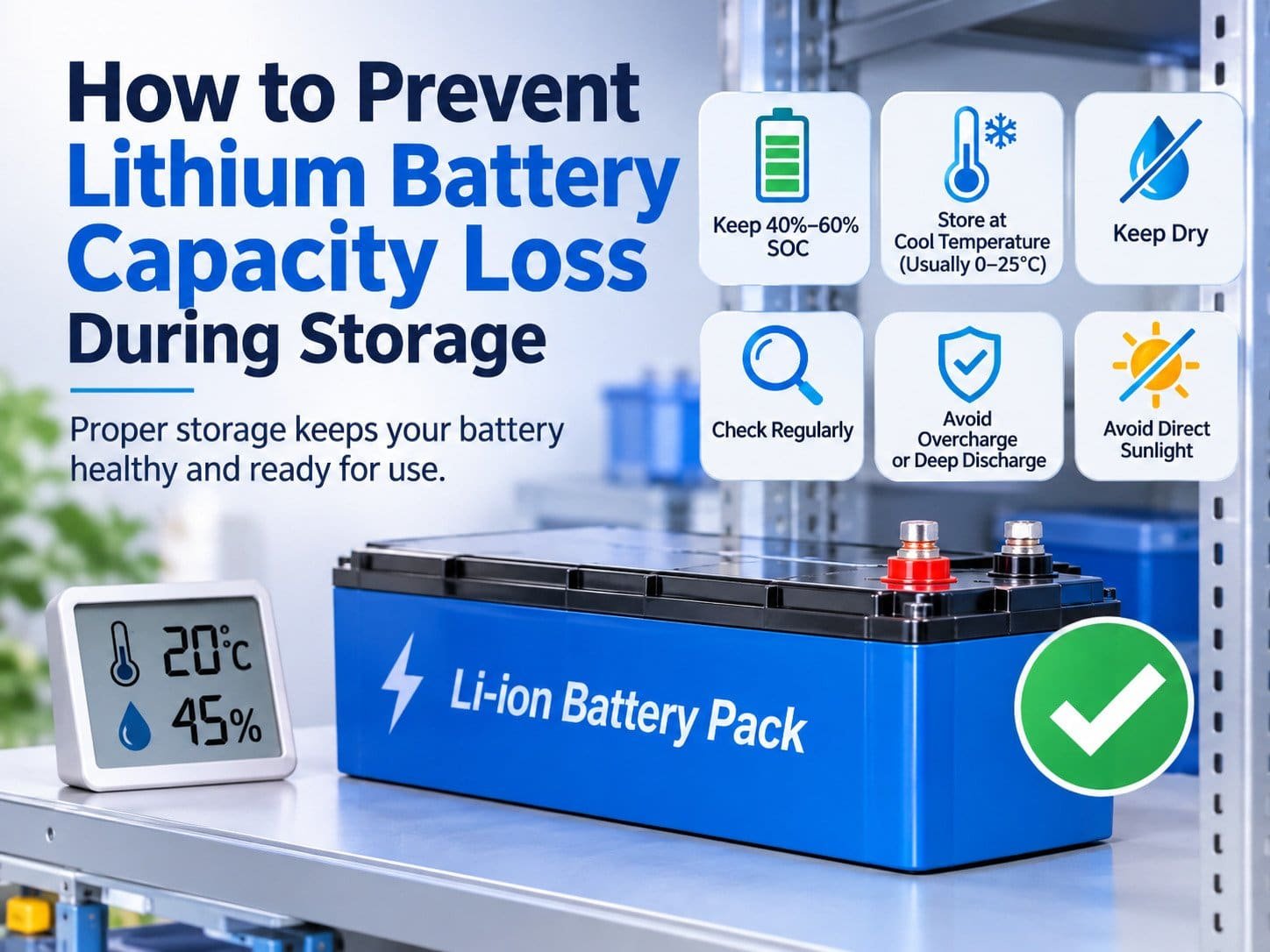
1. Store the Lithium Battery at an Appropriate State of Charge
One of the most important factors during long-term storage is the battery’s state of charge (SOC).
Storing a lithium battery at 100% charge for an extended period can accelerate calendar aging, especially when combined with high temperatures. On the other hand, storing a battery at an extremely low state of charge can increase the risk of over-discharge because the battery may continue to lose a small amount of energy through self-discharge and the power consumption of its battery management system (BMS).
For long-term storage, lithium batteries are generally stored at a moderate state of charge rather than fully charged or completely discharged. A commonly used range is around 40%–60% SOC, but the exact requirement depends on the cell chemistry, battery design, and manufacturer’s specifications.
For example, an LFP battery pack and an NMC battery pack may have different storage recommendations. Therefore, always follow the storage requirements provided by the battery or cell manufacturer.
Key points:
- Avoid storing lithium batteries at 100% SOC for long periods.
- Do not store the battery completely discharged.
- Maintain the recommended storage SOC.
- Check the battery periodically during long-term storage.
Proper SOC management can help reduce unnecessary aging and maintain battery performance.
2. Control the Storage Temperature
Temperature has a significant impact on lithium battery aging.
High temperatures can accelerate chemical reactions inside lithium-ion cells, which may increase capacity degradation over time. This is particularly important when a battery is stored at a high state of charge.
For this reason, lithium batteries should generally be stored in a cool, dry environment away from direct sunlight and heat sources.
Extremely cold conditions should also be avoided unless the battery manufacturer specifically allows them. Low temperatures can affect battery performance and may create additional risks if charging is attempted while the cells are below their permitted charging temperature.
The ideal storage temperature depends on the specific cell chemistry and manufacturer requirements. Rather than applying one temperature range to every lithium battery, the battery manufacturer’s specifications should be used as the primary reference.
Avoid storing lithium batteries:
- In direct sunlight
- Near heaters or other heat sources
- Inside vehicles exposed to high temperatures
- In areas with excessive humidity
- In locations with extreme temperature fluctuations
A stable and suitable storage environment helps slow down battery aging.
3. Avoid Long-Term Storage at 100% Charge
A common misconception is that a battery should always be fully charged before being stored.
This may be appropriate for short-term situations depending on the application, but it is generally not the best strategy for long-term lithium battery storage.
Lithium batteries naturally undergo calendar aging even when they are not being cycled. High SOC can accelerate this aging process, particularly at elevated temperatures.
Therefore, if a battery-powered device will not be used for an extended period, keeping the battery at the manufacturer’s recommended storage SOC is generally preferable to maintaining it at 100%.
For example, instead of charging a battery to 100% and leaving it unused for several months, the battery can be prepared for storage according to the manufacturer’s recommended SOC and then periodically inspected.
4. Prevent Deep Discharge During Storage
Lithium batteries do not stop consuming energy simply because the equipment is turned off.
Battery cells have a certain level of self-discharge, while the BMS and other electronic components may also consume a small amount of power depending on the battery design.
Over a long storage period, the battery voltage may gradually decrease.
If the battery remains at a very low state of charge for too long, it may enter an over-discharge condition. In severe cases, the battery may no longer be safely rechargeable.
This is why long-term storage should include periodic battery inspection.
The inspection may include:
- 电池电压
- SOC
- 细胞电位
- BMS status
- Battery appearance
- 温度
- Capacity, when required
If the battery voltage is significantly lower than expected, further evaluation should be performed before attempting to recharge it.
5. Keep the Battery Dry and Protected
The storage environment should be clean, dry, and protected from physical damage.
Although lithium battery cells are sealed, the complete battery pack may contain connectors, wiring, BMS components, switches, communication interfaces, and other electronic components that can be affected by moisture or contamination.
During storage, avoid:
- 接触水
- 高湿度
- Dust accumulation
- 直射阳光
- Mechanical impact
- Short circuits at exposed terminals
- Contact with conductive materials
For battery packs with exposed connectors or terminals, appropriate protective measures should be used to prevent accidental short circuits.
6. Inspect Stored Lithium Batteries Regularly
Long-term storage should not mean leaving the battery untouched for months or years.
Periodic inspection can help identify potential problems before they become serious.
For a lithium battery pack, basic inspection can include checking the overall voltage and SOC. For more advanced maintenance, technicians can also check individual cell voltages, internal resistance, BMS data, and charging/discharging performance.
One important indicator is the voltage difference between individual cells.
For example, if one cell consistently shows a significantly lower voltage than the other cells in the same battery pack, it may indicate cell imbalance, increased internal resistance, self-discharge, or another underlying issue.
In this situation, simply charging the battery may not solve the problem. The battery pack may require further diagnostic testing.
7. Monitor Cell Balance in Multi-Cell Battery Packs
A lithium battery pack is usually made by connecting multiple cells in series and/or parallel.
In a series-connected battery pack, cell consistency is particularly important because the weakest cell can affect the performance of the entire pack.
During storage, differences between cells can become more noticeable if the cells have different levels of self-discharge or aging.
A battery management system can monitor cell voltage and provide balancing functions depending on its design.
However, a BMS cannot compensate for every underlying battery problem.
If a battery pack shows abnormal cell voltage differences, technicians may need to investigate:
- Cell capacity differences
- Internal resistance differences
- Cell aging
- BMS balancing performance
- Wiring or connection issues
- Abnormal self-discharge
Maintaining good cell consistency is important for battery pack reliability and service life.
8. Avoid Unnecessary Charging and Discharging
Lithium batteries have a finite cycle life.
Every charge and discharge cycle contributes to battery aging, although the actual degradation depends on factors such as depth of discharge, charging current, temperature, SOC, and cell chemistry.
If a battery is being stored, unnecessary charge and discharge cycles should generally be avoided.
Instead, the battery should remain at the recommended storage SOC and only be recharged when required by the manufacturer’s storage guidelines.
This approach reduces unnecessary cycling while helping prevent excessive discharge during long-term storage.
9. Consider the Battery Chemistry
Not all lithium batteries behave exactly the same way during storage.
Different lithium-ion chemistries have different characteristics.
例如
- LFP (Lithium Iron Phosphate) batteries are widely used in energy storage, electric vehicles, industrial equipment, and other applications because of their thermal stability and long cycle life.
- NMC(镍锰钴) batteries are commonly used where higher energy density is important.
- Other lithium-ion chemistries may have their own storage requirements.
In addition, battery pack design can affect storage performance.
A custom battery pack may include a BMS, communication system, heating or cooling components, protection circuitry, and other electronics. These components can influence the battery’s power consumption during storage.
Therefore, storage recommendations should be based on the complete battery pack rather than assuming that every lithium battery follows exactly the same procedure.
10. Follow the Manufacturer’s Storage Recommendations
The safest approach is to follow the storage requirements provided by the cell or battery manufacturer.
Important specifications may include:
- Recommended storage SOC
- 储存温度
- Maximum storage period
- Inspection interval
- Recharge requirements
- Permitted charging temperature
- Transportation and safety requirements
These requirements can vary depending on the cell chemistry, battery configuration, BMS design, and intended application.
For custom lithium battery packs, the manufacturer should also provide appropriate storage and maintenance recommendations based on the actual battery design.
Can Lithium Battery Capacity Loss During Storage Be Reversed?
Not all capacity loss has the same cause.
A temporary reduction in available capacity may sometimes be related to temperature, SOC, or operating conditions. However, permanent capacity degradation caused by cell aging or chemical changes inside the battery cannot normally be reversed through simple charging.
If a stored lithium battery shows significantly reduced capacity, several factors should be investigated.
These may include:
- Long-term storage at high SOC
- High storage temperature
- 过度放电
- Cell aging
- 增加内部阻力
- 细胞失衡
- BMS problems
- Previous operating conditions
Professional battery testing can help determine whether the problem is related to the cells, BMS, connections, or the overall battery pack design.
How to Check the Health of a Stored Lithium Battery
Before putting a battery back into service after long-term storage, it is useful to evaluate its condition.
Depending on the application, battery health testing may include:
Voltage Test
Measure the overall battery voltage and, where applicable, individual cell voltages.
Internal Resistance Test
Internal resistance can provide useful information about cell condition. An increase in internal resistance may indicate aging or degradation.
Capacity Test
A controlled charge and discharge test can determine the battery’s actual usable capacity.
BMS Inspection
Check whether the BMS is operating correctly and whether any protection or fault conditions have been triggered.
Visual Inspection
Inspect the battery pack for swelling, damage, corrosion, leakage, damaged cables, or abnormal connectors.
For critical applications, such as AGVs, AMRs, medical equipment, industrial vehicles, and backup power systems, battery health should be evaluated carefully before returning the battery to service.
Lithium Battery Storage Checklist
Before storing a lithium battery for an extended period, consider the following checklist:
- Keep the battery at the recommended storage SOC.
- Avoid long-term storage at 100% charge.
- Do not store the battery in a completely discharged condition.
- Keep the battery in a cool and dry environment.
- Protect it from direct sunlight and heat sources.
- Prevent moisture and physical damage.
- Inspect the battery periodically.
- Monitor voltage and SOC.
- Check cell voltage differences when necessary.
- Follow the manufacturer’s storage and recharge recommendations.
- Test battery capacity before returning an old battery to critical applications.
结论
Proper storage is an important part of lithium battery maintenance.
Although lithium batteries naturally experience some capacity degradation over time, improper storage can accelerate the process. High temperature, prolonged high SOC, deep discharge, poor environmental conditions, and insufficient inspection can all affect battery performance and service life.
The best approach is to store the battery at the manufacturer’s recommended SOC and temperature, protect it from unsuitable environmental conditions, and periodically check its voltage, cell condition, and BMS status.
For battery packs that have already experienced abnormal capacity loss, professional testing can help identify the underlying cause and determine whether the battery can continue to be used safely.
For custom lithium battery applications, proper battery design is equally important. Cell selection, battery configuration, BMS protection, thermal management, and communication functions should all be considered according to the equipment’s operating conditions and storage requirements.
YIZHAN provides custom lithium battery pack solutions for various applications, including e-bikes, AGVs, AMRs, robots, golf carts, industrial equipment, UPS systems, and other battery-powered devices. From cell selection and battery design to BMS development, prototyping, testing, and mass production, we can develop battery packs according to specific application requirements.
If you are developing a new battery-powered product or need to improve the performance of an existing battery pack, contact YIZHAN to discuss your battery requirements.


 English
 Chinese
 Japanese
 German
 French
 Korean

