
Many people know that SOC is related to battery level, but they may not fully understand what it represents and why it plays such an important role in lithium battery performance, safety, and service life.
Simply put:
SOC (State of Charge) represents the remaining capacity of a battery as a percentage of its available total capacity. It is a key parameter for estimating how much energy a battery has left and how long it can continue operating.

Part 1. What Is Battery SOC?
SOC stands for:
State of Charge
It represents the ratio between the remaining battery capacity and the rated battery capacity.
The calculation formula is:
SOC = Remaining Capacity ÷ Rated Capacity × 100%
For example:
A:
- 48V 20Ah lithium battery pack
- Remaining capacity: approximately 10Ah
The SOC is:
SOC ≈ 50%
This means the battery has around half of its usable energy remaining.
Part 2. Is SOC the Same as the Battery Percentage on a Smartphone?
Many people think:
SOC is simply the battery percentage displayed on a phone.
However, the technology behind SOC estimation in industrial lithium batteries is much more complex.
Smartphones usually operate under relatively stable conditions, while industrial lithium batteries need to handle:
- High-current charging and discharging
- Extreme temperature environments
- Long operating hours
- Frequent charge and discharge cycles
For example, when an AGV robot is working continuously:
- Motor startup creates sudden current demand
- Load conditions change frequently
- Battery temperature fluctuates
All these factors can affect SOC estimation.
Therefore, industrial battery systems require more accurate SOC management algorithms.
Part 3. Why Is SOC Important for Lithium Batteries?
3.1 Prevent Overcharging and Over-Discharging
SOC is one of the most important parameters monitored by the Battery Management System (BMS).
By monitoring SOC, the BMS can determine:
- Current battery energy level
- Whether charging should be limited
- Whether discharge protection is required
Overcharging
May cause:
- Increased battery temperature
- Internal stress
- Reduced battery performance
Over-discharging
May lead to:
- Capacity loss
- Reduced cycle life
- Cell damage
Part 4. How Does SOC Help Extend Battery Life?
Lithium batteries do not perform equally under all operating conditions.
Long-term operation at extreme states, such as:
- Remaining fully charged for extended periods
- Deep discharge to extremely low levels
can increase battery stress.
Accurate SOC management helps optimize:
- Charging strategies
- Discharge limits
- Battery operating conditions
For industrial equipment, proper SOC control helps maintain stable performance and improve battery reliability.
Part 5. How Is SOC Calculated?
A BMS usually combines multiple methods to estimate SOC.
5.1 Coulomb Counting Method
Coulomb counting is one of the commonly used SOC estimation methods.
It calculates remaining capacity by monitoring:
- Current flowing into the battery
- Current flowing out of the battery
- Operating time
A simple way to understand it:
It tracks how much energy enters and leaves the battery, similar to monitoring water flowing into and out of a tank.
5.2 Voltage-Based Estimation
This method estimates SOC by measuring:
- Battery voltage
- Voltage change characteristics
However, for LiFePO4 batteries, voltage-based SOC estimation can be challenging.
Because LiFePO4 batteries have a relatively stable voltage platform, voltage changes are not always obvious during certain SOC ranges.
5.3 Intelligent Algorithm-Based Estimation
Advanced BMS solutions combine:
- Current measurement
- Voltage monitoring
- Temperature data
- Historical battery performance data
to improve SOC accuracy through intelligent algorithms.
Part 6. Why Is SOC Management Important for LiFePO4 Batteries?
LiFePO4 (Lithium Iron Phosphate) batteries are known for:
- Stable chemistry
- Long cycle life
- Reliable safety performance
However, they also have a unique characteristic:
LiFePO4 batteries have a relatively flat voltage curve.
This means:
When the battery SOC changes from 80% to 30%, the voltage difference may not be significant.
If SOC is estimated only through voltage:
It may result in:
- Inaccurate battery level display
- Unexpected power loss
- Incorrect remaining capacity estimation
Therefore, high-quality LiFePO4 battery systems require:
- Accurate current measurement
- Smart BMS algorithms
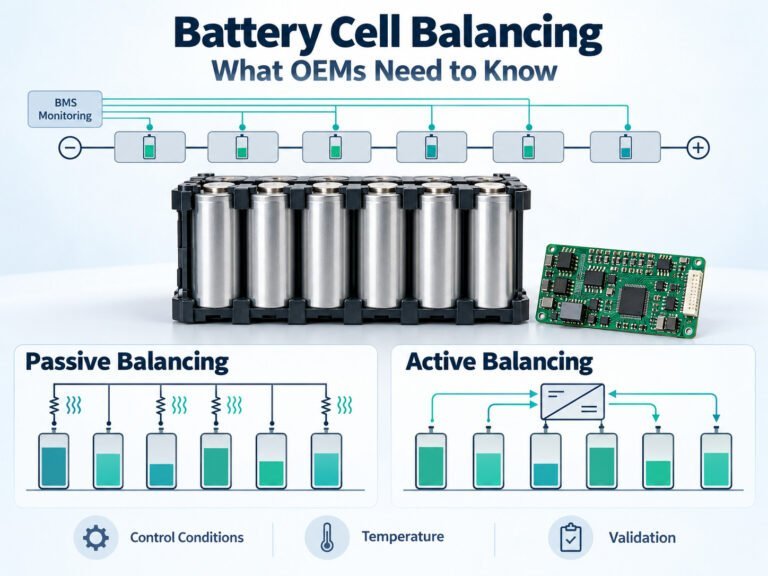
- Cell consistency management
Part 7. What Are the Differences Between SOC, SOH, and SOP?
In BMS systems, three important battery parameters are commonly used:
| Parameter | Full Name | Meaning |
|---|---|---|
| SOC | State of Charge | Remaining battery capacity |
| SOH | State of Health | Battery health condition |
| SOP | State of Power | Available power output capability |
Simply explained:
- SOC: How much energy is left?
- SOH: How healthy is the battery?
- SOP: How much power can the battery deliver right now?
Together, these parameters help ensure safe and efficient battery operation.
Part 8. How Does a Smart BMS Improve SOC Management?
An advanced BMS can provide:
✅ Real-time SOC monitoring
✅ Cell voltage monitoring
✅ Temperature monitoring
✅ Charging and discharging protection
✅ Battery data communication
Communication options include:
- CAN
- RS485
- UART
- Modbus
These features are widely used in:
- AGV and AMR robots
- Forklifts
- Marine batteries
- Industrial equipment
- Energy storage systems
Part 9. How to Choose a Lithium Battery with Accurate SOC Management?
When selecting a lithium battery supplier, do not only focus on battery capacity.
You should also evaluate:
1. BMS Solution
Check whether the battery supports:
- Accurate SOC calculation
- Communication functions
- Safety protection features
2. Cell Consistency
High-quality cell matching helps achieve:
- More accurate SOC estimation
- More balanced capacity aging
- Stable long-term performance
3. Manufacturer’s Engineering Capability
A professional lithium battery manufacturer should have:
- BMS development capability
- Battery system design experience
- Application-specific optimization capability
Conclusion: Why Is SOC Important?
SOC is not simply a battery percentage indicator.
It is a key parameter in intelligent battery management systems and directly affects:
✅ Battery safety
✅ Energy utilization
✅ Remaining runtime estimation
✅ Cycle life
✅ Equipment reliability
For AGVs, forklifts, robots, electric vehicles, and energy storage systems, accurate SOC management is essential for achieving safe, efficient, and reliable battery operation.


 English
  Chinese
  Japanese
  German
  French
  Korean
