
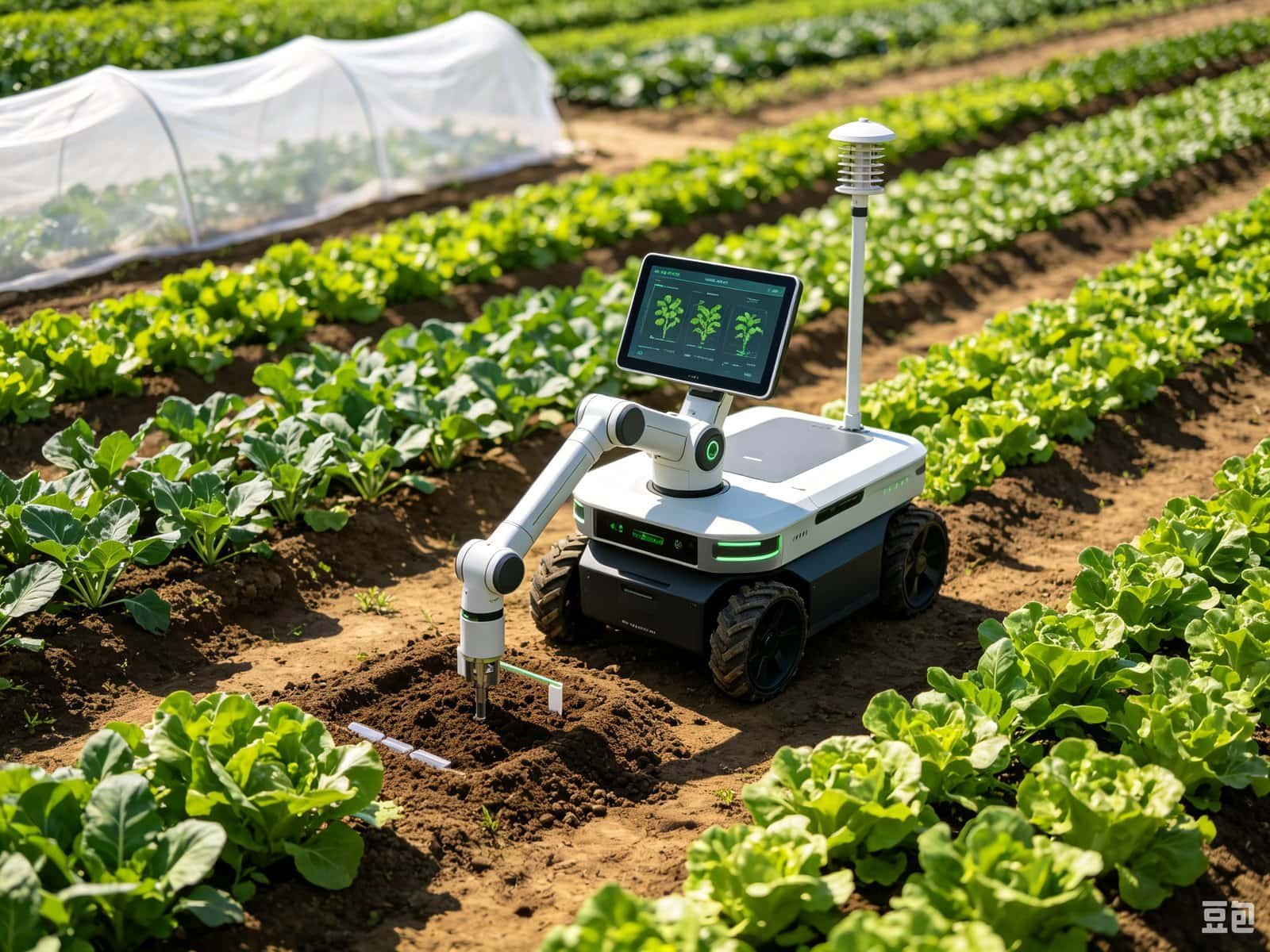
Agricultural robots are being used for tasks such as crop monitoring, autonomous navigation, precision spraying, weeding, harvesting assistance, greenhouse operations, and material transportation. Unlike indoor mobile robots, agricultural robots often work on uneven terrain and in environments exposed to dust, water, temperature changes, vibration, and long operating cycles.
The battery is therefore an important part of the robot system. It must provide sufficient energy for the required operating period while supporting the robot’s peak power demand, charging strategy, communication system, and environmental protection requirements.
LiFePO4, also known as lithium iron phosphate or LFP, is a lithium-ion battery chemistry that can be considered for many agricultural robot applications. Its characteristics can support applications that require stable cycling performance, thermal characteristics, and a defined battery management strategy.
For agricultural robot manufacturers and system integrators, battery selection should not be based only on voltage and capacity. The complete battery pack should be designed around the robot’s duty cycle, motors, electronics, environmental conditions, charging method, mechanical structure, and communication requirements.
This guide explains the key considerations when designing or sourcing a LiFePO4 battery for agricultural robots and how OEM/ODM battery development can support different robot platforms.
1. Why Agricultural Robots Have Specific Battery Requirements
Agricultural robots operate in conditions that can differ significantly from warehouses, factories, and indoor environments.
A field robot may need to travel across soil, grass, gravel, slopes, or other uneven surfaces. During operation, the traction motors can experience changes in load as the robot accelerates, turns, climbs slopes, or encounters obstacles.
In addition to traction motors, an agricultural robot may contain:
- Navigation and positioning systems
- Cameras and sensors
- LiDAR or radar
- Communication modules
- Industrial computers
- 로봇 팔
- Spraying systems
- Pumps
- Cutting or weeding mechanisms
- Actuators
- Cooling or heating equipment
- Auxiliary electronics
These loads can operate simultaneously or intermittently. As a result, the battery must be evaluated according to the complete electrical load profile rather than the traction motor alone.
For example, a robot may consume relatively low power while moving on flat ground but require a higher current during acceleration or climbing. A spraying pump or mechanical actuator may also create temporary power demand.
A suitable battery design should therefore consider both continuous energy consumption and peak current requirements.
2. Why Consider LiFePO4 for Agricultural Robots?
LiFePO4 is a lithium-ion battery chemistry based on lithium iron phosphate as the cathode material. It is widely used in applications that require rechargeable battery packs with defined electrical and thermal characteristics.
One reason LFP is considered for agricultural robots is its cycle-life characteristics under appropriate operating conditions. Agricultural robots may operate for many hours per day and can be charged frequently depending on the application.
Another consideration is thermal behavior. Battery cells generate heat during charging and discharging, especially when operating at higher currents. The battery pack therefore needs appropriate cell selection, electrical protection, thermal design, and BMS control.
LiFePO4 also has a relatively stable nominal voltage profile compared with some other lithium-ion chemistries. This can simplify system design when the robot’s motor controller and electronic systems are designed around an appropriate battery voltage range.
However, LiFePO4 is not automatically suitable for every agricultural robot. The correct chemistry, cell format, capacity, current rating, enclosure, BMS, and charging system must be selected according to the robot’s actual requirements.
3. Determine Battery Voltage Before Capacity
Battery voltage is one of the first specifications to define.
Common battery system voltages for mobile equipment include 24V, 36V, 48V, 60V, 72V, and other custom configurations. The required voltage depends on the motor controller, drive system, auxiliary electronics, and overall electrical architecture.
For an LFP battery pack, the nominal voltage is determined by the number of cells connected in series.
예를 들어
- 8S LFP: approximately 25.6V nominal
- 12S LFP: approximately 38.4V nominal
- 16S LFP: approximately 51.2V nominal
- 20S LFP: approximately 64V nominal
These values are based on a nominal cell voltage of approximately 3.2V.
The actual battery voltage range is different from the nominal voltage because cell voltage changes during charging and discharging. The robot’s motor controller and other electronics must therefore be compatible with the complete battery voltage range.
When developing a custom agricultural robot battery, the battery supplier should review the controller’s minimum and maximum voltage limits rather than selecting a battery based only on its nominal voltage.
4. Calculate Capacity from the Robot Duty Cycle
Battery capacity determines how much energy the battery can store.
For an initial estimate, battery energy can be calculated as:
에너지(Wh) = 전압(V) × 용량(Ah)
For example, a 51.2V 100Ah LFP battery has a nominal energy capacity of approximately:
51.2V × 100Ah = 5,120Wh
However, the robot may not be able to use the entire nominal capacity in real operating conditions.
Energy consumption can be affected by:
- 모터 효율
- Controller efficiency
- 지형
- Robot weight
- Payload
- Operating speed
- Slope
- 주변 온도
- Tire or track design
- Sensor and computing loads
- Hydraulic or electric auxiliary systems
- Battery discharge rate
A practical battery calculation should therefore begin with the robot’s duty cycle.
Important information includes average power consumption, peak power, operating hours, charging frequency, expected reserve energy, and operating environment.
A basic estimation method is:
Required Battery Energy = Average Power × Operating Time ÷ System Efficiency + Energy Reserve
The final battery capacity should then be validated through testing.
5. Peak Current Matters as Much as Capacity
A battery with sufficient Ah capacity may still fail to support a robot if its current capability is insufficient.
Agricultural robots can experience current peaks during:
- 모터 시동
- 가속
- Hill climbing
- Turning on uneven terrain
- Obstacle crossing
- Actuator operation
- Pump startup
- Tool engagement
The battery design should distinguish between continuous current and peak current.
For example, a robot may require 40A during normal operation but temporarily demand 80A or 100A during acceleration. The battery cells, BMS, connectors, busbars, fuse, wiring, and output terminals all need to support the required current.
This is why battery selection should not rely on capacity alone.
A professional battery specification should include:
- 공칭 전압
- Working voltage range
- 공칭 용량
- 연속 방전 전류
- 최대 방전 전류
- 연속 충전 전류
- Recommended charging current
- 작동 온도
- 충전 온도
- 통신 프로토콜
- IP 등급
- 치수
- 무게
- 커넥터 구성
6. BMS Design for Agricultural Robot Batteries
The Battery Management System, or BMS, is a key part of a custom lithium battery pack.
A BMS monitors and manages battery parameters such as:
- 세포 전위
- 패키지 전압
- 충전 전류
- 방전 전류
- 세포 온도
- 배터리 온도
- 충전 상태
- 건강 상태
- Overvoltage
- Undervoltage
- 과전류
- 단락 회로
- Overtemperature
For agricultural robots, BMS communication can also be important.
Depending on the robot architecture, the battery may communicate with the main controller through CAN, RS485, UART, or another interface.
CAN communication is commonly considered for mobile equipment because it allows the battery to exchange information with the vehicle or robot controller.
The communication system can provide information such as:
- 충전 상태
- 배터리 전압
- Battery current
- 온도
- 고장 상태
- 잔여 용량
- 충전 상태
- Battery alarms
The exact communication protocol should be defined together with the robot controller.
7. Outdoor Temperature and Agricultural Robot Operation
Temperature can affect lithium battery performance.
Agricultural robots may operate outdoors during hot summer conditions, cold mornings, or seasonal temperature changes. Greenhouse robots may also experience high humidity and elevated temperatures.
The battery specification should distinguish between:
- 작동 온도
- 충전 온도
- 보관 온도
- Cold-soak conditions
- Temperature transition conditions
Low-temperature operation requires particular attention because battery charging at unsuitable temperatures can cause safety and performance concerns.
If the robot needs to operate or charge in cold environments, the battery may require a heating solution. A BMS can monitor temperature and control charging according to the defined operating strategy.
High-temperature operation also requires attention to cell selection, enclosure design, thermal management, current limits, and installation location.
The battery manufacturer should define temperature limits according to the selected cells and complete pack design rather than using a generic temperature range for every application.
8. Water, Dust and IP Protection
Agricultural robots are frequently exposed to environmental contaminants.
Depending on the application, the robot may encounter:
- Rain
- Mud
- Soil
- Fertilizer
- Water spray
- 먼지
- Condensation
- Cleaning processes
The battery enclosure should therefore be designed according to the expected environment.
IP ratings are commonly used to describe protection against solid particles and water. For example, IP65, IP67, and IP68 indicate different levels of enclosure protection under defined test conditions.
However, selecting an IP rating is only one part of the design.
The battery pack also needs suitable:
- Enclosure materials
- Sealing structures
- Cable glands
- 커넥터
- Venting strategy
- Gaskets
- Fasteners
- Pressure management
- Corrosion protection
An IP-rated enclosure should be evaluated as a complete assembly. Connector interfaces and cable exits can affect the actual protection level of the installed battery.
9. Vibration and Mechanical Protection
Agricultural robots can experience continuous mechanical vibration because of uneven ground and moving equipment.
Mechanical stress may affect:
- Cell connections
- 버스바
- Welded joints
- PCB assemblies
- 커넥터
- 배선
- Enclosures
- 장착 브라켓
Battery pack construction should therefore consider mechanical reinforcement and suitable mounting methods.
Laser welding or other controlled joining processes can be used during battery pack assembly depending on the cell format and pack architecture.
The battery should also be securely fixed to the robot chassis to prevent excessive movement.
For applications with significant vibration, the battery manufacturer may perform vibration testing and mechanical validation based on the customer’s application requirements.
10. Battery Enclosure and Installation Design
The physical dimensions of an agricultural robot battery are often constrained by the robot chassis.
A custom battery pack may need to fit into:
- A chassis compartment
- A removable battery tray
- An underbody space
- A side-mounted compartment
- A rear battery box
- A sealed electronics compartment
Important mechanical parameters include:
- 길이
- 너비
- 높이
- 무게
- Mounting holes
- Connector location
- Cable direction
- Handle position
- Service access
- 냉각 요구 사항
A battery supplier should ideally review the robot’s mechanical drawing before finalizing the battery enclosure.
For new robot platforms, OEM/ODM development allows the battery structure to be designed together with the available installation space.
11. Charging Strategy for Long-Duty Agricultural Robots
Charging requirements should be defined at the beginning of the battery project.
Agricultural robots may use:
- Standard AC charging systems
- Dedicated battery chargers
- Automatic charging stations
- Robotic charging systems
- 기회 충전
- 배터리 교체
The required charging time depends on battery capacity, charger output, charging current, battery temperature, BMS limits, and the charging profile.
For autonomous robots, automatic charging can be particularly important because the robot may need to return to a designated charging station when its State of Charge reaches a defined threshold.
The battery and charger should therefore be electrically compatible.
The BMS should also communicate charging conditions and battery status where required by the system architecture.
12. Battery Communication with the Robot
Modern agricultural robots often rely on a central controller to coordinate multiple systems.
The battery can become part of this communication network.
For example, the robot controller may request battery information before starting a mission. During operation, it may monitor State of Charge and fault status.
A custom battery can be configured with communication parameters according to the customer’s system requirements.
Typical parameters may include:
- CAN baud rate
- CAN message structure
- Battery ID
- SOC 계산
- Voltage information
- Current information
- Temperature information
- 오류 코드
- 충전 상태
The communication protocol should be tested with the actual robot controller before mass production.
13. Safety and Protection Design
Lithium battery safety depends on the chemistry, cell quality, electrical design, mechanical construction, BMS, charger, manufacturing process, and operating conditions.
A custom agricultural robot battery may incorporate multiple layers of protection.
These can include:
- 셀 밸런싱
- 과충전 방지
- 과방전 방지
- 과전류 보호
- 단락 보호
- 온도 모니터링
- 퓨즈 보호
- Pre-charge circuitry
- 적합한 커넥터
- 기계적 보호
- Insulation materials
The protection strategy should be matched to the battery voltage, current, application environment, and system architecture.
For commercial agricultural robots, applicable transportation, product, and regional compliance requirements should also be reviewed during the development stage.
Depending on the target market and battery application, requirements may involve UN38.3, IEC standards, CE-related requirements, EU Battery Regulation requirements, or other market-specific regulations.
Certification should be evaluated according to the final product configuration and intended market.
14. Cell Selection for Agricultural Robot Battery Packs
The cell is the foundation of the battery pack.
LFP battery packs can use different cell formats, including cylindrical and prismatic cells. The appropriate format depends on capacity, space, current requirements, thermal management, mechanical structure, and production strategy.
세포 선정 시 다음 사항을 고려해야 합니다:
- Cell capacity
- Continuous current capability
- Cycle-life requirements
- Temperature characteristics
- 셀 일관성
- Supplier traceability
- Production quality
- 지원 요건
For B2B battery projects, traceability is also important.
A battery manufacturer should have processes for incoming cell inspection, cell matching, welding, assembly, BMS testing, capacity testing, aging, and final inspection.
Using a suitable cell does not replace the need for complete battery validation. The complete battery pack must be tested under the intended operating conditions.
15. Testing a LiFePO4 Battery for Agricultural Robots
Testing should cover both electrical and mechanical performance.
Typical battery pack tests may include:
Electrical Testing
- 용량 테스트
- 충전 및 방전 테스트
- Voltage verification
- Current testing
- BMS 보호 기능 테스트
- 통신 테스트
- Cell balancing verification
환경 테스트
- 고온 작동
- 저온 작동
- Temperature cycling
- Humidity exposure
- Water protection testing
- Dust protection testing
Mechanical Testing
- 진동 테스트
- Impact testing
- 커넥터 테스트
- Mounting validation
- Enclosure inspection
Production Quality Testing
- 용접 검사
- 절연 시험
- 내부 저항 테스트
- 에이징 테스트
- Full-pack functional testing
Testing requirements should be based on the application and relevant standards instead of applying one identical test program to every battery.
16. Why OEM/ODM Battery Development Can Be Useful
Agricultural robot manufacturers often have specific requirements that cannot be met by an off-the-shelf battery.
An OEM/ODM battery manufacturer can develop a battery around the robot’s electrical and mechanical system.
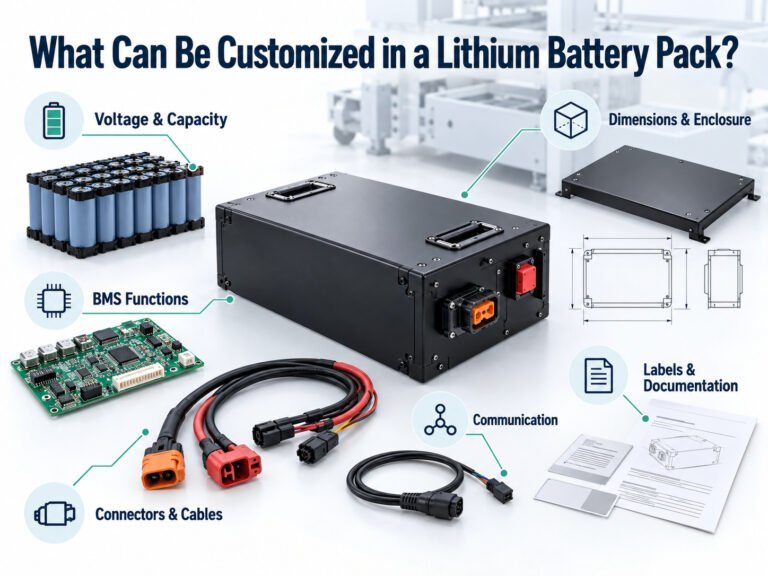
Customization can include:
- 배터리 전압
- 배터리 용량
- 셀 구성
- Pack dimensions
- 첨부 파일
- 커넥터
- BMS
- 통신 프로토콜
- 장착 구조
- 방수
- Heating system
- 충전 인터페이스
- 케이블 길이
- Labeling
- 포장
For a new agricultural robot, the battery supplier can work from the robot’s specifications or mechanical drawings.
A typical development process can include:
Requirement Definition → Electrical Design → Mechanical Design → BMS Configuration → Prototype → Testing → Design Validation → Pilot Production → Mass Production
This process helps identify design problems before large-scale manufacturing.
17. How to Choose an Agricultural Robot Battery Manufacturer
When sourcing a custom battery pack, buyers should evaluate the manufacturer’s technical and production capabilities rather than comparing only the battery price.
Key questions include:
- Can the manufacturer design custom LiFePO4 battery packs?
- Can the BMS communicate with the robot controller?
- Can the battery enclosure be customized?
- Can the manufacturer provide prototype samples?
- What cell brands and cell formats are available?
- What testing equipment is available?
- Can the supplier provide production traceability?
- Can the battery be customized for outdoor environments?
- Can the supplier support required certifications?
- Can the manufacturer provide engineering support after prototype approval?
A capable battery development process should connect engineering, production, testing, quality control, and after-sales support.
18. Custom LiFePO4 Battery Solutions for Agricultural Robots
For agricultural robot manufacturers, the battery is part of the complete machine rather than an independent accessory.
At Dongguan Yizhan Electronics Technology Co., Ltd., custom lithium battery packs can be developed according to the customer’s voltage, capacity, dimensions, current, BMS, communication, enclosure, and application requirements.
The manufacturing process can include cell sorting, battery pack assembly, laser welding, BMS integration, aging testing, capacity testing, vibration testing, and functional inspection.
For outdoor robotic applications, the battery structure can also be designed around requirements such as waterproofing, dust protection, vibration resistance, and mechanical installation.
OEM/ODM development can support different agricultural robot platforms, including autonomous mobile robots, spraying robots, weeding robots, inspection robots, transportation robots, and other specialized agricultural equipment.
The appropriate battery specification should be confirmed through engineering evaluation and application testing before mass production.
19. Battery Specification Checklist for Agricultural Robots
Before requesting a quotation from a battery manufacturer, the robot company can prepare the following information:
전기 사양
- 공칭 전압
- 작동 전압 범위
- 필요 용량
- Average power
- 최대 전력
- 정류 전류
- 피크 전류
- 충전 전류
- 충전기 사양
기계적 요구 사항
- Maximum battery dimensions
- Maximum weight
- Mounting position
- Connector location
- Cable requirements
- Enclosure requirements
환경 요건
- 작동 온도
- 충전 온도
- 습도
- 물 노출
- Dust exposure
- 진동
- Impact
Communication Requirements
- CAN
- RS485
- UART
- 통신 프로토콜
- Data parameters
- Fault reporting
Commercial Requirements
- Prototype quantity
- Target production volume
- 인증 요건
- 목표 시장
- Delivery schedule
- Packaging requirements
Providing this information allows the battery manufacturer to evaluate the project more accurately.
20. Conclusion
LiFePO4 batteries can be a practical battery chemistry option for agricultural robots that require rechargeable energy storage for extended field operation. However, choosing an LFP battery is only the beginning of the battery development process.
The final battery pack needs to be designed around the robot’s actual duty cycle, voltage, energy consumption, peak current, BMS requirements, charging strategy, environmental conditions, mechanical structure, and communication system.
For agricultural robots operating outdoors, particular attention should be given to temperature, water and dust protection, vibration, enclosure design, and charging conditions.
For OEM and ODM projects, cooperation between the robot manufacturer and battery manufacturer during the design stage can help align the battery with the robot’s electrical and mechanical architecture.
A properly specified LiFePO4 battery pack can become an integrated part of an agricultural robot power system, supporting reliable operation, controlled charging, battery monitoring, and long-term fleet management.
When sourcing a custom agricultural robot battery, buyers should evaluate not only cell chemistry and capacity, but also BMS engineering, pack construction, testing capability, certification support, production quality, and the manufacturer’s ability to develop the battery around the actual robot application.
자주 묻는 질문
Is LiFePO4 suitable for agricultural robots?
LiFePO4 can be considered for agricultural robots that require rechargeable battery packs with defined cycle-life, thermal, and safety characteristics. Suitability depends on the robot’s voltage, capacity, current, temperature, charging, and environmental requirements.
What voltage is commonly used for agricultural robot batteries?
Battery voltage varies according to the robot’s motor controller and electrical architecture. 24V, 36V, 48V, 51.2V, 60V, and 72V-class systems are examples of configurations that may be used, while custom voltages can also be developed.
How do I calculate the battery capacity for an agricultural robot?
Start with the robot’s average power consumption and required operating time. A basic estimate is Energy = Power × Time. System efficiency, peak loads, operating conditions, and reserve energy should also be included in the final calculation.
Does an agricultural robot battery need a BMS?
Yes. A lithium battery pack normally requires an appropriate BMS to monitor and protect the cells and manage operating conditions. For robotic applications, the BMS may also communicate with the robot controller.
Can the LiFePO4 battery pack be waterproof?
The battery enclosure can be designed for a specified IP protection level according to the application. The complete pack, including connectors, cable exits, seals, and enclosure, should be tested according to the required protection level.
Can the battery communicate with the agricultural robot?
Yes. A custom battery can be configured with communication interfaces such as CAN or RS485 when required. The communication protocol should be defined and tested with the robot controller.
Can an agricultural robot battery be customized?
Yes. OEM/ODM battery packs can be customized in voltage, capacity, dimensions, BMS, connectors, communication, enclosure, mounting structure, cables, and other parameters according to the robot’s requirements.
What information should I provide when requesting a custom battery?
Useful information includes voltage, capacity, operating time, average and peak current, dimensions, weight limits, operating temperature, charging method, communication protocol, IP requirements, connector specifications, and target application.
 English
  Chinese
  Japanese
  German
  French
  Korean
