
Medical devices often depend on rechargeable battery packs to provide portable power, backup operation, or continuous operation during mobility and transport. From portable patient monitors and infusion pumps to ventilators, diagnostic equipment, medical carts, and home-care devices, the battery is part of the overall system design rather than simply an interchangeable power source.
For medical device manufacturers, selecting a custom battery pack manufacturer requires attention to electrical performance, mechanical integration, battery management, safety, testing, regulatory requirements, production quality, and long-term supply capability.
A suitable battery manufacturing partner should be able to understand the requirements of the medical device, develop a battery architecture around those requirements, validate the design through testing, and provide consistent production quality.
This guide explains the key factors to consider when selecting a custom battery pack manufacturer for medical devices and how an OEM/ODM development process can support medical equipment projects.
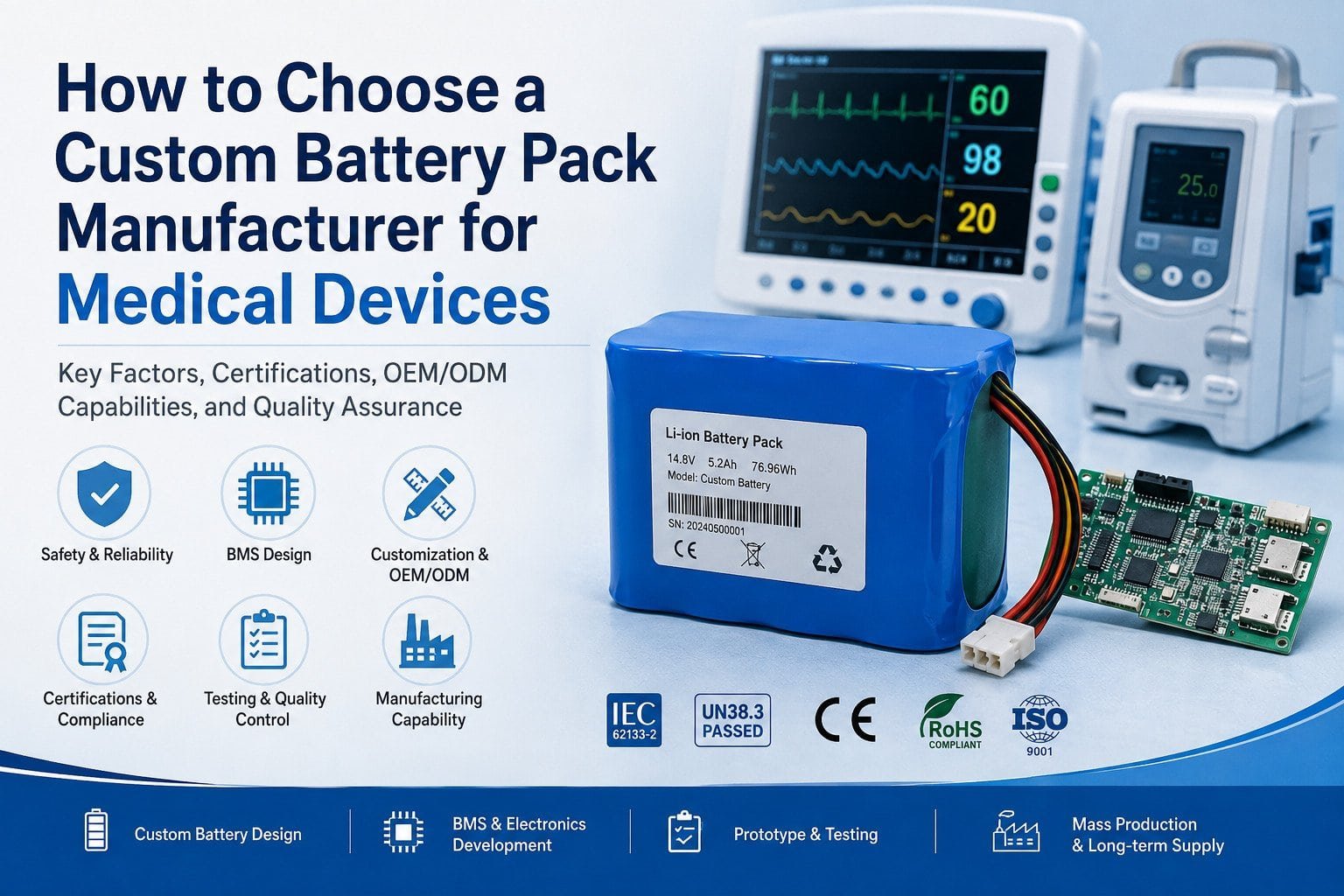
1. Why Medical Devices Need Custom Battery Packs
Many medical devices have specific power requirements that cannot be addressed effectively with a generic battery pack.
A medical device may require a particular voltage range, capacity, physical shape, connector, communication protocol, charging method, or battery management strategy. The battery may also need to fit into a limited enclosure while maintaining appropriate thermal and electrical characteristics.
For example, a portable medical monitor may require a compact rechargeable battery with a defined voltage and capacity. A medical cart may require a larger battery pack capable of supporting extended operation. A portable respiratory device may require a battery with a stable power output and BMS functions that communicate with the device controller.
A custom battery pack can be designed around these requirements.
Typical customization areas include:
- 배터리 화학
- Cell format and cell configuration
- 공칭 전압
- 용량
- 최대 연속 전류
- 피크 전류
- 배터리 치수
- 커넥터 유형
- BMS architecture
- 통신 인터페이스
- 충전 요건
- 인클로저 설계
- 보호 기능
- 작동 온도
- 장착 구조
- Labeling and identification
The battery development process should begin with the electrical and mechanical requirements of the medical device instead of selecting a battery based only on nominal capacity.
2. Start With the Medical Device’s Power Requirements
Before selecting a manufacturer, the medical device company should prepare a technical requirement specification.
The specification should describe how the equipment uses energy under normal operation, standby conditions, charging, and abnormal operating conditions.
주요 매개변수로는 다음이 있습니다:
전압
The battery voltage needs to match the input requirements of the medical device and its power management system.
A battery pack may use a series configuration such as 3S, 4S, or another configuration depending on the required voltage. The battery manufacturer should calculate the operating voltage range rather than relying only on nominal voltage.
용량
Capacity is normally expressed in ampere-hours (Ah) or watt-hours (Wh).
For equipment with relatively stable power consumption, an initial energy estimate can be calculated using:
에너지(Wh) = 전압(V) × 용량(Ah)
Actual usable energy depends on discharge conditions, temperature, battery management settings, device efficiency, aging, and other system factors.
현재
The manufacturer should understand both continuous and peak current requirements.
Some medical devices may have short periods of higher power consumption during motor operation, pump startup, communication activity, or other system functions. The battery, cells, protection components, wiring, connectors, and BMS should be evaluated against these conditions.
Runtime
Expected runtime provides another important design parameter.
A simplified calculation is:
Estimated Runtime (h) = Battery Energy (Wh) × System Efficiency ÷ Device Power (W)
This is an engineering estimate rather than a guaranteed operating time. Validation should be performed using the actual medical device under defined operating conditions.
3. Select the Appropriate Battery Chemistry
Battery chemistry influences voltage characteristics, energy density, thermal behavior, cycle performance, charging requirements, and system design.
Lithium-ion and lithium iron phosphate (LiFePO4) are among the rechargeable battery chemistries used in different applications.
Lithium-ion cells can support compact battery designs where energy density is an important consideration. Different lithium-ion cell chemistries also have different electrical and thermal characteristics.
LiFePO4 batteries have a different voltage profile and material chemistry and may be considered for applications where their specific characteristics fit the equipment requirements.
The correct chemistry should be selected according to the medical device’s:
- 전압 사양
- Energy requirements
- 공간 제한
- Current requirements
- Weight limitations
- 작동 온도
- 충전 시스템
- Expected service conditions
- Required protection strategy
- Product lifecycle
A professional battery manufacturer should explain the engineering trade-offs instead of selecting a chemistry based only on capacity.
4. Evaluate the Manufacturer’s Battery Cell Selection Process
Battery cells are fundamental components of a battery pack, and cell selection affects the electrical behavior of the complete pack.
A custom battery manufacturer should have a defined process for cell sourcing and evaluation.
주요 고려 사항은 다음과 같습니다:
- Cell manufacturer
- Cell model
- 세포 화학
- 공칭 용량
- 공칭 전압
- 최대 연속 방전 전류
- Charging characteristics
- 작동 온도 범위
- Cycle characteristics
- 생산 일관성
- Supply continuity
- 배치 추적성
For cylindrical cells, common formats include 18650 and 21700. Prismatic cells can also be used for battery designs requiring different mechanical arrangements.
The battery manufacturer should verify that the selected cell is suitable for the intended application rather than simply using a cell with a suitable nominal capacity.
Cell matching is also important when multiple cells are connected in series or parallel. Variations between cells can affect pack balance and long-term performance.
5. BMS Design Is a Key Part of Medical Battery Development
The Battery Management System, or BMS, is an important component of a rechargeable lithium battery pack.
A BMS can monitor and control multiple battery parameters depending on the design.
Typical functions include:
- 과충전 방지
- 과방전 방지
- 과전류 보호
- 단락 보호
- 온도 모니터링
- 세포 전압 모니터링
- 셀 밸런싱
- Charge control
- Discharge control
- 배터리 상태 모니터링
- 장애 감지
- Communication with the host device
For a medical device battery, the BMS should be developed according to the actual system requirements.
Some applications may require communication between the battery and the medical device. Depending on the system architecture, interfaces such as SMBus, I²C, CAN, UART, or other communication methods may be considered.
The battery manufacturer should be able to define the BMS protection thresholds, communication requirements, fault behavior, and data parameters with the medical equipment engineering team.
6. Mechanical Design and Battery Integration
A medical battery is often installed inside a limited enclosure.
Mechanical integration therefore needs to be considered during the early design stage.
The battery manufacturer may need to customize:
- 배터리 치수
- 주택
- Mounting holes
- Brackets
- Connector location
- 케이블 길이
- 케이블 배선
- Terminal position
- Labels
- 단열
- Protective materials
The battery pack should be designed to fit the medical device without interfering with other electronic or mechanical components.
The enclosure may also require consideration of heat dissipation, impact resistance, moisture exposure, cleaning procedures, and service access.
For equipment that is frequently moved, transported, or handled by medical staff, mechanical retention and protection should also be evaluated.
7. Thermal Management and Operating Temperature
Temperature can influence lithium battery performance and safety.
Medical equipment may be used in hospitals, clinics, ambulances, laboratories, homes, or mobile environments. These conditions can expose the battery to different ambient temperatures.
Battery development should therefore define:
- 충전 온도
- 방전 온도
- 보관 온도
- Temperature protection thresholds
- Temperature sensor position
- Thermal management requirements
The battery manufacturer should evaluate the relationship between cell selection, current load, enclosure design, and heat generation.
Temperature sensors can be integrated into the battery pack and connected to the BMS. The protection strategy can then respond to predefined temperature conditions.
Thermal design should be validated through testing rather than based solely on theoretical calculations.
8. Safety and Protection Requirements
Battery safety is an important part of medical equipment development.
A lithium battery pack should incorporate protection mechanisms appropriate to its electrical architecture and intended application.
Potential protection requirements include:
- Overvoltage protection
- Undervoltage protection
- 과전류 보호
- 단락 보호
- Overtemperature protection
- Charging protection
- 셀 밸런싱
- Abnormal condition detection
The protection design should consider both normal operation and foreseeable abnormal conditions.
The battery pack should also use suitable insulation, wiring, connectors, cell holders or structural supports, protective components, and enclosure materials.
Safety cannot be established through the BMS alone. Cell selection, pack construction, electrical design, charging equipment, mechanical design, manufacturing controls, and validation testing all contribute to the overall battery system.
9. Medical Battery Certifications and Compliance
Certification and regulatory requirements depend on the battery design, medical device, target market, and intended use.
A battery manufacturer should understand the relevant requirements before starting mass production.
Common standards and requirements that may be relevant to lithium battery products include:
- IEC 62133-2
- UN 38.3
- CE 관련 요구사항
- RoHS
- Applicable UL standards
- Transportation regulations
- Regional battery regulations
However, certification requirements should be evaluated on a project-by-project basis.
For example, a battery pack intended for a medical device in Europe may have different documentation and compliance requirements from a product intended for the United States or another market.
It is also important to distinguish between battery-level certification and medical-device-level regulatory approval. A battery certification does not automatically mean that the complete medical device is approved.
Medical device manufacturers should work with their regulatory and compliance teams to determine which standards apply to the complete product.
A battery supplier should be able to provide relevant technical documentation and support the customer’s compliance process.
10. Battery Testing and Quality Control
A custom medical battery manufacturer should have a documented testing process covering development samples, pilot production, and mass production.
Typical battery tests may include:
용량 테스트
Capacity testing verifies the actual discharge capacity under defined conditions.
Charge and Discharge Testing
Charging and discharging tests help validate the battery’s electrical behavior and compatibility with the intended charger and device.
Protection Testing
Protection functions can be evaluated under defined overcharge, over-discharge, overcurrent, short-circuit, and temperature conditions.
노화 시험
Battery aging tests can help identify early manufacturing issues and verify pack behavior before shipment.
온도 시험
Temperature-related testing evaluates battery performance and protection behavior under defined thermal conditions.
Mechanical Testing
Depending on the application, vibration, impact, drop, and other mechanical tests may be required.
For portable medical equipment, vibration testing can be relevant when the equipment is transported or operated in mobile environments.
Testing should have defined procedures, acceptance criteria, and records.
11. Manufacturing Quality and Traceability
Medical battery projects require consistent production processes.
A battery manufacturer should have documented manufacturing procedures covering incoming materials, cell inspection, assembly, welding, BMS installation, electrical testing, aging, final inspection, and shipment.
A typical battery pack production process may include:
- 입고 자재 검사
- Cell testing and sorting
- Cell grouping
- Cell connection
- BMS 설치
- Laser or resistance welding
- Wire and connector assembly
- Insulation and structural protection
- Enclosure assembly
- 전기 시험
- 용량 테스트
- Aging
- 최종 검사
- Packaging and shipment
Traceability is also important.
Depending on the project, production records may associate the finished battery pack with information such as cell batches, BMS versions, production dates, test results, and inspection records.
This can support quality investigations, production management, and after-sales service.
12. Why OEM/ODM Capability Matters
Medical equipment manufacturers often require more than an off-the-shelf battery.
An OEM/ODM battery supplier can participate in the product development process and adapt the battery to the equipment architecture.
OEM/ODM services may include:
- Battery specification development
- 세포 선택
- 배터리 구조 설계
- BMS 개발
- Firmware configuration
- 통신 프로토콜 개발
- 커넥터 맞춤 설정
- Cable customization
- 인클로저 설계
- 시제품 생산
- 기능 테스트
- 파일럿 프로덕션
- 대량 생산
- Technical documentation
For a new medical device, early communication between the equipment engineering team and battery manufacturer can prevent design problems later in the development cycle.
The battery supplier should understand not only the battery specification but also how the battery interacts with the charger, power management system, display, controller, and other electronic components.
13. The Custom Medical Battery Development Process
A structured development process helps both parties define responsibilities and technical requirements.
Step 1: Requirement Collection
The medical device manufacturer provides information about voltage, capacity, current, dimensions, runtime, operating temperature, connector requirements, communication requirements, and target markets.
Step 2: Battery Architecture
The battery manufacturer evaluates cell chemistry, cell configuration, series and parallel connections, BMS architecture, protection requirements, and mechanical structure.
Step 3: Engineering Design
Electrical and mechanical drawings are developed. BMS parameters, connectors, wiring, housing, and mounting arrangements are defined.
4단계: 시제품 개발
Prototype battery packs are manufactured for integration testing.
The medical device manufacturer can then evaluate the battery inside the actual equipment.
Step 5: Verification Testing
Electrical, mechanical, thermal, communication, charging, and protection functions are tested according to the project requirements.
6단계: 인증 및 규정 준수
Required battery-level testing and documentation are completed based on the target market and product design.
Step 7: Pilot Production
A pilot production run can be used to verify manufacturing processes, assembly procedures, test fixtures, and quality controls.
Step 8: Mass Production
After design verification and approval, the battery enters controlled mass production.
This process creates a connection between product development and manufacturing instead of treating the battery as a standalone component.
14. Questions to Ask a Custom Battery Manufacturer
Before selecting a battery supplier, medical device companies should evaluate both technical capabilities and manufacturing processes.
Useful questions include:
Can you develop a battery according to our device requirements?
The manufacturer should be able to review the electrical, mechanical, thermal, and communication requirements.
Can you customize the BMS?
A custom BMS may be required for specific protection thresholds, battery monitoring, communication, or charging behavior.
What battery cells can you supply?
Ask about available cell formats, chemistries, manufacturers, traceability, and supply continuity.
어떤 시험 장비를 보유하고 계신가요?
The supplier should be able to explain its capacity testing, aging, electrical safety, temperature, mechanical, and other applicable testing capabilities.
Can you support certification requirements?
The supplier should explain which battery-level standards and documents can be supported for the target market.
Can you provide prototypes before mass production?
Prototype development allows the battery to be evaluated inside the actual medical device.
How do you control production quality?
Ask about incoming inspection, cell matching, welding quality, BMS testing, aging, final inspection, and traceability.
Can you support long-term production?
Medical equipment may remain in production for many years. Battery manufacturers should have a process for managing cell availability, component changes, engineering changes, and product revisions.
15. Red Flags When Selecting a Battery Supplier
A supplier may not be suitable for a medical battery project if it cannot provide clear technical information about the proposed battery.
Warning signs can include:
- No defined cell sourcing process
- Limited BMS customization
- No documented testing process
- Unclear production traceability
- Incomplete technical documentation
- No prototype development capability
- Unclear certification scope
- Inconsistent communication about specifications
- Frequent component changes without engineering control
- Limited ability to support long-term production
Price is one part of supplier evaluation, but it should not be the only factor.
A battery pack that requires repeated redesign, causes integration problems, or lacks sufficient documentation can create additional engineering and production costs.
16. Long-Term Supply and Engineering Change Management
Medical equipment manufacturers often need stable product specifications after validation.
A change to the battery cell, BMS, connector, housing, or other key component can affect the system and may require additional verification.
For this reason, a battery manufacturer should have an engineering change management process.
Potential changes should be documented and communicated according to the agreed quality procedure.
The process may include:
- Component change notification
- Technical impact assessment
- Sample approval
- Verification testing
- Documentation updates
- Production approval
This approach helps maintain consistency between approved battery designs and future production batches.
17. Choosing a Battery Partner Based on the Complete Project
Selecting a custom battery pack manufacturer should involve more than comparing battery prices.
A medical equipment company should evaluate the complete supplier capability:
엔지니어링 역량
Can the manufacturer design the battery according to electrical, mechanical, thermal, and communication requirements?
BMS capability
Can the BMS be configured or developed for the device’s protection and monitoring requirements?
제조 역량
Can the supplier maintain consistent cell assembly, welding, testing, aging, and final inspection?
테스트 기능
Can the supplier validate the battery using documented procedures?
Compliance support
Can the supplier provide appropriate technical documents and support applicable battery-level compliance requirements?
OEM/ODM capability
Can the manufacturer support the project from prototype through pilot production and mass manufacturing?
Supply capability
Can the supplier maintain component sourcing and production capacity throughout the expected product lifecycle?
These factors provide a practical framework for supplier evaluation.
18. Custom Medical Battery Solutions From Yizhan
Dongguan Yizhan Electronics Technology Co., Ltd. provides custom lithium battery pack development and manufacturing for equipment manufacturers requiring application-specific battery solutions.
The company supports OEM and ODM battery projects, including battery pack design, cell selection, BMS development, structural customization, prototype production, testing, and mass production.
Depending on the equipment requirements, battery solutions can be developed using lithium-ion or LiFePO4 battery technologies.
The engineering process can cover:
- Battery voltage and capacity design
- 셀 구성
- BMS 사용자 지정
- Connector and cable design
- Battery enclosure customization
- 통신 기능
- Protection parameters
- 프로토타입 개발
- 용량 테스트
- 에이징 테스트
- 진동 테스트
- Quality inspection
- Production traceability
For medical equipment manufacturers, the battery design can be developed according to the electrical and mechanical requirements of the target device.
The applicable certification and regulatory requirements should be reviewed for each battery and medical device project based on its final configuration and target market.
19. FAQ About Custom Battery Packs for Medical Devices
What is a custom medical device battery?
A custom medical device battery is a rechargeable battery pack designed around the electrical, mechanical, thermal, communication, and operational requirements of a specific medical device.
Which battery chemistry is suitable for medical equipment?
There is no single chemistry suitable for every medical device. Lithium-ion and LiFePO4 are possible options depending on voltage, energy, size, weight, current, thermal requirements, and system design.
Can the BMS be customized?
Yes. A BMS can be configured or developed according to requirements such as voltage protection, current protection, temperature monitoring, balancing, charging control, and communication.
Can a battery manufacturer make a prototype?
A custom battery manufacturer with OEM/ODM capability can typically develop prototype battery packs before pilot and mass production. Prototype testing helps verify mechanical and electrical integration.
What certifications are required for medical batteries?
Requirements depend on the battery design, target market, medical device, transportation method, and applicable regulations. Standards such as IEC 62133-2 and UN 38.3 may be relevant to lithium battery projects, while additional requirements may apply to the complete medical device.
How long can a medical battery operate?
Runtime depends on battery energy, device power consumption, operating conditions, system efficiency, temperature, and battery condition. Runtime should be validated using the actual medical device under defined operating conditions.
Can the battery communicate with the medical device?
Yes. Where required, the battery can incorporate a communication interface and BMS data functions. The interface and communication protocol should be defined during the engineering stage.
What should medical device companies provide to a battery manufacturer?
Useful information includes target voltage, capacity, current, runtime, dimensions, connector requirements, operating temperature, charging method, communication requirements, target markets, and expected production volume.
20. Conclusion
Choosing a custom battery pack manufacturer for medical devices requires a system-level evaluation.
The right supplier should be able to connect battery chemistry, cell selection, BMS design, mechanical integration, thermal management, safety protection, testing, compliance documentation, manufacturing quality, and long-term supply planning.
For OEM and ODM projects, early cooperation between the medical device engineering team and battery manufacturer can help establish a battery architecture that fits the equipment from the beginning.
A structured process from requirement analysis and prototype development to verification, certification support, pilot production, and mass manufacturing provides a practical foundation for custom medical battery projects.
For medical equipment manufacturers evaluating lithium battery solutions, the key question is not simply whether a battery can provide the required voltage and capacity. The more important question is whether the battery manufacturer can develop, validate, manufacture, document, and support the complete battery solution throughout the product lifecycle.
With application-specific engineering and controlled manufacturing processes, a custom battery pack can become an integrated part of the medical device rather than an afterthought.
 English
  Chinese
  Japanese
  German
  French
  Korean
