
Medical devices rely on stable and reliable power to support monitoring, diagnosis, treatment, mobility, and patient care. From patient monitors and infusion pumps to portable ultrasound systems, medical carts, rehabilitation equipment, and medical robots, battery requirements vary according to the device’s electrical design, operating environment, mechanical structure, and intended use.
For medical equipment manufacturers, choosing a battery pack is not simply a matter of selecting a voltage and capacity. A suitable battery solution may require customized cell selection, battery configuration, BMS development, mechanical design, communication functions, safety protection, testing, and market-specific compliance.
This guide explains the key factors to consider when selecting a custom lithium battery pack for medical devices and how OEM/ODM battery development can support medical equipment manufacturers.
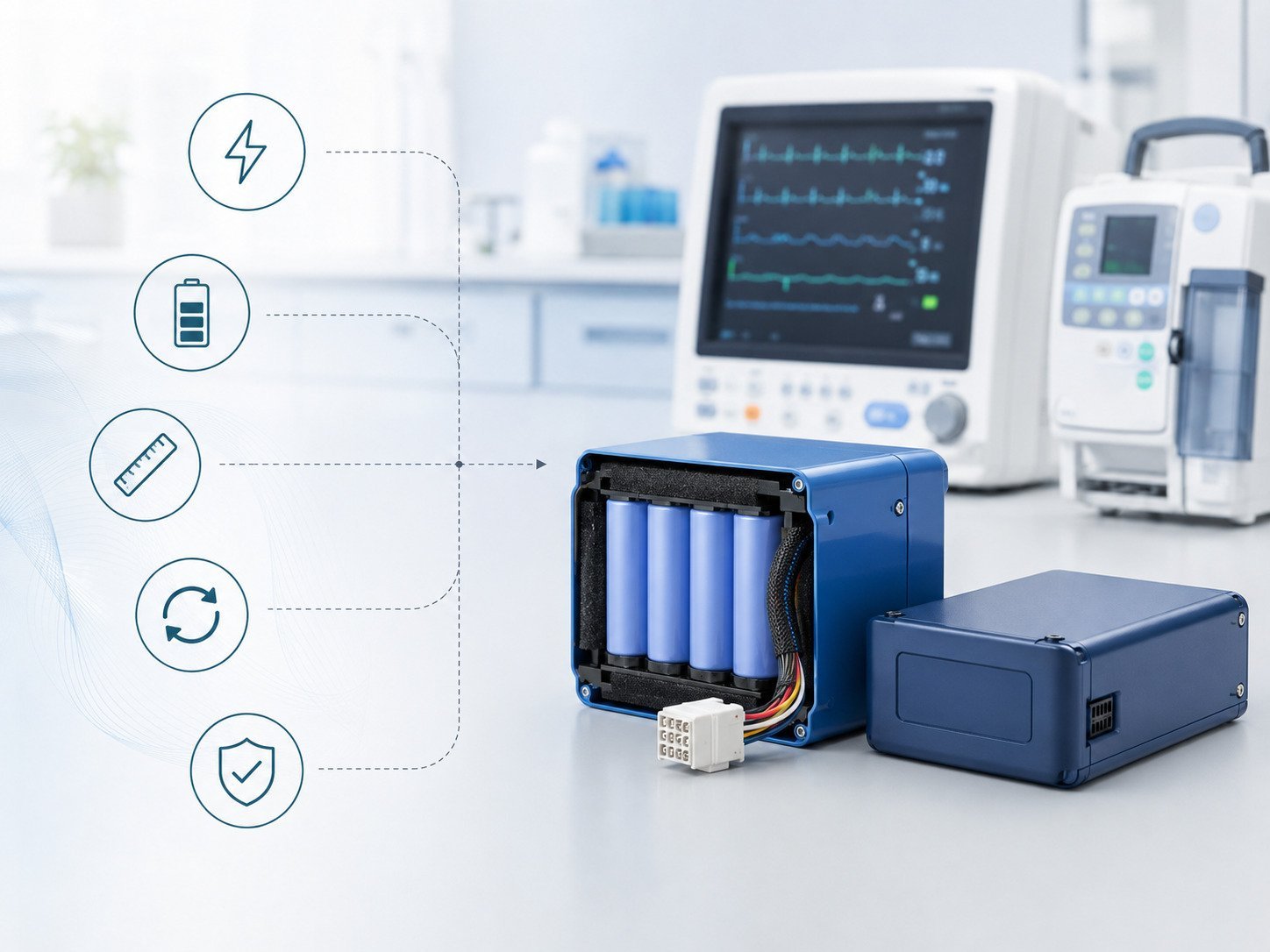
1. Why Medical Devices Require Custom Battery Packs
Many medical devices operate in environments where reliable power is important to continuous equipment operation. A battery failure can interrupt a monitoring process, stop equipment operation, or require an immediate replacement or recharge.
Medical equipment can also have strict limitations on battery dimensions, weight, operating time, and electrical characteristics.
일반적인 애플리케이션은 다음과 같습니다:
- Patient monitors
- 주입 펌프
- Portable ultrasound equipment
- Respiratory equipment
- Medical carts
- 재활 장비
- Medical robots
- Portable diagnostic devices
- Emergency medical equipment
- Home healthcare equipment
- Mobile medical equipment
Each application has a different load profile.
For example, a portable patient monitor may require a compact battery with stable output and sufficient runtime, while a medical cart may require a higher-capacity battery capable of supporting multiple devices.
A custom battery pack allows the battery manufacturer and medical equipment manufacturer to define the electrical, mechanical, thermal, and communication characteristics around the actual equipment requirements.
2. Start With the Medical Device’s Power Requirements
The first step in battery selection is to understand the equipment’s actual power consumption.
주요 매개변수로는 다음이 있습니다:
- 공칭 전압
- 작동 전압 범위
- Average power consumption
- 정류 전류
- 피크 전류
- Standby current
- 필수 작동 시간
- 충전 시간
- 에너지 소비
- 설치 공간
- 작동 온도
- 충전 온도
Battery Energy Calculation
A basic calculation is:
Required Energy = Average Power × Operating Time ÷ System Efficiency
For example, if a medical device consumes an average of 30 W and needs to operate for 6 hours, assuming 90% system efficiency:
30 W × 6 h ÷ 0.90 ≈ 200 Wh
The battery should then be designed with appropriate capacity and operating margin according to the actual discharge profile and equipment requirements.
Capacity alone does not provide enough information.
Battery energy can be calculated as:
에너지(Wh) = 전압(V) × 용량(Ah)
예를 들어
12 V × 10 Ah = 120 Wh
while:
24 V × 10 Ah = 240 Wh
Therefore, when comparing battery solutions, medical equipment manufacturers should evaluate both Ah and Wh.
3. Analyze the Equipment’s Load Profile
Average power consumption is only one part of battery design.
Some medical devices have short periods of high power demand. Motors, pumps, compressors, heating elements, wireless communication modules, and other components may create transient current peaks.
A battery design should therefore consider:
Continuous Current
The current required during normal operation.
Peak Current
The current required during startup or short-duration high-load conditions.
Standby Current
The power consumed when the equipment is not actively performing its primary function.
Load Variation
Some medical devices operate with changing power requirements throughout the operating cycle.
A battery that has sufficient nominal capacity may still experience voltage drop if the cell configuration and BMS are not designed for the actual peak current.
For this reason, battery engineering should consider the complete load profile rather than only the rated capacity of the device.
4. Select the Appropriate Lithium Battery Chemistry
Lithium-ion batteries are available in different chemistries. The appropriate chemistry depends on the device’s energy requirements, available space, weight limitations, operating conditions, cycle requirements, and safety design.
Two common options for custom battery packs are NMC lithium-ion and LiFePO4.
NMC Lithium-Ion Battery
NMC cells can be considered for applications where battery size and weight are important design factors.
잠재적인 응용 분야는 다음과 같습니다:
- Portable medical monitors
- Portable ultrasound equipment
- 진단 장비
- Portable respiratory equipment
- Compact medical devices
The battery pack can be configured according to the required voltage, capacity, dimensions, and current characteristics.
LiFePO4 배터리
LiFePO4 can be considered for applications where cycle life, thermal characteristics, and battery safety are important design factors.
잠재적인 응용 분야는 다음과 같습니다:
- Medical carts
- 재활 장비
- Medical robots
- Backup power equipment
- Mobile medical systems
- Equipment with frequent charge and discharge cycles
There is no universal battery chemistry for every medical device.
The selection should be based on the equipment’s complete technical requirements.
5. Design the Battery Configuration Around the Equipment
After selecting the cell chemistry, the battery configuration needs to be determined.
For lithium-ion battery packs, engineers typically define:
Series connection (S)
Determines the battery voltage.
Parallel connection (P)
Determines the battery capacity and available current.
For example, a battery configuration may be designed as:
4S2P
The final configuration depends on the selected cell specifications and equipment requirements.
Battery pack design also needs to consider:
- 세포 크기
- Cell capacity
- Cell internal resistance
- 연속 방전 전류
- 최대 방전 전류
- Thermal characteristics
- 사용 가능한 설치 공간
Cell consistency is particularly important for multi-cell battery packs. Cells should be evaluated according to relevant parameters such as voltage, capacity, and internal resistance before pack assembly.
6. BMS Design for Medical Device Battery Packs
The Battery Management System is an important part of a custom medical battery pack.
A BMS can monitor battery operating conditions and provide protection functions according to the battery architecture.
Typical functions include:
- 과충전 방지
- 과방전 방지
- 과전류 보호
- 단락 보호
- 과열 보호
- Under-temperature protection
- 셀 밸런싱
- 전압 모니터링
- 전류 모니터링
- 온도 모니터링
- SOC 추정
- SOH 모니터링
- 장애 감지
- Cycle count
The protection parameters should be configured according to the selected cells and equipment requirements.
A medical battery pack should not simply use a generic BMS without evaluating the actual electrical characteristics of the application.
7. Smart BMS Communication
Some medical equipment requires battery information to be communicated to the main control system.
A smart BMS can support communication protocols such as:
- CAN
- SMBus
- UART
Depending on the system architecture, the battery can provide information including:
| Battery Data | 애플리케이션 |
|---|---|
| 전압 | Power monitoring |
| 현재 | Load monitoring |
| SOC | Remaining battery estimation |
| SOH | Battery condition |
| 온도 | 열 모니터링 |
| Cycle Count | Maintenance information |
| Fault Code | System diagnostics |
| Remaining Capacity | Runtime estimation |
For OEM medical equipment, the communication protocol and data format can be defined during the battery development process.
This is particularly useful when the equipment’s display or control system needs to show battery status to operators.
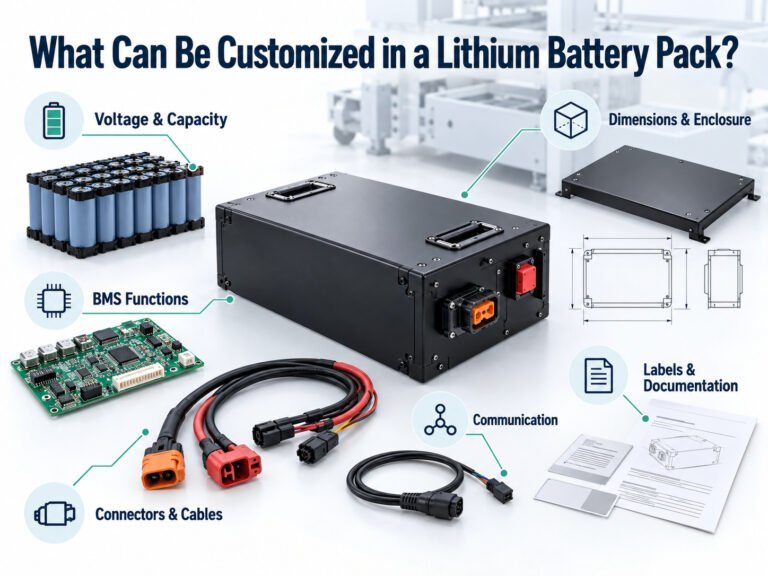
8. Customize the Battery Pack Dimensions
Medical equipment often has limited internal installation space.
A standard battery may not fit the mechanical structure or connector arrangement of the device. Custom battery pack development allows the battery to be designed around the available space.
Mechanical customization may include:
- 배터리 치수
- 세포 배열
- 커넥터 유형
- 커넥터 위치
- 케이블 길이
- 장착 구조
- Battery housing
- 단열
- Fuse location
- BMS position
- 충전 인터페이스
For example, the same electrical specification can potentially be packaged into different mechanical configurations depending on the equipment structure.
This is one of the main differences between a standard battery product and an OEM battery solution.
9. Consider Operating and Charging Temperature
Temperature has a direct influence on lithium battery performance and safety.
Medical equipment manufacturers should define:
- 작동 온도 범위
- 충전 온도 범위
- Storage temperature range
- Maximum battery temperature
- Minimum charging temperature
- Temperature transition conditions
A battery may operate in different environments depending on the application.
For example, equipment used in hospitals may experience relatively controlled indoor conditions, while emergency medical equipment or mobile healthcare systems may encounter a wider temperature range.
The BMS can use temperature sensors such as NTC thermistors to monitor cell or pack temperature and initiate protection according to predefined parameters.
If low-temperature charging is required, the battery design should specifically evaluate charging performance and protection strategy at low temperatures.
10. Battery Safety and Protection
Safety should be considered throughout the battery design process.
A custom medical battery pack can include several layers of protection.
Electrical Protection
Electrical protection may include:
- Overvoltage protection
- Undervoltage protection
- 과전류 보호
- 단락 보호
- 과충전 방지
- 과방전 방지
Thermal Protection
Temperature monitoring can help detect abnormal operating conditions.
기계적 보호
The battery structure should secure the cells and protect electrical connections against expected vibration, impact, and mechanical stress.
Cell Consistency
Cells used in the same battery pack should be appropriately matched according to the battery manufacturer’s quality-control process.
매개변수에는 다음이 포함될 수 있습니다:
- 용량
- 전압
- 내부 저항
- Self-discharge characteristics
A reliable battery development process therefore involves cell selection, electrical design, mechanical design, BMS development, testing, and production quality control.
11. Testing Requirements for Medical Battery Packs
Testing should be planned according to the battery design and target market.
Typical battery tests may include:
용량 테스트
Verifies whether the battery provides the specified capacity under defined test conditions.
Charge and Discharge Testing
Evaluates battery behavior during normal operating cycles.
노화 시험
Helps verify battery performance after controlled charging and discharging processes.
온도 시험
Evaluates battery behavior under specified temperature conditions.
진동 테스트
Assesses mechanical integrity under defined vibration conditions.
Mechanical Shock Testing
Evaluates the battery pack’s mechanical response to specified shock conditions.
Insulation Testing
Helps verify electrical insulation according to the applicable design and testing requirements.
BMS Functional Testing
Checks protection thresholds, balancing behavior, communication, and fault responses.
Testing requirements should be established before mass production rather than being treated as a final-stage activity.
12. Medical Battery Certifications and Compliance
Battery compliance depends on the battery design, equipment classification, target market, transportation requirements, and final product certification strategy.
Potential standards and requirements may include:
- IEC 62133-2
- UN38.3
- UL 표준
- CE 관련 요구사항
- RoHS
- EU 배터리 규정
- IEC 60601-1
However, battery-level compliance and complete medical device compliance are not the same thing.
For example, IEC 62133-2 addresses safety requirements for portable sealed secondary lithium cells and batteries. IEC 60601-1 addresses basic safety and essential performance requirements for medical electrical equipment.
Therefore, the battery manufacturer and medical equipment manufacturer should define the applicable compliance requirements at the beginning of the project.
The target sales market should also be identified early because regulatory requirements can differ between regions.
13. How to Choose a Medical Battery Pack Manufacturer
For medical equipment manufacturers, battery supplier evaluation should include engineering capability, production capability, quality management, testing resources, and OEM/ODM experience.
Engineering Capability
Ask whether the battery manufacturer can support:
- 세포 선택
- Battery configuration
- BMS 개발
- Firmware customization
- 기계 설계
- 커넥터 맞춤 설정
- 통신 프로토콜 개발
제조 역량
Evaluate production processes such as:
- 세포 선별
- 자동화된 조립
- 레이저 용접
- BMS assembly
- 배터리 노화
- 용량 테스트
- 최종 검사
품질 관리
A supplier should have defined procedures for:
- Incoming inspection
- Process inspection
- 배터리 테스트
- 최종 검사
- Batch management
- 제품 추적성
For long-term medical equipment projects, consistency between production batches is an important consideration.
14. Medical Battery OEM/ODM Development Process
A structured OEM/ODM process can help medical equipment manufacturers move from initial requirements to mass production.
1단계: 요구사항 분석
고객은 다음을 제공합니다:
- 전압
- 용량
- 현재
- Runtime
- 치수
- 운영 환경
- 통신 요구 사항
- 목표 시장
2단계: 셀 선택
Engineers evaluate suitable cell chemistry, size, capacity, discharge characteristics, and supply availability.
Step 3: Electrical Design
The battery configuration and electrical architecture are defined.
Step 4: BMS Development
Protection parameters, monitoring functions, communication protocols, and firmware requirements are established.
Step 5: Mechanical Design
Battery dimensions, housing, connectors, cables, and mounting structure are developed.
Step 6: Prototype
Prototype battery packs are manufactured for equipment integration and testing.
Step 7: Functional Testing
The prototype is tested for capacity, voltage, current, charging, discharge, temperature, BMS functions, and communication.
Step 8: Reliability Testing
Additional tests are performed according to the project requirements.
Step 9: Certification
Required battery and product-level compliance testing is carried out according to the target market and certification plan.
Step 10: Pilot Production
A pilot production run verifies manufacturing processes and quality-control procedures.
Step 11: Mass Production
After validation, the battery enters controlled mass production with defined inspection and traceability procedures.
15. Medical Device Applications for Custom Lithium Battery Packs
Custom lithium battery packs can be developed for different types of medical equipment.
| 애플리케이션 | Typical Battery Considerations |
|---|---|
| Patient Monitor | Compact design, stable power, runtime |
| Infusion Pump | Compact battery, controlled discharge |
| Portable Ultrasound | Energy capacity, weight, runtime |
| Medical Cart | High capacity, mobility |
| Medical Robot | Cycle life, current output, BMS |
| Rehabilitation Equipment | Capacity, mechanical integration |
| Respiratory Equipment | Stable continuous power |
| Diagnostic Equipment | Voltage stability, runtime |
| Emergency Equipment | Reliability, charging management |
| Home Healthcare Equipment | Compact design, safe operation |
The final battery specification should always be based on the actual equipment requirements.
16. Battery Communication and Equipment Integration
Battery integration should be considered at the equipment design stage.
The battery interface may include:
Power Interface
- Positive terminal
- Negative terminal
- 충전 인터페이스
통신 인터페이스
- CAN
- SMBus
- UART
모니터링
- 전압
- 현재
- 온도
- SOC
- SOH
- 고장 상태
The battery and medical equipment control system should be tested together to verify communication, charging, discharge behavior, fault handling, and system shutdown conditions.
This system-level validation is important for OEM medical equipment because the battery is part of the equipment’s overall power architecture.
17. Custom Medical Battery Pack Specification Checklist
Before requesting a quotation from a battery manufacturer, medical equipment manufacturers should prepare the following information:
| 요구사항 | 사양 |
|---|---|
| 배터리 화학 | NMC / LiFePO4 / Other |
| 공칭 전압 | V |
| 용량 | 아 |
| 에너지 | Wh |
| Continuous Current | A |
| Peak Current | A |
| 운영 시간 | Hours |
| 충전 시간 | Hours |
| 작동 온도 | °C |
| 충전 온도 | °C |
| 치수 | L × W × H |
| 무게 | kg |
| BMS | Required / Not Required |
| 커뮤니케이션 | CAN / SMBus / UART |
| 커넥터 | Type / Position |
| 주택 | Required / Not Required |
| IP 등급 | Required rating |
| 인증 | Target standards |
| 애플리케이션 | 의료 장비 |
| 타겟 시장 | EU / US / Asia / Global |
| 연간 발행 부수 | Units/year |
Providing these specifications allows the battery manufacturer to evaluate the project more accurately.
18. FAQ
What type of lithium battery is used in medical devices?
Medical devices can use different lithium battery chemistries depending on the application. NMC and LiFePO4 are two options that may be evaluated according to energy density, safety requirements, operating conditions, cycle requirements, and available space.
Can lithium battery packs for medical equipment be customized?
Yes. A custom battery pack can be designed around the equipment’s voltage, capacity, dimensions, connector, BMS, communication interface, operating temperature, and other requirements.
Can the BMS communicate with medical equipment?
Yes. Depending on the equipment architecture, a smart BMS can support interfaces such as CAN, SMBus, or UART.
Can battery dimensions and connectors be customized?
Yes. OEM battery manufacturers can design the battery structure, connector position, cable length, housing, and mounting configuration according to equipment requirements.
What certifications are required for medical device batteries?
Requirements depend on the battery design, target market, transportation requirements, and final medical device certification strategy. Standards and requirements may include IEC 62133-2, UN38.3, UL-related standards, CE-related requirements, and other applicable regulations.
Can LiFePO4 batteries be used in medical equipment?
Yes. LiFePO4 can be considered for medical equipment where its electrical characteristics, size, weight, operating conditions, and cycle requirements match the application.
How do I calculate the required battery capacity?
Start with the equipment’s average power consumption and required operating time:
Energy = Power × Operating Time
Then account for system efficiency, battery operating conditions, aging, and required reserve.
How long does a custom medical battery take to develop?
Development time depends on battery complexity, BMS requirements, mechanical design, certification requirements, and sample validation. A simple battery pack and a smart battery with custom communication and housing can have very different development cycles.
Can a medical battery manufacturer provide samples?
A professional OEM/ODM manufacturer can develop prototype battery packs for equipment integration and engineering validation before pilot production.
19. Work With a Custom Medical Battery Pack Manufacturer
Selecting a lithium battery for medical equipment requires coordination between the battery design and the equipment’s electrical, mechanical, thermal, and regulatory requirements.
A custom OEM/ODM approach allows the battery pack to be developed around the actual application rather than adapting the equipment to a standard battery.
For medical equipment manufacturers, the development process should consider:
Power requirements → Cell chemistry → Battery configuration → BMS → Mechanical design → Thermal conditions → Communication → Testing → Compliance → Mass production
Dongguan Yizhan Electronics Technology Co., Ltd. provides custom lithium battery pack OEM/ODM services for different equipment applications. The development process can include battery specification analysis, cell selection, battery pack design, BMS development, prototype production, testing, and production support.
If you are developing a medical device and need a custom battery solution, provide your voltage, capacity, dimensions, operating time, current requirements, communication interface, and target market. These parameters can be used to evaluate the battery architecture and develop an OEM/ODM solution.
 English
  Chinese
  Japanese
  German
  French
  Korean
