
A custom battery pack quote covers a product built for a specific application. Its cost includes the cells, electronics, structure, assembly and work needed to define and verify the design.
Voltage and capacity are part of the calculation, but they do not describe the entire product. Two packs labeled 48V 20Ah can use different cells, protection functions, connectors and enclosures.
This guide explains the items behind a custom battery pack quote and the information buyers can provide when requesting one.
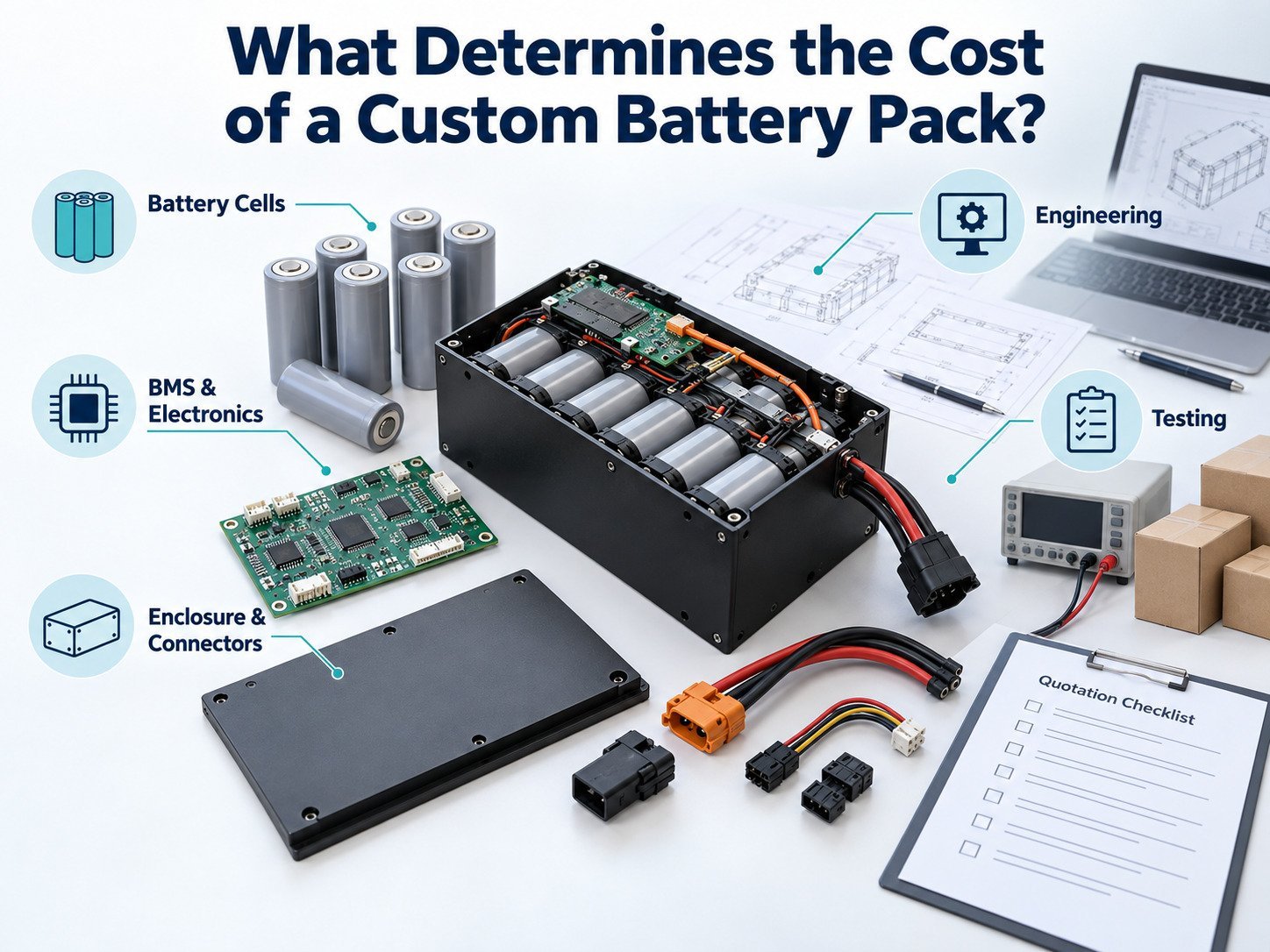
1. Battery Cells
Cells store the energy delivered by the pack. Their contribution to cost depends on the selected model, quantity and supply conditions.
A cell specification includes:
- Chemistry.
- Manufacturer and model.
- Nominal and minimum capacity.
- Operating voltage.
- Charge and discharge limits.
- Temperature limits.
- Dimensions.
Cell format alone does not establish price or performance. “18650” and “21700” describe sizes; each format includes models with different specifications.
細胞数
The series and parallel configuration determines how many cells the design uses.
For example, a 13S4P configuration contains 52 cells: four cells in each parallel group, with 13 groups connected in series.
This is a configuration example, not a recommendation for every battery described as 48V.
The quote should identify the cell model and the rules for any proposed substitution.
2. Battery Management System
The battery management system, or BMS, monitors operating conditions and controls the functions included in its design.
Its cost depends on the required hardware, software and validation.
The project may require:
- Cell voltage monitoring.
- Current measurement.
- Temperature sensing.
- Charge and discharge protection.
- Cell balancing.
- Fault records.
- Communication with equipment.
- Sleep and wake-up control.
A BMS with a stated current rating is not a complete specification. The supplier also needs protection thresholds, timing, recovery behavior and installation conditions.
If custom firmware is required, ask whether development is included in the unit price or quoted as a separate charge.
3. Continuous and Peak Current
The load profile affects the design of the electrical path.
Cells, interconnections, BMS components, fuses, connectors and cables must support the specified operating conditions.
Document:
- Continuous current.
- Peak current.
- Peak duration.
- Repetition rate.
- Temperature conditions.
- Permitted voltage drop.
A request such as “for a 500W motor” does not fully define battery current. Controller settings and actual operation also matter.
Providing a measured load profile gives the supplier a basis for selecting components and preparing the quote.
4. Enclosure and Mechanical Structure
The enclosure holds the battery assembly and provides the interfaces needed for installation.
Cost depends on its material, dimensions, construction and manufacturing method.
The scope may include:
- A purchased enclosure.
- Sheet-metal fabrication.
- Machined parts.
- Molded plastic components.
- Mounting brackets.
- Locks and handles.
- Seals.
- Internal cell restraints.
- Insulation.
A project using a custom molded enclosure may also involve tooling. Confirm whether tooling is a separate charge, who owns it and how modifications will be handled.
Requirements for appearance, surface finish and labeling should be stated before the quote is approved.
5. Connectors, Cables and Accessories
These parts are sometimes left out of an initial inquiry, but they belong in the product specification.
例としては、次のようなものがあります:
- Charge and discharge connectors.
- Signal connectors.
- Cable assemblies.
- Terminal covers.
- Power switches.
- Displays.
- Mounting rails.
- External chargers.
Identify part numbers where the equipment requires a particular component.
If the connector has not been selected, provide voltage, current, environmental and handling requirements. Also specify cable length and routing constraints.
Confirm whether the quote includes mating connectors and installation accessories.
6. Communication and Equipment Integration
A battery may need to exchange data with a controller, charger, inverter or display.
The cost scope depends on whether the required protocol is already supported or needs development.
Communication work can include:
- Reviewing the host specification.
- Implementing messages or registers.
- Defining data units and timing.
- Handling faults and timeouts.
- Testing with the host equipment.
- Managing firmware versions.
“CAN support” or “RS485 support” does not establish compatibility with a particular device.
Provide the actual protocol document and confirm who is responsible for integration testing.
7. Engineering and Prototype Development
A custom project may require engineering work before production.
This work can include:
- Reviewing requirements.
- Selecting cells.
- Designing the electrical configuration.
- Preparing mechanical drawings.
- Developing BMS settings or firmware.
- Building samples.
- Reviewing test results.
- Updating the design.
These activities are often described as non-recurring engineering, or NRE.
Ask the supplier to separate development charges from production pricing. Also confirm the number of sample builds and design revisions included.
Prototype pricing should not be assumed to represent the production unit price.
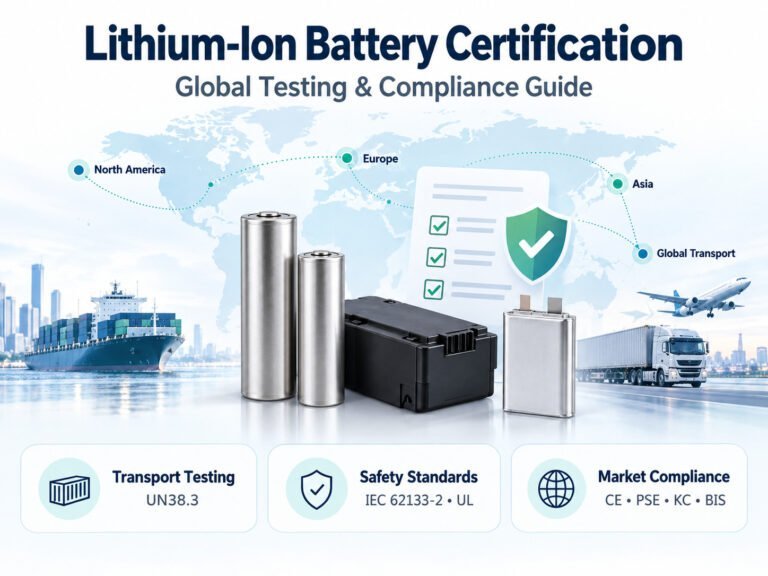
8. Testing and Certification
Testing costs depend on the product, intended market and evidence required.
The project may include:
- Development measurements.
- Electrical and thermal validation.
- Mechanical or environmental testing.
- Transport testing.
- Product safety assessment.
- Third-party certification.
These activities serve different purposes. A transport test does not replace product safety assessment, and cell documents do not automatically cover an assembled pack.
Before requesting a quotation, define:
- Destination markets.
- Intended application.
- Required standards and editions.
- Models to be covered.
- Required reports or certificates.
- Responsibility for test samples and fees.
Avoid treating certification as one fixed line item. The assessment body must confirm the scope for the actual design.
9. Manufacturing and Quality Records
Production cost includes the work needed to assemble and check the battery.
Depending on the design, this may involve cell inspection, interconnection, insulation, wiring, BMS installation and enclosure assembly.
The agreed production scope should identify:
- Incoming inspection requirements.
- Assembly instructions.
- Process checks.
- End-of-line tests.
- Serial numbers and traceability.
- Records supplied with the order.
- Acceptance criteria.
A statement such as “fully tested” is not a test plan. Ask which measurements are performed and how results are recorded.
10. Order Quantity and Release Schedule
Quantity affects how development, tooling, setup and purchasing costs are allocated.
A quotation should identify:
- Sample quantity.
- Quantity per production order.
- Expected annual demand.
- Delivery schedule.
- Minimum purchasing commitments.
- Price validity.
A forecast and a committed order are not the same thing. State which quantities are confirmed.
If a quote depends on an annual volume, ask what happens when actual releases do not match that volume.
11. Packaging and Shipping
Confirm whether the quoted price includes packaging, freight and related handling.
Battery shipping arrangements depend on the product and transport requirements.
The cost scope may include:
- Packaging materials.
- Terminal protection.
- Internal restraint.
- Required marks and labels.
- Shipping documents.
- Freight.
- Applicable handling charges.
Also confirm the trade terms, delivery location and responsibility for duties or taxes.
A battery unit price and a delivered project cost describe different things.
12. Warranty and Service Scope
Warranty terms should explain what is covered and how claims are handled.
Discuss:
- Coverage period.
- Operating conditions.
- Exclusions.
- Required claim information.
- Inspection procedures.
- Return arrangements.
- Repair or replacement process.
Do not treat a warranty period as proof of battery service life. Warranty is a contractual commitment; service-life statements need supporting conditions and evidence.
Separate One-Time Costs From Unit Costs
A quote can contain several types of charges.
| Cost Type | 例 |
|---|---|
| Development | Engineering, drawings and firmware |
| Tooling | Molds, fixtures and dedicated equipment |
| Samples | Prototype materials and assembly |
| Assessment | Laboratory work and certification fees |
| 制作 | Cells, components, assembly and agreed checks |
| 配送 | Packaging, freight and handling |
This structure helps buyers understand which costs apply once and which apply to each order.
An Illustrative Calculation
Suppose a project has a one-time development charge of $2,000 and an order for 100 packs at $150 per pack.
The calculation is:
$2,000 + (100 × $150) = $17,000
This example excludes any separately quoted testing, tooling, freight or taxes.
The figures explain cost allocation only. They are not market prices or a quotation.
Why Voltage and Capacity Are Not Enough for a Quote
Consider two packs both specified as 48V 20Ah.
One may use a purchased enclosure and a power-only connection. The other may require a custom housing, host communication, a lock, a display and project-specific testing.
Their labels do not describe those differences.
A usable quote needs an agreed configuration and a list of included work.
What to Include in a Battery RFQ
| Category | Information to Provide |
|---|---|
| 申し込み | Equipment type and intended use |
| 電圧 | Operating range and charging limits |
| エネルギー | Capacity and usable-energy requirement |
| 読み込み中 | Continuous current and peak profile |
| 機械 | Dimensions, mounting and mass limits |
| Interfaces | Connectors, cables and communication |
| 充電 | Charger requirements and schedule |
| 環境 | Temperature, moisture and vibration |
| コンプライアンス | Markets and required documents |
| 数量 | Samples, order size and forecast |
| Validation | Tests, criteria and responsibilities |
| 配送 | Packaging and destination |
If a requirement is not yet defined, mark it as open rather than supplying an assumed value.
How to Review Battery Quotations
Use the same specification when reviewing supplier quotes.
Check whether each quote includes the same cell model, BMS functions, enclosure, accessories, testing and delivery scope.
Ask suppliers to list:
- Assumptions.
- Exclusions.
- Separate charges.
- Customer-supplied items.
- Conditions that trigger a price review.
A price is meaningful only when its scope is understood.
よくある質問
Can a Custom Battery Be Quoted Without a Drawing?
An initial estimate may be possible, but mechanical requirements still need confirmation before design approval.
Does a Sample Price Apply to Production?
Not automatically. Samples can include purchasing, setup and assembly work specific to the prototype stage.
Is the Charger Included?
Only if the quote states that it is included. Confirm its model, quantity and compatibility requirements.
Are Certification Fees Included?
Check the quotation. Confirm the assessment scope and the documents to be delivered.
Can Parts Be Changed After Approval?
Changes should follow the agreed review process. They may affect price, validation and document coverage.
Preparing a Custom Battery Pack Budget
Define the product and the work required to deliver it. Separate development, tooling, assessment, production and shipping charges.
Request a quotation that identifies the configuration, quantities, assumptions and exclusions. This gives the project team a documented basis for budgeting and approval.
 English
  Chinese
  Japanese
  German
  French
  Korean
