
Industrial floor cleaning machines are used in warehouses, factories, shopping centers, hospitals, airports, and commercial facilities. These machines rely on electrical power to operate brush motors, vacuum motors, traction systems, controllers, and other components.
Battery-powered floor scrubbers require a battery system designed around the equipment’s electrical load, operating duration, charging arrangement, and installation space.
For manufacturers developing walk-behind floor scrubbers, ride-on cleaning machines, and automated floor cleaning equipment, lithium battery pack design for industrial floor cleaning machines involves electrical, mechanical, and safety considerations.
The battery must provide the required energy and discharge current while remaining compatible with the machine’s controller, charger, electrical connections, and operating environment.
This article explains the technical parameters involved in designing custom lithium battery packs for industrial floor cleaning equipment.
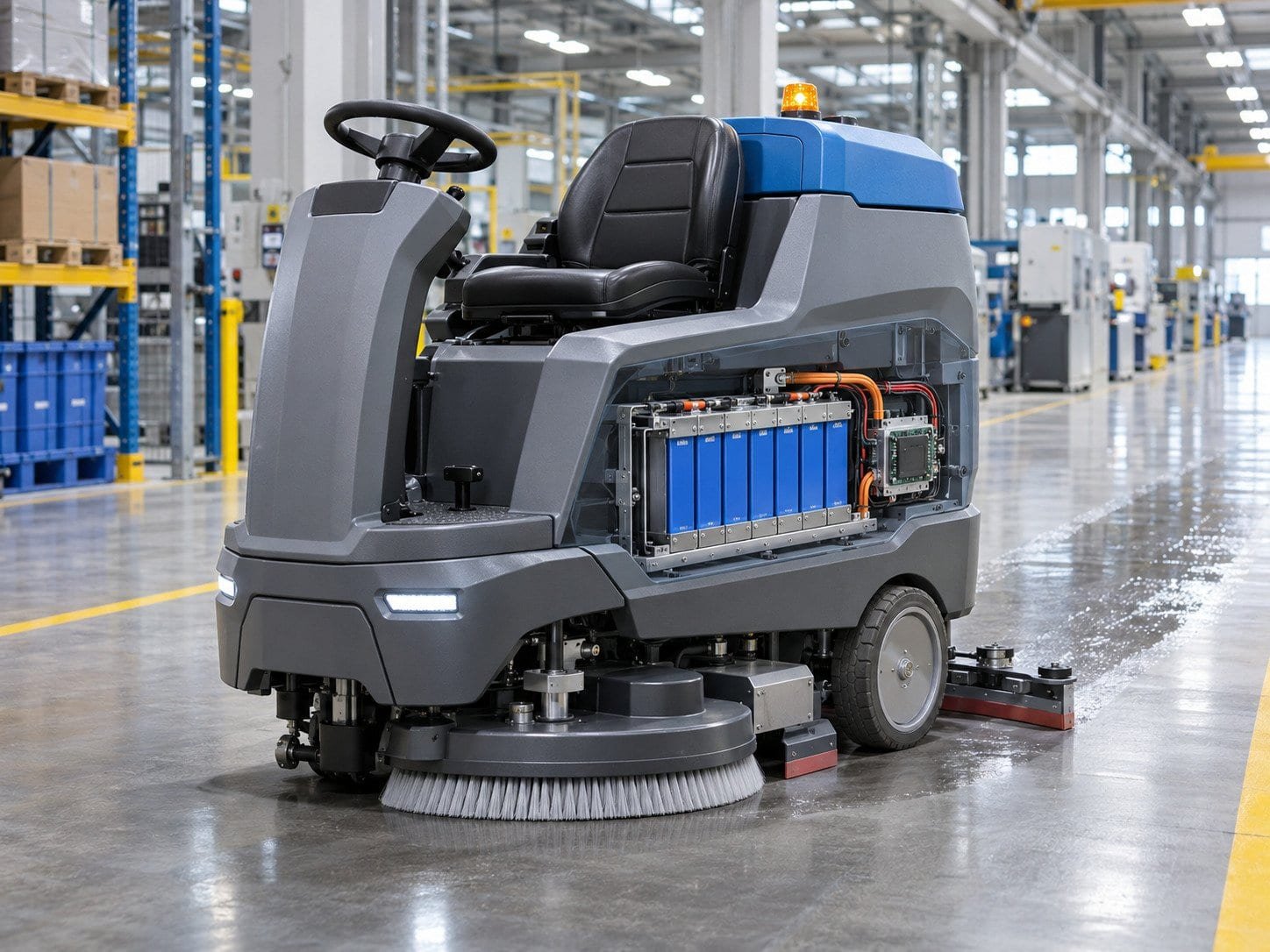
1. Lithium Battery Applications in Industrial Floor Cleaning Equipment
Industrial cleaning machines include several equipment categories with different power and operating requirements.
Walk-Behind Floor Scrubbers
Walk-behind floor scrubbers are operated by personnel and commonly use electrical power for brush rotation, vacuum suction, and traction when equipped with a drive motor.
Battery selection depends on the equipment’s power consumption, operating time, and available battery compartment.
Ride-On Floor Scrubbers
Ride-on floor scrubbers allow operators to control the equipment from a seated position.
These machines may use separate motors for traction, brush operation, and water recovery.
The battery pack must support the combined operating load and the required cleaning schedule.
Industrial Floor Sweepers
Industrial sweepers use brush systems and, depending on the design, vacuum or dust collection equipment.
Battery requirements depend on the brush motors, traction system, dust collection system, and operating conditions.
Autonomous Floor Cleaning Robots
Autonomous cleaning robots combine cleaning equipment with navigation and electronic control systems.
In addition to cleaning motors, the battery may supply power to sensors, onboard computers, communication modules, and navigation equipment.
These applications may require BMS communication, battery status monitoring, and integration with an automatic charging station.
2. Selecting Battery Voltage for Floor Cleaning Machines
Battery voltage is determined by the equipment’s electrical system.
Industrial cleaning machines may use 24V, 36V, or 48V-class electrical architectures, depending on the manufacturer and equipment design.
The actual nominal battery voltage depends on the selected lithium cell chemistry and series configuration.
LiFePO4 Battery Voltage Configurations
LiFePO4 cells typically have a nominal voltage of 3.2V.
Examples of battery configurations include:
| 構成 | 公称電圧 | Equipment Voltage Class |
|---|---|---|
| 8S LiFePO4 | 25.6V | 24V |
| 12S LiFePO4 | 38.4V | Application-dependent |
| 15S LiFePO4 | 48.0V | 48V |
| 16S LiFePO4 | 51.2V | Subject to controller compatibility |
These values are illustrative configurations rather than specifications for existing products.
Voltage Compatibility Requirements
Before selecting the battery configuration, the equipment manufacturer should confirm:
- 公称系統電圧
- Permitted operating voltage range
- Maximum battery voltage
- 最小動作電圧
- Motor controller voltage limits
- 充電器の仕様
- Battery protection requirements
For example, a 24V-class cleaning machine cannot be assumed to accept every lithium battery marketed as 24V.
The battery’s full charging voltage and discharge cutoff characteristics must be compatible with the equipment.
3. Calculating Battery Capacity for Industrial Floor Scrubbers
Battery capacity should be calculated according to the electrical energy required during the cleaning cycle.
Floor cleaning machines may operate multiple motors simultaneously.
These loads should be included in the capacity calculation.
Electrical Loads in Floor Cleaning Machines
Electrical power may be required for:
- Brush motors
- Vacuum motors
- Traction motors
- Water pumps
- Control electronics
- Display systems
- センサー
- 通信モジュール
The average power consumption depends on how these components operate during a cleaning cycle.
バッテリーのエネルギー計算
Nominal battery energy can be estimated using:
バッテリー容量(Wh)=公称電圧(V)× 容量(Ah)
For example, a theoretical 25.6V 100Ah battery has:
25.6V × 100Ah = 2,560Wh
The value represents nominal battery energy rather than guaranteed usable energy.
Required Energy Calculation
Equipment energy requirements can be estimated using:
Required Energy (Wh) = Average Electrical Power (W) × Operating Time (h)
Example: Walk-Behind Floor Scrubber
Assume a cleaning machine has the following illustrative average electrical loads:
| Component | Average Power |
|---|---|
| Brush Motor | 300W |
| Vacuum Motor | 250W |
| Traction Motor | 100W |
| Control and Auxiliary Equipment | 20W |
| Total | 670W |
For a required operating time of three hours:
670W × 3h = 2,010Wh
The cleaning machine requires approximately 2,010Wh of usable energy under these assumed operating conditions.
If the battery uses a nominal voltage of 25.6V:
2,010Wh ÷ 25.6V = 78.5Ah
This is the theoretical capacity requirement without a usable-energy allowance.
Assuming an illustrative usable energy fraction of 90%:
Required Nominal Capacity = 2,010Wh ÷ (25.6V × 0.90)
Required Nominal Capacity ≈ 87.2Ah
The 90% value is a calculation assumption and should not be treated as a universal battery specification.
The final capacity should account for actual equipment power consumption, battery operating limits, electrical losses, temperature, and aging requirements.
4. Continuous and Peak Discharge Current Requirements
Floor cleaning machines may operate brush, suction, and traction motors simultaneously.
The battery must supply the required current under the specified operating conditions.
連続放電電流
Continuous discharge current represents the current required during sustained equipment operation.
An initial current estimate can be calculated using:
Current (A) = Electrical Power (W) ÷ Battery Voltage (V)
For example, assuming an electrical load of 800W and a nominal battery voltage of 25.6V:
800W ÷ 25.6V = 31.25A
This calculation uses nominal voltage and does not represent the current at every battery state of charge.
The battery design should also consider operation at the minimum permitted battery voltage.
ピーク放電電流
Motor startup, traction acceleration, brush engagement, and temporary load changes may create short-duration current demand.
Peak current should be specified with its duration.
An illustrative project may require:
| パラメータ | Example Requirement |
|---|---|
| バッテリー電圧 | 25.6V |
| 定員 | 100Ah |
| 連続放電電流 | 40A |
| ピーク放電電流 | 80A |
| Peak Duration | 5 seconds |
These values are examples for engineering discussion and do not represent verified product specifications.
The actual continuous and peak current requirements must be determined from equipment measurements or the manufacturer’s electrical specifications.
5. LiFePO4 Battery Cell Selection for Cleaning Equipment
Lithium Iron Phosphate (LiFePO4) cells are used in industrial battery applications, including floor cleaning equipment.
Battery cell selection should be based on electrical performance requirements and the available installation space.
電気的特性
Relevant cell specifications include:
- 公称電圧
- 定格容量
- 連続放電電流
- Pulse discharge capability
- 充電電流
- 内部抵抗
- 充電可能温度範囲
- Discharging temperature range
- Cycle life conditions
機械的パラメータ
The battery designer should also evaluate:
- 細胞の寸法
- Cell weight
- Terminal structure
- Cell mounting arrangement
- 電気絶縁
- Heat dissipation paths
Prismatic and Cylindrical Cells
Prismatic LiFePO4 cells may be used in battery packs requiring specified capacity and enclosure arrangements.
Cylindrical lithium cells may be considered for applications with particular dimensions, current requirements, or mechanical constraints.
The cell format should be selected according to the equipment’s technical specifications.
6. Battery Management System Requirements
The Battery Management System (BMS) is a component of the lithium battery pack.
It monitors battery operating conditions and provides protection functions according to its hardware and software design.
BMS Protection Functions
A floor cleaning machine battery may require:
- Cell overvoltage protection
- Cell undervoltage protection
- 過電流保護
- 短絡保護
- Charging temperature protection
- Discharging temperature protection
- セルバランシング
- バッテリー状態の監視
The required functions and protection thresholds should be defined according to the selected cell specifications and equipment requirements.
BMS Current Rating
The BMS must be evaluated against the equipment’s continuous discharge current and defined peak current requirements.
For cleaning machines with multiple motors, simultaneous operation should be considered.
温度モニタリング
Battery temperature sensors can monitor selected locations within the battery pack.
Temperature thresholds should be established according to the selected cells and operating conditions.
State of Charge Monitoring
Some floor cleaning machines display the remaining battery charge.
A BMS may provide State of Charge (SOC) information through a supported interface.
The estimation method and accuracy should be evaluated during system development.
7. CAN Communication for Automated Cleaning Machines
Some industrial floor cleaning machines require communication between the battery and the equipment controller.
Depending on the project, communication options may include CAN, UART, or RS485.
A CAN-equipped BMS can transmit defined battery information according to an agreed communication protocol.
例としては、次のようなものがあります:
- バッテリー電圧
- バッテリー電流
- 充電状態
- 温度
- 保護状況
- 障害情報
CAN Protocol Integration
The equipment manufacturer should confirm:
- 通信インターフェース
- CAN bit rate
- Message identifiers
- データ形式
- Transmission intervals
- Connector pin assignments
A CAN interface does not automatically establish communication compatibility between the battery and equipment controller.
Monitoring and Control Functions
For a monitoring-only BMS configuration, CAN communication transmits battery operating data.
Charging and discharging are not automatically controlled through CAN communication.
Any control functions require specific hardware, firmware, and protocol arrangements.
For autonomous floor cleaning robots, communication requirements should be reviewed together with charging station integration.
8. Battery Charging Requirements
Battery charging is part of industrial floor cleaning machine operation.
Depending on the equipment, charging may involve an external charger, onboard charger, or automatic charging station.
充電電圧
Charging voltage must match the selected lithium battery chemistry and series configuration.
The manufacturer should confirm the approved charging profile and voltage limits.
充電電流
Charging current affects the charging schedule and thermal conditions of the battery.
The selected cells, BMS, connectors, and wiring must support the specified charging current.
Onboard and External Chargers
Some floor cleaning machines include an onboard charger.
Other equipment uses a separate external charger.
Battery and charger compatibility must be evaluated before system integration.
Automatic Charging for Cleaning Robots
Autonomous cleaning equipment may return to a charging station during operation.
The battery design should account for:
- Charging contact arrangement
- Charging voltage and current
- BMS protection behavior
- Equipment power state during charging
- Charging station communication, where required
The charging method should be confirmed according to the equipment manufacturer’s system design.
9. Mechanical Design and Battery Compartment Integration
Industrial floor cleaning machines have defined battery installation spaces.
The battery pack must fit the equipment’s mechanical structure and electrical interface requirements.
バッテリー寸法
Customers should provide the available installation dimensions:
長さ × 幅 × 高さ
The dimensions should account for the complete battery enclosure, connectors, cable exits, handles, and mounting components.
Battery Mounting
The battery should be secured according to the machine’s operating conditions.
The design should consider vibration, equipment movement, and the specified mounting orientation.
Battery Mass and Machine Stability
Battery mass and its position may influence the machine’s mechanical balance, traction, and stability.
For equipment originally designed around lead-acid batteries, a change in battery mass may require review of the machine’s stability and applicable mechanical requirements.
A lithium battery should not be treated as a direct replacement solely because its nominal voltage and dimensions are similar.
Connectors and Wiring
Battery connections should be selected according to the equipment’s electrical current, mechanical structure, and operating environment.
Connector compatibility, cable specifications, polarity, and installation arrangements should be confirmed during development.
10. Environmental Protection and Operating Conditions
Floor cleaning equipment may operate in environments where water, detergent, humidity, vibration, and temperature changes affect electrical components.
Battery enclosure requirements depend on the equipment’s design and battery installation position.
Water and Moisture Exposure
Battery packs installed near water tanks, cleaning systems, or wet floor areas may require specified protection against moisture.
The required Ingress Protection (IP) rating should be determined according to actual exposure conditions.
Enclosure Materials
Plastic and metal enclosures may be considered according to project requirements.
Material selection should address structural requirements, electrical insulation, environmental exposure, and mechanical integration.
Detergent and Chemical Exposure
Cleaning equipment may use water and chemical detergents.
Where the battery enclosure or connectors may contact these substances, material compatibility should be evaluated.
動作温度
Battery charging and discharging must follow the selected cell manufacturer’s temperature specifications.
BMS temperature protection and enclosure thermal design should account for the equipment’s working conditions.
11. Lithium Battery Requirements for Walk-Behind and Ride-On Floor Scrubbers
Walk-behind and ride-on cleaning machines may have different electrical and mechanical requirements.
| Design Parameter | Walk-Behind Floor Scrubber | Ride-On Floor Scrubber |
|---|---|---|
| Electrical System | According to equipment design | According to equipment design |
| Main Loads | Brush, vacuum, optional traction | Brush, vacuum, traction |
| バッテリー容量 | Based on energy demand | Based on energy demand |
| 連続電流 | Based on simultaneous loads | Based on simultaneous loads |
| ピーク電流 | Motor startup and load changes | Motor startup and load changes |
| インストール | Defined battery compartment | Defined battery compartment |
| ビーエムエス | Protection and optional monitoring | Protection and optional monitoring |
| 充電 | Onboard or external | Onboard or external |
| コミュニケーション | According to controller requirements | According to controller requirements |
Battery specifications should be determined individually rather than selected solely by machine category.
12. Battery Testing and Applicable Standards
Industrial floor cleaning machine battery development may require electrical, mechanical, environmental, and safety validation.
The required testing depends on the equipment, target market, and applicable product standards.
電気試験
テストには、以下のものが含まれる場合があります:
- 公称電圧の確認
- Battery capacity testing
- Charging and discharging evaluation
- Continuous current testing
- ピーク電流試験
- BMS protection verification
機械的試験
テストには、以下のものが含まれる場合があります:
- Battery enclosure inspection
- Mounting verification
- Connector assessment
- 振動試験
- Mechanical integrity assessment
環境試験
Depending on the project, testing may include:
- 温度試験
- 湿度への曝露
- Ingress protection testing
- Exposure to relevant cleaning chemicals
Applicable Standards
Examples of standards and regulatory requirements that may be relevant include:
| スタンダード | Scope |
|---|---|
| IEC 62619 | Safety requirements for secondary lithium cells and batteries used in industrial applications |
| IEC 60335-2-72 | Safety requirements for applicable commercial floor treatment machines |
| IEC 60529 | Enclosure ingress protection classification |
| UN38.3 | Transportation testing for lithium cells and batteries |
| Applicable EU Regulations | Product and equipment requirements according to the target market |
The applicability of each standard must be evaluated according to the battery design, equipment classification, and market requirements.
Battery-level test results do not automatically establish compliance for the complete floor cleaning machine.
13. Information Required for a Custom Floor Scrubber Battery Quotation
Equipment manufacturers requesting a custom battery pack should provide the following information.
| 項目 | Required Information |
|---|---|
| Equipment Type | Walk-behind scrubber, ride-on scrubber, sweeper, or autonomous cleaner |
| Nominal Battery Voltage | V |
| Permitted Voltage Range | Minimum and maximum voltage |
| Required Runtime | 営業時間 |
| Average Power Consumption | W |
| 連続放電電流 | A |
| ピーク放電電流 | A and duration |
| バッテリー容量 | Ah or Wh, if specified |
| バッテリー化学 | LiFePO4 or ternary lithium-ion |
| バッテリー寸法 | Maximum length × width × height |
| バッテリー重量 | Maximum permitted mass or required mass range |
| BMS Requirements | Protection, monitoring, and balancing |
| コミュニケーション | CAN, UART, RS485, or other interface |
| 充電方法 | Onboard charger, external charger, or charging station |
| Charging Voltage and Current | V and A |
| Connector Requirements | Charging, discharging, and signal connectors |
| Enclosure Requirements | Material, mounting, and IP rating |
| 動作温度 | Charging and discharging conditions |
| 認証 | Applicable standards and target market |
| Sample Quantity | Prototype requirements |
| Production Quantity | Estimated purchase volume |
| Delivery Destination | Country and address |
If the required battery capacity has not yet been calculated, customers can provide the equipment’s power consumption and operating duration for an initial technical evaluation.
14. Custom Lithium Battery Packs for Floor Cleaning Machines at Dongguan Yizhan Electronics Technology Co., Ltd.
東莞伊湛電子科技有限公司 provides OEM and ODM lithium battery pack development and manufacturing services for industrial equipment, electric mobility, robotics, and energy storage applications.
For industrial floor cleaning machine projects, battery configurations can be evaluated according to customer requirements involving electrical load, operating voltage, battery capacity, installation dimensions, and charging interfaces.
Our custom battery pack development services include:
- LiFePO4 and ternary lithium-ion battery configurations
- Customized voltage and capacity
- 電池セルの選定
- BMSの設定
- CAN, UART, and RS485 communication options
- 温度モニタリング
- Customized charging and discharging connectors
- Plastic and metal battery enclosures
- バッテリーパックアセンブリ
- Technical documentation and testing coordination
Specific battery configurations, communication functions, environmental requirements, and testing arrangements are determined according to the confirmed project specifications.
We work with equipment manufacturers to evaluate battery requirements for new product development and OEM battery integration.
結論
Lithium battery pack design for industrial floor cleaning machines involves evaluating electrical loads, operating runtime, discharge current, charging requirements, and mechanical installation conditions.
Brush motors, vacuum motors, traction systems, and control electronics determine the equipment’s electrical demand.
Battery voltage, capacity, cell selection, BMS configuration, and charging interfaces must be compatible with the equipment’s electrical architecture.
For walk-behind floor scrubbers, ride-on cleaning machines, and autonomous cleaning equipment, the final battery configuration should be based on confirmed technical requirements and project validation.
Looking for a custom lithium battery pack for industrial floor cleaning equipment?
連絡先 東莞伊湛電子科技有限公司 with your equipment specifications, battery voltage, required runtime, discharge current, battery dimensions, and estimated production quantity.
Our team can review your application requirements and discuss a custom battery pack configuration for your project.
 English
 Chinese
 Japanese
 German
 French
 Korean

