
Walkie pallet trucks are widely used for horizontal material handling in warehouses, distribution centers, retail facilities, and manufacturing environments. As lithium-ion technology becomes more common in material handling equipment, battery selection has become an important part of pallet truck design and fleet management.
For many walkie pallet trucks, 24V lithium battery systems are a practical starting point. Commercial models on the market use configurations such as 24V 20Ah, 24V 36Ah, 24V 78Ah, and higher-capacity packs depending on equipment design and operating requirements.
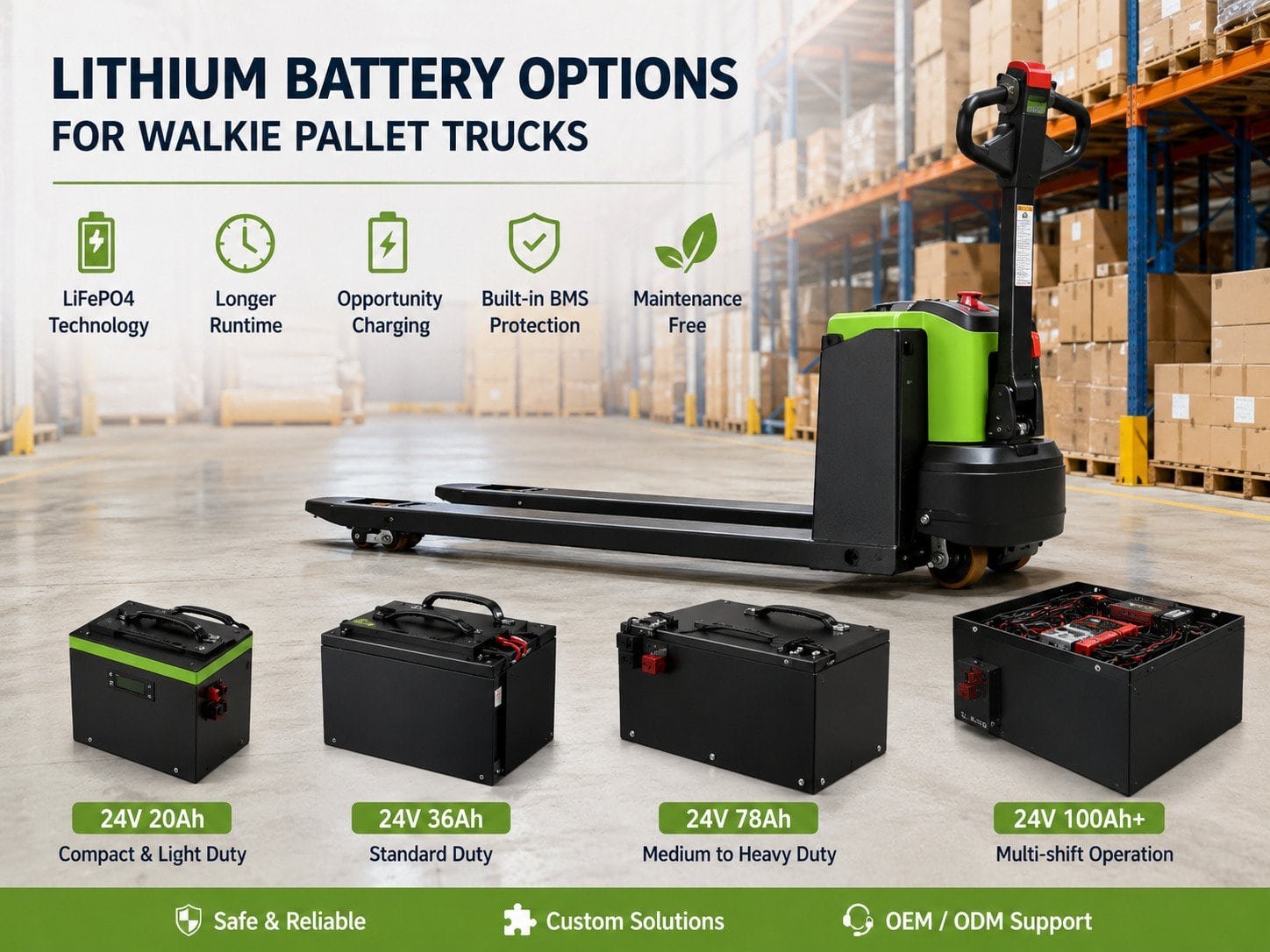
1. 24V LiFePO4 Battery
A 24V LiFePO4 battery is one of the lithium options worth considering for walkie pallet trucks.
A typical LiFePO4 pack can be designed with:
- 25.6V nominal voltage
- Different Ah capacities according to operating requirements
- Integrated BMS
- High continuous discharge capability
- Built-in protection against overcharge, over-discharge, over-current, and temperature conditions
- Optional CAN or RS485 communication
- External or onboard charging
The exact capacity should not be selected simply according to the physical size of the battery. The truck’s motor power, lifting requirements, operating hours, duty cycle, and available battery compartment should all be considered.
2. Compact Lithium Batteries for Light-Duty Walkie Pallet Trucks
For short-distance material handling and relatively light-duty applications, a compact lithium battery can provide a practical solution.
For example, some commercially available walkie pallet trucks use 24V 20Ah or 24V 36Ah lithium-ion batteries.
These configurations can be suitable for applications such as:
- Retail stores
- Small warehouses
- Short-distance pallet movement
- Low-duty-cycle operations
- Delivery and loading areas
A removable battery design can also simplify battery replacement and charging.
3. Medium-Capacity Lithium Battery Packs
For warehouses with longer operating hours, a larger battery capacity may be required.
Commercial pallet truck designs demonstrate that capacity can vary considerably. For example, the Raymond 8250 uses a 24V lithium-ion battery rated at 78Ah, while other configurations are available at higher capacities.
A medium-capacity battery can be considered when the equipment needs:
- 稼働時間の延長
- More frequent pallet movement
- Higher daily workload
- Reduced battery-change frequency
- Scheduled opportunity charging
The correct capacity should be calculated from actual energy consumption rather than selected only by Ah.
4. High-Capacity LiFePO4 Batteries for Multi-Shift Operations
High-utilization warehouses may require substantially larger battery packs.
For example, industrial Class III lithium battery systems are available in 24V configurations with capacities reaching hundreds of amp-hours and can support opportunity charging.
These batteries are more appropriate for applications involving:
- 複数のシフト
- High pallet throughput
- Rider pallet trucks
- 物流センター
- Continuous material handling
- Opportunity charging during work breaks
For this type of application, the battery system needs to be designed around the complete duty cycle, including discharge current, charging strategy, thermal management, and battery compartment dimensions.
5. Removable vs. Integrated Lithium Batteries
Walkie pallet trucks can use either removable または integrated lithium battery designs.
Removable Battery
A removable pack can be taken out of the equipment for charging or replacement.
利点は以下の通り:
- Quick battery replacement
- Easier maintenance
- Potential spare-battery operation
- Flexible charging arrangements
This approach is particularly useful when the equipment needs to return to service quickly.
Integrated Battery
An integrated battery remains installed inside the pallet truck and may use an onboard charger.
This design can provide:
- Simplified daily operation
- Reduced battery handling
- Better integration with the truck’s electrical system
- Optional communication between the BMS and vehicle controller
Some industrial pallet trucks use CAN communication between the battery and truck to exchange operating information.
6. Key Battery Specifications to Check
When selecting a lithium battery for a walkie pallet truck, voltage and capacity are only part of the specification.
バッテリー電圧
Confirm the truck’s required voltage before selecting the battery.
Many walkie pallet trucks use a 24V electrical platform. For example, the CLARK WEP20 specifies a 24V electrical system, while Raymond also offers 24V lithium-ion pallet truck configurations.
バッテリー容量
Battery capacity should be matched to:
- モーター出力
- 積載重量
- 移動距離
- 営業時間
- Number of operating shifts
- 充電の機会
放電電流
The battery must provide sufficient current for both normal operation and peak loads.
The BMS should therefore be configured according to the truck’s traction motor and lifting motor requirements.
バッテリー寸法
Physical compatibility is critical.
Before designing a custom battery, confirm:
- 長さ
- 幅
- 高さ
- 端位置
- コネクタの種類
- 取り付け方法
- Battery compartment clearance
A battery with the correct voltage but incorrect dimensions is not a suitable replacement.
BMS and Communication
For more advanced pallet trucks, the BMS can communicate with the vehicle controller through protocols such as CAN.
This allows the battery system to provide information such as:
- 充電状態
- バッテリー電圧
- 現在
- 温度
- 障害状況
- Battery protection status
7. Lithium-Ion vs. Lead-Acid
Lithium-ion batteries and lead-acid batteries have different operating characteristics.
| 特徴 | リチウムイオン/LiFePO4 | 鉛酸 |
|---|---|---|
| メンテナンス | 低い | より高い |
| 充電 | 柔軟な | Requires more planning |
| チャンスチャージ | Suitable for many designs | More limited |
| エネルギー効率 | 概して高い | 概して低い |
| バッテリー重量 | 概して低い | 概して高い |
| バッテリーの交換 | Model dependent | Model dependent |
| ビーエムエス | Integrated | Typically not required |
| 初期費用 | Usually higher | Usually lower |
The actual economic result depends on battery price, utilization, charging infrastructure, operating hours, replacement cycle, and local energy costs.
8. Can a Walkie Pallet Truck Be Converted to Lithium?
In some cases, a lead-acid-powered walkie pallet truck can be converted to lithium, but it should not be treated as a simple battery swap.
Before a retrofit, check:
- 元のバッテリー電圧
- 電池ケースの寸法
- Battery weight requirements
- Motor continuous and peak current
- コントローラーの互換性
- 充電器の互換性
- Connector and communication interface
- BMSの要件
- 機械的取り付け
- Safety and certification requirements
The battery’s weight can also affect equipment stability and mechanical design, so a retrofit should be evaluated as a complete system.
9. Custom Lithium Battery Solutions for Walkie Pallet Trucks
For OEM equipment manufacturers, a custom lithium battery pack can be designed around the actual pallet truck rather than adapting a generic battery.
A custom battery project may include:
- 24V LiFePO4 battery design
- Customized Ah capacity
- カスタム寸法
- Custom connectors
- スマートBMS
- CAN/RS485通信
- Removable or integrated structure
- Charger matching
- 温度モニタリング
- IP規格準拠の筐体
- Mechanical mounting design
The battery manufacturer should receive the equipment’s electrical and mechanical specifications before confirming the final battery configuration.
10. How to Choose the Right Lithium Battery
A practical selection process is:
Step 1: Confirm the pallet truck’s voltage.
Step 2: Measure the battery compartment.
Step 3: Determine daily operating hours and duty cycle.
Step 4: Calculate required battery capacity.
Step 5: Confirm continuous and peak discharge current.
Step 6: Select the appropriate LiFePO4 cell configuration.
Step 7: Define BMS functions and communication requirements.
Step 8: Match the charger to the battery.
Step 9: Verify mechanical and electrical compatibility.
Step 10: Complete prototype testing before mass production.
結論
Lithium battery options for walkie pallet trucks range from compact 24V packs for light-duty applications to high-capacity LiFePO4 systems for intensive warehouse operations.
The right battery is not necessarily the one with the largest capacity. Voltage, capacity, discharge current, dimensions, BMS, charging method, communication protocol, operating environment, and duty cycle all need to work together.
For OEM and equipment manufacturers, a customized lithium battery pack can provide greater flexibility when the standard battery does not match the pallet truck’s electrical, mechanical, or operational requirements.
 English
  Chinese
  Japanese
  German
  French
  Korean
