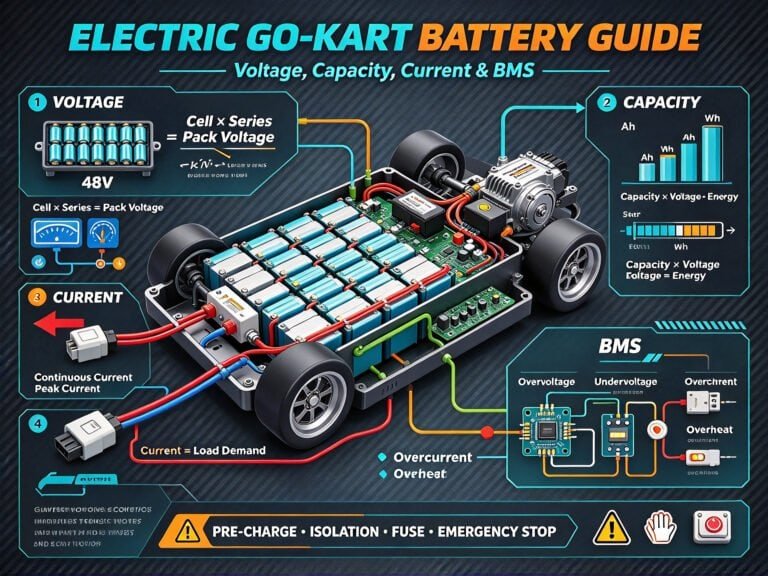
How to Convert a Golf Cart from Lead-Acid Batteries to Lithium Batteries: A Practical Guide

Golf carts have traditionally used lead-acid battery systems, but lithium batteries are becoming an option for golf courses, resorts, communities, industrial facilities, and private users.

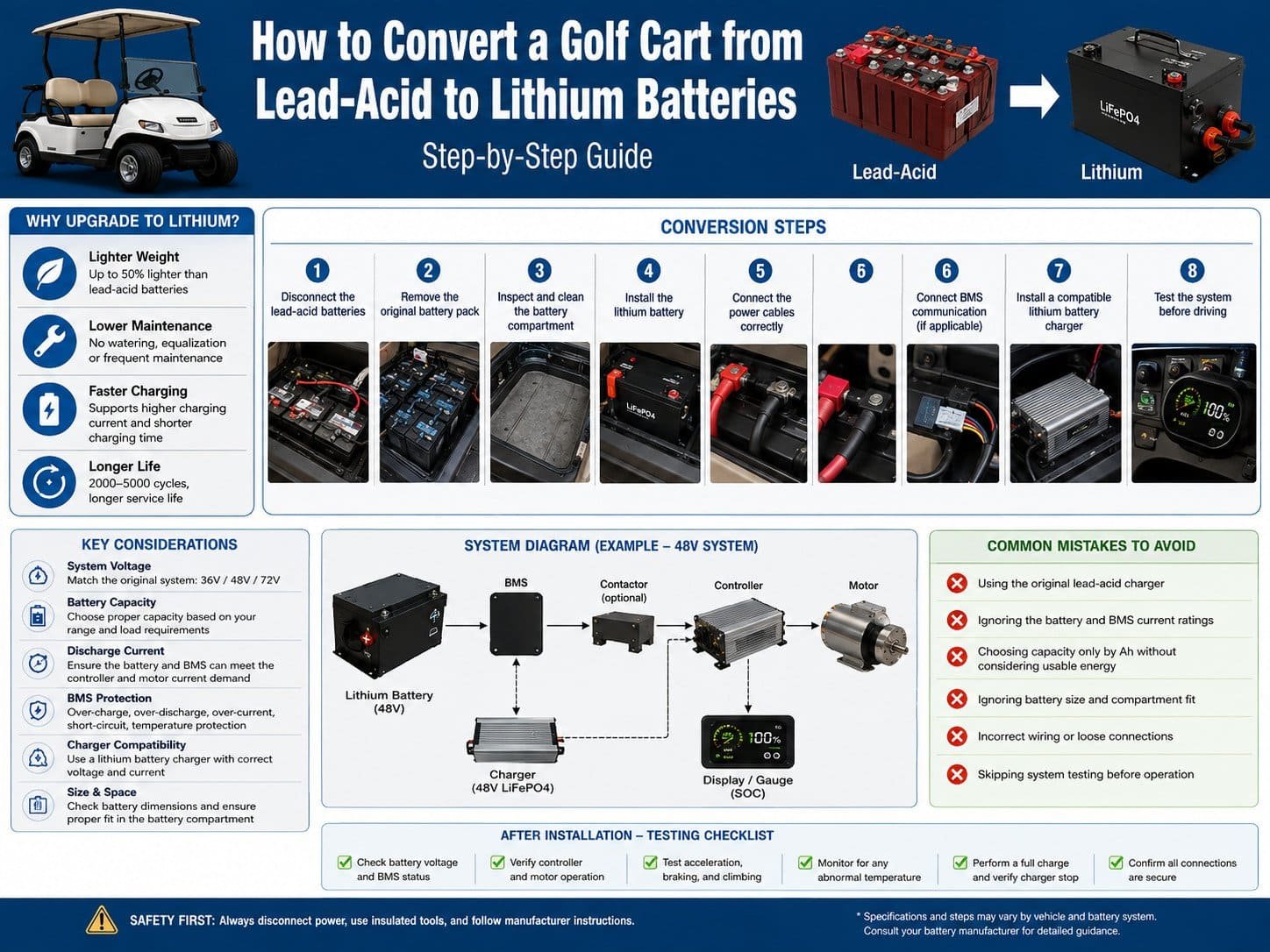
Replacing a lead-acid battery pack with a lithium battery can reduce battery weight, lower routine maintenance requirements, and provide a different charging and energy-use profile. However, a successful conversion involves more than simply removing the old batteries and installing a lithium battery pack.

Voltage, battery capacity, discharge current, BMS, charger, motor, controller, wiring, battery compartment dimensions, and vehicle operating conditions all need to be evaluated before the conversion.

Lithium battery systems for golf carts are available in different voltage platforms, including 36V, 48V, and 72V. The appropriate configuration depends on the original vehicle design and the requirements of the application.

Golf Cart from Lead Acid to Lithium Batteries

Part 1. Why Convert a Golf Cart from Lead-Acid to Lithium?

A lithium battery conversion can offer several practical benefits, depending on the vehicle and operating conditions.

1.1 Lower Battery Weight

Lead-acid battery packs are relatively heavy. Lithium batteries generally provide higher energy density, so a lithium battery pack with a suitable energy capacity can reduce the overall battery weight.

Reducing battery weight may affect acceleration, climbing performance, and energy consumption. However, the actual result also depends on the motor, controller, vehicle load, tires, terrain, and driving conditions.

1.2 Lower Routine Maintenance Requirements

Traditional lead-acid batteries may require regular inspection of electrolyte levels, terminals, corrosion, and battery connections.

Lithium battery packs are normally enclosed systems equipped with a Battery Management System (BMS). This reduces some of the routine maintenance associated with conventional flooded lead-acid batteries.

1.3 Different Charging Characteristics

Lithium batteries can support charging systems designed specifically for their chemistry and operating requirements.

However, an existing lead-acid charger should not automatically be used with a lithium battery.

The charger should be selected according to the lithium battery manufacturer’s specifications, including charging voltage, charging current, charging profile, and compatibility with the BMS.


Part 2. Check the Golf Cart’s Electrical System Before Conversion

Before purchasing a lithium battery, identify the specifications of the existing golf cart.

At minimum, check the following parameters:

パラメータ Information to Check
System voltage 36V / 48V / 72V
Original battery type Lead-acid, AGM, etc.
Original capacity Ah
モーター出力 W / kW
Controller current A
Original charger Output voltage and current
Battery compartment Length × width × height
Battery configuration Series / parallel
Vehicle application Golf course, community transport, industrial use, etc.
車両積載量 Passengers and cargo
動作環境 Flat terrain, slopes, high or low temperatures, etc.

System Voltage Is the First Parameter to Confirm

If the original golf cart uses a 48V electrical system, a lithium battery designed for the same voltage platform is normally the starting point for evaluation.

Do not select a battery only according to its capacity.

The voltage, current capability, BMS, charger, controller, and motor must work as a compatible system.


Part 3. Choose an Appropriate Lithium Battery Chemistry

Different lithium battery chemistries are available for electric vehicle applications.

LiFePO4, or lithium iron phosphate, is one commonly used chemistry for golf carts and other low-speed electric vehicles.

LiFePO4 batteries are characterized by good thermal stability and suitable cycle performance for applications that require repeated charging and discharging.

When selecting a battery for a golf cart conversion, the key question is not simply which chemistry is “better.”

Instead, evaluate whether the battery meets the actual requirements of the vehicle.

Important parameters include:

  • バッテリー電圧
  • 定格容量
  • 連続放電電流
  • ピーク放電電流
  • BMS protection parameters
  • バッテリー寸法
  • Charger compatibility
  • 動作温度
  • 通信要件

The battery should be evaluated as part of the complete vehicle power system.


Part 4. How to Choose the Right Lithium Battery Capacity

Battery capacity directly affects the available energy and potential driving range.

例えば、こうだ:

48V × 100Ah ≈ 4.8kWh

A 48V 105Ah battery provides approximately:

48V × 105Ah ≈ 5.04kWh

These calculations represent nominal energy. Actual usable energy and driving range will vary.

Golf cart range can be affected by:

  • Vehicle weight
  • Passenger load
  • 走行速度
  • Terrain and slope
  • Motor efficiency
  • Controller settings
  • Tire pressure
  • Ambient temperature
  • Battery condition
  • Driving habits

For this reason, the capacity of a lithium battery should not be selected simply by matching the Ah rating of the original lead-acid battery.

The evaluation should consider usable energy and the vehicle’s actual operating requirements.


Part 5. Why Is the BMS Important for a Lithium Golf Cart Battery?

A Battery Management System, or BMS, is an important part of a lithium battery pack.

Unlike conventional lead-acid batteries, lithium battery packs require electronic monitoring and protection to manage the cells within the pack.

Depending on the design, a BMS can provide functions such as:

  • Cell voltage monitoring
  • Pack voltage monitoring
  • 過充電保護
  • 過放電保護
  • 過電流保護
  • 短絡保護
  • 温度モニタリング
  • 過熱保護
  • セルバランシング
  • 充電状態(SOC)の推定

Pay Attention to Discharge Current

Golf carts can require relatively high current during acceleration, hill climbing, or heavy-load operation.

Therefore, the BMS should not only meet the normal operating current. Its continuous and peak discharge ratings should also be evaluated against the controller and motor requirements.

If the BMS cannot supply the required current, the vehicle may experience:

  • Reduced acceleration
  • Reduced climbing performance
  • BMS protection activation
  • Temporary power interruption
  • Battery alarms

For this reason, a specification such as 48V 100Ah is not enough to determine whether a battery is suitable.

The continuous and peak discharge current should also be checked.


Part 6. Does the Original Charger Need to Be Replaced?

In many lithium battery conversions, the original lead-acid charger needs to be replaced with a charger designed for the lithium battery system.

Lead-acid and lithium batteries use different charging characteristics.

Therefore, a 48V lead-acid charger should not automatically be considered suitable for a 48V lithium battery.

Before selecting a charger, verify:

  • Charger output voltage
  • Maximum charging current
  • Charging profile
  • BMS compatibility
  • 通信要件
  • Connector configuration

Some lithium battery systems can communicate with chargers or vehicle systems through interfaces such as CAN or RS485.

Whether communication is required depends on the battery, charger, and vehicle architecture.

The battery, BMS, and charger should therefore be evaluated as a complete charging system.


Part 7. Do the Motor and Controller Need to Be Replaced?

必ずしもそうではない。.

If the replacement lithium battery uses the same system voltage and its current characteristics are compatible with the existing controller and motor, some golf carts can retain their original motor and controller.

For example, a 48V lithium battery may be used as a replacement for an existing 48V lead-acid battery system when the electrical specifications are compatible.

However, changing the system voltage is a different situation.

If a golf cart is changed from 48V to 72V, the entire electrical system needs to be evaluated.

This may include:

  • Motor rated voltage
  • Controller rated voltage
  • Controller current rating
  • DC-DC converter
  • Instrument panel
  • Contactors
  • Relays
  • Fuses
  • Wiring
  • Other electrical components

Increasing battery voltage simply to increase vehicle speed is not recommended unless the complete power system has been designed and validated for the new voltage.


Part 8. Step-by-Step Golf Cart Lithium Battery Conversion

Once the vehicle specifications have been confirmed, the conversion can be planned systematically.

Step 1: Disconnect the Original Lead-Acid Battery

Turn off the vehicle and follow the manufacturer’s service procedures before disconnecting the battery.

Lead-acid batteries can be heavy, so appropriate handling equipment and precautions should be used.

Avoid short circuits when working around battery terminals.

Step 2: Remove the Original Battery Pack

Before removing the batteries, record the original:

  • Series connections
  • Positive and negative terminal positions
  • Cable routing
  • Cable specifications
  • Terminal locations

Taking photos before disassembly can help during installation.

Step 3: Inspect the Battery Compartment

Clean and inspect the battery compartment.

Check for:

  • 腐食
  • Damaged battery trays
  • Aging cables
  • Damaged terminals
  • Loose mounting components
  • スペースの制限

Then compare the available space with the dimensions of the lithium battery.

Step 4: Install the Lithium Battery

Place the lithium battery into the battery compartment.

The battery should be securely mounted so that it does not move excessively during acceleration, braking, or operation on uneven terrain.

Step 5: Connect the Main Power Cables

Connect the positive and negative cables according to the battery manufacturer’s wiring instructions.

確認:

  • Cable cross-sectional area
  • Fuse rating
  • Terminal condition
  • Polarity
  • Connection torque

Use appropriate insulated tools when working on high-current battery connections.

Step 6: Connect the BMS Communication System

If the battery uses CAN, RS485, UART, or another communication interface, connect the system according to the manufacturer’s wiring diagram.

Not every golf cart requires communication between the battery and vehicle.

The requirement depends on the battery and vehicle architecture.

Step 7: Install the Compatible Charger

Install a charger that matches the lithium battery’s voltage, current, and charging requirements.

Verify the charging parameters before the first charging cycle.

Step 8: Perform Initial Testing

After installation, check:

  • バッテリー電圧
  • BMS status
  • SOC reading
  • Controller status
  • Charging status
  • Accelerator response
  • Brake operation

Perform an initial low-speed test before normal operation.


Part 9. What Should Be Tested After Conversion?

A converted golf cart should not immediately be placed into long-distance or heavy-load operation.

Testing can be performed in several stages.

Static Testing

確認:

  • バッテリー電圧
  • BMS status
  • Alarm status
  • Terminal temperature
  • ケーブルの接続
  • Fuse condition

No-Load Testing

Operate the vehicle at low speed and check:

  • 加速
  • Motor noise
  • BMS alarms
  • Instrument display
  • SOC indication

Load Testing

Gradually increase the operating load.

Evaluate the vehicle under:

  • Passenger load
  • Cargo load
  • Inclines
  • 加速

Monitor battery current and voltage during these conditions.

Charging Testing

Perform a complete charging test.

確認:

  • Charger startup
  • 充電電流
  • BMS operation
  • バッテリー温度
  • Charging termination

Any abnormal voltage, temperature, communication, or protection behavior should be investigated before normal operation.


Part 10. Common Mistakes When Converting from Lead-Acid to Lithium

Mistake 1: Looking Only at Voltage

Two batteries can both be rated at 48V while having very different current capabilities.

The battery’s continuous and peak discharge ratings should be compared with the vehicle’s requirements.

Mistake 2: Reusing the Lead-Acid Charger

A charger designed for lead-acid batteries may not have the appropriate charging profile for a lithium battery.

Use a charger specified for the lithium battery system.

Mistake 3: Comparing Batteries Only by Ah

The same Ah rating does not necessarily mean the same usable energy or operating performance between lead-acid and lithium batteries.

Consider nominal energy, usable capacity, discharge conditions, and vehicle requirements.

Mistake 4: Ignoring Battery Dimensions

Lithium batteries may be lighter than lead-acid batteries, but their physical dimensions vary between models.

Measure the available battery compartment before selecting a replacement.

The key dimensions are:

Length × Width × Height

Mistake 5: Ignoring the BMS

The BMS is an important part of a lithium battery system.

Its voltage, current, temperature, protection, and communication parameters should be appropriate for the vehicle.


Part 11. How to Design a Custom Lithium Battery for a Golf Cart

Golf cart manufacturers, fleet operators, and conversion companies may require a battery pack designed around a specific vehicle platform.

A custom lithium battery can be configured according to several parameters.

電圧

Common voltage platforms include:

  • 36V
  • 48V
  • 51.2V
  • 72V

The actual voltage should match the vehicle’s electrical system.

定員

Battery capacity can be selected according to the required operating range.

Examples include:

  • 60Ah
  • 80Ah
  • 100Ah
  • 105Ah
  • 120Ah
  • 150Ah

The appropriate capacity should be determined from the vehicle load, expected operating time, charging schedule, and available installation space.

ビーエムエス

The BMS can be configured according to the electrical and communication requirements of the vehicle.

Possible functions include:

  • スマートBMS
  • CAN
  • RS485
  • UART
  • SOC monitoring
  • ブルートゥース・モニタリング
  • 温度モニタリング

機械設計

The battery enclosure can also be designed around the available installation space.

Possible configurations include:

  • Single battery pack
  • Modular battery system
  • Slide-in battery
  • Protective battery enclosure
  • Custom mounting brackets

For fleet applications, additional functions such as battery data monitoring, fault records, and maintenance management may also be considered.


12. Is Converting a Golf Cart to Lithium Worth It?

Whether a lithium conversion is worthwhile depends on how the golf cart is used.

For vehicles that operate frequently or require repeated charging, lithium batteries may provide advantages in terms of weight, maintenance requirements, and charging characteristics.

For example, golf resort fleet conversion projects have used 48V 105Ah lithium battery systems to replace lead-acid batteries in golf carts. The actual benefits of such a conversion depend on the vehicle configuration, operating conditions, battery system, and fleet management practices.

For individual golf cart owners, the decision can be evaluated by comparing:

Battery cost + charger cost + installation cost + expected service life

with the expected cost of continuing to use and replace lead-acid batteries.

Other factors should also be considered, including vehicle condition, daily operating hours, charging infrastructure, and expected annual mileage.


結論

Converting a golf cart from lead-acid batteries to lithium batteries involves more than replacing one battery chemistry with another.

A complete conversion should consider:

Voltage → Capacity → Discharge Current → BMS → Charger → Controller → Motor → Battery Compartment → Wiring → Safety Testing

For a 48V golf cart, using a lithium battery designed for the same voltage platform may simplify the conversion when the battery, BMS, charger, controller, and motor are electrically compatible.

However, changing the system voltage or significantly increasing power requirements requires a broader evaluation of the vehicle’s electrical and mechanical systems.

For golf cart manufacturers and conversion companies, a customized LiFePO4 battery pack can be designed around specific requirements such as battery compartment dimensions, capacity, discharge current, BMS communication, charging requirements, and vehicle operating conditions.

The key to a successful conversion is not simply choosing a battery with the right voltage and capacity. It is ensuring that the battery and the complete golf cart power system are properly matched and tested.

Frequently Asked Questions

Can I replace lead-acid batteries with lithium batteries in a golf cart?

In many cases, yes. However, the replacement battery must be compatible with the golf cart’s system voltage, current requirements, charger, controller, motor, battery compartment, and wiring.

Can I use the original charger with a lithium battery?

Do not assume that the original lead-acid charger is compatible. Check the lithium battery manufacturer’s charging requirements and use a compatible charger.

Is LiFePO4 suitable for golf carts?

LiFePO4 is a commonly used lithium battery chemistry for golf carts and other low-speed electric vehicles. Its suitability depends on the specific vehicle and operating requirements.

Does a lithium conversion require a new motor?

Not necessarily. If the lithium battery uses the same system voltage and is compatible with the existing controller and motor, the original motor may be retained.

Does the golf cart controller need to be replaced?

It depends on the battery voltage, discharge current, controller specifications, and vehicle design. A controller evaluation is particularly important when changing the system voltage.

How do I choose the capacity of a golf cart lithium battery?

Consider the required driving range, vehicle load, operating conditions, charging schedule, available installation space, and motor power. Do not select capacity based only on the Ah rating of the original lead-acid batteries.

What information is needed to customize a golf cart lithium battery?

A battery manufacturer will typically need information such as system voltage, desired capacity, motor power, controller current, battery compartment dimensions, connector type, communication requirements, charger specifications, and intended operating environment.

Learn how warehouse managers can choose the right forklift battery based on voltage, capacity, discharge current, BMS, charging, dimensions, safety, and total cost.
2026-08-17
+
Learn how to convert a golf cart from lead-acid to lithium batteries, including voltage, capacity, BMS, charger, controller, installation, and safety testing.
2026-08-17
+
Custom lithium battery packs for AGV, AMR and agricultural robots. OEM/ODM battery solutions with LiFePO4 and lithium-ion cells, smart BMS, customized voltage, capacity and communication.
2026-08-15
+
Learn how to customize a lithium battery for an electric forklift, including voltage, capacity, cell selection, BMS, dimensions, connectors, charging, communication, and safety requirements.
2026-08-14
+