
Les voiturettes de golf fonctionnent traditionnellement avec des batteries au plomb, mais les batteries au lithium constituent désormais une alternative pour les parcours de golf, les complexes touristiques, les collectivités, les sites industriels et les particuliers.
Le remplacement d'un bloc-batterie au plomb par une batterie au lithium permet de réduire le poids de la batterie, de limiter les besoins en entretien courant et d'offrir un profil de charge et de consommation d'énergie différent. Cependant, pour que cette conversion soit réussie, il ne suffit pas de simplement retirer les anciennes batteries et d'installer un bloc-batterie au lithium.
La tension, la capacité de la batterie, le courant de décharge, le système de gestion de la batterie (BMS), le chargeur, le moteur, le variateur, le câblage, les dimensions du compartiment de la batterie et les conditions d'utilisation du véhicule doivent tous être évalués avant la conversion.
Les systèmes de batteries au lithium destinés aux voiturettes de golf sont disponibles en différentes tensions, notamment 36 V, 48 V et 72 V. La configuration appropriée dépend de la conception d'origine du véhicule et des exigences de l'application.
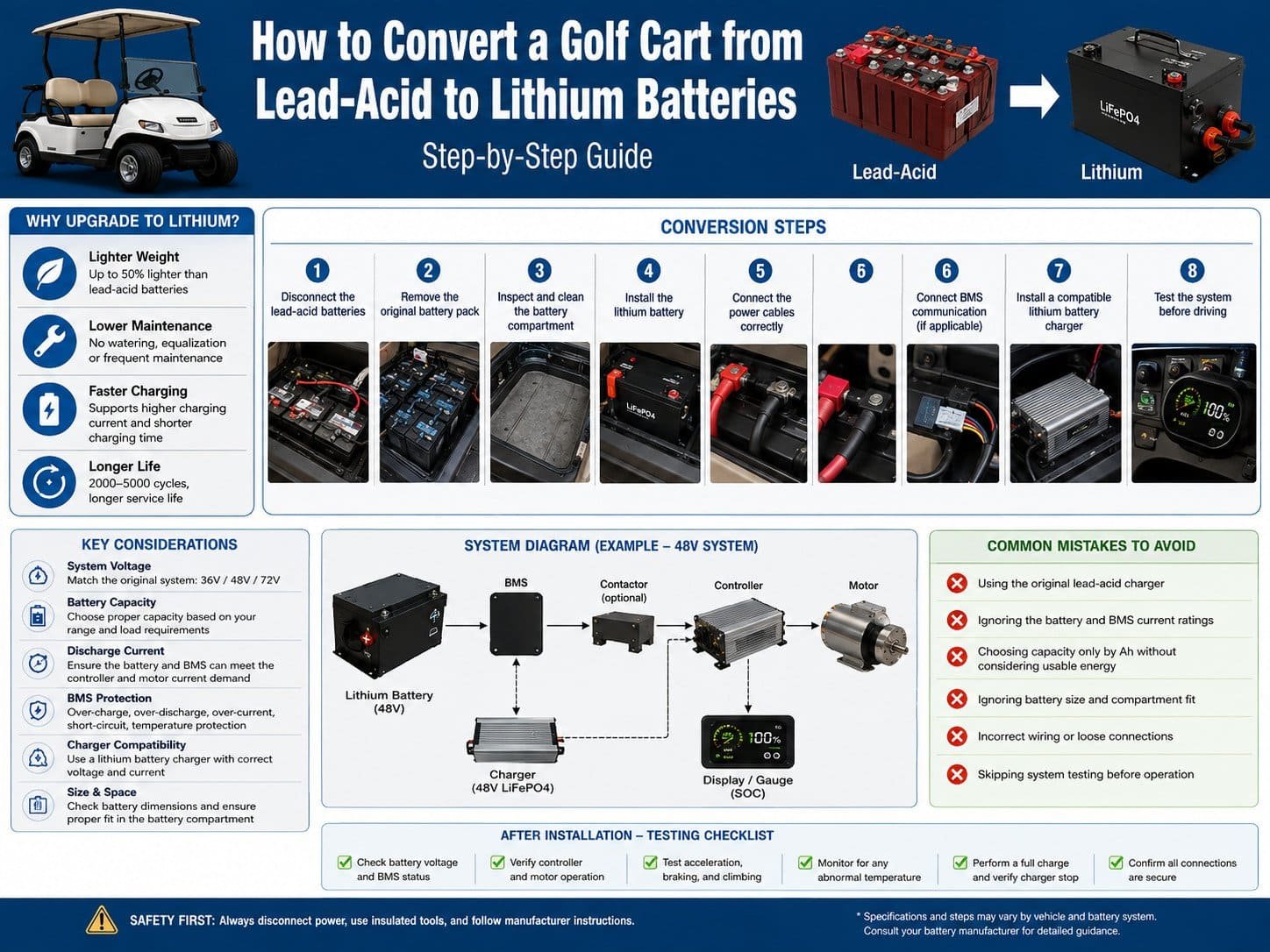
1re partie. Pourquoi passer d'une batterie au plomb à une batterie au lithium pour une voiturette de golf ?
La conversion à une batterie au lithium peut offrir plusieurs avantages pratiques, en fonction du véhicule et des conditions d'utilisation.
1.1 Poids réduit de la batterie
Les batteries au plomb sont relativement lourdes. Les batteries au lithium offrent généralement une densité énergétique plus élevée ; ainsi, une batterie au lithium dotée d'une capacité énergétique adaptée permet de réduire le poids total de la batterie.
La réduction du poids de la batterie peut avoir une incidence sur l'accélération, les performances en montée et la consommation d'énergie. Toutefois, le résultat concret dépend également du moteur, du boîtier électronique, de la charge du véhicule, des pneus, du terrain et des conditions de conduite.
1.2 Besoins réduits en matière d'entretien courant
Les batteries au plomb traditionnelles peuvent nécessiter une vérification régulière du niveau d'électrolyte, des bornes, de la corrosion et des connexions de la batterie.
Les batteries au lithium sont généralement des systèmes fermés équipés d'un système de gestion de batterie (BMS). Cela permet de réduire une partie de l'entretien régulier associé aux batteries au plomb-acide à électrolyte liquide classiques.
1.3 Différentes caractéristiques de charge
Les batteries au lithium peuvent être associées à des systèmes de recharge spécialement conçus pour leur composition chimique et leurs exigences de fonctionnement.
Cependant, un chargeur pour batteries au plomb existant ne doit pas être utilisé systématiquement avec une batterie au lithium.
Le chargeur doit être choisi en fonction des spécifications du fabricant de la batterie au lithium, notamment la tension de charge, le courant de charge, le profil de charge et la compatibilité avec le BMS.
2e partie. Vérification du système électrique de la voiturette de golf avant la conversion
Avant d'acheter une batterie au lithium, vérifiez les caractéristiques techniques de la voiturette de golf dont vous disposez.
Vérifiez au minimum les paramètres suivants :
| Paramètres | Informations à vérifier |
|---|---|
| Tension du système | 36 V / 48 V / 72 V |
| Type de batterie d'origine | Plomb-acide, AGM, etc. |
| Capacité d'origine | Ah |
| Puissance du moteur | W / kW |
| Courant du contrôleur | A |
| Chargeur d'origine | Tension et courant de sortie |
| Compartiment à piles | Longueur × largeur × hauteur |
| Configuration de la batterie | En série / en parallèle |
| Application automobile | Parcours de golf, transports collectifs, usage industriel, etc. |
| Charge du véhicule | Passagers et fret |
| Environnement opérationnel | Terrain plat, pentes, températures élevées ou basses, etc. |
La tension du système est le premier paramètre à vérifier
Si la voiturette de golf d'origine est équipée d'un système électrique de 48 V, une batterie au lithium conçue pour la même tension constitue généralement le point de départ de l'évaluation.
Ne choisissez pas une batterie uniquement en fonction de sa capacité.
La tension, la capacité de courant, le BMS, le chargeur, le contrôleur et le moteur doivent fonctionner comme un système cohérent.
3e partie. Choisir une composition chimique adaptée pour une batterie au lithium
Il existe différentes compositions chimiques de batteries au lithium destinées aux véhicules électriques.
Le LiFePO₄, ou phosphate de fer lithié, est une composition chimique couramment utilisée pour les voiturettes de golf et autres véhicules électriques à faible vitesse.
Les batteries LiFePO4 se caractérisent par une bonne stabilité thermique et des performances de cycle adaptées aux applications nécessitant des cycles répétés de charge et de décharge.
Lorsqu'on choisit une batterie pour la conversion d'une voiturette de golf, la question essentielle n'est pas simplement de savoir quelle composition chimique est “ la meilleure ”.”
Vérifiez plutôt si la batterie répond aux exigences réelles du véhicule.
Parmi les paramètres importants, on peut citer :
- Tension de la batterie
- Capacité nominale
- Courant de décharge continu
- Courant de décharge maximal
- Paramètres de protection du BMS
- Dimensions de la batterie
- Compatibilité des chargeurs
- Température de fonctionnement
- Exigences en matière de communication
La batterie doit être évaluée dans le cadre du système d'alimentation électrique complet du véhicule.
4e partie. Comment choisir la bonne capacité pour une batterie au lithium
La capacité de la batterie influe directement sur l'énergie disponible et l'autonomie potentielle.
Par exemple :
48 V × 100 Ah ≈ 4,8 kWh
Une batterie de 48 V et 105 Ah offre environ :
48 V × 105 Ah ≈ 5,04 kWh
Ces calculs correspondent à l'énergie nominale. L'énergie réellement utilisable et l'autonomie peuvent varier.
L'autonomie d'une voiturette de golf peut être influencée par :
- Poids du véhicule
- Nombre de passagers
- Vitesse de conduite
- Relief et pente
- Rendement du moteur
- Paramètres du contrôleur
- Pression des pneus
- Température ambiante
- État de la batterie
- Habitudes de conduite
C'est pourquoi la capacité d'une batterie au lithium ne doit pas être choisie simplement en s'alignant sur la capacité en Ah de la batterie au plomb d'origine.
L'évaluation doit tenir compte de l'énergie utile et des besoins réels de fonctionnement du véhicule.
Partie 5. Pourquoi le BMS est-il important pour une batterie au lithium destinée à une voiturette de golf ?
Un système de gestion de batterie (ou BMS) est un élément essentiel d'un bloc-batterie au lithium.
Contrairement aux batteries plomb-acide classiques, les packs de batteries au lithium nécessitent un système de surveillance et de protection électronique pour gérer les cellules qu'ils contiennent.
Selon sa conception, un BMS peut offrir des fonctionnalités telles que :
- Surveillance du potentiel cellulaire
- Surveillance de la tension du bloc-batterie
- Protection contre les surcharges
- Protection contre la surcharge
- Protection contre les surintensités
- Protection contre les courts-circuits
- Contrôle de la température
- Protection contre la surchauffe
- Équilibre cellulaire
- Estimation de l'état de charge (SOC)
Faites attention au courant de décharge
Les voiturettes de golf peuvent nécessiter un courant relativement élevé lors des accélérations, des montées ou lorsqu'elles transportent de lourdes charges.
Par conséquent, le BMS ne doit pas seulement être adapté au courant de fonctionnement normal. Ses capacités de décharge en continu et de pointe doivent également être évaluées au regard des exigences du variateur et du moteur.
Si le système de gestion de la batterie (BMS) n'est pas en mesure de fournir le courant requis, le véhicule peut présenter les problèmes suivants :
- Accélération réduite
- Performances en montée réduites
- Activation de la protection BMS
- Coupure temporaire de courant
- Alarmes de batterie
C'est pourquoi une spécification telle que 48 V 100 Ah Cela ne suffit pas pour déterminer si une batterie est adaptée.
Il convient également de vérifier le courant de décharge continu et le courant de décharge de pointe.
Partie 6. Faut-il remplacer le chargeur d'origine ?
Dans de nombreux cas de conversion à une batterie au lithium, le chargeur plomb-acide d'origine doit être remplacé par un chargeur conçu pour le système de batterie au lithium.
Les batteries au plomb et les batteries au lithium présentent des caractéristiques de charge différentes.
Par conséquent, un chargeur pour batteries au plomb de 48 V ne doit pas être automatiquement considéré comme adapté à une batterie au lithium de 48 V.
Avant de choisir un chargeur, vérifiez :
- Tension de sortie du chargeur
- Courant de charge maximal
- Profil de recharge
- Compatibilité avec le système de gestion de la batterie (BMS)
- Exigences en matière de communication
- Configuration des connecteurs
Certains systèmes de batteries au lithium peuvent communiquer avec des chargeurs ou des systèmes embarqués via des interfaces telles que CAN ou RS485.
La nécessité d'une communication dépend de la batterie, du chargeur et de l'architecture du véhicule.
La batterie, le BMS et le chargeur doivent donc être évalués en tant que système de recharge complet.
Partie 7. Faut-il remplacer le moteur et le variateur ?
Pas nécessairement.
Si la batterie au lithium de remplacement fonctionne à la même tension et que ses caractéristiques de courant sont compatibles avec le contrôleur et le moteur existants, certains voiturettes de golf peuvent conserver leur moteur et leur contrôleur d'origine.
Par exemple, une batterie au lithium de 48 V peut être utilisée pour remplacer un système existant de batteries au plomb-acide de 48 V lorsque les caractéristiques électriques sont compatibles.
En revanche, la modification de la tension du réseau est un cas à part.
Si la tension d'une voiturette de golf passe de 48 V à 72 V, il convient de procéder à une évaluation complète du système électrique.
Cela peut notamment inclure :
- Tension nominale du moteur
- Tension nominale du régulateur
- Intensité nominale du régulateur
- Convertisseur CC-CC
- Tableau de bord
- Contacteurs
- Relais
- Fusibles
- Câblage
- Autres composants électriques
Il n'est pas recommandé d'augmenter la tension de la batterie dans le seul but d'augmenter la vitesse du véhicule, à moins que l'ensemble du système d'alimentation n'ait été conçu et validé pour cette nouvelle tension.
Partie 8. Guide étape par étape pour la conversion d'une batterie au lithium d'une voiturette de golf
Une fois les caractéristiques techniques du véhicule confirmées, la transformation peut être planifiée de manière systématique.
Étape 1 : Débranchez la batterie au plomb d'origine
Coupez le moteur et respectez les procédures d'entretien indiquées par le constructeur avant de débrancher la batterie.
Les batteries au plomb peuvent être lourdes ; il convient donc d'utiliser un équipement de manutention adapté et de prendre les précautions nécessaires.
Évitez les courts-circuits lorsque vous intervenez à proximité des bornes de la batterie.
Étape 2 : Retirez la batterie d'origine
Avant de retirer les piles, notez la valeur initiale :
- Connexions en série
- Positions des bornes positive et négative
- Acheminement des câbles
- Caractéristiques techniques des câbles
- Emplacements des terminaux
Prendre des photos avant le démontage peut s'avérer utile lors du remontage.
Étape 3 : Vérifiez le compartiment à piles
Nettoyez et inspectez le compartiment à piles.
Vérifiez les points suivants :
- Corrosion
- Porte-batteries endommagés
- Câbles usés
- Bornes endommagées
- Pièces de fixation non fixées
- Limites d'espace
Comparez ensuite l'espace disponible avec les dimensions de la batterie au lithium.
Étape 4 : Installation de la batterie au lithium
Placez la pile au lithium dans le compartiment à pile.
La batterie doit être solidement fixée afin qu'elle ne bouge pas trop lors des accélérations, des freinages ou lors d'une utilisation sur un terrain accidenté.
Étape 5 : Raccordez les câbles d'alimentation principaux
Raccordez les câbles positif et négatif conformément aux instructions de câblage fournies par le fabricant de la batterie.
Vérifier :
- Section transversale du câble
- Intensité nominale du fusible
- État terminal
- Polarité
- Couple de serrage
Utilisez des outils isolés adaptés lorsque vous intervenez sur les connexions de batterie à courant élevé.
Étape 6 : Raccordement du système de communication du BMS
Si la batterie utilise une interface de communication de type CAN, RS485, UART ou autre, effectuez le raccordement du système conformément au schéma de câblage fourni par le fabricant.
Toutes les voiturettes de golf ne nécessitent pas une communication entre la batterie et le véhicule.
Cette exigence dépend de la batterie et de l'architecture du véhicule.
Étape 7 : Installez le chargeur compatible
Installez un chargeur adapté à la tension, à l'intensité et aux exigences de charge de la batterie au lithium.
Vérifiez les paramètres de charge avant le premier cycle de charge.
Étape 8 : Effectuer les premiers tests
Une fois l'installation terminée, vérifiez :
- Tension de la batterie
- État du BMS
- Lecture SOC
- État du contrôleur
- État de charge
- Réponse de l'accélérateur
- Fonctionnement des freins
Effectuez un premier essai à faible vitesse avant de passer au fonctionnement normal.
Partie 9. Que faut-il tester après la conversion ?
Une voiturette de golf transformée ne doit pas être utilisée immédiatement pour des trajets de longue distance ou le transport de charges lourdes.
Les essais peuvent être réalisés en plusieurs étapes.
Essais statiques
Vérifier :
- Tension de la batterie
- État du BMS
- État de l'alarme
- Température au niveau des bornes
- Raccordements par câble
- État du fusible
Essais à vide
Conduisez le véhicule à faible vitesse et vérifiez :
- Accélération
- Bruit du moteur
- Alarmes BMS
- Affichage des instruments
- Indication SOC
Tests de charge
Augmentez progressivement la charge de fonctionnement.
Évaluez le véhicule selon les critères suivants :
- Nombre de passagers
- Chargement
- Pentes
- Accélération
Surveillez le courant et la tension de la batterie dans ces conditions.
Tests de charge
Effectuez un test de charge complet.
Vérifier :
- Démarrage du chargeur
- Courant de charge
- Fonctionnement du BMS
- Température de la batterie
- Fin de la recharge
Tout comportement anormal au niveau de la tension, de la température, de la communication ou des dispositifs de protection doit faire l'objet d'une analyse avant la reprise du fonctionnement normal.
Partie 10. Erreurs courantes lors du passage d'une batterie au plomb à une batterie au lithium
Erreur n° 1 : ne tenir compte que de la tension
Deux batteries peuvent toutes deux avoir une tension nominale de 48 V tout en présentant des capacités de courant très différentes.
Il convient de comparer les capacités de décharge continue et de pointe de la batterie aux exigences du véhicule.
Erreur n° 2 : réutiliser le chargeur pour batteries au plomb
Un chargeur conçu pour les batteries au plomb-acide peut ne pas disposer du profil de charge adapté à une batterie au lithium.
Utilisez un chargeur adapté au système de batterie au lithium.
Erreur n° 3 : comparer les batteries uniquement en fonction de leur capacité en Ah
Une même classification « Ah » ne garantit pas nécessairement la même énergie utile ni les mêmes performances de fonctionnement entre les batteries au plomb et les batteries au lithium.
Tenez compte de la puissance nominale, de la capacité utile, des conditions de décharge et des exigences du véhicule.
Erreur n° 4 : ne pas tenir compte des dimensions de la batterie
Les batteries au lithium sont certes plus légères que les batteries au plomb, mais leurs dimensions varient d'un modèle à l'autre.
Mesurez les dimensions du compartiment à piles avant de choisir une pile de rechange.
Les principaux aspects sont les suivants :
Longueur × Largeur × Hauteur
Erreur n° 5 : ne pas tenir compte du système de gestion de batterie (BMS)
Le BMS est un élément essentiel d'un système de batterie au lithium.
Ses paramètres de tension, de courant, de température, de protection et de communication doivent être adaptés au véhicule.
Partie 11. Comment concevoir une batterie au lithium sur mesure pour une voiturette de golf
Les fabricants de voiturettes de golf, les exploitants de flottes et les entreprises spécialisées dans la conversion peuvent avoir besoin d'un bloc-batterie conçu spécialement pour une plateforme de véhicule donnée.
Une batterie au lithium sur mesure peut être configurée en fonction de plusieurs paramètres.
Tension
Parmi les plateformes de tension courantes, on peut citer :
- 36V
- 48V
- 51.2V
- 72V
La tension effective doit correspondre à celle du système électrique du véhicule.
Capacité
La capacité de la batterie peut être choisie en fonction de l'autonomie requise.
En voici quelques exemples :
- 60 Ah
- 80Ah
- 100Ah
- 105Ah
- 120 Ah
- 150Ah
La capacité appropriée doit être déterminée en fonction de la charge du véhicule, de la durée d'utilisation prévue, du programme de recharge et de l'espace disponible pour l'installation.
BMS
Le BMS peut être configuré en fonction des exigences électriques et de communication du véhicule.
Parmi les fonctions possibles, on peut citer :
- Smart BMS
- CAN
- RS485
- UART
- Surveillance du SOC
- Surveillance Bluetooth
- Contrôle de la température
Conception mécanique
Le boîtier de la batterie peut également être conçu en fonction de l'espace d'installation disponible.
Les configurations possibles sont les suivantes :
- Bloc-batterie simple
- Système de batteries modulaires
- Batterie à insérer
- Boîtier de protection pour batterie
- Supports de fixation sur mesure
Pour les applications de flotte, des fonctions supplémentaires telles que la surveillance des données relatives aux batteries, l'historique des pannes et la gestion de la maintenance peuvent également être envisagées.
12. Est-ce que ça vaut le coup de convertir une voiturette de golf au lithium ?
La pertinence d'une conversion au lithium dépend de l'utilisation qui est faite de la voiturette de golf.
Pour les véhicules qui circulent fréquemment ou qui nécessitent des recharges répétées, les batteries au lithium peuvent présenter des avantages en termes de poids, d'entretien et de caractéristiques de recharge.
Par exemple, dans le cadre de projets de conversion de flottes de véhicules de complexes de golf, des systèmes de batteries au lithium de 48 V et 105 Ah ont été utilisés pour remplacer les batteries au plomb-acide des voiturettes de golf. Les avantages concrets d’une telle conversion dépendent de la configuration du véhicule, des conditions d’exploitation, du système de batteries et des pratiques de gestion de la flotte.
Pour les particuliers propriétaires d'une voiturette de golf, cette décision peut être évaluée en comparant :
Coût de la batterie + coût du chargeur + coût d'installation + durée de vie prévue
en tenant compte du coût prévu lié à la poursuite de l'utilisation et au remplacement des batteries au plomb.
D'autres facteurs doivent également être pris en compte, notamment l'état du véhicule, les heures d'utilisation quotidiennes, les infrastructures de recharge et le kilométrage annuel prévu.
Conclusion
La conversion d'une voiturette de golf équipée de batteries au plomb-acide en batteries au lithium ne se résume pas à remplacer une technologie de batterie par une autre.
Une conversion complète doit tenir compte des éléments suivants :
Tension → Capacité → Courant de décharge → BMS → Chargeur → Contrôleur → Moteur → Compartiment de batterie → Câblage → Tests de sécurité
Pour une voiturette de golf de 48 V, l'utilisation d'une batterie au lithium conçue pour la même tension peut simplifier la conversion lorsque la batterie, le système de gestion de batterie (BMS), le chargeur, le variateur et le moteur sont électriquement compatibles.
Toutefois, modifier la tension du système ou augmenter considérablement les besoins en puissance nécessite une évaluation plus approfondie des systèmes électriques et mécaniques du véhicule.
Pour les fabricants de voiturettes de golf et les entreprises spécialisées dans la conversion, il est possible de concevoir un bloc-batterie LiFePO4 sur mesure en fonction d'exigences spécifiques telles que les dimensions du compartiment de batterie, la capacité, le courant de décharge, la communication avec le système de gestion de batterie (BMS), les exigences de charge et les conditions d'utilisation du véhicule.
La clé d'une conversion réussie ne réside pas simplement dans le choix d'une batterie présentant la tension et la capacité adéquates. Il s'agit de s'assurer que le la batterie et l'ensemble du système d'alimentation de la voiturette de golf sont correctement adaptés et testés.
Foire aux questions
Puis-je remplacer les batteries au plomb d'une voiturette de golf par des batteries au lithium ?
Dans de nombreux cas, oui. Cependant, la batterie de remplacement doit être compatible avec la tension du système de la voiturette de golf, ses besoins en courant, son chargeur, son régulateur, son moteur, son compartiment de batterie et son câblage.
Puis-je utiliser le chargeur d'origine avec une batterie au lithium ?
Ne partez pas du principe que le chargeur d'origine pour batteries au plomb est compatible. Vérifiez les consignes de charge du fabricant de la batterie au lithium et utilisez un chargeur compatible.
Le LiFePO4 est-il adapté aux voiturettes de golf ?
Le LiFePO4 est une composition chimique couramment utilisée pour les batteries au lithium destinées aux voiturettes de golf et autres véhicules électriques à faible vitesse. Son adéquation dépend du véhicule concerné et des conditions d'utilisation.
La conversion au lithium nécessite-t-elle un nouveau moteur ?
Pas nécessairement. Si la batterie au lithium utilise la même tension que le système et est compatible avec le variateur et le moteur existants, le moteur d'origine peut être conservé.
Faut-il remplacer le boîtier de commande de la voiturette de golf ?
Cela dépend de la tension de la batterie, du courant de décharge, des caractéristiques du régulateur et de la conception du véhicule. Il est particulièrement important de procéder à une évaluation du régulateur en cas de modification de la tension du système.
Comment choisir la capacité d'une batterie au lithium pour voiturette de golf ?
Tenez compte de l'autonomie requise, de la charge du véhicule, des conditions d'utilisation, du programme de recharge, de l'espace disponible pour l'installation et de la puissance du moteur. Ne choisissez pas la capacité en vous basant uniquement sur la capacité nominale en Ah des batteries au plomb d'origine.
Quelles informations faut-il fournir pour personnaliser une batterie au lithium destinée à une voiturette de golf ?
Un fabricant de batteries aura généralement besoin d'informations telles que la tension du système, la capacité souhaitée, la puissance du moteur, le courant du contrôleur, les dimensions du compartiment de la batterie, le type de connecteur, les exigences en matière de communication, les caractéristiques techniques du chargeur et l'environnement d'exploitation prévu.

 English
  Chinese
  Japanese
  German
  French
  Korean
