
Ces dernières années, les entrepôts du monde entier ont connu une transformation discrète mais profonde. Les batteries au plomb traditionnelles sont rapidement remplacées par des systèmes de batteries au lithium, notamment dans les chariots élévateurs, les véhicules à guidage automatique (AGV) et les équipements de manutention.
Cette évolution ne se limite pas à la modernisation des sources d'énergie : elle s'inscrit dans une démarche plus large visant à améliorer l'efficacité, à développer l'automatisation et à mettre en place une gestion intelligente de l'énergie dans les opérations logistiques.
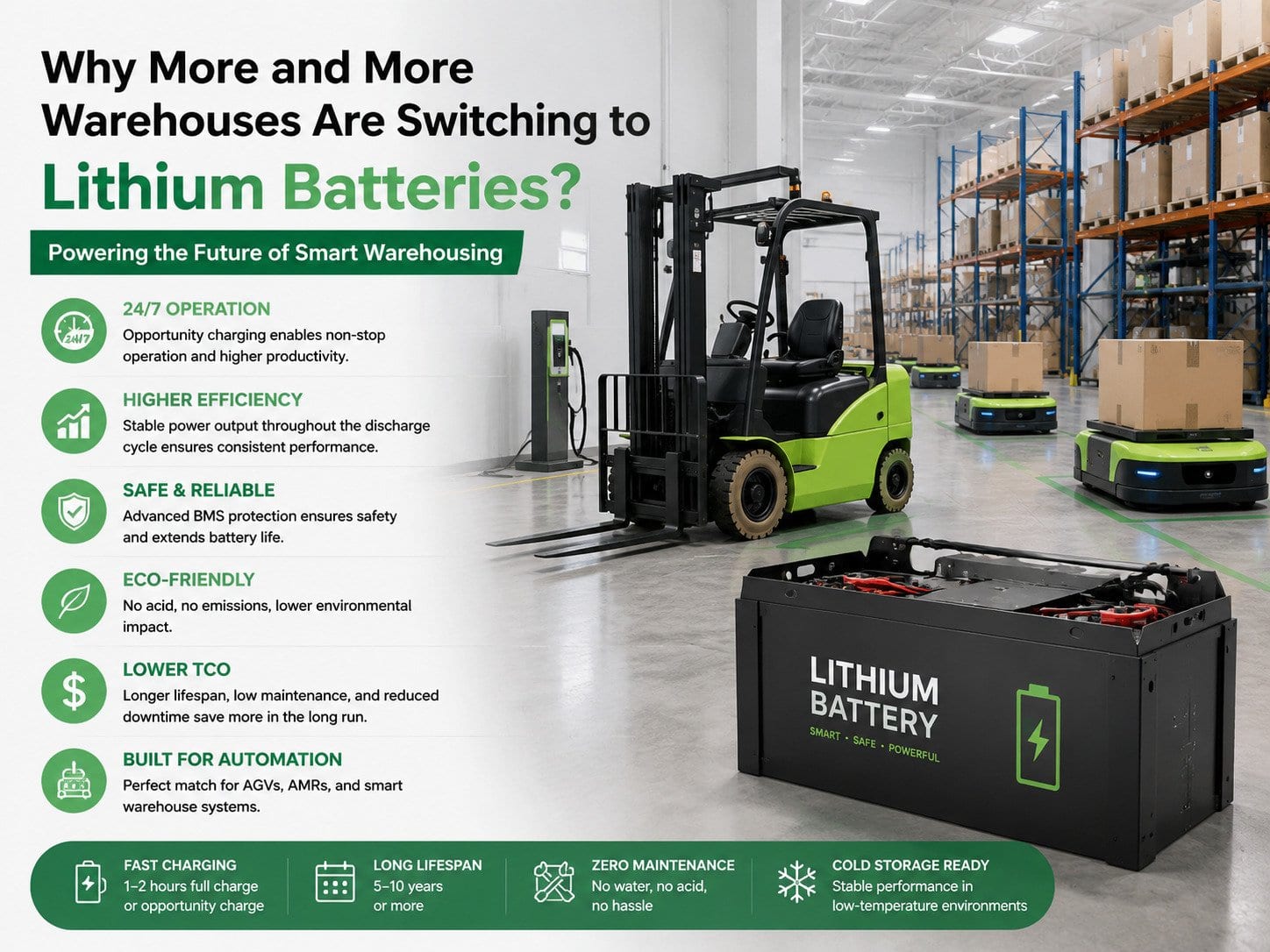
1re partie. L'essor des opérations d'entrepôt 24 h/24, 7 j/7
Les chaînes d'approvisionnement modernes, portées par le commerce électronique et les exigences de la distribution mondiale, imposent aux entrepôts de fonctionner de manière quasi continue.
Les batteries au plomb ont du mal à fonctionner dans cet environnement, car elles nécessitent :
- Cycles de charge longs (généralement 8 heures ou plus)
- Temps de refroidissement après la charge
- Salles de recharge dédiées et systèmes d'échange de batteries
Les batteries au lithium, en revanche, prennent en charge :
- Recharge occasionnelle (recharge pendant les pauses)
- Fonctionnalité de recharge rapide
- Pas besoin de remplacer la batterie pendant les services
Cela permet aux chariots élévateurs et aux équipements de rester en service plus longtemps, ce qui améliore considérablement la productivité de l'entrepôt.
Partie 2. Rendement accru et performances stables
L'un des principaux avantages des batteries au lithium réside dans leur courbe de décharge plate.
Contrairement aux batteries au plomb, qui perdent progressivement de leur puissance à mesure qu'elles se déchargent, les batteries au lithium maintiennent une tension de sortie constante tout au long de leur cycle de charge.
Il en résulte que :
- Performances stables des chariots élévateurs
- Une puissance de levage constante
- Fonctionnement fiable pour les véhicules à guidage automatique (AGV) et les systèmes automatisés
Dans les entrepôts automatisés, cette stabilité est essentielle : les machines doivent fonctionner de manière prévisible, sans perte de performance.
Partie 3. Réduction du coût total de possession (TCO)
Bien que les batteries au lithium aient un coût initial plus élevé, leur valeur à long terme est nettement supérieure.
Parmi les principaux avantages en termes de coûts, on peut citer :
- Durée de vie plus longue (souvent de 5 à 10 ans)
- Besoins d'entretien minimes
- Meilleure efficacité énergétique (moins de gaspillage d'énergie pendant la recharge)
- Pas besoin de piles de rechange ni de changer de système
Au fil du temps, les entrepôts réduisent les temps d'arrêt, les coûts de main-d'œuvre et les frais d'entretien, ce qui fait des batteries au lithium un choix plus économique à long terme.
Partie 4. La solution idéale pour l'automatisation et les entrepôts intelligents
À mesure que les entrepôts s'orientent vers l'automatisation, les batteries au lithium sont devenues la source d'énergie privilégiée pour les AGV et les AMR.
Ces systèmes nécessitent :
- Cycles fréquents de démarrage et d'arrêt
- Alimentation électrique à tension stable
- Systèmes énergétiques compacts et légers
- Surveillance de la batterie en temps réel
Grâce à leurs systèmes de gestion de batterie (BMS) intégrés, les batteries au lithium peuvent offrir :
- Contrôle en temps réel de l'état de la batterie
- Communication CAN/RS485 avec les systèmes d'entrepôt
- Contrôle et protection intelligents de la charge
Les batteries au lithium s'intègrent donc tout naturellement aux systèmes logistiques de l'Industrie 4.0.
Partie 5. Amélioration de la sécurité et de la performance environnementale
Les entrepôts modernes accordent également la priorité à la sécurité et au développement durable.
Les systèmes de batteries au lithium offrent :
- Aucune fuite d'acide ni émanations corrosives
- Réduction du risque d'incendie grâce à la protection avancée du système de gestion de batterie (BMS)
- Impact environnemental réduit par rapport aux batteries au plomb-acide
Ces caractéristiques les rendent particulièrement adaptées aux entrepôts intérieurs, aux centres de logistique alimentaire et aux installations de la chaîne du froid.
Partie 6. Excellentes performances dans les environnements de stockage frigorifique
Les entrepôts frigorifiques posent un défi particulier aux batteries traditionnelles.
Les batteries au plomb subissent une baisse significative de leurs performances à basse température, tandis que les systèmes de batteries au lithium — en particulier ceux conçus pour les environnements froids — conservent des performances stables.
Les avantages comprennent
- Démarrage fiable à basse température
- Décharge stable dans les environnements froids
- Intégration d'un système de chauffage en option pour les conditions extrêmes
Les batteries au lithium sont donc idéales pour la logistique de la chaîne du froid et les installations de stockage réfrigérées.
Conclusion : Des systèmes énergétiques nécessitant beaucoup d'entretien aux systèmes énergétiques intelligents
Le passage des batteries au plomb-acide aux batteries au lithium dans les entrepôts n'est pas seulement une mise à niveau : il s'agit d'une véritable transformation de la gestion de l'énergie.
Les entrepôts ne dépendent plus de la gestion et de l'entretien manuels des batteries. Ils évoluent désormais vers des écosystèmes énergétiques intelligents et automatisés, alimentés par des systèmes de batteries au lithium intelligents.
En termes simples :
Les entrepôts passent de la “ maintenance des batteries ” à l“” intelligence énergétique ».”
Vous recherchez des solutions sur mesure pour le stockage de batteries au lithium ?
Nous proposons des systèmes de batteries au lithium sur mesure pour :
- Chariots élévateurs
- AGV / AMR
- Équipements de logistique d'entrepôt
- Systèmes d'automatisation industrielle
Grâce à nos capacités OEM/ODM, à l'intégration de systèmes de gestion de batterie (BMS) intelligents et à notre accompagnement en matière de certifications internationales, nous aidons les entrepôts à passer à la nouvelle génération de systèmes énergétiques.
FAQ
Q1 : Pourquoi les entrepôts adoptent-ils les batteries au lithium ?
En effet, les batteries au lithium offrent une recharge plus rapide, une durée de vie plus longue, moins d'entretien et une meilleure compatibilité avec les systèmes d'automatisation tels que les AGV.
Q2 : Les batteries au lithium sont-elles plus performantes que les batteries au plomb pour les chariots élévateurs ?
Oui. Les batteries au lithium offrent une puissance de sortie stable, une durée de vie plus longue et ne nécessitent aucun entretien, ce qui les rend plus efficaces pour l'exploitation de chariots élévateurs en plusieurs équipes.
Q3 : Quelle est la durée de vie des batteries au lithium utilisées dans les entrepôts ?
En général, entre 5 et 10 ans, en fonction de l'utilisation, du nombre de cycles de charge et de la qualité du système de gestion de la batterie.
Q4 : Les batteries au lithium peuvent-elles être utilisées dans les véhicules à guidage automatique (AGV) et les robots d'entrepôt ?
Oui. Les batteries au lithium constituent la source d'alimentation privilégiée pour les AGV et les AMR en raison de leur recharge rapide et de leurs capacités de communication intelligentes via le système de gestion de batterie (BMS).
Q5 : Les batteries au lithium sont-elles sûres pour une utilisation en entrepôt ?
Oui. Lorsqu'elles sont équipées d'un système BMS adapté, les batteries au lithium intègrent plusieurs niveaux de protection, notamment contre les surtensions, les surintensités et les températures excessives.
 English
  Chinese
  Japanese
  German
  French
  Korean
