
Logistics robots are increasingly used for material transportation, warehouse operations, production-line logistics, sorting, and automated handling.
These robots depend on a reliable power system to operate drive motors, controllers, sensors, industrial computers, communication modules, lifting mechanisms, and safety systems.
A logistics robot battery is therefore more than a group of lithium cells. It is an integrated power system that may include battery cells, a Battery Management System (BMS), protection components, temperature sensors, busbars, connectors, wiring harnesses, and a custom enclosure.
For an OEM logistics robot manufacturer, battery selection should be based on the complete equipment requirements. Voltage and capacity are important, but current, operating cycle, charging method, communication protocol, dimensions, temperature, and mechanical installation also need to be evaluated.
This guide explains the engineering considerations involved in selecting and customizing lithium battery packs for logistics robots.
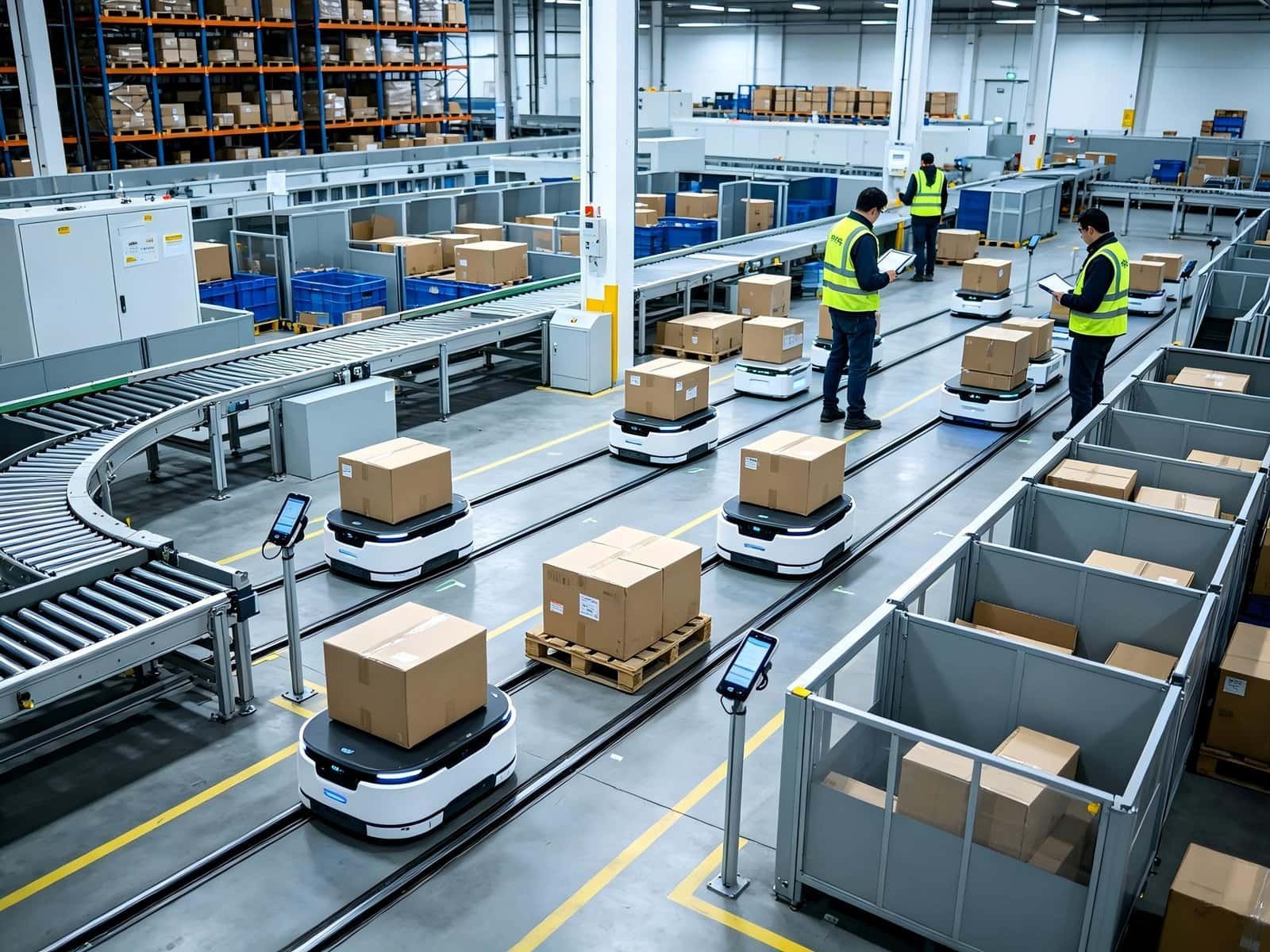
What Is a Logistics Robot Battery?
A logistics robot battery is a rechargeable battery pack designed to provide electrical power to robots used in warehouses, factories, distribution centers, and internal logistics systems.
Depending on the robot architecture, the battery can supply power to:
- Moteurs d'entraînement
- Lifting motors
- Motor controllers
- Industrial computers
- LiDAR
- Appareils photo
- Navigation sensors
- Safety sensors
- Wireless communication systems
- Systèmes de contrôle
- Displays and indicators
Different logistics robots have different power requirements.
For example, a mobile transport robot may primarily require power for traction, while a robot with lifting functions may have additional peak power requirements.
The battery configuration should therefore be developed according to the robot’s actual operating profile.
Lithium Battery Applications for Logistics Robots
Lithium battery packs can be designed for several types of automated logistics equipment.
Warehouse Robots
Warehouse robots can use lithium batteries for transportation, sorting, picking assistance, and internal material movement.
AGV
Automated Guided Vehicles use battery power for driving, control systems, sensors, and communication.
AMR
Autonomous Mobile Robots may require power for drive motors, navigation systems, LiDAR, cameras, computers, and wireless communication.
Automated Handling Robots
Robotic handling platforms may require additional power for lifting or material handling mechanisms.
Mobile Inspection Robots
Inspection robots may use battery power for movement, cameras, sensors, computers, and communication systems.
Each application requires a battery configuration based on its own electrical and mechanical specifications.
LiFePO4 Battery for Logistics Robots
LiFePO4, also known as lithium iron phosphate or LFP, is a lithium-ion battery chemistry that can be considered for industrial robotic applications.
LiFePO4 battery systems have characteristics including:
- Stable electrochemical behavior
- Stabilité thermique
- Rechargeable operation
- Suitability for repeated charge and discharge
- Compatibility with BMS protection systems
The battery configuration can be customized according to the required voltage and capacity.
For example, a 25.6V 100Ah LiFePO4 battery has a nominal energy of:
25.6V × 100Ah = 2,560Wh
This equals approximately:
2.56kWh
The actual usable energy depends on the battery operating window, load profile, temperature, BMS settings, and system efficiency.
Other lithium-ion chemistries may also be evaluated depending on the robot’s requirements.
How to Calculate Logistics Robot Battery Capacity
Battery capacity should be calculated from the robot’s energy requirements rather than selected only from the motor rating.
The basic formula is:
Énergie de la batterie (Wh) = Tension (V) × Capacité (Ah)
Par exemple :
48V × 50Ah = 2,400Wh
The nominal battery energy is approximately 2.4kWh.
Estimated operating time can be calculated using:
Operating Time (h) = Available Energy (Wh) ÷ Average Power Consumption (W)
If the robot consumes an average of 600W:
2,400Wh ÷ 600W = 4 hours
This is a theoretical calculation.
Actual operating time can be affected by:
- Charge utile
- Travel distance
- Vitesse de conduite
- Accélération
- Braking
- Rendement du moteur
- Floor conditions
- Lifting operations
- Sensor consumption
- Computer consumption
- Température ambiante
- Battery operating window
- Charging strategy
For an OEM project, actual operating data should be used when available.
Average Power and Peak Power Requirements
A logistics robot does not necessarily consume the same amount of power throughout its operating cycle.
Power demand may increase during:
- Motor startup
- Accélération
- Tournage
- Ramp operation
- Heavy-load transportation
- Lifting
- Rapid movement
- System startup
The battery should therefore be evaluated using both average current et peak current.
Courant continu
Continuous current refers to the current the battery needs to provide during normal operation.
Courant de crête
Peak current refers to short-duration current requirements that may occur during motor startup, acceleration, lifting, or other high-load events.
The following components should be evaluated together:
- Éléments de batterie
- BMS
- Fuse
- Busbars
- Cables
- Connecteurs
The BMS current rating should also be compatible with the robot’s operating requirements.
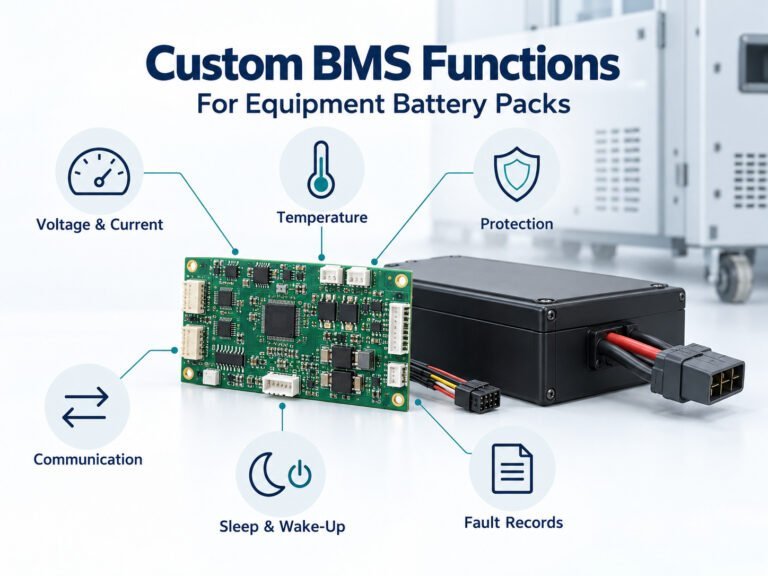
Smart BMS for Logistics Robot Battery Packs
The Battery Management System is an important component of a lithium battery pack.
A smart BMS can monitor and manage battery operating conditions.
Depending on the BMS design, monitoring functions can include:
- Individual cell voltage
- Total battery voltage
- Courant de charge
- Courant de décharge
- Température de la batterie
- Cell temperature
- État de charge (SOC)
- État de santé (SOH)
Protection functions may include:
- Protection contre les surcharges
- Protection contre la surcharge
- Protection contre les surintensités
- Protection contre les courts-circuits
- Protection contre la surchauffe
- Under-temperature protection
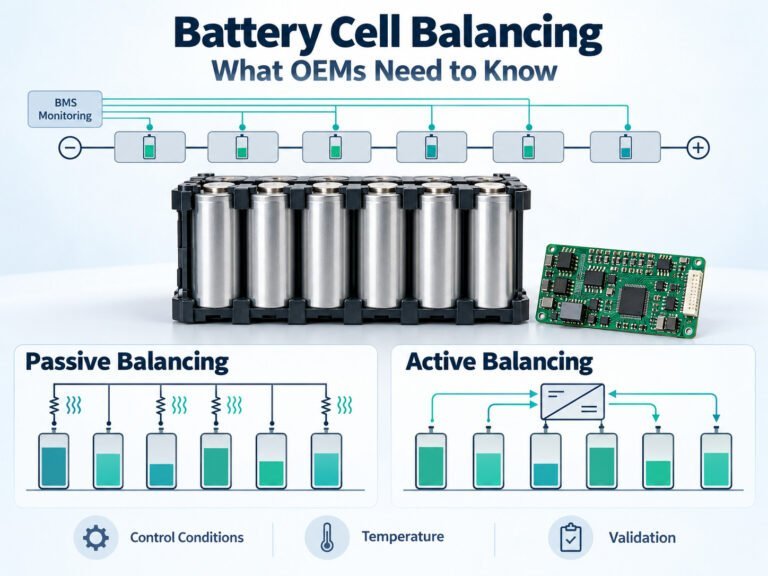
Cell balancing can also be implemented according to the battery configuration.
CAN Communication for Logistics Robot Batteries
Many industrial robots use communication between the battery and the main controller.
CAN communication can allow the BMS to transmit battery information such as:
- Tension de la batterie
- Actuel
- SOC
- Température
- État de charge
- État des défauts
- Alarm information
For an OEM logistics robot project, the communication protocol should be defined during the engineering stage.
The BMS needs to use communication parameters and data formats that are compatible with the robot controller.
If available, the customer can provide:
- CAN protocol
- CAN database file
- CAN ID information
- Data format
- Fault codes
- SOC requirements
This information can be used when configuring or developing the smart BMS.
RS485 and UART Communication
Some logistics robots use RS485 or UART instead of CAN.
Possible battery communication interfaces include:
- CAN
- RS485
- UART
- Modbus RTU
The appropriate communication interface depends on the robot’s control architecture.
For customized battery development, communication requirements may include:
- Baud rate
- Address
- Data format
- Register information
- Communication commands
- Informations sur les pannes
- SOC information
Communication testing should be completed during the prototype validation stage.
Battery Charging for Logistics Robots
The charger should be compatible with the battery chemistry and electrical configuration.
Important charging parameters include:
- Chimie des batteries
- Tension nominale
- Tension de charge
- Courant de charge
- Profil de recharge
- Type de chargeur
- Connecteur
- BMS requirements
- Exigences en matière de communication
For a custom battery project, the charger should be evaluated together with the battery.
A mismatch between the charger and battery specifications can affect charging performance and battery protection.
Charging Methods for Logistics Robots
Logistics robots can use different charging strategies depending on their operating schedule.
Chargement standard
The robot returns to a designated charging area after completing an operating cycle.
This approach can be used when the robot has sufficient operating time between charging sessions.
Recharge à la demande
The robot receives charging during idle periods.
Potential charging periods include:
- Breaks
- Waiting periods
- Shift changes
- Low-demand periods
- Automated docking
The battery should be designed according to the required charging current and charging frequency.
Automated Charging
AGVs and AMRs may automatically connect to charging stations.
The charging system may communicate with the battery BMS and robot controller.
Battery information may include:
- SOC
- État de charge
- Température
- État des défauts
- Charging permission
The battery, BMS, charger, and robot controller should be designed as a compatible system.
Custom Logistics Robot Battery Dimensions
Battery installation space is often defined by the robot’s mechanical structure.
A custom battery pack can be designed according to:
- Longueur
- Largeur
- Hauteur
- Compartiment à piles
- Points de fixation
- Emplacement du connecteur
- Sortie de câble
- Handle
- Structure de l'enceinte
For an OEM battery project, useful mechanical information includes:
- Battery compartment drawing
- 2D mechanical drawing
- 3D model
- Connector drawing
- Mounting specifications
This information can be used to develop a battery enclosure that fits the available installation space.
Battery Weight and Robot Design
Battery weight is another factor in logistics robot design.
The battery contributes to the total robot weight and may affect:
- Drive motor load
- Consommation d'énergie
- Charge utile
- Center of gravity
- Braking
- Mechanical structure
For this reason, battery capacity and battery weight should be considered together.
A battery with additional capacity also adds battery mass. The final configuration should therefore balance energy requirements with the robot’s mechanical and operational requirements.
Battery Enclosure Design
The battery enclosure protects the cells, BMS, wiring, and other electrical components.
Possible enclosure materials include:
- ABS
- PC
- Aluminum
- Steel
- Engineering plastics
The enclosure can be designed to address:
- Mechanical protection
- Dissipation thermique
- Protection contre la poussière
- Water protection
- Connector placement
- Acheminement des câbles
- Mounting
- Maintenance access
The appropriate enclosure structure depends on the robot’s working environment and mechanical requirements.
Environmental Requirements
Logistics robots can operate in different environments, including:
- Entrepôts
- Centres de distribution
- Sites de production
- Production lines
- Cold storage
- Loading areas
Potential environmental factors include:
- Température
- Humidité
- Poussière
- Eau
- Vibrations
- Choc mécanique
The battery design should define the required operating and charging temperature range.
For applications requiring protection against dust or water, an appropriate IP-rated enclosure can be considered.
The selected IP rating should be verified through applicable testing.
Safety Design for Logistics Robot Lithium Batteries
Battery safety involves multiple components and design stages.
Cell Selection
Battery cells should be evaluated according to:
- Capacité
- Tension
- Courant continu
- Courant de crête
- Résistance interne
- Exigences relatives aux cycles
- Température de fonctionnement
- Manufacturer specifications
Protection du BMS
BMS parameters should be configured according to:
- Configuration des cellules
- Tension de la batterie
- Actuel
- Température
- Conditions de recharge
- Discharging requirements
Electrical Protection
A battery pack may include:
- Fuse
- Busbar
- Circuit de protection
- Insulation
- Capteurs de température
- Rated connectors
- Appropriate cables
Thermal Design
Thermal considerations may include:
- Chimie cellulaire
- Actuel
- Operating cycle
- Température ambiante
- Enclosure
- Dissipation thermique
Mechanical Protection
The battery enclosure and mounting structure should be designed according to the vibration and mechanical conditions expected during robot operation.
Logistics Robot Battery Testing
Battery testing should be defined according to the battery design, equipment requirements, and applicable standards.
Capacity Testing
Capacity testing can verify battery performance under defined charging and discharging conditions.
BMS Testing
BMS testing may evaluate:
- Protection contre les surcharges
- Protection contre la surcharge
- Protection contre les surintensités
- Protection contre les courts-circuits
- Protection de la température
- Équilibre cellulaire
Communication Testing
For smart battery systems, testing may include:
- Communication CAN
- Communication RS485
- Communication UART
- SOC data
- Fault reporting
- État de charge
Temperature Testing
Depending on the application, testing may include:
- High-temperature operation
- Fonctionnement à basse température
- Charging at defined temperatures
- Contrôle de la température
Mechanical Testing
Depending on the equipment requirements:
- Essais de vibration
- Impact testing
- Tests des connecteurs
- Mounting testing
- Enclosure inspection
Testing requirements should be defined based on the actual battery design and intended application.
Logistics Robot Battery Certifications and Compliance
Battery certification and compliance requirements depend on:
- Chimie des batteries
- Configuration de la batterie
- Product application
- Destination market
- Transportation method
- Applicable regulations
For lithium batteries transported internationally, ONU 38.3 is an important transportation testing requirement.
Depending on the product and target market, additional requirements may include:
- CE
- Normes CEI
- Normes UL
- RoHS
- Exigences en matière de compatibilité électromagnétique (CEM)
- Regional battery regulations
For products placed on the European market, applicable requirements under Règlement de l'UE sur les batteries (UE) 2023/1542 should also be evaluated.
Certification requirements should be considered during the battery development stage rather than only after the battery has entered production.
Custom Logistics Robot Battery Development Process
A structured development process helps connect the battery with the robot’s electrical and mechanical systems.
Step 1: Equipment Requirement Analysis
Collect:
- Robot model
- Tension nominale
- Puissance du moteur
- Courant moyen
- Courant de crête
- Durée de fonctionnement
- Conditions de recharge
- Dimensions de la batterie
- Exigences en matière de communication
Step 2: Operating Profile
Evaluate:
- Horaires d'ouverture quotidiens
- Operating cycles
- Charge utile
- Travel distance
- Vitesse de conduite
- Accélération
- Lifting frequency
- Fréquence de recharge
Step 3: Cell Selection
Evaluate:
- Chimie cellulaire
- Capacité
- Tension
- Current capability
- Résistance interne
- Dimensions
- Temperature specifications
Step 4: Battery Configuration
Determine:
- Series connection
- Parallel connection
- Tension nominale
- Capacité
- L'énergie
- Current capability
Step 5: BMS Development
Define:
- Paramètres de protection
- Current rating
- Capteurs de température
- SOC
- SOH
- CAN
- RS485
- UART
Step 6: Mechanical Design
Develop:
- Boîtier de batterie
- Mounting structure
- Connecteur
- Cable
- Wiring harness
- Dimensions de la batterie
Step 7: Prototype Production
The prototype can be evaluated for:
- Physical installation
- Electrical compatibility
- Charging
- Communication
- Durée de fonctionnement
- Température
- Mechanical integration
Step 8: Testing
Testing can be performed according to:
- Caractéristiques de la batterie
- Equipment requirements
- Target market
- Applicable standards
Step 9: Validation and Production
After prototype validation, the battery design can move into production with defined quality control and inspection procedures.
OEM and ODM Logistics Robot Battery Pack
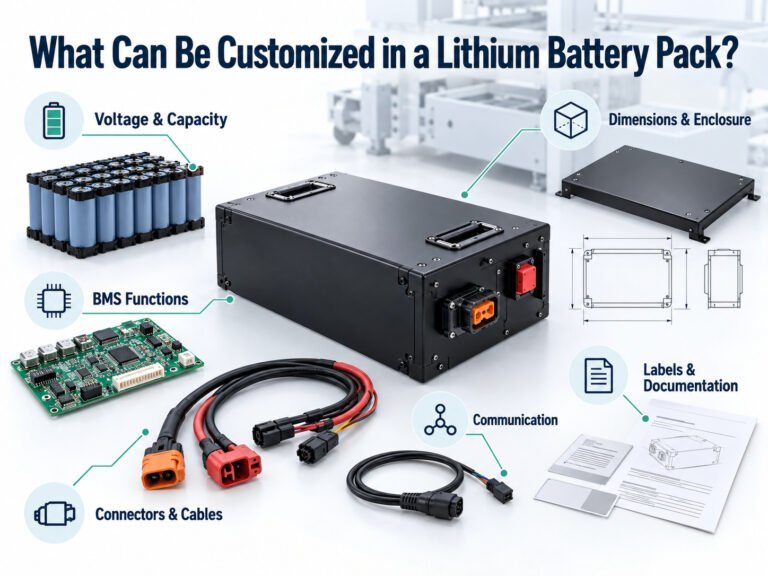
OEM and ODM battery development allows the battery to be designed around the customer’s equipment.
Electrical Customization
- Tension
- Capacité
- Configuration des cellules
- Courant de décharge
- Chimie des batteries
BMS Customization
- Paramètres de protection
- SOC
- SOH
- CAN
- RS485
- UART
Personnalisation mécanique
- Dimensions de la batterie
- Enclosure
- Mounting
- Connecteur
- Cable
- Wiring harness
Charging Customization
- Tension de charge
- Courant de charge
- Compatibilité des chargeurs
- Communication relative à la recharge
Product Customization
Depending on the project:
- Battery label
- Product identification
- Emballage
- Technical documentation
What Information Is Needed for a Custom Logistics Robot Battery?
For accurate battery engineering, the following information is useful:
| Exigence | Exemple |
|---|---|
| Type de robot | AGV / AMR / Logistics Robot |
| Chimie des batteries | LiFePO4 / Li-ion |
| Tension nominale | 24V / 36V / 48V / 51.2V |
| Capacité | Ah |
| Courant moyen | A |
| Courant de crête | A |
| Durée de fonctionnement | Hours |
| Temps de charge | Hours |
| Chargeur | Model / Specification |
| Communication | CAN / RS485 / UART |
| Dimensions de la batterie | L × W × H |
| Connecteur | Model / Specification |
| Température de fonctionnement | °C |
| IP requirement | En fonction de l'application |
| Target market | EU / US / Japan / Other |
| Quantité | Prototype / Batch Production |
Additional information can include:
- Equipment datasheet
- Original battery specifications
- Charger datasheet
- Motor datasheet
- Controller datasheet
- Battery compartment drawing
- Connector drawing
- Protocole de communication
- 3D model
How to Choose a Logistics Robot Battery Manufacturer
Selecting a battery manufacturer involves more than comparing battery prices.
For an OEM project, manufacturers can be evaluated based on engineering, production, testing, documentation, and compliance capabilities.
Compétences en ingénierie des batteries
The supplier should be able to evaluate:
- Sélection des cellules
- Configuration de la batterie
- BMS
- Exigences actuelles
- Communication
- Charging
- Mechanical integration
Capacités de production
Relevant production processes may include:
- Cell grading
- Correspondance des cellules
- Soudage
- PACK assembly
- Installation du système de gestion de batterie (BMS)
- Aging
- Contrôles électriques
- Contrôle final
Testing Capability
Les examens peuvent inclure :
- Essais de capacité
- Tests du système de gestion de la batterie (BMS)
- Tests de communication
- Essais de température
- Essais de vibration
- Waterproof testing when required
Documentation
For OEM battery projects, useful documents can include:
- Battery specification
- Cell datasheet
- BMS specification
- Test reports
- Certification documents
- Charging specifications
- Protocole de communication
Technical claims should be supported by appropriate documentation.
Engineering Considerations When Designing a Logistics Robot Battery
From a battery engineering perspective, capacity is only one part of the battery design.
A logistics robot battery should be evaluated through several parameters.
1. Energy
Battery energy can be estimated using:
Énergie (Wh) = Tension (V) × Capacité (Ah)
2. Current
The battery should support the required continuous and peak current.
3. Operating Cycle
The battery requirement depends on how often the robot:
- Drives
- Stops
- Accelerates
- Turns
- Lifts
- Carries loads
- Returns to the charging station
4. Charging Strategy
The battery should be designed according to:
- Standard charging
- Frais d'opportunité
- Automated charging
5. Communication
When the robot controller requires battery information, the BMS may need:
- CAN
- RS485
- UART
6. Installation
The battery needs to fit the robot’s:
- Compartiment à piles
- Points de fixation
- Emplacement du connecteur
- Acheminement des câbles
- Weight limitations
7. Environment
The battery should be evaluated according to:
- Température
- Humidité
- Poussière
- Eau
- Vibrations
This engineering approach helps define the battery as part of the robot’s complete power system.
À propos de Dongguan Yizhan Electronics Technology Co.
Dongguan Yizhan Electronics Technology Co. Ltd. is a lithium battery PACK manufacturer providing customized battery solutions for industrial equipment and robotics applications.
The company’s battery development process can cover:
Requirement Analysis → Cell Selection → Battery Configuration → BMS Design → Mechanical Design → Prototype → Testing → Certification Evaluation → Production
Battery applications include:
- Robots logistiques
- Robots d'entrepôt
- AGV
- AMR
- Robots d'inspection
- Robots industriels
- Chariots élévateurs électriques
- Walkie stackers
- Transpalettes
- Other mobile industrial equipment
Depending on project requirements, battery packs can integrate:
- Cellules LiFePO4
- Cellules au lithium-ion
- Smart BMS
- Communication CAN
- Communication RS485
- Communication UART
- Capteurs de température
- Custom connectors
- Custom wiring harnesses
- Custom enclosures
The final battery configuration is determined according to the customer’s equipment specifications, operating conditions, charging requirements, communication system, mechanical structure, and target market.
Why Customize a Battery for a Logistics Robot?
A standard battery may not match the electrical and mechanical requirements of a specific logistics robot.
Custom battery development can address several areas.
Electrical Requirements
- Tension
- Capacité
- Actuel
- L'énergie
Communication Requirements
- CAN
- RS485
- UART
- Other supported protocols
Mechanical Requirements
- Dimensions
- Mounting
- Position du connecteur
- Longueur du câble
- Enclosure
Charging Requirements
- Tension de charge
- Courant de charge
- Compatibilité des chargeurs
- Charging strategy
Environmental Requirements
- Température de fonctionnement
- Humidité
- Poussière
- Water exposure
- Vibrations
Compliance Requirements
- Transportation testing
- Market-specific regulations
- Applicable product standards
For OEM robotics manufacturers, these requirements can be defined during the robot development stage.
Logistics Robot Battery Quality Control
Quality control should cover the battery from incoming cells to finished PACK.
A typical process may include:
Cell Inspection
Cells can be inspected for:
- Tension
- Résistance interne
- Capacité
- Physical condition
Cell Matching
Cells can be grouped according to defined electrical parameters.
PACK Assembly
Battery assembly may include:
- Disposition des cellules
- Raccordement des barres omnibus
- Soudage
- Installation du système de gestion de batterie (BMS)
- Câblage
- Insulation
- Enclosure assembly
Tests fonctionnels
The finished battery can be tested for:
- Tension
- Capacité
- Charging
- Discharging
- Fonctions du BMS
- Communication
Aging
Battery aging can be used to identify potential electrical or assembly issues before shipment.
Inspection finale
Final inspection can include:
- Apparence
- Dimensions
- Connecteur
- Tension
- Communication
- Fonctions de protection
- Labeling
The specific inspection procedure depends on the battery design and production requirements.
Logistics Robot Battery Selection Checklist
Before ordering a lithium battery for a logistics robot, confirm the following.
Electrical
☐ Nominal voltage
☐ Capacity
☐ Energy
☐ Continuous current
☐ Peak current
☐ Cell chemistry
BMS
☐ Overcharge protection
☐ Over-discharge protection
☐ Over-current protection
☐ Temperature protection
☐ SOC
☐ SOH
☐ Cell balancing
Communication
☐ CAN
☐ RS485
☐ UART
☐ Communication protocol
☐ Data format
Charging
☐ Charging voltage
☐ Charging current
☐ Charger compatibility
☐ Charging method
☐ Automated charging requirements
Mechanical
☐ Battery dimensions
☐ Weight
☐ Mounting points
☐ Connector position
☐ Cable length
☐ Enclosure
Environnement
☐ Operating temperature
☐ Charging temperature
☐ Humidity
☐ Dust
☐ Water exposure
☐ Vibration
Compliance
☐ UN 38.3
☐ Applicable IEC standards
☐ Applicable UL standards
☐ CE requirements
☐ RoHS
☐ EU Battery Regulation requirements where applicable
FAQ
What type of battery is used in logistics robots?
Lithium-ion batteries, including LiFePO4 battery systems, can be used for logistics robots. The appropriate battery chemistry depends on the robot’s voltage, capacity, current, operating cycle, temperature, and installation requirements.
Can I customize a lithium battery for my logistics robot?
Yes. Voltage, capacity, dimensions, BMS, connectors, communication interfaces, enclosure, and charging specifications can be customized according to the robot’s requirements.
Can LiFePO4 batteries be used in logistics robots?
Yes. LiFePO4 is a lithium-ion chemistry that can be evaluated for logistics robot applications based on the robot’s electrical and operating requirements.
What voltage is used for logistics robot batteries?
The required voltage depends on the robot’s electrical system. Industrial battery systems may use configurations such as 24V, 36V, 48V, or 51.2V. The correct voltage should be determined from the equipment specifications.
Can a logistics robot battery communicate with the robot controller?
Yes. A smart BMS can support CAN, RS485, UART, or another communication interface when the BMS is configured to match the robot controller.
Can logistics robot batteries support automated charging?
Yes. A battery system can be designed for automated charging when the battery, BMS, charger, and robot controller support the intended charging architecture.
Can the battery dimensions be customized?
Yes. Battery dimensions, enclosure, mounting structure, connectors, cables, and wiring can be customized according to the robot’s installation space.
How do I calculate the required battery capacity?
Start with the robot’s voltage, average power consumption, operating time, peak current, charging schedule, and operating conditions.
The basic energy calculation is:
Wh = V × Ah
Actual battery capacity should be confirmed through the robot’s operating profile.
What certifications are required for logistics robot batteries?
Requirements depend on the battery, application, transportation method, and target market. UN 38.3 is relevant to lithium battery transportation, while additional regional or product-specific requirements may apply.
How long can a logistics robot battery operate?
Operating time depends on battery energy and the robot’s actual power consumption.
A basic estimate is:
Operating Time = Battery Energy ÷ Average Power Consumption
Actual runtime can vary according to payload, driving conditions, motor operation, auxiliary equipment, temperature, and battery operating parameters.
Can the battery support CAN communication and automated charging at the same time?
Yes. A battery can be designed with a smart BMS and CAN communication while supporting an automated charging system, provided the battery, charger, and robot controller are designed with compatible communication and charging requirements.
Conclusion
A Logistics Robot Battery is an integrated power system that needs to work with the robot’s electrical, mechanical, communication, and charging systems.
Battery development should consider:
Cell Chemistry + Voltage + Capacity + Current + BMS + Communication + Charging + Dimensions + Weight + Environment + Safety + Compliance
LiFePO4 is one battery chemistry that can be evaluated for logistics robot applications. Other lithium-ion chemistries may also be considered according to the equipment’s requirements.
For logistics robots, AGVs, AMRs, and warehouse automation systems, a custom lithium battery pack can integrate:
- Éléments de batterie
- BMS
- Protection components
- Capteurs de température
- Communication CAN
- Communication RS485
- Communication UART
- Custom connectors
- Custom wiring
- Custom enclosure
A structured OEM/ODM development process can follow:
Requirement Analysis → Cell Selection → Battery Configuration → BMS Design → PACK Design → Prototype → Testing → Validation → Production
For equipment manufacturers, defining battery requirements during the robot development stage can provide the engineering information needed for battery integration and validation.
Dongguan Yizhan Electronics Technology Co., Ltd. provides custom lithium battery PACK solutions for logistics robots, AGVs, AMRs, warehouse robots, and other industrial equipment according to OEM and ODM requirements.
 English
  Chinese
  Japanese
  German
  French
  Korean
