
Forklift batteries are an important part of warehouse operations. The right battery affects operating time, charging schedules, equipment availability, maintenance requirements, and the overall cost of running a forklift fleet.
For warehouse managers, battery purchasing should therefore involve more than comparing battery prices. Voltage, capacity, discharge current, battery dimensions, charging requirements, operating conditions, BMS functions, safety requirements, and total cost of ownership all need to be considered.
Lithium-ion batteries, including LiFePO4 batteries, are increasingly used in material-handling equipment. However, lithium batteries are not automatically suitable for every forklift. The battery needs to match the forklift’s electrical system and the warehouse’s operating requirements.
This guide explains the main factors warehouse managers should evaluate when selecting a forklift battery.
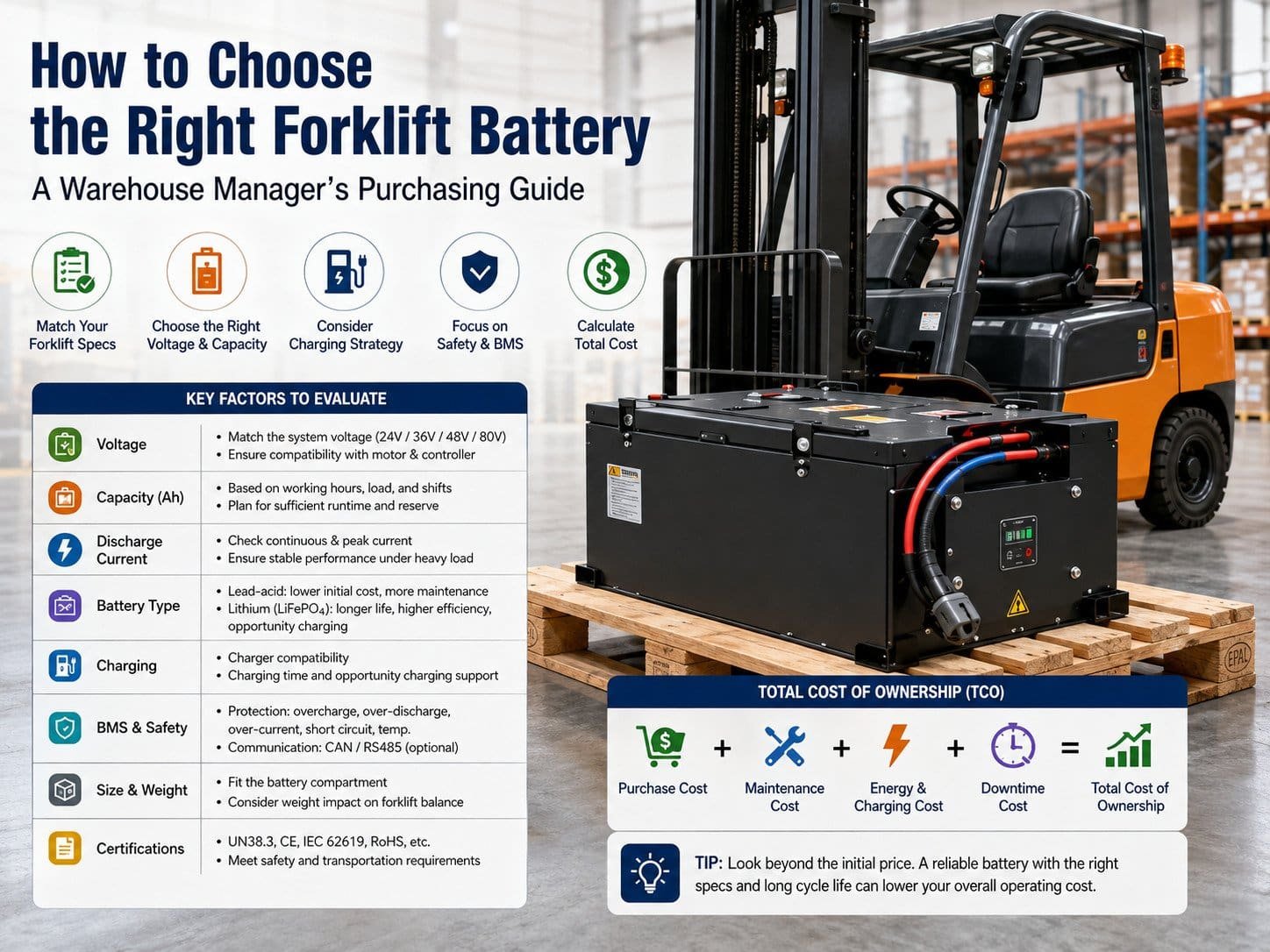
Part 1. Start With Your Forklift Specifications
Before contacting a battery manufacturer, collect the basic specifications of the forklift.
The information should include:
| Paramètres | What to Check |
|---|---|
| Forklift type | Counterbalance, reach truck, pallet truck, stacker, etc. |
| Tension du système | 24V, 36V, 48V, 72V, 80V, etc. |
| Capacité requise | Ah |
| Puissance du moteur | kW |
| Courant du contrôleur | A |
| Compartiment à piles | Longueur × largeur × hauteur |
| Connecteur | Connector type and position |
| Mode de recharge | Conventional, opportunity charging, fast charging, etc. |
| Horaires de travail | Hours per shift |
| Number of shifts | 1, 2, or 3 shifts |
| Environnement opérationnel | Indoor, outdoor, cold storage, high-temperature areas, etc. |
| Load | Average and maximum load |
| Communication | CAN, RS485, or other interfaces |
This information provides the foundation for battery selection.
A battery with the correct voltage but insufficient current capability, unsuitable dimensions, or an incompatible BMS may not perform properly even if its nominal specifications appear suitable.
Part 2. Choose the Correct Forklift Battery Voltage
Voltage is one of the first specifications to confirm.
Common forklift battery systems include:
- 24V
- 36V
- 48V
- 72V
- 80V
The replacement battery should normally match the forklift’s designed voltage unless the forklift manufacturer or an engineering team has specifically approved a different configuration.
For example, if a forklift is designed around a 48V electrical system, a 48V lithium battery would normally be evaluated as a replacement option.
Changing the system voltage is not simply a battery replacement. It may require evaluation of:
- Moteur
- Contrôleur
- Chargeur
- Convertisseur CC-CC
- Contacteurs
- Câblage
- Affichage
- Mesures de sécurité
- Autres composants électriques
For this reason, warehouse managers should provide the original forklift voltage when requesting a battery quotation.
Part 3. Determine the Required Battery Capacity
Battery capacity is normally expressed in ampere-hours (Ah).
The required capacity depends on how the forklift is used.
For example, a warehouse operating a forklift for several hours per shift may require a different battery capacity from a facility using the forklift intermittently.
Battery energy can be estimated using:
Énergie (Wh) = Tension (V) × Capacité (Ah)
Par exemple :
48V × 500Ah = 24,000Wh
or approximately:
24kWh
This is the nominal energy based on the rated voltage and capacity. Actual usable energy depends on battery chemistry, operating conditions, BMS settings, temperature, discharge rate, and other factors.
Factors Affecting Capacity Requirements
Warehouse managers should consider:
- Operating hours per shift
- Number of shifts per day
- Average load
- Maximum load
- Travel distance
- Lifting frequency
- Average operating speed
- Warehouse temperature
- Charging opportunities
- Required reserve capacity
A larger battery is not necessarily the appropriate choice.
Oversizing the battery may increase initial cost and weight without providing a practical benefit if the forklift already has sufficient operating time.
Part 4. Evaluate Discharge Current
Capacity is only one part of forklift battery performance.
A forklift can require high current during:
- Début
- Accélération
- Heavy-load lifting
- Ramp operation
- Frequent direction changes
- High-intensity warehouse operations
Therefore, the battery’s continuous and peak discharge current should be compared with the forklift controller and motor requirements.
For example, a battery specified as:
48V 500Ah
does not provide enough information by itself.
The battery specification should also indicate the available discharge current.
A battery with insufficient current capability may experience voltage drop or BMS protection during high-load operation.
Possible symptoms include:
- Accélération réduite
- Reduced lifting performance
- Sudden power interruption
- Protection du BMS
- Alarmes de batterie
When purchasing a forklift battery, ask the manufacturer for both continuous discharge current et peak discharge current.
Part 5. Lead-Acid vs. Lithium Forklift Batteries
Warehouse managers often compare conventional lead-acid batteries with lithium-ion alternatives.
Both technologies have different operating characteristics.
Batteries plomb-acide
Lead-acid batteries are widely used in industrial equipment and have an established supply and service infrastructure.
Depending on the battery type, maintenance may involve:
- Contrôle des électrolytes
- Water replenishment
- Terminal inspection
- Nettoyage
- Charging management
- Battery room ventilation
Lead-acid batteries may also require dedicated charging and battery-handling areas in some warehouse operations.
Piles au lithium
Lithium-ion forklift batteries generally require less routine maintenance than flooded lead-acid batteries.
Depending on the design, a lithium battery can provide:
- Integrated BMS
- No routine electrolyte watering
- Fonctionnalité de recharge ponctuelle
- Surveillance de la batterie
- Consistent voltage during discharge
- Communication de données
- Reduced battery handling requirements
However, lithium batteries also require appropriate charging equipment, BMS protection, thermal management, installation, and operating procedures.
The decision should therefore be based on the warehouse’s actual operating model rather than simply comparing the purchase prices of the two battery types.
Part 6. Consider LiFePO4 for Forklift Applications
LiFePO4, or lithium iron phosphate, is one lithium battery chemistry used in industrial vehicles and material-handling equipment.
Its characteristics can make it suitable for applications requiring repeated charge and discharge cycles and stable operation.
When evaluating a LiFePO4 forklift battery, warehouse managers should look beyond the chemistry itself.
Important specifications include:
- Cell specifications
- Rated voltage
- Capacité nominale
- Courant de décharge continu
- Courant de décharge maximal
- Courant de charge
- Température de fonctionnement
- Protection du BMS
- Interface de communication
- Enclosure design
- Service requirements
A LiFePO4 battery should still be selected according to the forklift manufacturer’s requirements and the actual warehouse application.
Part 7. Evaluate Charging Requirements
Charging is an important part of forklift fleet management.
Before purchasing a new battery, determine how the forklift will be charged.
There are several possible operating strategies:
Conventional Charging
The forklift is operated for a period of time and then charged during a designated charging period.
Recharge à la demande
The forklift is connected to a compatible charger during breaks or other available periods.
Exploitation en équipes successives
Forklifts operating across multiple shifts may require carefully planned charging schedules to avoid downtime.
Lithium batteries can be suitable for some opportunity-charging applications, but the battery and charger must be designed for the intended charging method.
Vérifier :
- Tension de sortie du chargeur
- Courant de charge
- Temps de charge
- Battery charging limits
- Compatibilité avec le système de gestion de la batterie (BMS)
- Type de connecteur
- Exigences en matière de communication
- Plage de températures de charge
Do not assume that an existing lead-acid charger can be used with a lithium battery.
A lithium battery should be charged with a charger specified for the battery system.
Part 8. Check Battery Dimensions and Installation
Physical compatibility is just as important as electrical compatibility.
Before purchasing, measure the forklift battery compartment.
Important dimensions include:
Longueur × Largeur × Hauteur
Also check:
- Battery weight requirements
- Points de fixation
- Terminal location
- Position du connecteur
- Longueur du câble
- Battery access
- Retention system
- Clearance around the battery
Battery weight can also be relevant to forklift stability.
Forklifts are designed around specific load and counterweight configurations. Replacing a heavy lead-acid battery with a significantly lighter lithium battery can change the vehicle’s weight distribution.
Therefore, the replacement battery should be evaluated against the forklift manufacturer’s requirements for battery weight and dimensions.
Part 9. Evaluate the BMS
The Battery Management System is an important component of a lithium forklift battery.
A BMS monitors and protects the battery during charging and discharging.
Depending on the battery design, BMS functions can include:
- Surveillance du potentiel cellulaire
- Surveillance de la tension du bloc-batterie
- Protection contre les surcharges
- Protection contre la surcharge
- Protection contre les surintensités
- Protection contre les courts-circuits
- Protection contre la surchauffe
- Protection contre le froid
- Équilibre cellulaire
- Surveillance du SOC
- Fault recording
For fleet applications, an intelligent BMS can also provide information that helps operators and maintenance teams monitor battery condition.
Interfaces de communication
Depending on the forklift and battery system, communication may use:
- CAN
- CAN FD
- RS485
- UART
- Modbus
Communication requirements should be confirmed before ordering the battery.
A battery with the required electrical specifications but an incompatible communication interface may require additional integration work.
Part 10. Consider Warehouse Operating Conditions
The same battery specification may perform differently under different operating conditions.
Warehouse managers should consider where the forklift will operate.
Cold Storage
Low temperatures can affect battery charging and discharge performance.
If forklifts operate in refrigerated or frozen warehouses, the battery should be designed for the specified temperature range.
Charging at low temperatures may require additional battery protection or thermal management depending on the battery design.
High-Temperature Environments
Warehouses without adequate temperature control may expose batteries to elevated temperatures.
The battery’s specified operating and charging temperature range should therefore be checked.
Outdoor Operation
Outdoor forklifts may encounter:
- Pluie
- Poussière
- Variations de température
- Uneven surfaces
The battery enclosure and connectors should be appropriate for the operating environment.
An IP rating may be relevant when water or dust protection is required, but the appropriate rating should be determined based on the actual application.
Part 11. Check Safety and Certification Requirements
Forklift batteries used in commercial or industrial environments should be evaluated for applicable safety and transportation requirements.
Depending on the market and application, requirements may include:
- UN 38.3 transportation testing
- IEC-related battery safety standards
- CE requirements
- Exigences en matière de compatibilité électromagnétique (CEM)
- RoHS
- Applicable regional regulations
- Exigences spécifiques au client
The exact requirements depend on the battery design, destination market, application, and transportation method.
Warehouse managers should ask suppliers to provide relevant test reports and certification documentation rather than relying only on a statement such as “certified.”
For lithium battery procurement, documentation can include:
- Test reports
- Certificats
- Safety data information
- Caractéristiques de la batterie
- BMS specifications
- Manuels d'utilisation
- Charging instructions
- Transportation documents
The documents should correspond to the actual battery model being purchased.
Part 12. Calculate Total Cost of Ownership
Purchase price is only one part of forklift battery cost.
A better approach is to evaluate Total Cost of Ownership (TCO).
A basic TCO model can include:
Battery purchase cost + charger cost + installation cost + maintenance cost + energy cost + replacement cost + downtime cost
For example, a warehouse manager comparing lead-acid and lithium batteries may consider:
| Cost Factor | Plomb-acide | Lithium |
|---|---|---|
| Initial battery cost | Usually lower | Usually higher |
| Entretien courant | May be higher | Generally lower |
| Watering | Required for some types | Not required |
| Charging process | Dedicated charging schedule | May support opportunity charging |
| Manipulation des batteries | May require battery changing equipment | Depends on system |
| Charging infrastructure | Existing infrastructure may be available | May require compatible charger |
| Temps d'arrêt | Depends on charging strategy | Depends on charging strategy |
| Durée de vie | En fonction de l'application | En fonction de l'application |
The actual TCO should be calculated using the warehouse’s own operating data.
For example, a fleet running one shift per day may have a different economic result from a fleet operating continuously across three shifts.
Part 13. Evaluate the Forklift Battery Manufacturer
Selecting a battery manufacturer is another important purchasing decision.
Warehouse managers should evaluate suppliers based on technical capability and documentation rather than price alone.
1. Battery Engineering Capability
Ask whether the supplier can customize:
- Tension
- Capacité
- BMS
- Communication
- Connecteurs
- Enclosure
- Mounting structure
- Cable configuration
2. Cell Quality and Traceability
Ask what type of cells are used and whether the supplier can provide cell specifications and traceability information.
3. BMS Development
A suitable supplier should understand the relationship between:
Battery → BMS → Charger → Controller → Forklift
This is particularly important for custom battery projects.
4. Testing Capability
Ask about testing procedures such as:
- Essais de capacité
- Essais de charge/décharge
- Tests du système de gestion de la batterie (BMS)
- Essais de température
- Contrôle de l'isolation
- Essais de vibration
- Tests de vieillissement
- Tests de communication
5. Certification Documentation
Request documentation for the specific battery model being purchased.
6. After-Sales Support
For warehouse fleets, technical support can be important when issues involve:
- Charging
- Alarmes BMS
- Communication
- Installation
- Remplacement de la batterie
- Fault diagnosis
A supplier should be able to provide appropriate technical documentation and support for the battery system.
Part 14. Common Forklift Battery Purchasing Mistakes
Mistake 1: Choosing Only Based on Price
A low purchase price does not necessarily mean a lower overall operating cost.
Battery life, maintenance, charging, downtime, and replacement costs should also be considered.
Mistake 2: Selecting Capacity Without Checking Operating Conditions
A battery that looks suitable on paper may not provide sufficient operating time under heavy loads or multi-shift operation.
Mistake 3: Ignoring Discharge Current
Capacity and voltage do not tell the whole story.
The battery must also support the current demanded by the forklift.
Mistake 4: Reusing an Incompatible Charger
A charger should be matched to the battery chemistry and charging specifications.
Mistake 5: Ignoring Battery Weight
Battery weight can affect forklift balance and rated performance.
Always check the forklift manufacturer’s battery weight requirements.
Mistake 6: Ignoring Communication Requirements
A forklift may require communication between the battery and vehicle controller.
CAN, RS485, or other interfaces should be confirmed before purchase.
Mistake 7: Buying Before Measuring the Battery Compartment
A battery that cannot physically fit the forklift is not a usable replacement, regardless of its electrical specifications.
Part 15. Forklift Battery Purchasing Checklist
Before placing an order, warehouse managers can use the following checklist:
- Confirm forklift voltage
- Confirm required battery capacity
- Check motor and controller specifications
- Check continuous and peak current requirements
- Measure battery compartment dimensions
- Confirm battery weight requirements
- Confirm connector type
- Select suitable battery chemistry
- Evaluate BMS functions
- Confirm communication protocol
- Check charger compatibility
- Review operating temperature
- Review safety and transportation documentation
- Request battery test reports
- Confirm installation requirements
- Calculate total cost of ownership
- Evaluate supplier engineering capability
- Confirm warranty and technical support
This checklist can help reduce compatibility problems before the battery enters production or warehouse operation.
Part 16. Questions to Ask a Forklift Battery Supplier
Before purchasing, warehouse managers can ask suppliers the following questions:
About the Battery
- What cell chemistry is used?
- What is the rated voltage?
- What is the rated capacity?
- What are the continuous and peak discharge currents?
- What is the operating temperature range?
- What is the battery weight?
- What are the battery dimensions?
About the BMS
- What protection functions are included?
- Does the BMS support CAN or RS485?
- Can the BMS communicate with the forklift controller?
- Is SOC information available?
- Can fault data be recorded?
About Charging
- What charger should be used?
- What is the recommended charging current?
- Is opportunity charging supported?
- Does the charger communicate with the BMS?
- What happens when the battery reaches full charge?
About Quality and Documentation
- What testing is performed before shipment?
- Can test reports be provided?
- What transportation documents are available?
- What certifications apply to the specific model?
- What technical support is available after delivery?
The answers should be documented and compared between suppliers.
Part 17. When Should a Warehouse Consider a Custom Forklift Battery?
Standard batteries can work well when the forklift uses a common battery compartment and electrical configuration.
A custom battery may be more appropriate when the warehouse requires:
- Non-standard dimensions
- Specific voltage
- Higher capacity
- Courant de décharge plus élevé
- Custom connectors
- Communication CAN
- Communication RS485
- Specific charging requirements
- Cold-storage operation
- Special mounting structures
- Fleet monitoring
For OEM forklift manufacturers, custom battery development can also allow the battery enclosure, BMS, connectors, and communication system to be designed around the vehicle platform.
The development process should begin with the forklift specifications rather than starting with an existing battery model and attempting to adapt the vehicle afterward.
Part 18. Final Decision: Which Forklift Battery Should You Buy?
There is no single battery specification that fits every warehouse.
The appropriate battery depends on the forklift and operating environment.
A practical selection process is:
Forklift Specifications → Voltage → Capacity → Current → Battery Chemistry → BMS → Charger → Dimensions → Operating Environment → Safety Documentation → TCO → Supplier Evaluation
For warehouses considering lithium battery adoption, LiFePO4 batteries can be evaluated when their electrical, mechanical, charging, and operating characteristics match the forklift requirements.
The most important step is to collect accurate vehicle and operating data before requesting quotations.
A battery quotation should not be evaluated by price alone. The battery’s specifications, testing, documentation, charging system, BMS, installation requirements, expected operating conditions, and supplier support should all be part of the purchasing decision.
Conclusion
Choosing a forklift battery is a technical and operational decision.
For warehouse managers, the goal should be to select a battery that matches the forklift’s electrical system, operating schedule, load requirements, charging strategy, installation space, and safety requirements.
Before purchasing, confirm the key parameters:
Voltage, capacity, discharge current, dimensions, weight, BMS, charger, communication, operating temperature, certifications, and total cost of ownership.
For lithium forklift batteries, proper system matching is particularly important because the battery, BMS, charger, controller, and forklift need to work together.
A structured purchasing process can help warehouse managers reduce compatibility issues, plan charging more effectively, and make battery decisions based on actual operating requirements rather than purchase price alone.
FAQ
What voltage forklift battery do I need?
The battery voltage should normally match the forklift’s original electrical system, such as 24V, 36V, 48V, 72V, or 80V. Check the forklift manufacturer’s specifications before purchasing.
How do I calculate forklift battery capacity?
Battery energy can be estimated using voltage × Ah. However, actual capacity requirements should also consider operating hours, load, travel distance, charging opportunities, temperature, and operating conditions.
Are lithium batteries suitable for forklifts?
Lithium batteries can be suitable for many forklift applications, particularly operations involving frequent charging or multiple shifts. Suitability depends on the forklift, battery specifications, charging system, and operating environment.
Is LiFePO4 suitable for warehouse forklifts?
LiFePO4 is one lithium battery chemistry used in industrial vehicles. Its suitability should be evaluated according to the forklift’s voltage, capacity, current, temperature, charging, and installation requirements.
Can I use my existing forklift charger with a lithium battery?
Do not assume compatibility. The charger should meet the lithium battery manufacturer’s voltage, current, charging profile, and communication requirements.
What is the most important specification when buying a forklift battery?
There is no single specification that determines suitability. Voltage, capacity, discharge current, dimensions, weight, BMS, charger compatibility, operating conditions, and safety requirements should be evaluated together.
How can I reduce the total cost of forklift batteries?
Consider total cost of ownership rather than purchase price alone. Maintenance, charging, labor, battery handling, downtime, energy consumption, service life, and replacement costs can all affect the overall cost.
What information should I provide when requesting a forklift battery quotation?
Provide the forklift model, voltage, battery capacity, motor and controller specifications, battery compartment dimensions, connector type, working hours, number of shifts, operating temperature, charging method, and any communication requirements.
 English
  Chinese
  Japanese
  German
  French
  Korean
