
With the rapid growth of smart homes, commercial cleaning equipment, and autonomous service robots, cleaning robots are becoming an important part of modern living and industrial environments. Behind every efficient cleaning robot is a reliable battery system that determines operating time, performance, safety, and user experience.
Choosing the right battery for a cleaning robot is not simply about selecting a battery with higher capacity. Battery chemistry, size, charging efficiency, cycle life, safety features, and customization capability all play important roles.
As a professional lithium battery manufacturer, Yizhan Electronics provides customized lithium battery solutions for cleaning robots, robotic vacuum systems, and intelligent cleaning equipment, helping customers improve product performance and reliability.
This guide explains 6 key factors to consider when selecting a cleaning robot battery.
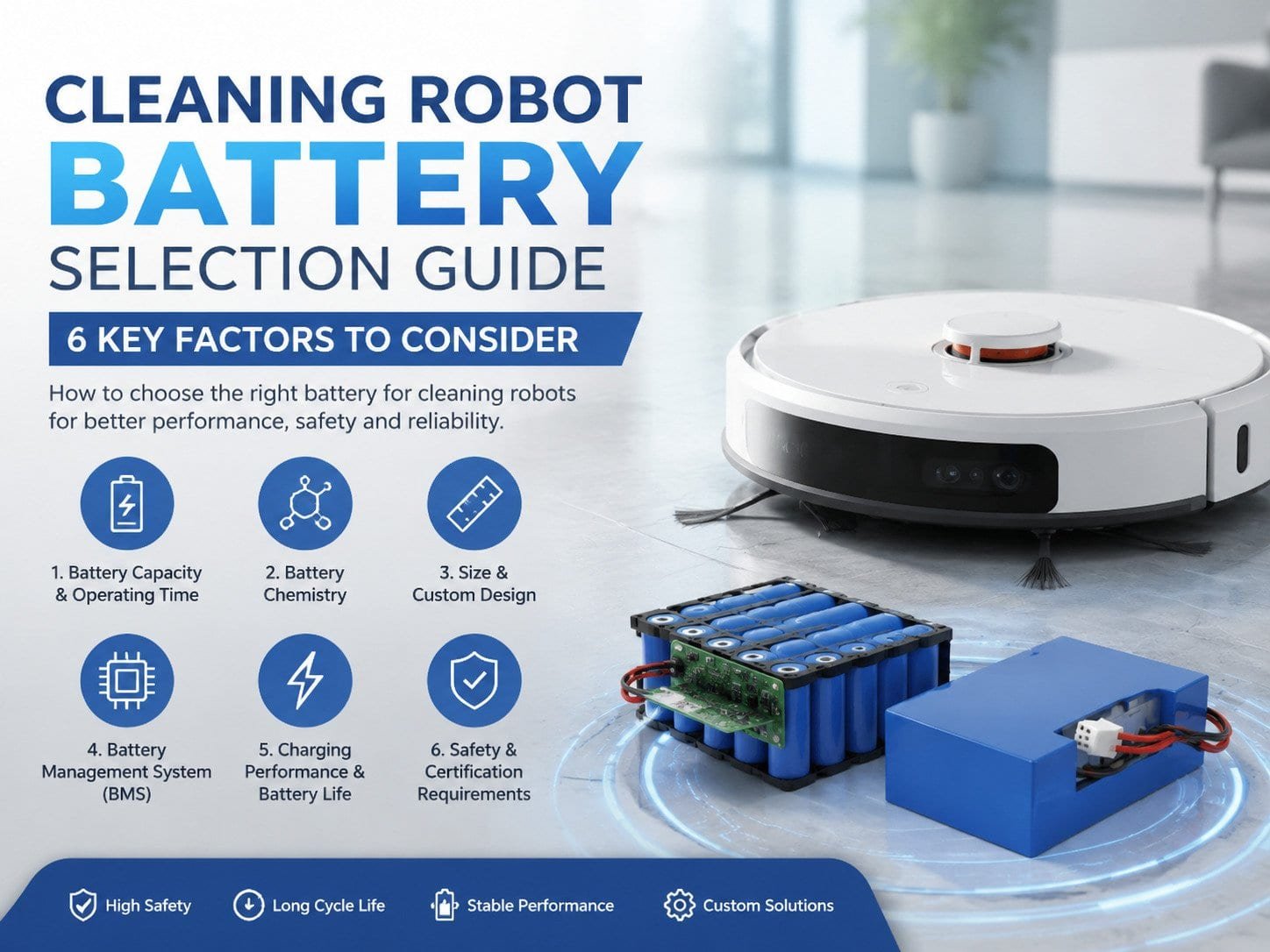
Part 1. Battery Capacity and Operating Time
Battery capacity directly affects how long a cleaning robot can operate before recharging.
Capacity is usually measured in:
- Ah (Ampere-hour)
- Wh (Watt-hour)
A higher-capacity battery can provide longer working time, but it also increases battery size and weight.
When selecting a battery capacity, manufacturers should consider:
- Robot motor power
- Cleaning area
- Environnement de travail
- Cleaning frequency
- Required operating hours
Par exemple :
- Home cleaning robots usually require compact batteries with moderate capacity.
- Commercial cleaning robots require higher-capacity battery packs for extended operation.
A professional battery supplier can help balance capacity, size, and performance to meet specific product requirements.
Part 2. Battery Chemistry Selection
The battery chemistry determines performance, safety, and lifespan.
Common battery types used in cleaning robots include:
Batterie lithium-ion
Lithium-ion batteries are widely used in cleaning robots because of their:
- Densité énergétique élevée
- Conception légère
- Longue durée de vie
- Fonctionnalité de recharge rapide
They allow manufacturers to design smaller and more efficient robot products.
Batterie au lithium-polymère (LiPo)
LiPo batteries provide:
- Flexible shape design
- Lightweight structure
- Densité énergétique élevée
They are suitable for compact robots where space is limited.
Batterie LiFePO4
LiFePO4 batteries are known for:
- Excellente stabilité thermique
- Haut niveau de sécurité
- Longue durée de vie
- Reliable operation
They are suitable for commercial cleaning robots and applications requiring long service life.
Part 3. Battery Size and Custom Design
Cleaning robots often have limited internal space, making battery dimensions an important consideration.
A standard battery may not always fit the robot structure.
Customized battery solutions can provide:
- Custom battery dimensions
- Special-shaped battery packs
- Customized connectors
- Flexible installation methods
- Optimized weight distribution
For robot manufacturers, a customized battery pack can maximize available space and improve overall product design.
Yizhan Electronics supports OEM/ODM battery customization according to customer requirements, including battery structure design, BMS configuration, and performance optimization.
Part 4. Battery Management System (BMS)
The Battery Management System (BMS) is the intelligent control center of a lithium battery pack.
A reliable BMS helps monitor and protect the battery by managing:
- Tension
- Actuel
- Température
- État de charge
- Remaining capacity (SOC)
- Battery health status (SOH)
Safety protection functions include:
- Protection contre les surcharges
- Protection contre la surcharge
- Protection contre les courts-circuits
- Protection contre les surintensités
- Protection de la température
For smart cleaning robots, advanced BMS communication can also support:
- Communication CAN
- Communication RS485
- Surveillance à distance
- Battery data management
A well-designed BMS improves battery reliability and extends service life.
Part 5. Charging Performance and Battery Life
Charging efficiency directly affects the user experience of cleaning robots.
A high-quality battery should provide:
- Stable charging performance
- Temps de recharge plus court
- Low energy loss
- Consistent output power
Battery cycle life is another important factor.
Typical lithium battery cycle life:
| Type de batterie | Cycle de vie |
|---|---|
| Standard Lithium-Ion Battery | Around 500–1,000 cycles |
| High-quality Lithium Battery Pack | Around 1,000–2,000+ cycles |
| Batterie LiFePO4 | Entre 3 000 et 5 000 cycles environ |
A longer cycle life means fewer battery replacements and lower maintenance costs throughout the product lifecycle.
Part 6. Safety and Certification Requirements
Safety is critical for intelligent cleaning equipment, especially for products used in homes, offices, and commercial environments.
A reliable cleaning robot battery should include:
- Stable battery cells
- Protective BMS design
- Quality manufacturing processes
- Safety testing and certification
Common battery certifications include:
- UN38.3
- IEC 62133
- CE
- RoHS
- FCC
For international markets, battery compliance requirements should be considered during the product development stage.
Working with an experienced battery manufacturer can help ensure the battery system meets global market requirements.
FAQ
1. What type of battery is commonly used in cleaning robots?
Most cleaning robots use lithium-ion batteries because they provide high energy density, lightweight design, long service life, and stable performance. Depending on the application requirements, cleaning robots may also use lithium polymer (LiPo) or LiFePO4 batteries.
2. How long does a cleaning robot battery usually last?
The lifespan of a cleaning robot battery depends on battery chemistry, usage frequency, charging habits, and operating conditions.
Durée de vie typique :
- Standard lithium-ion batteries: around 500–1,000 cycles
- High-quality lithium battery packs: around 1,000–2,000+ cycles
- LiFePO4 batteries: around 3,000–5,000 cycles
A properly designed battery system can significantly extend the service life of cleaning robots.
3. How do I choose the right capacity for a cleaning robot battery?
The right battery capacity depends on:
- Robot power consumption
- Required cleaning time
- Puissance du moteur
- Working area
- Fréquence de recharge
- Weight limitations
A higher capacity battery provides longer operating time but may increase size and weight. A professional battery manufacturer can help optimize the balance between runtime and product design.
4. Are lithium batteries better than traditional batteries for cleaning robots?
Yes. Lithium batteries offer several advantages compared with traditional battery technologies:
- Densité énergétique plus élevée
- Durée de vie plus longue
- Vitesse de chargement plus rapide
- Besoins d'entretien réduits
- More stable power output
- Poids plus léger
These advantages make lithium batteries suitable for modern smart cleaning robots and autonomous cleaning equipment.
5. Why is BMS important for cleaning robot batteries?
The Battery Management System (BMS) plays a critical role in battery safety and performance.
A reliable BMS can:
- Monitor voltage and current
- Control charging and discharging
- Prevent overcharging and over-discharging
- Protect against overheating
- Provide battery status information
For intelligent cleaning robots, smart BMS communication can also support functions such as CAN, RS485, and remote battery monitoring.
6. Can cleaning robot batteries be customized?
Yes. Custom battery solutions are often required because cleaning robots have different designs and space limitations.
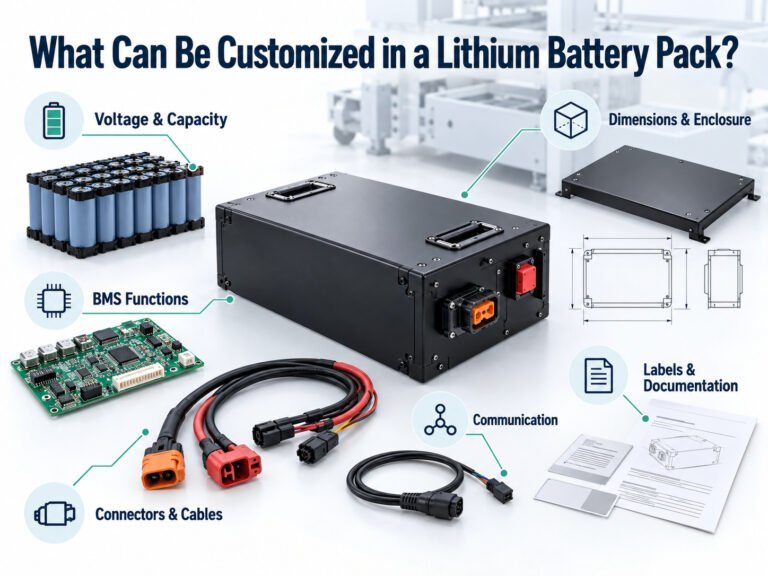
Battery manufacturers can customize:
- Dimensions de la batterie
- Tension et capacité
- Forme de la batterie
- Connecteurs
- Fonctions du BMS
- Protocoles de communication
- Charging solutions
Customized batteries help manufacturers achieve better product integration and performance.
7. What certifications are required for cleaning robot batteries?
Depending on the target market, cleaning robot batteries may require certifications such as:
- UN38.3
- IEC 62133-2
- CE
- RoHS
- FCC
For global sales, selecting a battery supplier with certification experience can simplify product compliance.
8. How long does it take to charge a cleaning robot lithium battery?
Charging time depends on:
- Battery capacity
- Charger power
- Battery management system
- Courant de charge
Most lithium cleaning robot batteries can be fully charged within several hours. Fast charging solutions can further reduce downtime for commercial cleaning robots.
9. Can lithium batteries support commercial cleaning robots?
Yes. Lithium battery solutions are widely used in:
- Commercial floor cleaning robots
- Autonomous vacuum robots
- Hotel cleaning robots
- Warehouse cleaning robots
- Robots de service
For commercial applications, battery systems with higher capacity, longer cycle life, and smart monitoring functions are usually preferred.
10. How does Yizhan Electronics support cleaning robot battery projects?
Yizhan Electronics provides customized lithium battery solutions for cleaning robots and intelligent equipment.
Our services include:
- Conception du bloc-batterie
- Li-ion, LiPo, and LiFePO4 solutions
- Développement d'un système de gestion des bâtiments sur mesure
- Essais de prototypes
- Production OEM/ODM
- Soutien à la certification
We help robot manufacturers develop reliable battery systems that meet different application requirements.
 English
  Chinese
  Japanese
  German
  French
  Korean
