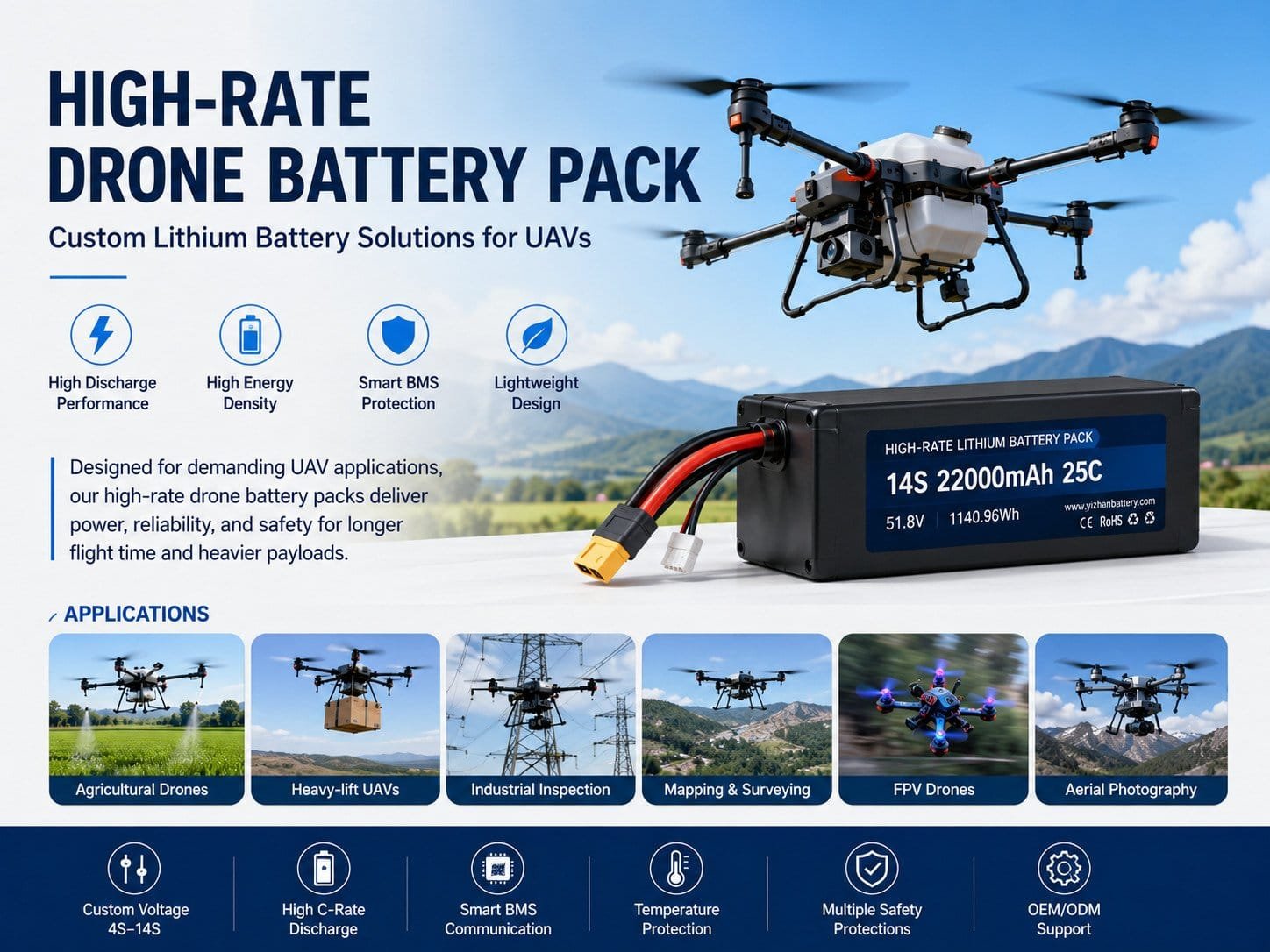
Drones and unmanned aerial vehicles (UAVs) are used in agriculture, inspection, mapping, surveying, logistics, aerial photography, emergency response, and industrial operations. As these applications become more specialized, the battery needs to be designed around the aircraft rather than selected only by nominal capacity.
A UAV battery pack must supply sufficient energy for the required flight time while also handling takeoff current, acceleration, hovering, payload operation, and changing power demand. Battery weight, voltage stability, discharge capability, thermal performance, mechanical integration, BMS functions, and charging requirements can all affect the performance of the complete aircraft.
Yizhan Battery provides custom high-rate lithium battery packs for drones and UAV applications. Our OEM/ODM service covers battery cell selection, electrical configuration, high-current design, BMS development, structural customization, prototype production, testing, and mass production.
Whether you are developing an agricultural drone, industrial UAV, heavy-lift platform, inspection drone, or other electrically powered aerial equipment, the battery can be developed according to your voltage, capacity, current, dimensions, connector, communication, and operating requirements.

What Is a High-Rate Drone Battery Pack?
A high-rate drone battery pack is designed to deliver a relatively high current in relation to its rated capacity. This characteristic is important for UAVs because propulsion systems can create substantial power demand during takeoff, acceleration, climbing, hovering, and rapid maneuvering.
The C-rate is commonly used to describe battery discharge capability.
For example, a 20 Ah battery with a theoretical 10C discharge rate corresponds to:
20 Ah × 10C = 200 A
However, this calculation should not be interpreted as the guaranteed continuous output of the finished battery pack.
Actual battery performance depends on several factors, including:
- Cell chemistry
- Cell model
- Cell internal resistance
- Number of cells in parallel
- Batterietemperatur
- Discharge duration
- BMS current limits
- Cable resistance
- Connector rating
- Welding and busbar design
- Thermisches Management
- Betriebsbedingungen
Therefore, UAV battery design should evaluate the complete battery pack rather than relying on the C-rate printed on a cell or battery label.
Why Battery Design Matters for UAV Applications
The battery is part of the UAV propulsion and electrical system. Its characteristics can affect flight time, payload capability, acceleration response, thermal conditions, and operational reliability.
A suitable UAV battery design normally considers five major factors:
1. Energy Capacity
Capacity determines how much electrical energy the battery can store.
A basic calculation is:
Battery Energy (Wh) = Nominal Voltage (V) × Capacity (Ah)
For example, a 44.4 V, 20 Ah battery has a nominal energy of:
44.4 V × 20 Ah = 888 Wh
Actual usable energy depends on the permitted operating voltage range, discharge conditions, temperature, system efficiency, and energy reserve.
2. Discharge Capability
A UAV can require high current during takeoff and other high-load conditions.
The battery should therefore be evaluated for:
- Continuous current
- Peak current
- Peak duration
- Current recovery
- Voltage drop
- Temperature rise
3. Battery Weight
Battery capacity cannot be considered independently from weight.
Adding capacity increases available energy but also increases battery mass. The aircraft’s motor system must carry the additional weight, which can change overall energy consumption.
Battery design therefore involves balancing:
Energy + Power + Weight + Thermal Performance
4. Voltage Stability
A battery’s voltage changes during discharge.
Under high current, internal resistance can create voltage drop. Excessive voltage drop may affect ESC and motor performance.
Cell selection and pack configuration are therefore important for applications with high instantaneous current.
5. Thermal Performance
High-current discharge generates heat.
If heat cannot be effectively managed, battery temperature may increase during flight. Thermal design should therefore consider cell characteristics, airflow, enclosure design, current demand, discharge duration, and ambient temperature.
High-Rate Lithium Battery Solutions for Different UAV Applications
Different UAVs have different battery requirements. A battery designed for a small FPV drone may not be suitable for an agricultural drone or heavy-lift platform.
Agricultural Drone Battery
Agricultural drones are commonly used for crop spraying, spreading, monitoring, and agricultural inspection.
Their battery systems may experience repeated:
- Takeoff
- Klettern
- Hovering
- Spraying
- Beschleunigung
- Direction changes
- Landing
- Batteriewechsel
During spraying operations, the aircraft carries additional payload, increasing propulsion demand.
A custom agricultural drone battery can be designed according to:
- UAV voltage
- Motorleistung
- ESC specifications
- Maximum takeoff weight
- Nutzlast
- Flight time
- Spray system power
- Peak current
- Continuous current
- Ladevorgaben
- Betriebstemperatur
Battery capacity should be calculated from the complete flight profile rather than estimated only from the aircraft’s nominal power rating.
Heavy-Lift UAV Battery
Heavy-lift UAVs can carry cameras, sensors, delivery equipment, industrial tools, or other payloads.
The battery needs to support the propulsion system while keeping battery mass within the aircraft’s allowable weight range.
For heavy-lift applications, battery design can focus on:
- High-current discharge
- Voltage configuration
- Zellabgleich
- Low-resistance connections
- Thermisches Management
- Hochstromsteckverbinder
- BMS-Schutz
- Battery monitoring
- Mechanische Befestigung
A higher-voltage architecture can also be considered where appropriate because system current for a given power level is related to voltage.
The relationship is:
Power (W) = Voltage (V) × Current (A)
Therefore, increasing system voltage can reduce the current required for the same power, subject to the motor, ESC, battery, and overall system design.
Industrial Inspection UAV Battery
Industrial inspection drones may carry:
- High-resolution cameras
- Thermal cameras
- LiDAR
- Gassensoren
- Kommunikationsgeräte
- Lighting equipment
- Other inspection instruments
The battery must support both propulsion and onboard equipment.
For these applications, a battery design may include smart monitoring functions that allow the aircraft system to obtain information such as:
- Batteriespannung
- Aktuell
- Temperatur
- Ladezustand
- Zellspannung
- Fehlerstatus
- Cycle information
CAN or other communication interfaces can be considered when required by the UAV control architecture.
Mapping and Surveying Drone Battery
Mapping drones may require a stable power supply during relatively long flight missions.
Bei der Auslegung von Batterien sollte Folgendes berücksichtigt werden:
- Required flight duration
- Nutzlastgewicht
- Average power consumption
- Cruise power
- Takeoff power
- Return-to-home reserve
- Betriebstemperatur
- Ladehäufigkeit
A battery with excessive capacity can add unnecessary mass, while insufficient capacity may reduce mission duration.
The appropriate capacity should therefore be determined from the aircraft’s actual duty cycle.
FPV and High-Performance Drone Battery
FPV and high-performance drones can experience rapid changes in power demand.
Battery design may prioritize:
- Hohe Entladeleistung
- Niedriger Innenwiderstand
- Lightweight construction
- Hochstromsteckverbinder
- Short cable length
- Appropriate wire gauge
- Zellabgleich
- Thermal performance
For these applications, peak current and voltage sag can be important considerations alongside nominal capacity.
How to Choose the Right Drone Battery Voltage
Battery voltage is determined by the electrical architecture of the UAV.
Common battery configurations may include:
- 4S
- 6S
- 8S
- 10S
- 12S
- 14S
- Custom configurations
For lithium-ion or LiPo battery packs, the actual nominal voltage depends on the selected cell chemistry and configuration.
For a series-connected battery:
Pack Voltage ≈ Cell Nominal Voltage × Number of Series Cells
For example, a typical lithium-ion cell with a nominal voltage around 3.6–3.7 V can form a higher-voltage pack through series connection.
The correct voltage should be determined from:
- Motor specification
- ESC voltage range
- Flight controller system
- Electrical accessories
- Ladesystem
- Required power
- Existing battery architecture
The battery voltage should not be selected independently from the aircraft’s propulsion system.
How to Calculate Drone Battery Capacity
Battery capacity should be calculated from the UAV’s actual energy requirements.
A simplified calculation is:
Required Battery Energy = Average Power × Flight Time ÷ System Efficiency + Energy Reserve
For example, if a UAV consumes an average of 800 W during a 30-minute mission:
800 W × 0.5 h = 400 Wh
If the system requires additional energy reserve and accounts for conversion and discharge losses, the required battery energy will be higher than 400 Wh.
Capacity can then be estimated from:
Capacity (Ah) = Required Energy (Wh) ÷ Nominal Voltage (V)
This is only an initial calculation.
A professional battery design should also evaluate peak power, temperature, voltage range, discharge depth, payload variation, battery aging, and mission reserve.
High C-Rate vs. High Capacity
A common mistake in UAV battery selection is focusing only on capacity.
A 30 Ah battery does not automatically provide sufficient current for a high-power aircraft.
Zum Beispiel:
- Battery A: 20 Ah × 30C = theoretical 600 A
- Battery B: 30 Ah × 15C = theoretical 450 A
Although Battery B has greater capacity, Battery A has a higher theoretical current capability under the simplified C-rate calculation.
However, actual battery performance still depends on the cell model and complete pack design.
For UAV applications, battery selection should consider both:
Energy requirement and power requirement.
This is why custom battery design can be useful for specialized UAV manufacturers.
BMS Functions for Drone Battery Packs
A Battery Management System (BMS) can provide protection, monitoring, balancing, and communication functions depending on the battery architecture.
Schutz vor Überladung
The BMS monitors cell and pack voltage during charging and can activate protection when the defined voltage threshold is exceeded.
Schutz vor Überentladung
The BMS can monitor battery voltage and protect the pack when the voltage falls below the configured limit.
Over-Current Protection
Current monitoring can be used to detect abnormal current conditions.
Protection parameters should be selected according to the cell specification and actual application requirements.
Kurzschlussschutz
A BMS can provide protection against defined short-circuit conditions.
The exact protection behavior depends on the BMS design and electrical architecture.
Temperaturschutz
Temperature sensors can monitor battery temperature during charging and discharging.
Temperature protection can be configured for:
- High-temperature charging
- Low-temperature charging
- High-temperature discharge
- Abnormal temperature conditions
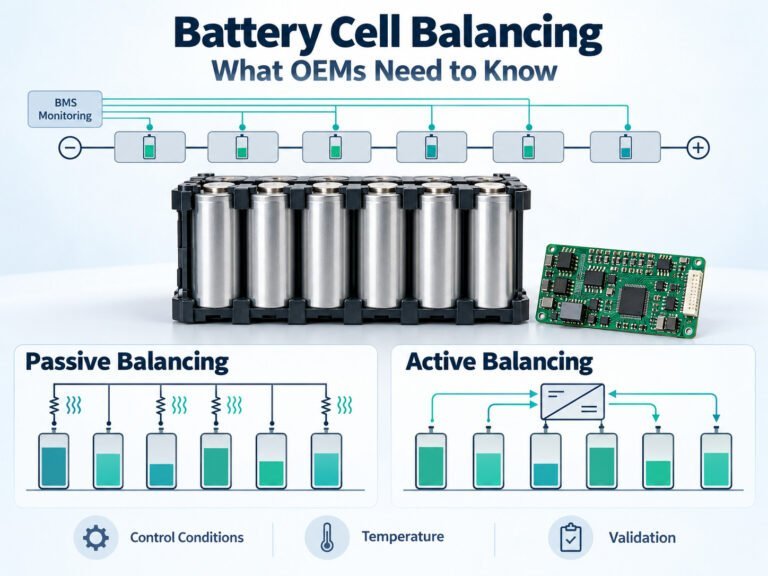
Zellausgleich
Series-connected cells can develop voltage differences during operation.
A balancing function helps maintain cell voltage consistency within the battery pack.
Ladezustand
A smart BMS can estimate battery state of charge using current, voltage, temperature, and battery characteristics.
Kommunikation
Depending on the UAV system, communication can be developed around interfaces such as:
- CAN
- UART
- SMBus
- Custom communication protocols
Communication requirements should be confirmed during the battery development stage.
Smart UAV Battery Monitoring
For industrial UAVs, battery monitoring can provide useful information to the aircraft control system.
A smart battery may provide:
| Battery Data | Anmeldung |
|---|---|
| Pack Voltage | System monitoring |
| Pack Current | Load monitoring |
| Cell Voltage | Cell status |
| Temperatur | Thermal monitoring |
| SOC | Remaining energy estimation |
| Fault Status | Protection monitoring |
| Cycle Count | Battery maintenance |
| Charging Status | Charging management |
Battery communication should be integrated with the UAV’s existing electrical and software architecture.
Mechanical Design of Drone Battery Packs
Electrical performance is only one part of UAV battery development.
The battery must also fit the aircraft mechanically.
Custom mechanical features may include:
- Abmessungen der Batterie
- Mounting holes
- Mounting rails
- Quick-release structures
- Anschlussposition
- Cable length
- Handle
- Housing
- Protective structure
- Weight distribution
- Waterproofing requirements
For agricultural and industrial UAVs, battery packs may be exposed to dust, moisture, vibration, temperature changes, and repeated installation.
The enclosure and mechanical structure should therefore be designed according to the actual operating environment.
High-Current Electrical Design
A high-rate battery requires more than high-rate cells.
The complete current path should be considered.
Dazu gehören:
Cells → Welding → Busbars → BMS → Wires → Connectors → UAV Power System
Each component introduces electrical resistance.
At high current, even relatively small resistance can generate heat.
Power loss caused by resistance can be estimated using:
P = I²R
As current increases, resistance-related heat generation increases rapidly.
For this reason, high-current battery design may require:
- Appropriate wire gauge
- Low-resistance connectors
- Proper welding parameters
- Suitable busbar design
- Correct BMS current rating
- Short electrical paths
- Thermisches Management
Cell Selection for High-Rate Drone Batteries
Cell selection is an important stage in UAV battery development.
Potential selection criteria include:
Die Energiedichte
Higher energy density can help achieve a target energy level within a defined weight limit.
Discharge Capability
The cell should support the required continuous and peak current.
Innenwiderstand
Lower internal resistance can help reduce voltage drop and heat generation under load, subject to the characteristics of the selected cell.
Zyklus Leben
If the UAV operates frequently, cycle performance becomes an important consideration.
Temperature Characteristics
The battery should be evaluated under the expected operating temperature range.
Cell Consistency
Cells used in the same pack should have suitable consistency in:
- Kapazität
- Innerer Widerstand
- Spannung
Cell matching supports balanced pack operation.
Drone Battery Testing and Quality Control
A UAV battery should be validated before mass production.
Depending on the project, testing can include:
Capacity Test
Measures the actual discharge capacity under defined test conditions.
Charge and Discharge Test
Evaluates battery behavior under specified charging and discharge profiles.
High-Current Test
Evaluates the battery under defined current conditions.
Temperature Test
Measures temperature behavior during charging and discharging.
BMS Protection Test
Checks configured protection functions.
Cell Voltage Test
Checks voltage consistency across series-connected cells.
Alterungstest
Battery packs can undergo controlled aging processes before shipment according to production requirements.
Vibrationstest
UAV battery packs can be subjected to vibration conditions relevant to the application.
Mechanical Inspection
Checks:
- Abmessungen
- Anschlussposition
- Housing
- Befestigungspunkte
- Kabelverlegung
- Labeling
Testing requirements should be defined according to the battery design, UAV application, destination market, and applicable standards.
UAV Battery Safety and Transportation
Lithium batteries used in drones need to be considered from both product safety and transportation perspectives.
Depending on the product and market, relevant requirements may include:
- UN38.3
- CE
- RoHS
- Applicable lithium battery transportation requirements
- Customer-specific certification requirements
Certification is not a universal checklist. The applicable standards depend on battery chemistry, configuration, application, destination market, and final product design.
For B2B projects, certification requirements should be confirmed before battery development and mass production.
Drone Battery OEM/ODM Development Process
Yizhan Battery supports custom battery development for UAV manufacturers, drone brands, equipment companies, and system integrators.
Step 1: Requirement Analysis
The customer provides available technical information.
Recommended information includes:
- UAV model
- Motor specification
- ESC specification
- System voltage
- Average current
- Peak current
- Required flight time
- Nutzlast
- Abmessungen der Batterie
- Maximum battery weight
- Anschluss
- Ladeverfahren
- Kommunikationsanforderungen
- Betriebstemperatur
If some information is unavailable, battery configuration can be estimated from the available electrical and mechanical requirements.
Step 2: Battery Configuration
Unser Ingenieurteam bewertet:
Voltage + Capacity + Current + Series/Parallel Configuration
The preliminary battery architecture is then developed according to the UAV’s power requirements.
Step 3: Cell Selection
Cells are evaluated according to:
- Kapazität
- Discharge capability
- Innerer Widerstand
- Gewicht
- Cycle requirements
- Temperature requirements
- Target cost
Step 4: BMS Development
The BMS can be selected or developed according to the project.
Potential functions include:
- Schutz vor Überladung
- Schutz vor Überentladung
- Überstromschutz
- Kurzschlussschutz
- Temperaturschutz
- Zellausgleich
- SOC estimation
- CAN-Kommunikation
- UART-Kommunikation
Step 5: Mechanical Design
The battery structure is designed around the aircraft installation space.
Engineering may consider:
- Abmessungen
- Weight distribution
- Montageverfahren
- Anschlussposition
- Kabelverlegung
- Enclosure
- Protection requirements
Step 6: Prototype Production
A prototype battery is manufactured for engineering validation.
The prototype can be used to evaluate:
- Electrical compatibility
- Mechanical fit
- Current performance
- Temperature behavior
- BMS-Funktionen
- Kommunikation
- Aufladen
Step 7: Testing and Validation
The battery is tested according to the agreed technical specifications.
Die Tests können Folgendes umfassen:
Capacity → Current → Temperature → BMS → Charging → Mechanical → Communication
Additional tests can be added according to the UAV application.
Step 8: Mass Production
After prototype approval, the finalized battery enters mass production.
A typical manufacturing workflow includes:
Cell Inspection → Cell Sorting → Cell Assembly → Welding → BMS Installation → Wiring → Pack Assembly → Electrical Testing → Aging → Final Inspection
Production records and quality-control procedures can be established according to the customer’s requirements.
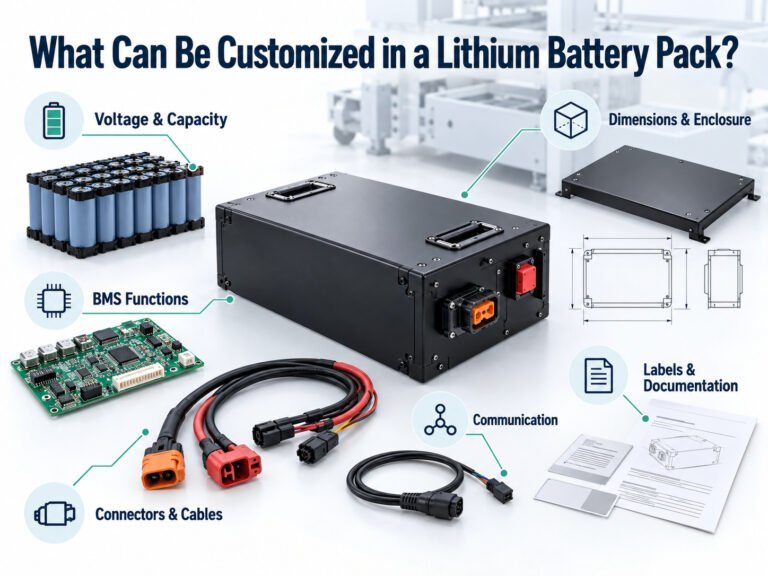
Anpassungsoptionen
Yizhan Battery supports customization across multiple parts of the UAV battery pack.
Electrical Customization
- Spannung
- Kapazität
- Series/parallel configuration
- Discharge capability
- Charging parameters
- BMS
- Kommunikation
Mechanical Customization
- Länge
- Breite
- Höhe
- Housing
- Befestigungskonstruktion
- Anschlussposition
- Cable length
- Handle
Functional Customization
- SOC monitoring
- CAN-Kommunikation
- Überwachung der Temperatur
- Zellausgleich
- Fault reporting
- Battery identification
Branding
For OEM customers, battery packs can also be customized with:
- Logo
- Labels
- Product markings
- Verpackung
- User documentation
Why Work With a Custom Drone Battery Manufacturer?
A standard battery may not match the UAV’s mechanical and electrical requirements.
For example, a standard battery may have:
- The wrong connector
- Insufficient current capability
- Excessive weight
- Incorrect dimensions
- Incompatible BMS communication
- Unsuitable mounting structure
- Incorrect charging parameters
A custom battery pack can be developed around the actual UAV design.
This approach allows battery engineering to consider the complete system from the beginning.
Yizhan Battery UAV Battery OEM/ODM
Yizhan Battery is a lithium battery pack manufacturer providing customized battery solutions for industrial and mobility applications.
For UAV battery projects, our OEM/ODM service can cover:
Requirement Analysis → Cell Selection → Electrical Design → BMS → Structural Design → Prototype → Testing → Mass Production
We can develop battery packs based on:
- Technical specifications
- CAD drawings
- Existing battery samples
- Motor and ESC information
- UAV power requirements
- Einbauraum
- Target capacity
- Target voltage
- Required current
The goal is to create a battery pack that fits the UAV’s electrical, mechanical, thermal, and operational requirements.
FAQ About High-Rate Drone Batteries
What type of battery is used in drones?
Different drones use different lithium battery technologies depending on their size, power requirements, weight limitations, flight time, and application. High-rate LiPo batteries are common in applications requiring high power, while high-rate lithium-ion configurations can also be considered for applications where energy density and mission duration are important.
What is a high C-rate drone battery?
A high C-rate battery is designed to provide a relatively high discharge current compared with its rated capacity. The required C-rate should be calculated from the UAV’s actual current demand and validated under the intended operating conditions.
How do I calculate drone battery capacity?
A basic calculation is:
Capacity (Ah) = Required Energy (Wh) ÷ Battery Voltage (V)
The result should then be adjusted according to system efficiency, usable energy, flight reserve, temperature, battery aging, and actual flight conditions.
Does a higher Ah battery mean longer flight time?
Not necessarily. Higher capacity increases stored energy, but it also adds battery weight. The aircraft must carry the additional mass, which can increase propulsion energy consumption.
What is the difference between drone battery capacity and C-rate?
Capacity indicates how much charge the battery can store, while C-rate describes discharge capability relative to capacity.
For UAV applications, both energy and power requirements should be evaluated.
Can you customize a high-rate UAV battery?
Yes. Battery voltage, capacity, cell configuration, discharge capability, BMS, dimensions, connector, cable, communication, and housing can be customized according to project requirements.
Can you develop agricultural drone batteries?
Yes. Battery packs can be designed for agricultural drones according to payload, motor power, flight time, peak current, continuous current, dimensions, charging requirements, and operating environment.
Can the UAV battery use CAN communication?
Yes. CAN communication can be considered for smart battery applications when the UAV system requires battery data communication.
Can you customize the battery connector?
Yes. Connector type, cable specification, cable length, and connector location can be customized according to the UAV’s electrical and mechanical requirements.
Can you make lightweight drone batteries?
Yes. Weight can be considered during cell selection, pack configuration, enclosure design, and electrical design. However, weight reduction should be evaluated together with capacity, current capability, thermal performance, mechanical strength, and safety requirements.
Do you provide drone battery samples?
Prototype and sample production can be arranged after the battery specification and design requirements are confirmed.
Do you support drone battery OEM and ODM?
Yes. We support OEM/ODM battery pack development from initial technical requirements through prototype development, testing, and mass production.
Custom High-Rate Drone Battery Pack
A UAV battery is more than a combination of cells. It is an integrated system involving energy capacity, discharge performance, electrical resistance, BMS protection, thermal management, mechanical structure, communication, and charging.
For UAV manufacturers and drone developers, battery design should begin with the aircraft’s actual operating profile.
Yizhan Battery provides customized lithium battery pack solutions for:
- Agricultural Drones
- Industrial UAVs
- Heavy-Lift Drones
- Inspection UAVs
- Mapping Drones
- Surveying Drones
- FPV Drones
- Specialized UAV Platforms
From cell selection and high-current design to BMS development, structural customization, testing, and production, our OEM/ODM service supports the development of battery packs for different UAV applications.
Looking for a custom high-rate drone battery pack? Send us your UAV voltage, capacity, peak current, continuous current, flight time, dimensions, and connector requirements to start the battery design process.