
Lithium iron phosphate (LFP) batteries are widely used in electric vehicles, energy storage systems, marine equipment, AGVs, robots, forklifts, golf carts, medical devices, and other industrial applications. Their stable chemistry, good cycle performance, and thermal characteristics make LFP a common choice for battery pack applications.
However, the performance of an LFP battery pack depends on more than the battery cells themselves. A properly designed 电池管理系统 (BMS) is also an important part of the battery pack.
The BMS monitors battery conditions, manages charging and discharging, provides protection, and can communicate battery information to the host equipment. For customized LFP battery packs, the BMS should be selected and configured according to the electrical and operating requirements of the application.
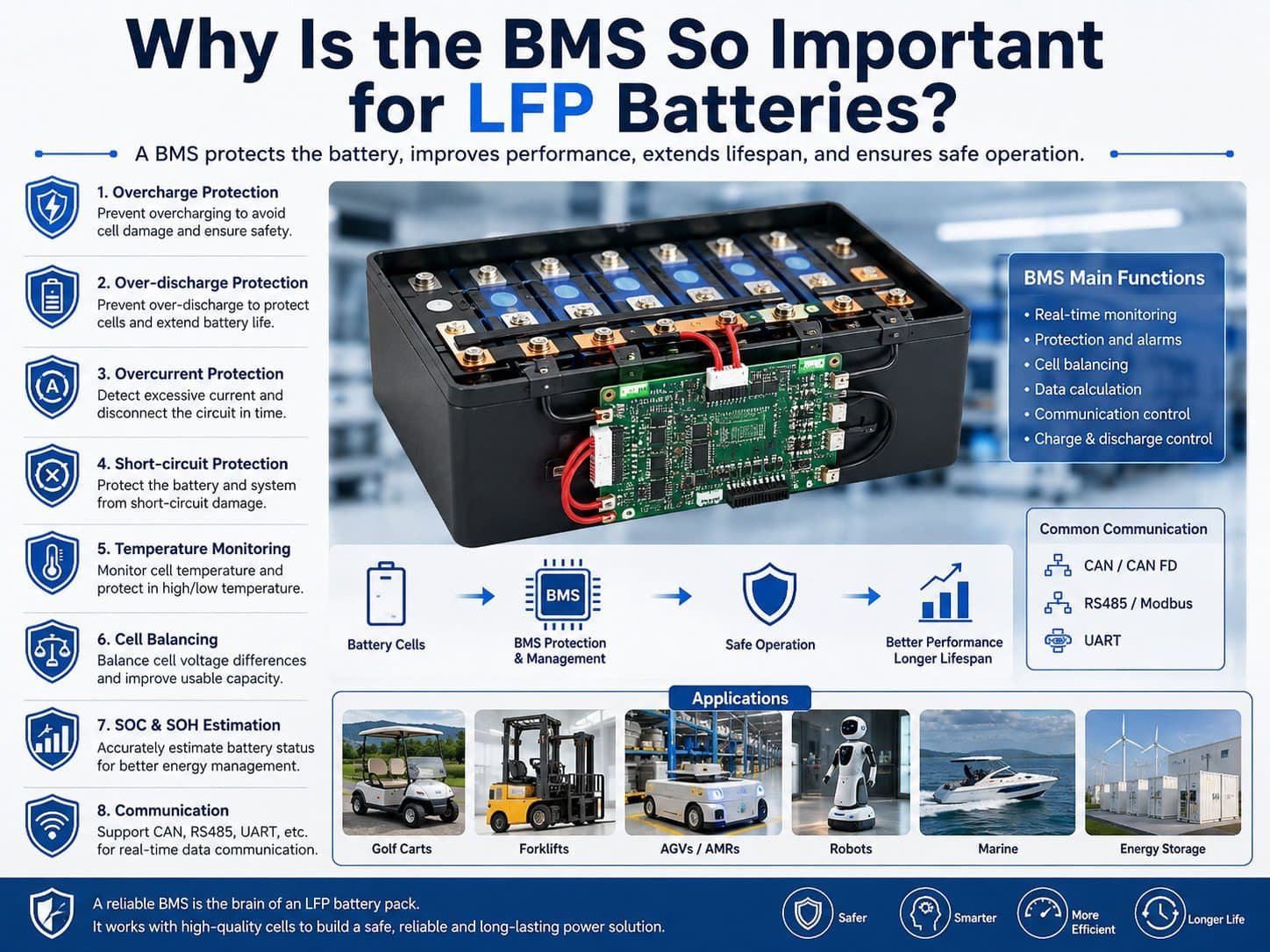
Part 1.What Is a Battery Management System?
A Battery Management System, or BMS, is an electronic control system used to monitor and manage a rechargeable battery pack.
For an LFP battery pack, the BMS can monitor parameters such as:
- 细胞电位
- 电池组电压
- 充电电流
- 放电电流
- 电池温度
- 充电状态 (SOC)
- 健康状况(SOH)
- 故障状况
Based on these measurements, the BMS can control or disconnect charging and discharging when specified protection thresholds are reached.
In simple terms, the battery cells store energy, while the BMS helps manage how that energy is charged, discharged, and monitored.
Part 2.Why Does an LFP Battery Need a BMS?
LFP chemistry has good thermal stability and is widely used in rechargeable battery systems. However, this does not mean that an LFP battery can operate without protection.
A battery pack may contain multiple cells connected in series and parallel. Small differences between cells can occur during manufacturing and operation.
For example, cells may have differences in:
- 容量
- 内部电阻
- 电压
- 温度
- Aging rate
As the battery goes through repeated charge and discharge cycles, these differences can become more noticeable.
A BMS helps monitor these conditions and keeps the battery operating within its specified limits.
1. Overcharge Protection
Overcharging can negatively affect lithium battery cells.
During charging, the BMS monitors the voltage of individual cells or cell groups. When a cell reaches the configured upper voltage limit, the BMS can stop or interrupt charging to prevent the cell from exceeding its specified operating range.
This function is particularly important for battery packs with multiple cells connected in series.
For example, in a 16S LFP battery pack, the total pack voltage is determined by the voltage of all 16 cell groups. Even when the overall pack voltage appears normal, one cell group may reach its upper voltage limit earlier than others.
Cell-level voltage monitoring allows the BMS to identify this condition.
2. Over-Discharge Protection
LFP cells also have specified minimum discharge voltage limits.
If a battery continues discharging after a cell reaches its lower voltage threshold, cell performance and service life may be affected.
The BMS monitors cell voltage during discharge and can disconnect the load when the configured protection threshold is reached.
This prevents the battery from continuing to operate outside its specified voltage range.
3. Overcurrent Protection
Different applications require different discharge currents.
For example, an electric motor may draw a high current during startup or acceleration. Industrial equipment can also generate temporary current peaks during operation.
The BMS can monitor the current flowing through the battery pack and respond when the current exceeds the configured protection threshold.
Overcurrent protection can help protect:
- 电池单元
- 母线
- 电缆
- 连接器
- MOSFET
- Other electrical components
The BMS current rating should be selected according to the actual load requirements rather than simply matching the nominal battery capacity.
4. Short-Circuit Protection
A short circuit can cause a very high current to flow through the battery.
The BMS can detect a rapid increase in current and disconnect the battery circuit when the protection conditions are met.
The response time and protection strategy depend on the BMS design.
However, BMS protection should not be considered the only safety measure. Battery packs should also use appropriate fuses, wiring, connectors, insulation, enclosure structures, and other protection components.
5. Temperature Monitoring
Temperature affects battery performance, charging, and safety.
A BMS can use temperature sensors to monitor the battery pack during charging and discharging.
If the temperature exceeds a configured limit, the BMS can stop charging or discharging, depending on the protection strategy.
Temperature monitoring can also be important in cold environments.
For example, LFP batteries generally require protection against charging at temperatures below the manufacturer’s specified charging range. A BMS with low-temperature charging protection can prevent charging when the battery temperature is too low.
This is particularly relevant for outdoor equipment, marine batteries, AGVs, forklifts, and other applications exposed to changing environmental conditions.
6. Cell Balancing
Cell balancing is another important BMS function.
A battery pack may contain many cells connected in series. Even when the cells come from the same production batch, their electrical characteristics are not perfectly identical.
During repeated charging and discharging, some cells may reach their upper voltage limit earlier than others.
Without appropriate balancing, the difference between cells can increase over time.
A BMS can use a balancing strategy to reduce voltage differences between cells.
There are two common approaches:
被动平衡
Passive balancing removes a small amount of energy from cells with higher voltage through resistive components.
It is relatively simple and widely used in battery packs.
主动平衡
Active balancing transfers energy between cells rather than simply dissipating it as heat.
It can be considered for battery systems where balancing efficiency is particularly important, although the circuit is generally more complex.
The appropriate balancing method depends on the battery design, cell configuration, cost requirements, and application.
7. SOC and SOH Estimation
A smart BMS can estimate the battery’s 充电状态 (SOC) 和 健康状况(SOH).
SOC indicates the approximate remaining charge in the battery.
例如
- 100% SOC: Battery is fully charged
- 50% SOC: Approximately half of the usable charge remains
- Low SOC: Battery is approaching its discharge limit
SOH is used to describe the battery’s health condition compared with its original performance.
These parameters can be transmitted to the host device through communication interfaces.
This can help equipment operators understand the battery condition and plan charging or maintenance.
8. Communication With the Equipment
For many modern applications, the BMS does more than provide basic protection.
A smart BMS can communicate with the host equipment through protocols such as:
- CAN
- CAN FD
- RS485
- UART
- Modbus-RTU
For example, an AGV may receive battery SOC information through CAN communication.
A golf cart controller may need information about battery voltage and current.
A marine battery system may use a display or monitoring device to show battery status.
The communication protocol and data format should therefore be defined during the battery design stage.
9. BMS Design for Different Applications
A BMS should not be selected solely according to battery voltage.
Different applications have different operating conditions and current requirements.
AGV and AMR Batteries
AGVs and AMRs may operate for long periods and frequently accelerate, decelerate, and recharge.
Their BMS may need:
- High-current discharge capability
- SOC监控
- CAN 通信
- 温度监测
- Fault reporting
- 充电控制
叉车电池
Electric forklifts can require high discharge currents and frequent charging.
The BMS may need to support:
- High-current operation
- 温度监测
- SOC估算
- CAN 通信
- 过流保护
- Battery fault diagnosis
Marine Batteries
Marine battery packs operate in environments with moisture, vibration, and temperature changes.
In addition to BMS functions, the complete battery pack should consider:
- 防水外壳
- Connector protection
- Corrosion resistance
- Vibration resistance
- 低温充电保护
- Appropriate IP protection
高尔夫球车电池
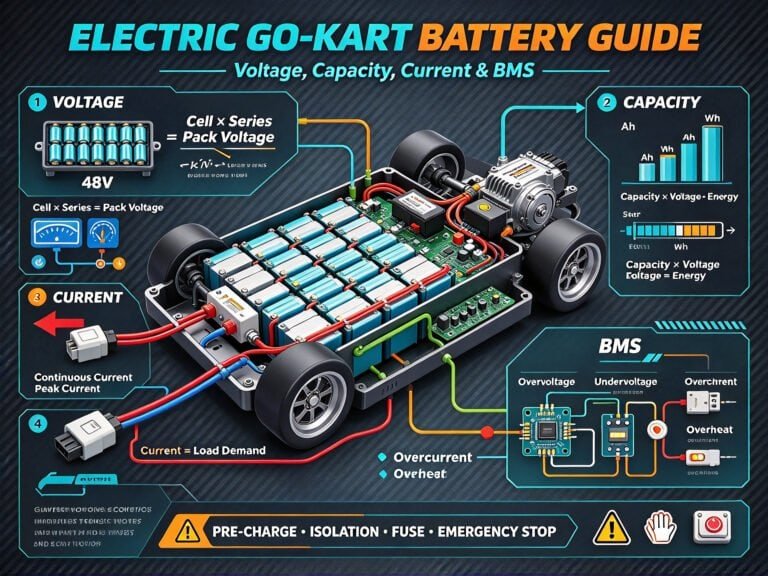
Golf carts may use 36V, 48V, or other battery configurations.
The BMS should be compatible with the motor controller and charger while providing suitable current and temperature protection.
Part 3.How to Choose the Right BMS for an LFP Battery?
When designing an LFP battery pack, several parameters should be considered.
电池电压
First determine the required battery configuration.
例如
- 12V-class LFP battery
- 24V-class LFP battery
- 36V-class LFP battery
- 48V-class LFP battery
- Higher-voltage battery systems
The number of cells connected in series determines the battery’s nominal voltage and charging voltage.
电池容量
Capacity is normally expressed in Ah.
A higher-capacity battery may require a BMS with suitable current-handling capability depending on the application.
However, BMS current rating should be determined primarily by the actual charging and discharging current requirements.
连续放电电流
The BMS should support the equipment’s continuous operating current.
For example, if a motor normally operates at a high current, selecting a BMS with an insufficient continuous current rating can result in unnecessary protection events.
Peak Current
Some equipment requires short-duration current peaks.
Motor startup, acceleration, lifting, and other dynamic loads can generate temporary high-current demand.
Therefore, both continuous and peak current should be considered.
Temperature Range
The battery’s expected operating temperature should be defined before selecting the BMS.
这包括
- 充电温度
- 卸料温度
- 储存温度
Temperature sensor placement is also important because the sensor should accurately represent the thermal condition of the battery pack.
Part 4.What Happens If an LFP Battery Does Not Have a Properly Designed BMS?
An LFP battery pack without appropriate battery management may have difficulty controlling cell voltage, current, and temperature.
Potential problems can include:
- 超额收费
- 过度放电
- 过电流
- 细胞失衡
- Abnormal temperature
- 可用容量减少
- Accelerated battery degradation
- Unexpected shutdown
For this reason, the BMS should be treated as part of the overall battery system rather than as an optional accessory.
At the same time, a BMS cannot compensate for poor-quality cells or an unsuitable battery design. Cell selection, cell matching, electrical connections, thermal design, mechanical structure, protection components, and manufacturing quality all contribute to battery performance.
Part 5.BMS and Custom LFP Battery Packs
For OEM and ODM battery applications, BMS selection should begin during the battery design stage.
A custom battery manufacturer may need to define:
- 电池电压
- 电池容量
- 连续放电电流
- 峰值放电电流
- 充电电流
- 单元配置
- 温度范围
- 通信协议
- SOC and SOH requirements
- Installation dimensions
- 防护要求
- 充电器兼容性
For example, a 51.2V 100Ah LFP battery for an industrial vehicle may require a different BMS configuration from a 12.8V 100Ah marine battery.
Although both batteries use LFP chemistry, their operating conditions and electrical requirements are different.
结论
The BMS is an important part of an LFP battery pack because it helps monitor and manage the battery’s electrical and thermal conditions.
Its functions can include overcharge protection, over-discharge protection, overcurrent protection, short-circuit protection, temperature monitoring, cell balancing, SOC/SOH estimation, and communication with the host equipment.
However, BMS performance should always be evaluated together with the cells, battery structure, electrical protection, thermal design, charger, and application requirements.
For OEM and ODM projects, selecting the right BMS at the beginning of the battery development process can help create a battery pack that matches the equipment’s voltage, current, communication, and environmental requirements.
 English
  Chinese
  Japanese
  German
  French
  Korean
