
Choosing the right cells is one of the first steps in developing a custom drone battery pack. The battery affects not only flight time, but also power output, payload capacity, battery weight, operating temperature, and the overall design of the UAV power system.
For agricultural drones, industrial UAVs, inspection drones, and other high-power applications, a battery pack needs to deliver sufficient current while remaining within the required weight, size, and thermal limits.
A suitable cell should therefore be selected according to the actual power requirements of the drone rather than capacity alone.
This guide explains how to select lithium-ion cells for a custom drone battery pack, how to calculate C-rate and series-parallel configurations, and what to consider when developing a battery for UAV applications.
Part 1.Why Cell Selection Matters for Drone Battery Packs
A drone battery operates under a different load profile from many conventional battery-powered devices.
During takeoff, climbing, acceleration, and heavy-load operation, the propulsion system can demand significant current. At the same time, the battery needs to remain light enough to avoid unnecessarily increasing the aircraft’s energy consumption.
The main parameters to evaluate include:
- 电池电压
- 容量
- 连续放电电流
- 峰值放电电流
- 能量密度
- Power capability
- 内部电阻
- Cell weight
- 工作温度
- 周期寿命
- Physical dimensions
These parameters need to be evaluated together.
For example, a 5Ah cell with a high discharge capability may be more suitable for a high-power UAV than a 6Ah cell designed primarily for energy capacity.
Part 2.What Type of Cells Are Used in Drone Batteries?
Lithium-based rechargeable cells are commonly considered for drone battery systems. The appropriate cell format depends on the UAV’s electrical and mechanical requirements.
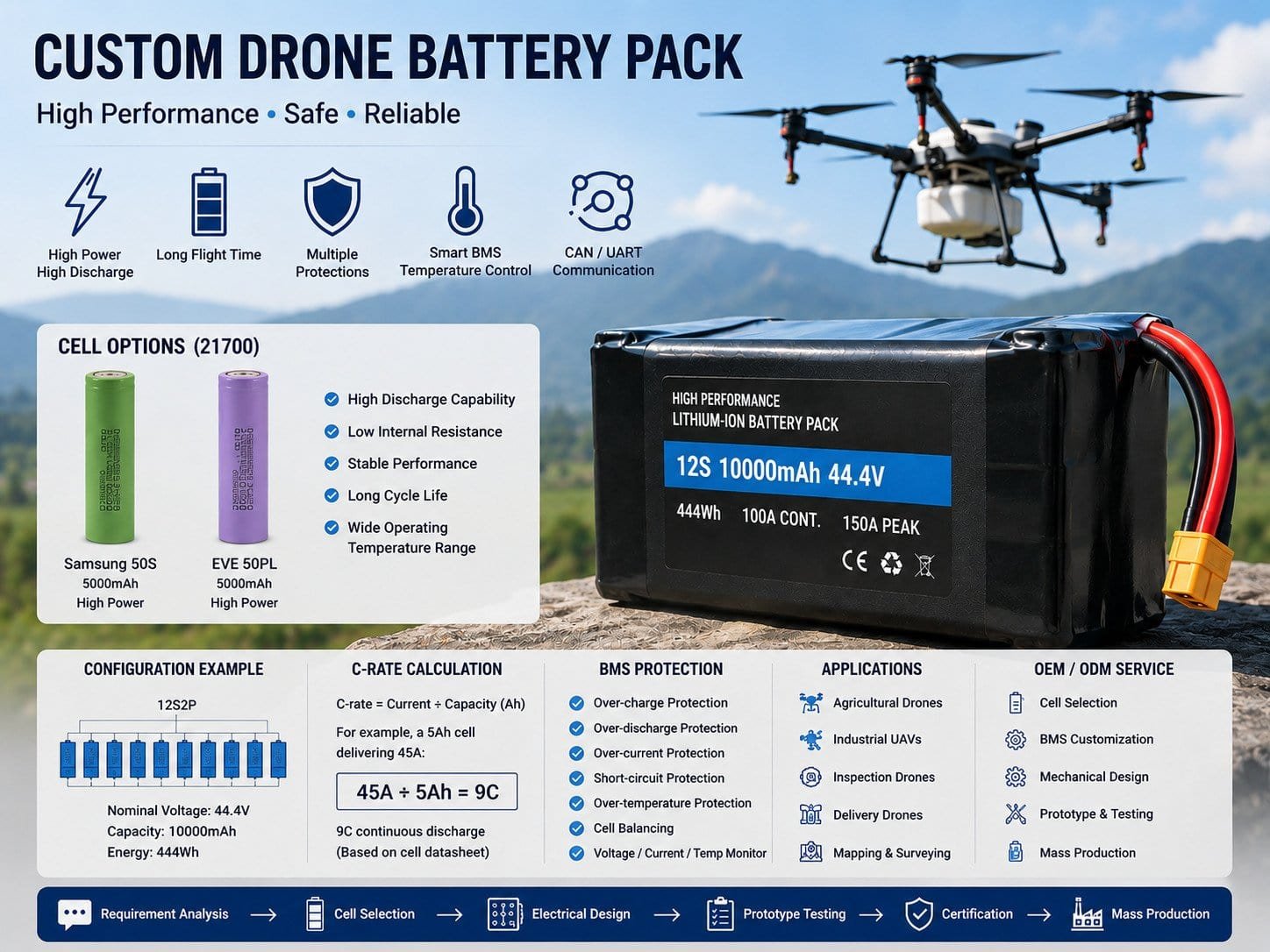
For high-power UAV battery packs, 21700 cylindrical lithium-ion cells are one option to evaluate because they can provide a combination of capacity, power capability, and cell-level packaging efficiency.
Examples of cells that may be evaluated include:
- Samsung 50S
- EVE 50PL
These cells have different performance characteristics and should not be treated as direct equivalents.
The final selection should always be based on the applicable manufacturer’s datasheet and the actual requirements of the drone.
Part 3.Key Parameters for Drone Battery Cell Selection
1. Battery Voltage
The first step is determining the voltage required by the UAV power system.
For a lithium-ion cell with a nominal voltage of approximately 3.6V, cells connected in series increase the battery voltage.
例如
6S: 3.6V × 6 = approximately 21.6V nominal
12S: 3.6V × 12 = approximately 43.2V nominal
14S: 3.6V × 14 = approximately 50.4V nominal
The actual nominal voltage and maximum charging voltage depend on the selected cell chemistry and battery configuration.
The PACK should be designed according to the motor, ESC, power electronics, and manufacturer’s voltage requirements.
2.电池容量
Capacity is normally expressed in Ah or mAh.
例如
5000mAh = 5Ah
Battery energy can be estimated using:
能量 (Wh) = 电压 (V) × 容量 (Ah)
A 21.6V, 10Ah battery therefore has a nominal energy of approximately:
21.6 × 10 = 216Wh
Actual usable energy will vary depending on the discharge limits, operating conditions, system efficiency, temperature, and required battery reserve.
Capacity should therefore be considered together with battery weight and power requirements.
3. Continuous Discharge Current
Continuous discharge current indicates how much current the cell can provide under the manufacturer’s specified test conditions.
This is particularly important for UAVs because the propulsion system can place a substantial continuous load on the battery.
For example, if a 5Ah cell can continuously deliver 45A under a specified test condition:
45A ÷ 5Ah = 9C
This means the corresponding continuous discharge rate is 9C under that condition.
However, the manufacturer’s specified test conditions should always be checked before using a C-rate for PACK design.
4. Peak Discharge Current
Peak current is different from continuous current.
A cell may support a higher current for a limited period, but that does not mean it can safely deliver the same current continuously.
For UAV applications, both should be evaluated:
连续电流
和
峰值电流
The duration of the peak current should also be considered.
For example, a drone may have a relatively moderate average power requirement but a significantly higher current requirement during takeoff.
5. Internal Resistance
Internal resistance influences voltage drop and heat generation when current flows through the cell.
A simplified relationship is:
Voltage Drop = Current × Internal Resistance
As current increases, voltage drop and heat generation can become more significant.
For high-power drone applications, cell consistency and internal resistance are therefore important during cell selection and PACK assembly.
6. Cell Weight
Battery weight directly affects the aircraft’s total weight.
Increasing battery capacity can increase flight time, but it also adds mass.
This creates an engineering trade-off between:
电池容量
电池重量
Flight Time
Payload
Power Consumption
A larger battery does not automatically result in longer practical flight time.
Part 4.Samsung 50S for Drone Battery Packs
Samsung 50S is a 21700-format lithium-ion cell designed for high-power applications.
It can be considered for UAV battery applications where high discharge performance is required.
潜在的应用包括:
- Agricultural drones
- Industrial UAVs
- High-power drones
- Heavy-payload UAVs
- Commercial UAV platforms
When using Samsung 50S, the PACK configuration should be determined according to the drone’s required voltage and current.
The cell should also be evaluated under the actual application conditions, including temperature, discharge profile, and PACK thermal behavior.
Samsung 50S C-Rate Calculation
The C-rate can be calculated using:
C-rate = Current ÷ Capacity
For a 5Ah cell delivering 45A:
45A ÷ 5Ah = 9C
The exact usable current and corresponding C-rate should be based on the manufacturer’s current specification and test conditions.
Part 5.EVE 50PL for UAV Battery Applications
EVE 50PL can be considered as a 21700 high-power cell option for customized UAV battery packs.
For manufacturers looking for a domestic cell option, it can be evaluated according to:
- 标称容量
- 连续放电电流
- 峰值放电能力
- 内部电阻
- Cell weight
- 工作温度
- Cycle-life requirements
When using EVE 50PL as an alternative to another cell, the comparison should cover more than nominal capacity.
A proper evaluation should include:
- 当前能力
- Voltage behavior under load
- 温度上升
- 内部电阻
- Cycle performance
- PACK-level performance
A cell should not be described as a direct replacement simply because two models have similar dimensions and capacity.
Part 6.Samsung 50E for Energy-Oriented Applications
Samsung 50E is a 21700-format lithium-ion cell generally associated with energy-oriented applications.
Compared with high-power cells, an energy-oriented cell may be more appropriate where the application places greater emphasis on energy capacity and does not require the same level of high-current output.
Potential applications can include:
- Long-duration equipment
- eBike battery packs
- 储能
- Portable power systems
- Certain lower-power UAV applications
For drones, 50E should be evaluated according to the actual current requirement. It should not automatically be substituted for a high-power cell simply because both cells have a similar nominal capacity.
Part 7.Samsung 58E for 18650 Applications
Samsung 58E belongs to the 18650 cell category and is positioned differently from 21700 high-power cells.
It can be considered where the battery design requires:
- 18650 dimensions
- High capacity per cell
- Compact cell arrangement
- Energy-oriented performance
For high-power UAV applications, however, the cell’s discharge characteristics must be carefully evaluated before selecting it.
The physical size of the cell alone does not determine whether it is suitable for a drone.
Part 8.How to Calculate the Number of Cells in a Drone Battery Pack
Once the voltage and current requirements are known, the series and parallel configuration can be calculated.
Series Connection
Series connection determines the battery voltage.
For approximately 3.6V nominal lithium-ion cells:
6S = approximately 21.6V
12S = approximately 43.2V
14S = approximately 50.4V
The actual configuration depends on the UAV power system.
Parallel Connection
Parallel connection increases capacity and current capability.
For a 5Ah cell:
1P = 5Ah
2P = 10Ah
3P = 15Ah
例如
12S2P
means 12 cells connected in series and 2 cells connected in parallel at each series level.
The total cell count is:
12 × 2 = 24 cells
The nominal capacity is:
5Ah × 2 = 10Ah
The nominal voltage is approximately:
3.6V × 12 = 43.2V
How to Determine the Required Parallel Count
Suppose the UAV requires:
100A continuous current
and the selected cell has a specified continuous current capability of:
45A per cell
The theoretical minimum parallel count is:
100A ÷ 45A = 2.22
Therefore, 2P would not provide sufficient theoretical current capacity based on this simplified calculation.
A higher parallel configuration would need to be evaluated.
However, actual PACK design must also consider:
- BMS current limit
- 连接器额定值
- Busbar resistance
- 焊接质量
- 温度上升
- 细胞温度
- Wiring resistance
- Safety margin
The simple mathematical result is only the starting point.
Part 8.How to Select Cells for Different Drone Applications
Different UAV applications have different power requirements.
Agricultural Drone Battery
Agricultural drones often carry payloads such as spraying or spreading systems.
The battery may need to balance:
- High discharge capability
- 能源产能
- 电池重量
- 周期寿命
- 环境条件
- Installation and removal requirements
High-power 21700 cells such as Samsung 50S or EVE 50PL can be evaluated for suitable configurations.
Industrial UAV Battery
Industrial drones used for inspection, mapping, surveying, and monitoring may have different payload and flight-time requirements.
The battery design should consider the equipment carried by the UAV and its average and peak power consumption.
Heavy-Payload Drone Battery
Heavy-lift UAVs generally place greater demands on the propulsion system.
重要参数包括:
- Maximum take-off weight
- Payload
- 电机功率
- ESC current
- 电池电压
- 峰值电流
- Flight duration
High-power cells should be evaluated according to the complete system load.
Long-Endurance Drone
For long-endurance applications, energy density becomes an important design parameter.
However, increasing capacity also increases battery weight.
The battery manufacturer should therefore evaluate the relationship between:
Battery Energy → Battery Weight → Flight Power → Flight Time
rather than selecting a cell based solely on Ah capacity.
Part 10.Custom BMS for Drone Battery Packs
A customized BMS can provide monitoring and protection functions according to the battery architecture.
Depending on the design, the BMS may monitor:
- 单个电池电压
- Total pack voltage
- Charge and discharge current
- 细胞温度
- 电池温度
- SOC
- SOH
- Cycle count
- 故障状态
Protection functions may include:
- 过充电保护
- 过放电保护
- 过流保护
- 短路保护
- 过温保护
- Under-temperature protection
- 细胞平衡
For intelligent UAV systems, communication can also be integrated into the BMS.
Part 11.CAN Communication for Smart Drone Batteries
A smart UAV battery may need to communicate with the flight controller or power-management system.
Depending on the system architecture, communication interfaces may include:
- CAN
- UART
- RS485
- Other customized protocols
The battery can transmit information such as:
- SOC
- SOH
- 电压
- 当前
- 温度
- 剩余容量
- Cycle count
- 故障信息
Communication requirements should be defined before BMS firmware development.
Part 12.Mechanical Design of a Custom Drone Battery
Electrical performance is only one part of a drone battery.
The battery must also physically fit the aircraft.
Mechanical customization can include:
- Battery length
- Battery width
- Battery height
- 住房结构
- 安装点
- 连接器位置
- 电缆长度
- 电缆布线
- 锁定机构
- Cooling structure
For agricultural and industrial UAVs, the battery housing may also need to account for vibration, dust, moisture, and repeated battery replacement.
Part 13.Thermal Management of High-Rate Drone Batteries
High-current discharge generates heat.
Battery temperature can influence:
- 放电性能
- 内部电阻
- Battery efficiency
- 周期寿命
- 安全
Thermal management can include:
- 细胞排列
- 热界面材料
- Airflow
- 温度传感器
- 住宅设计
- BMS温度保护
For high-rate battery packs, prototype testing should measure temperature under representative loads.
Part 14.Testing a Custom Drone Battery Pack
Before mass production, the battery should be evaluated at both cell and PACK level.
电气测试
测试可能包括:
- 容量
- 充电性能
- 放电性能
- 内部电阻
- 电压一致性
- 连续电流
- 峰值电流
热测试
Testing may evaluate:
- 细胞温度
- PACK temperature
- Temperature distribution
- 负载下的温升
BMS 测试
The BMS should be checked for:
- Overvoltage protection
- Undervoltage protection
- 过流保护
- 短路保护
- 温度保护
- 细胞平衡
- 交流
机械测试
Depending on the application, testing can include:
- 振动
- 影响
- Connector durability
- Housing integrity
- Installation and removal cycles
应用程序测试
The final battery should also be tested under representative UAV operating conditions.
This can include:
- Takeoff
- Hovering
- 攀岩
- Cruise
- 重载运行
- Landing
Application testing can reveal performance characteristics that are not visible in a simple laboratory discharge test.
Part 15.Certification and Transportation of Drone Lithium Batteries
Lithium battery requirements depend on the battery design, destination market, transportation method, and final product.
For lithium batteries, manufacturers may need to consider requirements such as:
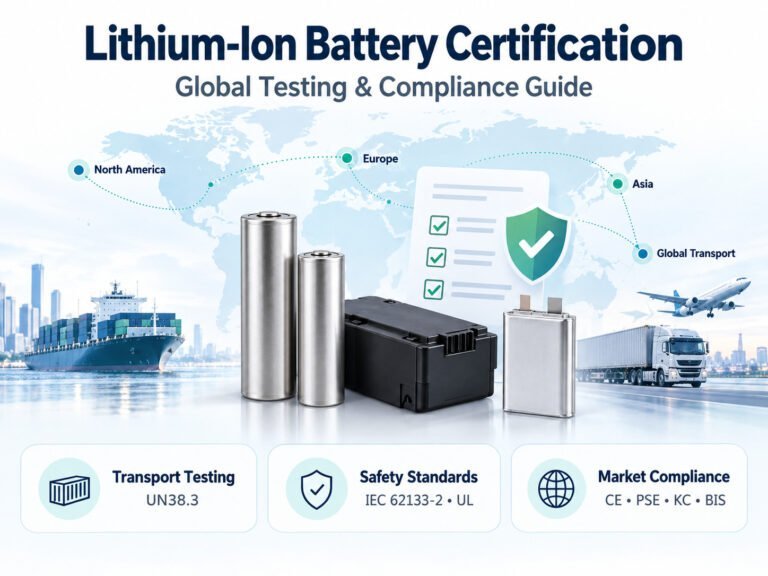
- 联合国 38.3
- IEC 62133-2
- 与CE相关的要求
- RoHS
- 适用的地区性电池法规
UN 38.3 is particularly relevant to the transportation of lithium batteries and battery-powered products.
Certification and transportation requirements should be considered during development rather than after the battery has entered mass production.
Part 16.What Information Is Needed for a Custom Drone Battery?
A battery manufacturer normally needs the following information:
电气要求
- 额定电压
- Maximum voltage
- 容量
- 连续电流
- 峰值电流
- 电机功率
- ESC specifications
机械要求
- Maximum battery dimensions
- Maximum battery weight
- 安装方法
- 连接器
- 电缆长度
- Housing requirements
Operating Requirements
- Target flight time
- Payload
- 工作温度
- 储存温度
- 充电时间
- 预期循环寿命
Communication Requirements
- CAN
- UART
- RS485
- Other communication protocols
Market Requirements
- Target country
- 运输要求
- 必备证书
- Battery labeling requirements
Providing these specifications at the beginning of the project can make cell selection and PACK development more efficient.
Part 17.OEM/ODM Drone Battery PACK Development
For UAV manufacturers, OEM/ODM battery development can cover the complete process from cell selection to mass production.
A typical development workflow includes:
需求分析
↓
细胞选择
↓
电气设计
↓
串并联配置
↓
BMS 开发
↓
机械设计
↓
Prototype Production
↓
Electrical and Thermal Testing
↓
应用程序测试
↓
认证
↓
批量生产
This process allows the battery design to be evaluated as part of the complete UAV system.
Part 18.Why Work With an Experienced Drone Battery PACK Manufacturer?
A custom drone battery requires coordination between electrical engineering, battery technology, mechanical design, BMS development, testing, and production.
When evaluating a battery manufacturer, consider:
- Cell selection capability
- PACK design capability
- BMS 开发
- 通信一体化
- 原型制作
- Testing equipment
- 质量管理
- Production traceability
- 认证支持
- Mass-production capability
The manufacturer’s experience should be evaluated based on the actual requirements of the UAV project rather than marketing claims alone.
常见问题解答
What cells are commonly used for drone batteries?
High-power lithium-ion cells, including suitable 21700 cells, can be considered for many UAV battery applications. Samsung 50S and EVE 50PL are examples of high-power cell options that can be evaluated for customized drone battery packs.
Is Samsung 50S suitable for agricultural drones?
Samsung 50S can be evaluated for agricultural UAV applications that require high discharge performance. The final selection depends on the drone’s current demand, battery configuration, weight requirements, and thermal conditions.
Can EVE 50PL replace Samsung 50S?
EVE 50PL can be evaluated as an alternative cell option. However, a direct replacement should not be assumed based only on capacity or physical dimensions. Discharge performance, internal resistance, temperature rise, cycle life, and PACK-level performance should be verified.
What is the C-rate of a drone battery?
C-rate describes the relationship between battery current and capacity.
The formula is:
C-rate = Current ÷ Capacity (Ah)
For example, a 5Ah battery delivering 45A corresponds to 9C.
Is a higher C-rate always better for a drone?
No. The required C-rate depends on the UAV’s actual power demand.
A higher-power cell may provide additional current capability, but it can also involve different capacity, weight, cost, and thermal characteristics.
The cell should be selected according to the complete application requirements.
How many cells does a drone battery need?
The number depends on the required voltage, capacity, current, and cell specifications.
For example, a 12S2P battery using 5Ah cells contains 24 cells and has a nominal capacity of approximately 10Ah.
The final configuration must be calculated according to the UAV system.
Does a drone battery need a BMS?
The need for a BMS and its specific functions depends on the battery architecture and UAV system. A suitable battery management and protection system can monitor cell voltage, current, temperature, and other operating parameters.
Can a drone battery support CAN communication?
Yes. CAN communication can be integrated into a smart battery system when required by the UAV’s control architecture.
Can drone battery dimensions be customized?
Yes. Battery dimensions, housing, connectors, cables, mounting points, and other mechanical features can be customized according to the UAV design.
结论
Choosing the right cell for a drone battery PACK requires more than comparing capacity.
The selection process should consider voltage, capacity, continuous discharge current, peak current, C-rate, internal resistance, cell weight, operating temperature, PACK configuration, BMS requirements, thermal management, and application conditions.
For high-power UAV applications, Samsung 50S and EVE 50PL can be evaluated as 21700 high-power cell options. Samsung 50E can be considered for applications with greater emphasis on energy capacity, while Samsung 58E provides an 18650-format option for designs where that cell format is required.
The final battery configuration should always be verified against the applicable manufacturer’s specifications and validated through prototype, electrical, thermal, and application testing.
A well-planned OEM/ODM development process allows the battery PACK to be designed around the UAV’s actual power system, mechanical structure, flight requirements, and target market.
 English
  Chinese
  Japanese
  German
  French
  Korean
