
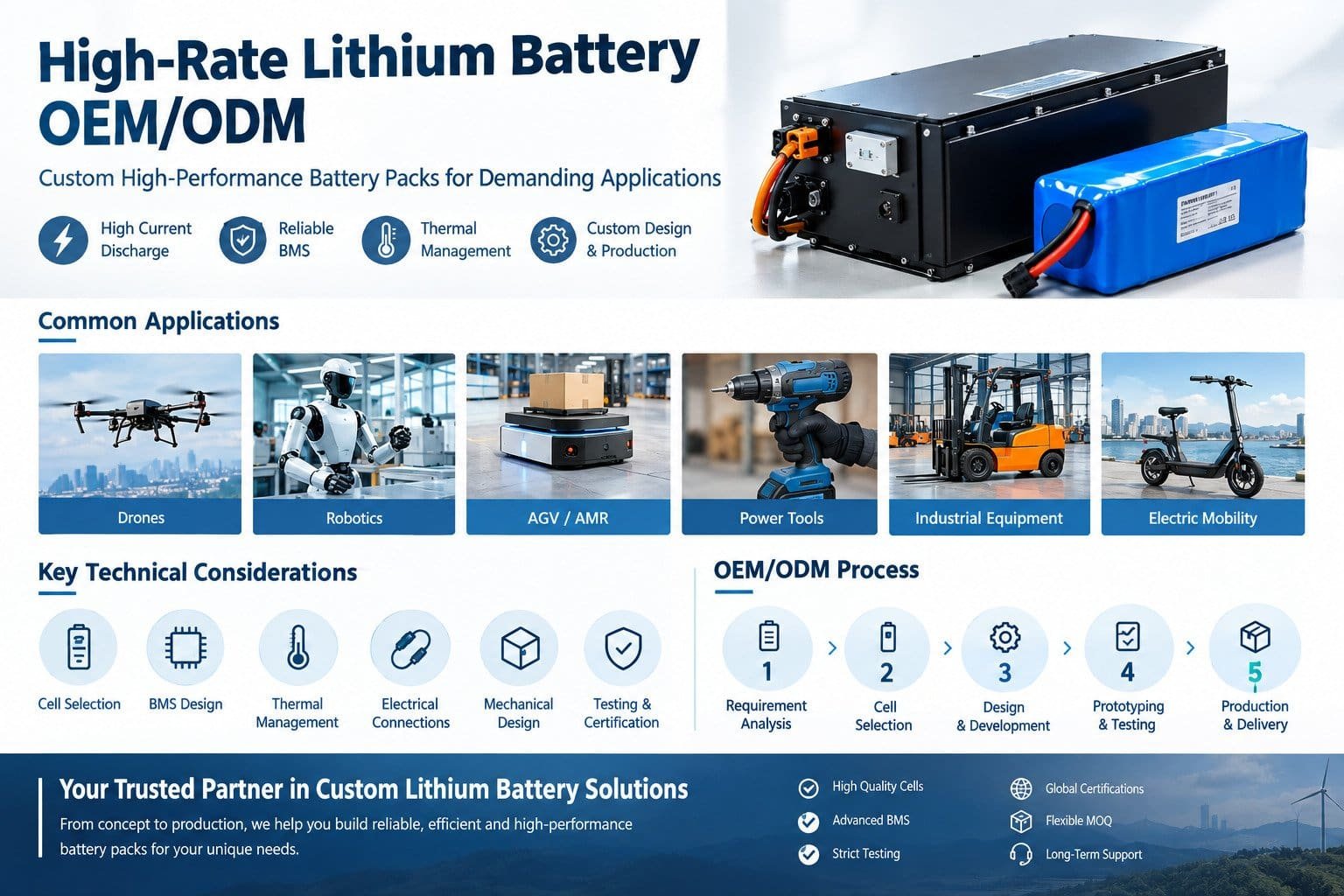
High-rate lithium battery packs are used in equipment that requires substantial current within a short or continuous operating period. Robotics, drones, AGVs, AMRs, power tools, industrial equipment, electric mobility products, and other battery-powered systems may all require a battery pack designed for high-current discharge.
For B2B buyers, selecting a high-rate lithium battery supplier involves more than choosing a battery with a high C-rate. The complete battery pack needs to match the equipment’s voltage, capacity, continuous current, peak current, operating temperature, mechanical space, communication requirements, and safety requirements.
A capable High-Rate Lithium Battery OEM/ODM manufacturer should therefore provide more than cell assembly. The development process can include cell selection, battery configuration, BMS design, thermal management, mechanical engineering, prototyping, testing, certification support, and mass production.
This guide explains the main technical considerations when sourcing a custom high-rate lithium battery pack and what buyers should evaluate before starting an OEM/ODM project.
What Is a High-Rate Lithium Battery?
A high-rate lithium battery is designed to provide relatively high electrical current compared with its rated capacity.
Battery discharge capability is commonly described using the C 速率.
For example, a 20Ah battery theoretically delivering 1C corresponds to approximately:
20Ah × 1C = 20A
At 3C:
20Ah × 3C = 60A
At 5C:
20Ah × 5C = 100A
However, this calculation alone does not define whether a battery pack is suitable for a particular application.
Actual performance depends on the characteristics of the selected cells and the complete battery system, including:
- 细胞化学
- 细胞模型
- 内部电阻
- Continuous discharge capability
- 峰值放电能力
- BMS current rating
- MOSFET configuration
- Busbar or nickel-strip design
- 电缆规格
- 连接器额定值
- 热管理
- 工作温度
- 电池盒
- 保护参数
For this reason, a battery labeled as a “high-rate battery” should still be evaluated according to the actual operating requirements of the equipment.
Why High-Rate Battery Design Requires More Than High-Current Cells
A battery pack is a system rather than a collection of individual cells.
The power path can be simplified as:
Cell → Cell Group → BMS → Power Connection → Cable → Connector → Equipment
Every part of this system needs to support the required current.
For example, a battery pack may use cells capable of high-current discharge, but if the BMS has a lower current limit, the battery cannot deliver the cell’s full capability.
Likewise, an undersized cable or connector can introduce additional resistance and heat.
This is why a professional High-Rate Lithium Battery OEM/ODM project should evaluate the complete electrical architecture instead of focusing on cell specifications alone.
1. Define the Electrical Requirements
Before selecting cells, the battery manufacturer needs to understand how the battery will actually operate.
A basic battery specification may include:
| 参数 | 示例 |
|---|---|
| 额定电压 | 48V |
| 容量 | 30 安培 |
| Continuous Discharge | 60A |
| Peak Discharge | 100A |
| Peak Duration | 10秒 |
| 充电电流 | 20A |
| 工作温度 | -10°C to 45°C |
| 充电温度 | 0°C 至 45°C |
| 交流 | CAN |
| Cycle Requirement | Application dependent |
The manufacturer’s engineering team can use this information to determine the appropriate cell configuration and BMS architecture.
Continuous Current
Continuous current refers to the current that the battery is expected to provide during normal operation.
Peak Current
Peak current refers to a temporary current demand that may occur during:
- 电机启动
- 加速度
- 举重
- 攀岩
- Rapid movement
- Tool activation
- Drone takeoff
- Robotic movement
The peak current should always be accompanied by a duration.
例如
100A for 10 seconds
is a more useful engineering specification than simply stating:
100A peak.
2. Select the Appropriate Lithium-Ion Cell
Cell selection is one of the most important steps in a high-rate battery project.
Common lithium battery chemistries include:
NMC / Lithium Nickel Manganese Cobalt Oxide
NMC cells can provide a combination of energy density and power performance depending on the specific cell design.
They are commonly considered for:
- 无人机
- 机器人
- 电动工具
- Electric mobility
- Portable industrial equipment
LiFePO4 / LFP
LFP cells are commonly used where cycle life, thermal characteristics, and long-duration operation are important.
典型的应用包括
- AGV
- AMR
- 电动叉车
- 高尔夫球车
- 工业设备
- 储能系统
However, chemistry alone does not determine whether a battery is suitable for high-rate operation.
Two cells using the same chemistry can have significantly different:
- 容量
- 内部电阻
- 连续电流
- 峰值电流
- Temperature characteristics
- Cycle performance
Therefore, B2B buyers should request the specific cell model and datasheet rather than evaluating a supplier only by chemistry.
3. Understand Continuous and Peak Discharge Capability
High-rate battery specifications should distinguish between continuous and peak discharge.
例如
Battery A
- Capacity: 30Ah
- Continuous discharge: 60A
- Peak discharge: 100A for 10 seconds
This specification describes the operating capability more clearly than simply stating “3C battery.”
The required current should be determined from the actual equipment.
For a motor-driven system, the manufacturer may need information about:
- Motor rated power
- 电动机启动电流
- Controller current
- Peak torque
- Operating cycle
- 加速度频率
- Regenerative braking
- Auxiliary loads
This allows the battery manufacturer to select an appropriate configuration.
4. Design the BMS for High-Current Operation
The BMS plays an important role in a high-rate battery pack.
A BMS can monitor and protect the battery against conditions such as:
- 超额收费
- 过度放电
- 过电流
- 短路
- 温度过高
- Under-temperature
For a custom industrial battery, additional functions may include:
- 细胞平衡
- SOC计算
- SOH 监测
- Current measurement
- 温度监测
- Event recording
- CAN 通信
- UART通信
- RS485通信
- 蓝牙
- 4G connectivity
The BMS current rating should correspond to the actual battery operating requirements.
For example, if the application requires 80A continuous discharge, selecting a BMS with an unsuitable current rating can limit the battery system even when the cells themselves can support the load.
5. Consider Voltage Drop Under High Load
High-current applications also need to consider voltage drop.
A simplified relationship is:
ΔV = I × R
其中:
- ΔV is voltage drop
- I is current
- R is resistance
As current increases, voltage drop becomes more significant.
For example, if the total effective resistance in a power path is 10mΩ and the battery delivers 100A:
ΔV = 100A × 0.01Ω = 1V
That voltage drop can affect equipment performance.
Depending on the application, excessive voltage drop may contribute to:
- Controller protection
- Motor performance reduction
- System restart
- Communication interruption
- Reduced output power
Therefore, a high-rate battery design should consider cell resistance, interconnections, busbars, cables, connectors, and BMS power components together.
6. Thermal Management Is Part of High-Rate Battery Design
High current creates heat inside the battery system.
A basic relationship for resistive heat generation is:
P = I²R
This means that increasing current can significantly increase heat generation.
For high-rate battery packs, the engineering team may need to evaluate:
- 单元间距
- Heat conduction
- 外壳设计
- 热界面材料
- 温度传感器
- Cooling paths
- Airflow
- 散热
- BMS温度保护
For applications with frequent high-current discharge, thermal testing should be performed under representative operating conditions.
For example, an engineering team may test:
High-current discharge → Temperature rise → Rest → Repeated discharge
This provides more useful information than a simple capacity test.
7. Cell Matching and Battery Pack Consistency
A multi-cell battery pack depends on the consistency of its cells.
重要参数包括:
- 容量
- 内部电阻
- 电压
- 自放电特性
Cells are typically sorted and matched before pack assembly according to the manufacturer’s process requirements.
For a series-connected battery, cell imbalance can affect the usable capacity and protection behavior of the complete pack.
A BMS can provide balancing and monitoring, but good battery design starts with appropriate cell selection and matching.
For OEM/ODM buyers, it is useful to ask the manufacturer about:
- Cell sorting procedures
- Matching criteria
- Incoming inspection
- Cell batch management
- 可追溯性
8. Mechanical Design for High-Rate Battery Packs
Electrical performance is only one part of a custom battery pack.
The battery also needs to fit the customer’s equipment.
OEM/ODM mechanical customization can include:
- 电池尺寸
- 住房
- 安装点
- 连接器位置
- Cable exit
- 充电端口
- Waterproof structure
- 防震保护
- Vibration resistance
- Label placement
- 安装方法
For mobile equipment, weight distribution can also influence the final design.
For example, a robot battery may need to fit inside a compact battery compartment while maintaining sufficient cooling space.
An AGV battery may need to support frequent installation and removal.
A drone battery may need to balance weight, power output, and physical dimensions.
Therefore, battery mechanical design should be developed according to the equipment rather than simply modifying an existing battery model.
9. High-Rate Battery Testing
A battery manufacturer’s testing capability should be evaluated before starting a B2B project.
A high-rate battery pack may require several levels of testing.
电气测试
Typical tests include:
- 电压
- 容量
- 收费
- 出院
- 连续电流
- 峰值电流
- 电压一致性
- 内部电阻
BMS 测试
The BMS may be tested for:
- 过充电保护
- 过放电保护
- 过流保护
- 短路保护
- 过温保护
- 细胞平衡
- 交流
热测试
The battery can be tested under specified current loads while monitoring temperature changes.
老化测试
Battery aging can help identify early production issues before shipment.
For B2B applications, a defined testing process is particularly important when the battery is being supplied in repeated production batches.
10. Battery Certification and Transportation Compliance
Lithium battery manufacturers should also help buyers understand the applicable compliance requirements.
Depending on the battery application and target market, requirements may include:
- UN38.3
- MSDS
- CE
- RoHS
- IEC 62133-2
- IEC 62619
- UL标准
- EN standards
- 联邦电信交通委员会
- PSE
- KC
- 欧盟《电池法规》的要求
The exact requirements depend on the product, market, battery chemistry, application, and intended use.
Buyers should therefore confirm whether the certification or test report applies to the specific battery model being purchased.
11. What Should Buyers Ask a High-Rate Battery Manufacturer?
Before placing an OEM/ODM order, buyers can prepare a technical questionnaire.
Cell Information
要求:
- 电池制造商
- 细胞模型
- 化学
- 容量
- 额定电压
- 内部电阻
- Continuous discharge specification
- Relevant datasheet
Battery Information
要求:
- 额定电压
- 额定容量
- 最大连续电流
- 峰值电流
- 峰值持续时间
- 充电电流
- 工作温度
- 尺寸
- 重量
BMS Information
要求:
- Continuous current rating
- Peak current rating
- 保护参数
- 通信协议
- Firmware requirements
- SOC information
Manufacturing Information
Ask about:
- 原型开发
- Production capacity
- 质量控制
- Cell traceability
- 老化测试
- 最终检查
- Batch management
Compliance Information
Ask for applicable:
- UN38.3
- MSDS
- Test reports
- 安全认证
- Market-specific compliance documents
12. High-Rate Lithium Battery Applications
High-rate lithium battery packs can be developed for different types of equipment.
无人机
Drone batteries may require high current during:
- Takeoff
- 加速度
- 攀岩
- Rapid maneuvering
The design needs to consider weight, discharge current, thermal behavior, and connector performance.
机器人
Robots may experience repeated changes in power demand.
The battery may need to support:
- Motor movement
- Sensors
- Controllers
- Communication systems
- Actuators
CAN or other communication interfaces may also be required.
AGV and AMR
AGV and AMR battery requirements depend on:
- 旅行距离
- 工作时间
- 电机功率
- Payload
- 充电频率
- 工作环境
LFP batteries are commonly considered for applications requiring longer operating cycles and repeated charging.
Power Tools
Power tools can generate rapid changes in current demand.
Battery design therefore needs to account for:
- 峰值电流
- 连续电流
- Motor characteristics
- 温度
- Pack dimensions
- User handling
工业设备
Industrial equipment may require customized battery packs with:
- High continuous current
- 交流
- 坚固的外壳
- 温度监测
- Long operating periods
- 定制连接器
13. High-Rate Lithium Battery OEM/ODM Process
A structured OEM/ODM process helps reduce unnecessary development iterations.
步骤 1:需求分析
客户需提供:
- 应用
- 电压
- 容量
- 当前
- 尺寸
- 运行环境
- 通信要求
步骤 2:单元格选择
The engineering team evaluates suitable cell models based on power, energy, size, temperature, and application requirements.
Step 3: Electrical Design
The battery configuration and BMS architecture are defined.
Step 4: Mechanical Design
The housing, mounting system, connectors, cables, and thermal structure are developed.
Step 5: Prototype Development
A prototype is produced for initial testing.
Step 6: Performance Validation
The battery is tested under specified operating conditions.
Step 7: Design Optimization
If testing identifies issues with temperature, voltage drop, capacity, structure, or communication, the design can be adjusted.
Step 8: Pilot Production
A small production batch is used to validate manufacturing processes.
Step 9: Mass Production
After the specifications and quality requirements are confirmed, the battery enters regular production.
14. How to Evaluate a High-Rate Lithium Battery Manufacturer
Price should not be the only factor in supplier evaluation.
A B2B buyer can assess a manufacturer across several dimensions:
| Evaluation Area | 需要检查的内容 |
|---|---|
| 细胞选择 | Specific cell models and datasheets |
| Engineering | Electrical, BMS and mechanical design |
| Current Capability | Continuous and peak current |
| Thermal Design | Temperature monitoring and heat management |
| 测试 | Battery-level validation |
| BMS | Protection and communication |
| 制造业 | Production and quality control |
| 认证 | Applicable reports and documents |
| OEM/ODM | Custom design capability |
| After-Sales | Technical support and issue analysis |
The goal is to identify whether the supplier can support the complete product development process.
15. Why OEM/ODM Matters for B2B Battery Projects
A standard battery can work for products with fixed specifications.
However, many industrial products have unique requirements.
For example, a customer may need:
51.2V + 30Ah + 80A continuous + CAN + custom housing
Another project may require:
72V + 100Ah + high-current discharge + IP-rated enclosure + custom BMS
These specifications may require different electrical and mechanical architectures.
A battery OEM/ODM manufacturer can develop the pack around the customer’s equipment rather than forcing the equipment to adapt to an existing battery.
16. Total Project Cost Matters More Than Battery Unit Price
A low battery price does not necessarily mean a low total project cost.
The total cost of an OEM/ODM battery project may include:
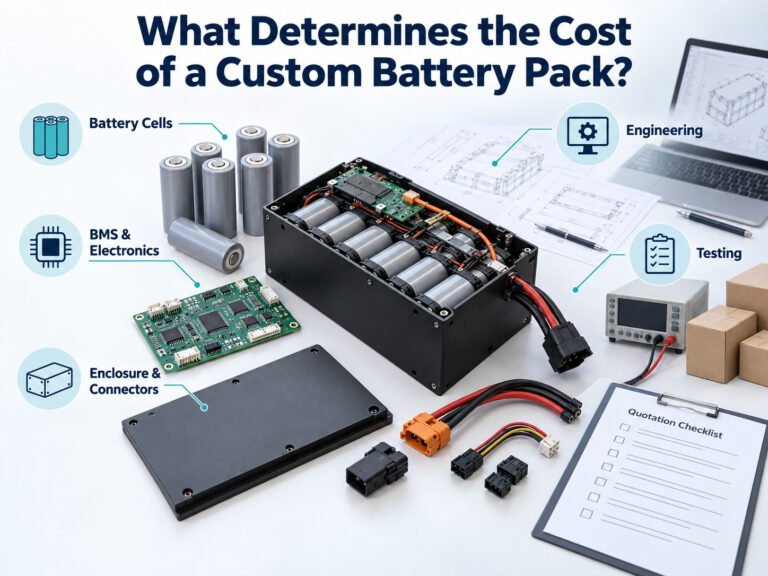
Battery + Engineering + Prototype + Testing + Certification + Tooling + Logistics + After-Sales
A supplier that provides a suitable engineering solution at the beginning may reduce redesign and validation work later.
For long-term B2B cooperation, buyers should therefore consider the overall project cost and supply capability rather than comparing battery unit prices alone.
Conclusion: What Should Buyers Look for in a High-Rate Lithium Battery OEM/ODM Partner?
Choosing a high-rate lithium battery manufacturer requires a system-level evaluation.
The buyer should look beyond the advertised C-rate and examine the complete battery architecture:
Cell → Configuration → BMS → Electrical Path → Thermal Management → Mechanical Structure → Testing → Certification → Production
A suitable High-Rate Lithium Battery OEM/ODM partner should be able to understand the equipment’s real operating conditions and translate those requirements into a battery design that can be prototyped, tested, validated, and produced consistently.
For applications such as drones, robots, AGVs, AMRs, power tools, electric mobility equipment, and industrial machines, the right battery specification starts with the load profile rather than a catalog number.
The most useful information for a battery manufacturer is therefore not simply:
“I need a high-rate lithium battery.”
It is:
“My equipment requires X volts, X Ah, X amps continuous, X amps peak for X seconds, operates at X°C, has these dimensions, and requires this communication protocol.”
That information gives an OEM/ODM engineering team a practical starting point for cell selection, BMS design, thermal management, mechanical design, testing, and production.
常见问题
What is a high-rate lithium battery?
A high-rate lithium battery is designed to provide relatively high current compared with its rated capacity. Its suitability depends on the cell, BMS, electrical connections, thermal design, and application conditions.
How do I calculate battery discharge current?
一个简化的计算方法是:
Current = Capacity × C-rate
For example, a 30Ah battery at 3C corresponds to approximately 90A. Actual continuous and peak current capability should be confirmed using the specific cell and battery design.
Can lithium battery packs be customized for high-current applications?
Yes. OEM/ODM manufacturers can customize cell configuration, voltage, capacity, BMS, connectors, cables, housing, dimensions, communication, and thermal design according to equipment requirements.
Is a high C-rate enough to select a battery?
No. C-rate is only one specification. Buyers should also evaluate continuous current, peak current, peak duration, internal resistance, temperature rise, BMS capability, voltage drop, and testing data.
Which applications use high-rate lithium batteries?
Common applications include drones, robotics, AGVs, AMRs, power tools, industrial equipment, electric mobility products, and other systems with high or rapidly changing power requirements.
What information should I provide for a custom high-rate battery?
At minimum, provide the required voltage, capacity, continuous current, peak current and duration, operating temperature, charging requirements, dimensions, communication interface, and application.
Can a high-rate battery use LiFePO4 cells?
Yes. Certain LFP cells are designed for high-current applications. However, the specific cell model needs to be evaluated according to the required current, energy, temperature range, size, and cycle requirements.
 English
  Chinese
  Japanese
  German
  French
  Korean
