Why Lithium Batteries Are Becoming the Preferred Choice for Material Handling Equipment
Author:
qystars
Date:
A Complete Guide to Lithium Battery Solutions for Forklifts, AGVs, AMRs, and Warehouse Automation
The material handling industry is undergoing a major transformation as warehouses, factories, and logistics centers move toward automation, higher efficiency, and smarter operations. Traditional lead-acid batteries have powered forklifts and industrial vehicles for decades, but their limitations in charging time, maintenance requirements, and operating efficiency have encouraged companies to explore advanced energy solutions.
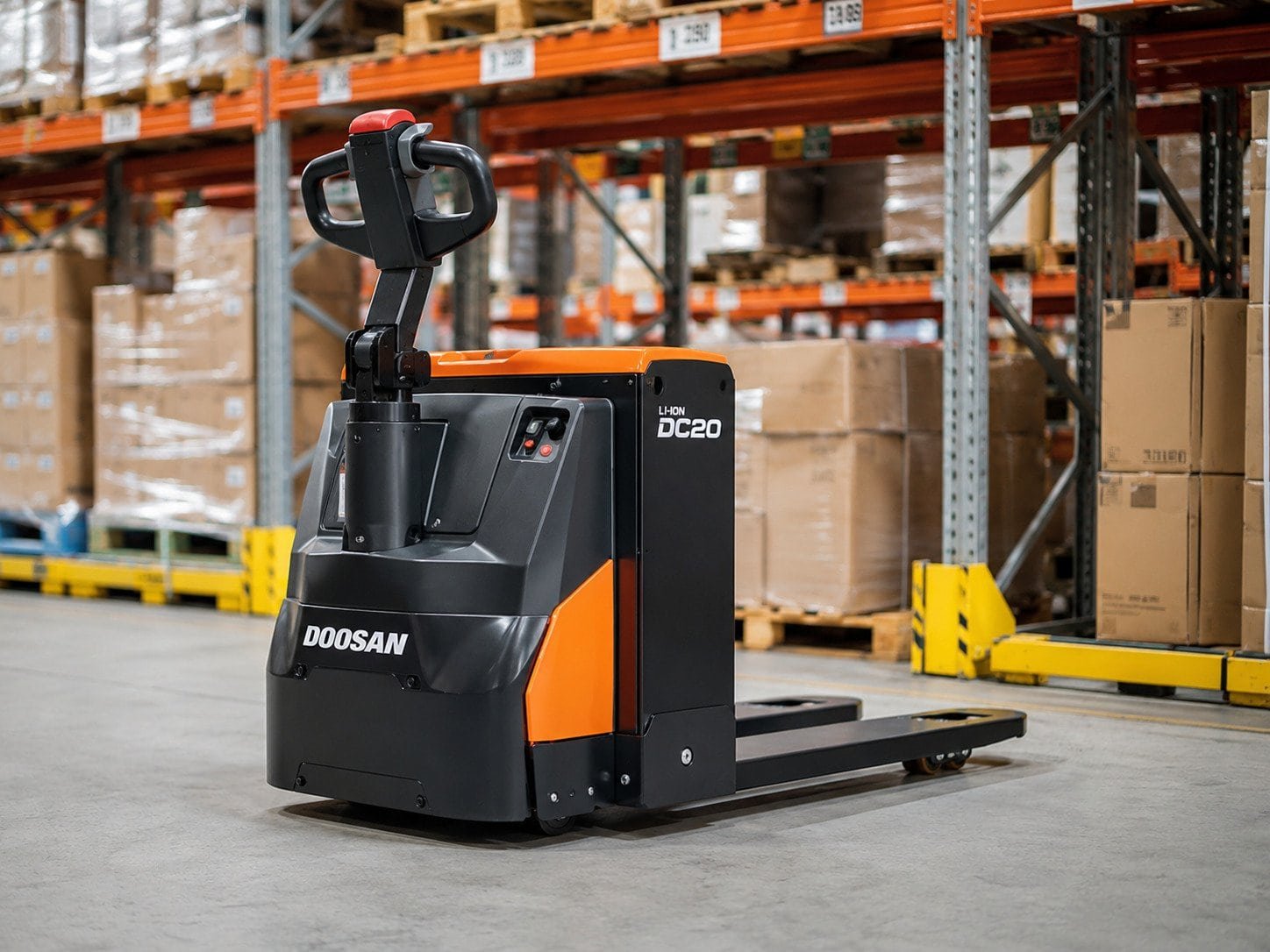
Lithium batteries are becoming an increasingly important power source for modern material handling equipment, including electric forklifts, Automated Guided Vehicles (AGVs), Autonomous Mobile Robots (AMRs), pallet trucks, stackers, and industrial transport vehicles.
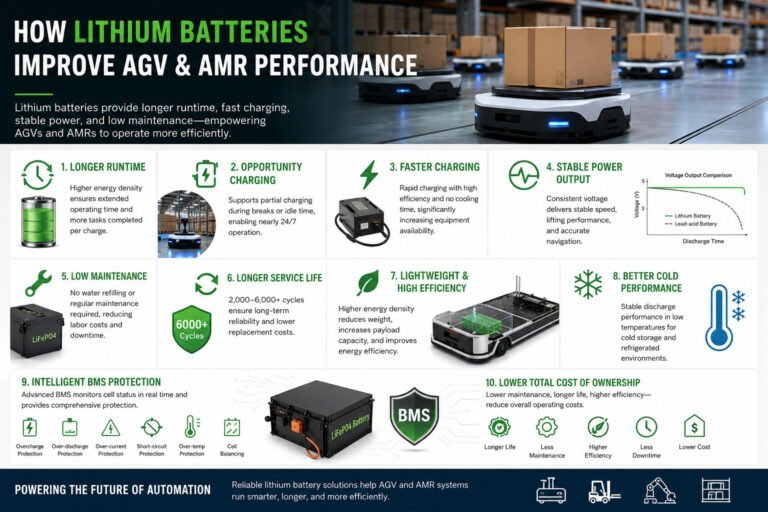
With advantages such as longer cycle life, faster charging, higher energy efficiency, maintenance-free operation, and intelligent Battery Management Systems (BMS), lithium battery technology helps businesses improve productivity while reducing long-term operating costs.
As a professional lithium battery manufacturer, Dongguan Yizhan Electronics Technology Co., Ltd. provides customized lithium battery solutions for industrial equipment, warehouse automation, AGV/AMR robots, and material handling applications.
1. The Growing Demand for Lithium Batteries in Material Handling Applications
Modern logistics and manufacturing environments require equipment that can operate continuously, reliably, and efficiently. Warehouses are becoming more automated, and companies are adopting robotic solutions to improve workflow and reduce labor dependency.
Material handling equipment now needs:
Longer operating hours
Faster charging capability
Stable power output
Lower maintenance requirements
Intelligent monitoring systems
Safe operation in demanding environments
Traditional lead-acid batteries often struggle to meet these requirements.
Common challenges of lead-acid batteries include:
Long charging periods
Regular maintenance requirements
Reduced performance during deep discharge
Shorter service life
Battery replacement downtime
Heavy battery weight
Lithium batteries provide an alternative solution designed for modern industrial applications.
2. Higher Energy Efficiency Improves Equipment Productivity
One of the key advantages of lithium batteries is their higher energy efficiency compared with traditional battery technologies.
Lithium battery systems typically provide:
Higher charge and discharge efficiency
Better energy utilization
More stable voltage output
Reduced energy loss
For material handling equipment, this means:
Longer working time per charge
More operating cycles per day
Improved equipment availability
For example, electric forklifts powered by lithium batteries can maintain stable performance during repeated lifting, transportation, and loading operations.
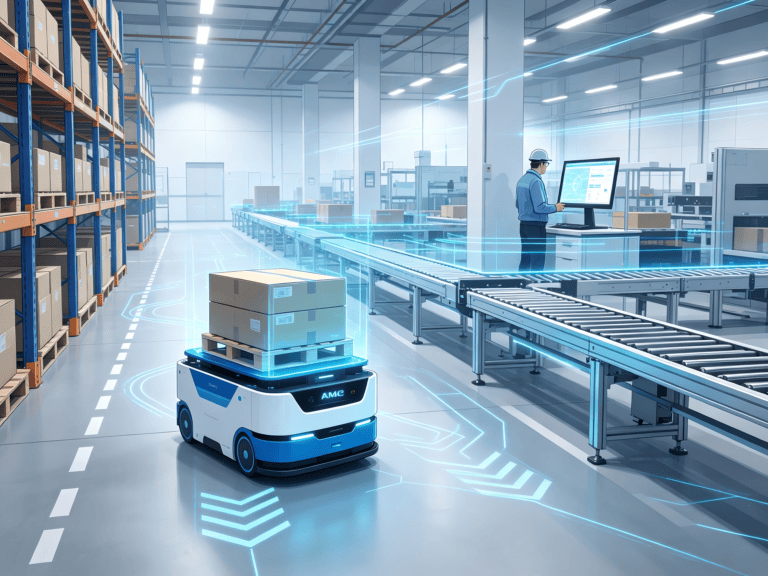
In automated warehouses, stable energy output is especially important because AGVs and AMRs require precise movement control and reliable communication between the battery system and vehicle controller.
3. Fast Charging Reduces Equipment Downtime
Downtime is one of the biggest concerns in logistics and manufacturing operations.
Traditional lead-acid batteries usually require several hours for a full recharge and often need dedicated charging areas.
Operators can recharge batteries during short breaks, shift changes, or idle periods.
Flexible Operation
Equipment does not need to wait for a complete charging cycle before returning to work.
For 24/7 warehouses and automated production lines, fast charging helps maximize equipment utilization.
4. Longer Cycle Life Reduces Total Ownership Costs
Although lithium batteries may have a higher initial purchase cost compared with lead-acid batteries, their longer service life can reduce the total cost of ownership.
A typical comparison:
Feature
Lead Acid Battery
Lithium Battery
Cycle Life
Around 500-1500 cycles
2000-6000+ cycles
Maintenance
Regular maintenance required
Maintenance-free
Charging Speed
Slow
Fast
Energy Efficiency
Lower
Higher
Performance Stability
Decreases during discharge
Stable output
Service Life
Shorter
Longer
For companies operating large fleets of forklifts or warehouse robots, fewer battery replacements can significantly reduce operational expenses.
Maintenance requirements are an important factor when selecting industrial batteries.
Lead-acid batteries often require:
Electrolyte level checks
Water refilling
Cleaning corrosion
Ventilation management
Lithium batteries use a sealed design and do not require routine water maintenance.
Benefits include:
Reduced labor requirements
Cleaner working environments
Lower maintenance costs
Simplified battery management
This makes lithium batteries suitable for:
Smart warehouses
Food processing facilities
Pharmaceutical production
Clean manufacturing environments
6. Lithium Batteries Provide Stable Power for Industrial Equipment
Material handling equipment frequently experiences high-load operations, including:
Starting and stopping
Lifting heavy materials
Continuous transportation
Frequent acceleration
Lithium batteries provide stable voltage output throughout the discharge cycle.
This helps equipment achieve:
Consistent motor performance
Smooth operation
Reliable control response
Improved productivity
For AGV and AMR systems, stable battery performance supports accurate navigation, positioning, and communication.
7. Smart BMS Technology Enhances Battery Safety and Management
Modern industrial lithium batteries are equipped with advanced Battery Management Systems (BMS).
A smart BMS monitors important battery parameters:
Voltage
Current
Temperature
State of Charge (SOC)
State of Health (SOH)
Protection functions include:
Overcharge protection
Over-discharge protection
Over-current protection
Short circuit protection
Thermal protection
Cell balancing
For industrial applications, intelligent communication is also important.
Many lithium battery systems support:
CAN communication
CAN FD
RS485
UART
Modbus protocols
This allows battery data to communicate with:
Vehicle controllers
Warehouse management systems
Industrial monitoring platforms
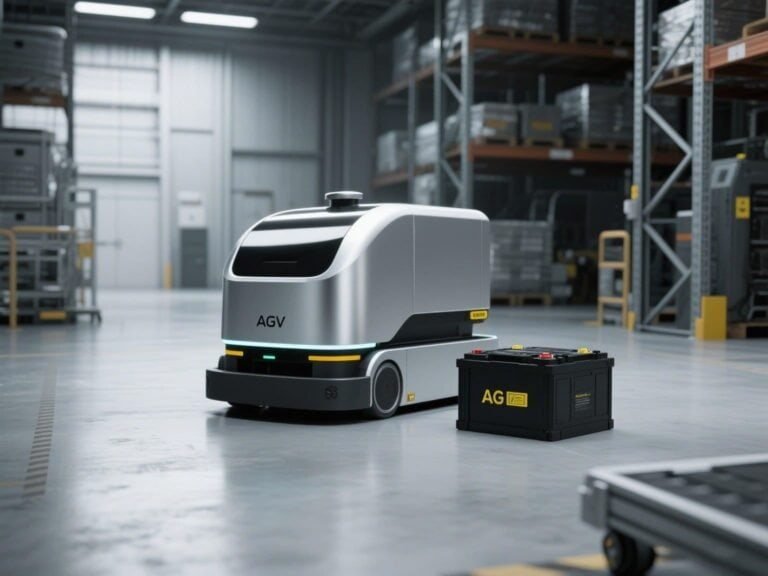
8. Lithium Batteries Support AGV and AMR Automation Development
Automation is changing the future of logistics.
AGVs and AMRs require batteries with:
Compact design
High reliability
Long runtime
Fast recharge capability
Intelligent communication
Lithium battery solutions are widely used in:
Autonomous warehouse robots
Manufacturing robots
Material transport robots
Smart factory equipment
Compared with traditional batteries, lithium solutions provide better support for automated operations because they can deliver consistent performance with less human intervention.
9. Lightweight Design Improves Material Handling Performance
Professional lithium battery manufacturing includes:
Cell Sorting
High-quality cells are selected and matched according to:
Voltage difference
Internal resistance
Capacity consistency
Welding Process
Advanced welding technologies ensure:
Reliable connections
Low resistance
Stable electrical performance
Aging Testing
Each battery pack should undergo:
Charging tests
Discharging tests
Capacity verification
Protection testing
Safety Testing
Common certifications include:
UN38.3
IEC 62133-2
CE
UL certifications
RoHS
MSDS
13. Why Choose Yizhan Lithium Battery Solutions?
Dongguan Yizhan Electronics Technology Co., Ltd. specializes in customized lithium battery solutions for industrial and commercial applications.
Our capabilities include:
13 years of lithium battery manufacturing experience
OEM and ODM battery customization
LiFePO4 and lithium-ion battery solutions
AGV and AMR battery solutions
Smart BMS integration
Global export experience
Professional quality control systems
We provide battery solutions for:
Material handling equipment
Forklifts
AGVs
AMRs
Industrial robots
Warehouse automation systems
From battery design and prototype development to mass production,Yizhan supports customers with complete lithium battery solutions.
Conclusion: Lithium Batteries Power the Future of Material Handling
The transition from lead-acid batteries to lithium battery technology is accelerating across the material handling industry.
With advantages including:
✔ Longer service life
✔ Faster charging
✔ Higher efficiency
✔ Lower maintenance
✔ Smart battery management
✔ Stable performance
Lithium batteries are becoming an important energy solution for forklifts, AGVs, AMRs, and modern warehouse automation equipment.
As industries continue moving toward intelligent and sustainable operations, customized lithium battery solutions will play an increasingly important role in improving productivity and operational efficiency.
FAQ
Q1: Why are lithium batteries better than lead-acid batteries for forklifts?
Lithium batteries provide longer cycle life, faster charging, higher efficiency, and maintenance-free operation, helping reduce downtime and operating costs.
Q2: Are LiFePO4 batteries suitable for AGV and AMR robots?
Yes. LiFePO4 batteries are widely used in AGV and AMR applications because of their safety, long lifespan, and stable performance.
Q3: How long does an industrial lithium battery last?
The lifespan depends on usage conditions, but many industrial lithium batteries can support thousands of charge cycles and several years of operation.
Q4: Can lithium batteries be customized for existing equipment?
Yes. Lithium battery manufacturers can customize voltage, capacity, size, connectors, BMS communication, and mechanical structure according to equipment requirements.
Q5: What certifications are required for industrial lithium batteries?
Common certifications include UN38.3, IEC 62133-2, CE, UL, RoHS, and MSDS depending on the application and market requirements.
Discover how lithium batteries improve forklifts, AGVs, and AMRs with fast charging, long cycle life, smart BMS, and customized industrial battery solutions.
Learn how to choose the right AMR Robot LiFePO4 Battery.This complete guide covers battery voltage, capacity, BMS, safety, charging, testing, and OEM customization for industrial AMR applications.
Discover how lithium batteries improve AGV and AMR performance through longer runtime, fast charging, intelligent BMS, higher energy efficiency, and lower maintenance costs. Learn how customized lithium battery solutions support industrial automation.


 English
  Chinese
  Japanese
  German
  French
  Korean
