
In the electric forklift industry, lithium-ion batteries, especially LiFePO4 (Lithium Iron Phosphate) batteries, are increasingly replacing traditional lead-acid batteries. While lead-acid batteries usually have a lower upfront purchase cost, lithium-ion batteries offer significant advantages in maintenance, safety, and long-term operating costs.
This article explains the key differences between lithium-ion and lead-acid forklift batteries to help businesses choose the right battery solution based on their operating requirements.
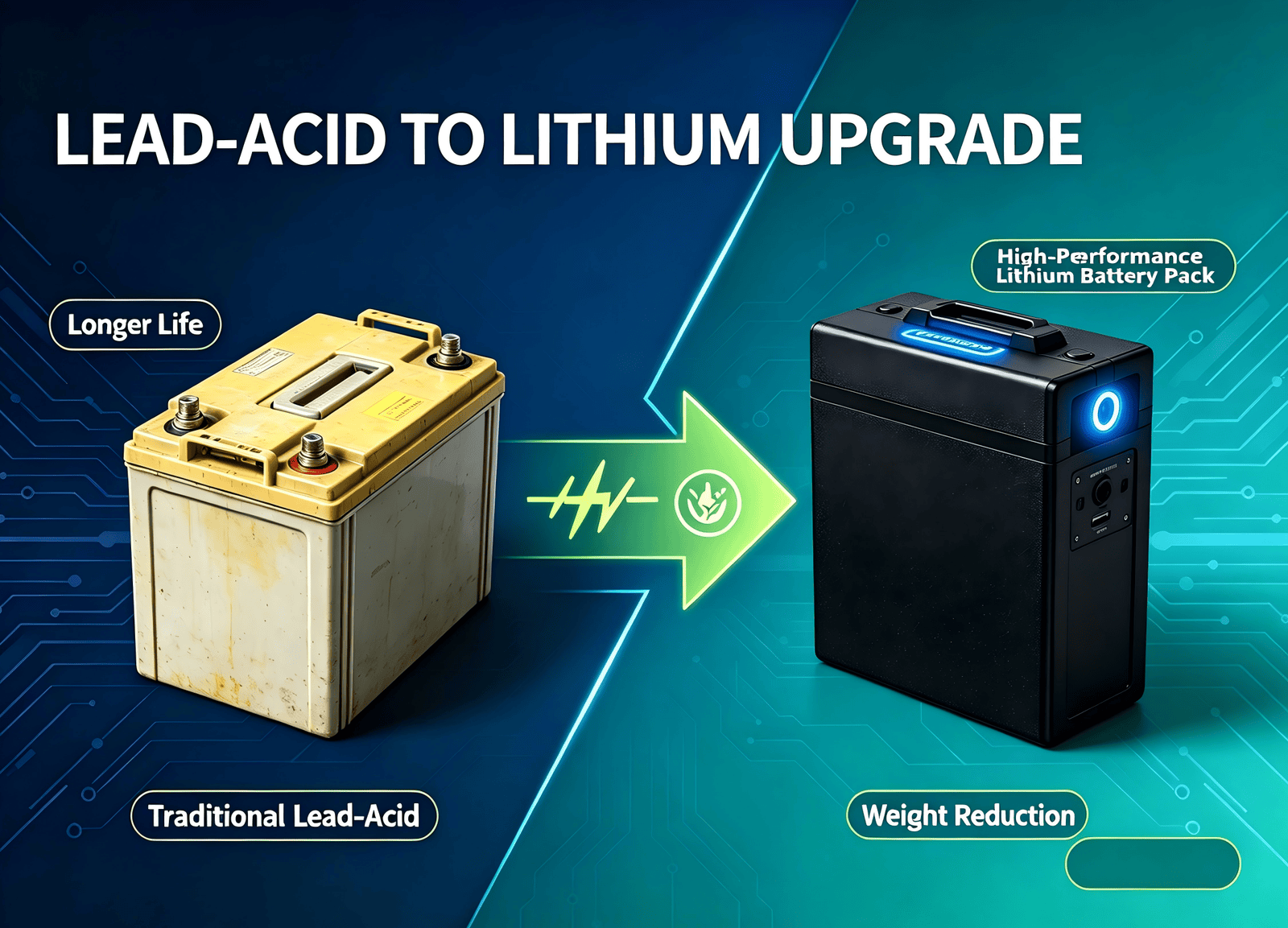
Part 1. Maintenance Cost Comparison
Maintenance requirements are one of the biggest differences between lithium-ion and lead-acid forklift batteries.
| Comparison Item | Lithium-Ion Battery | 납축전지 |
| Daily Maintenance | 유지보수가 거의 필요 없음 | Requires water refilling and electrolyte inspection |
| Battery Balancing | Automatically managed by BMS | Requires regular equalization charging |
| Battery Replacement Frequency | Longer service life, fewer replacements | Requires more frequent replacement |
| 다운타임 | 가동 중단 시간 최소화 | Longer downtime for maintenance and charging |
Lithium-Ion Forklift Batteries
Modern lithium forklift batteries are equipped with an intelligent Battery Management System (BMS), which continuously monitors:
- 전압
- 현재
- 온도
- SOC(충전 상태)
- 건강 상태 (SOH)
Operators do not need to perform regular maintenance tasks such as:
- Adding distilled water
- Cleaning acid residue
- Checking electrolyte levels
- Performing manual equalization charging
This greatly reduces labor costs and simplifies battery management.
Lead-Acid Forklift Batteries
Traditional lead-acid batteries require regular maintenance, including:
- Refilling distilled water
- Cleaning acid corrosion
- Checking electrolyte levels
- Preventing sulfation
- Performing equalization charging
If maintenance is neglected, lead-acid batteries can experience:
- Reduced capacity
- 수명 단축
- Lower charging efficiency
- 조기 장애
부분 2. Safety Comparison
Safety is a critical factor for industrial vehicle applications.
Safety Risks of Lead-Acid Batteries
During charging, lead-acid batteries may release:
- Hydrogen gas
- Oxygen gas
They also carry risks such as:
- 산 누출
- 부식
- Electrolyte splashing
Therefore, lead-acid battery charging areas usually require:
- Proper ventilation
- 전용 충전실
- Additional safety management
Safety Advantages of Lithium-Ion Batteries
Modern lithium forklift batteries, especially LiFePO4 batteries, are designed with multiple protection features:
- 과충전 방지
- 과방전 방지
- 과전류 보호
- 단락 보호
- High/low temperature protection
- Intelligent battery monitoring
LiFePO4 chemistry provides excellent thermal stability and is widely used in industrial applications requiring high safety performance.
However, proper battery selection and operation remain important. Businesses should choose batteries with reliable certifications and use compatible charging systems to ensure safe operation.
부분 3. Cost Analysis: Initial Investment vs. Total Cost of Ownership (TCO)
Many companies focus only on the initial purchase price, but the actual cost of ownership depends on the entire lifecycle of the battery.
1. Initial Purchase Cost
일반적으로:
- Lead-acid batteries have a lower upfront cost.
- Lithium-ion batteries require a higher initial investment.
For businesses with limited budgets and low-intensity operations, lead-acid batteries may still be a practical option.
2. Service Life Comparison
일반적인 수명:
| 배터리 유형 | 주기 수명 |
| 납축전지 | Around 1,000–1,500 cycles |
| LiFePO4 리튬 배터리 | Around 3,000–5,000 cycles |
The longer lifespan of lithium batteries reduces battery replacement frequency and lowers long-term operating expenses.
3. Energy Efficiency and Charging Performance
Lithium-ion forklift batteries provide:
- Higher charging and discharging efficiency
- Lower energy loss
- 더 빠른 충전 기능
- Opportunity charging support
Operators can recharge lithium batteries during breaks or shift changes without waiting for a full charging cycle.
납산 배터리는 일반적으로 필요합니다:
- 8–10 hours of charging time
- Cooling periods after charging
- Dedicated charging schedules
For warehouses and factories operating multiple shifts, lithium batteries can significantly improve equipment availability.
4. Labor Cost Savings
Switching to lithium forklift batteries can reduce labor requirements related to:
- Battery watering
- Battery cleaning
- Battery replacement
- Battery handling
- Maintenance management
For large warehouse fleets, these savings can have a significant impact on total operating costs.
부분 4. Application Recommendations
Applications Better Suited for Lithium-Ion Batteries
Lithium forklift batteries are ideal for:
- Three-shift operations
- E-commerce warehouses
- Cold storage facilities
- Automated warehouses
- AGV and AMR logistics systems
- High-utilization forklift fleets
다음과 같은 혜택이 있습니다:
- 연장된 운영 시간
- 가동 중단 시간 단축
- 유지보수 부담이 적음
- 생산성 향상
Applications Where Lead-Acid Batteries Remain Suitable
Lead-acid batteries can still be suitable for:
- Single-shift operations
- Low-frequency forklift usage
- Companies with limited initial budgets
- Facilities with existing charging infrastructure
For these applications, lead-acid batteries may remain a cost-effective choice.
부분 5. Quick Comparison: Lithium-Ion vs. Lead-Acid Forklift Batteries
| 기능 | Lithium-Ion Battery | 납축전지 |
| 초기 비용 | 더 높은 | 아래로 |
| 수명 | ★★★★★ | ★★★ |
| 유지 관리 요구 사항 | ★★★★★ (Maintenance-Free) | ★★ |
| Charging Efficiency | ★★★★★ | ★★ |
| Multi-Shift Operation | ★★★★★ | ★★ |
| 다운타임 | 낮음 | 더 높은 |
| 에너지 효율 | 높음 | 아래로 |
| 총 소유 비용 | Lower for intensive use | Higher over lifecycle |
부분 6. Cost Estimate for Upgrading from Lead-Acid to Lithium-Ion Forklift Batteries
For companies considering a transition from traditional lead-acid forklift batteries to lithium-ion solutions, the biggest concern is usually the upgrade cost.
Although lithium-ion batteries require a higher initial investment, the total cost should be evaluated based on battery lifespan, maintenance savings, energy efficiency, and productivity improvements.
1.Initial Upgrade Cost
The cost of upgrading from lead-acid to lithium-ion depends on:
- Forklift model and battery compartment size
- 필요한 전압 및 용량
- Battery chemistry (LiFePO4 or other lithium technologies)
- Charger replacement requirements
- Communication system integration
- Installation and commissioning costs
Typical lithium forklift battery upgrade costs:
Forklift Type Lead-Acid Battery Replacement Estimated Lithium Battery Upgrade Cost
| Forklift Type | Lead-Acid Battery Replacement | Estimated Lithium Battery Upgrade Cost |
| 1.5–2 Ton Electric Forklift | 24V/36V lead-acid battery | Around $1,500–$4,000 |
| 2–3.5 Ton Electric Forklift | 48V lithium battery system | Around $3,000–$8,000 |
| 3.5–5 Ton Electric Forklift | 72V lithium battery system | Around $6,000–$15,000+ |
Actual costs vary depending on battery capacity, cell brand, BMS requirements, certifications, and customization.
2.Additional Upgrade Costs to Consider
Charger Replacement
Lead-acid and lithium batteries require different charging strategies.
When upgrading to lithium batteries, companies may need:
- Dedicated lithium battery charger
- Smart charging system
- Charging parameter adjustment
Estimated charger upgrade cost:
$300–$1,500 per charger
Battery Compartment Adaptation
Lithium batteries usually have a higher energy density, allowing manufacturers to design more compact battery packs.
Depending on the forklift model, upgrades may require:
- Battery tray modification
- Connector replacement
- Wiring adjustment
- Communication interface integration
Estimated cost:
$200–$1,000
BMS and Smart Monitoring Integration
Modern lithium forklift batteries often include intelligent BMS functions:
- 실시간 배터리 모니터링
- CAN 통신
- 원격 진단
- Fault warnings
- Data recording
For fleet management systems, additional integration may increase costs.
Estimated cost:
$200–$2,000 depending on requirements
3.Long-Term Cost Savings After Upgrade
Although the initial investment is higher, lithium battery upgrades can reduce operating costs through:
Reduced Battery Replacement Frequency
예시:
Lead-acid battery
- Lifespan: 1,000–1,500 cycles
- Replacement may be required every 2–3 years in intensive operations
Lithium battery
- Lifespan: 3,000–5,000 cycles
- Can often operate 5–8 years under proper conditions
This reduces long-term replacement expenses.
Reduced Maintenance Costs
Lead-acid battery maintenance includes:
- 물 채우기
- Acid cleaning
- Electrolyte inspection
- 이퀄라이제이션 충전
Lithium batteries eliminate most routine maintenance tasks.
For a forklift fleet, annual maintenance savings can reach hundreds or thousands of dollars depending on fleet size and usage.
Improved Productivity
리튬 배터리 지원:
- 기회 충전
- 더 빠른 충전
- 더 높은 에너지 효율성
- Longer continuous operation
For warehouses operating multiple shifts, reducing battery changeovers and downtime can significantly improve productivity.
4.Estimated Return on Investment (ROI)
For high-frequency forklift operations, the payback period of a lithium upgrade is typically:
2–4 years
ROI depends on:
- 매일 운영 시간
- Number of forklift units
- Electricity cost
- Labor cost
- Battery replacement frequency
- 유지보수 요건
For businesses running forklifts 8–24 hours per day, lithium conversion often provides a faster return compared with low-utilization applications.
5.Is Lithium Forklift Battery Upgrade Worth It?
A lithium battery upgrade is especially valuable for companies that:
✔ Operate forklifts multiple shifts
✔ Need to reduce downtime
✔ Want to eliminate battery maintenance
✔ Manage large warehouse fleets
✔ Require higher energy efficiency
✔ Plan long-term equipment operation
For low-frequency applications, lead-acid batteries may still be economical. However, for modern logistics, manufacturing, and automated warehouse environments, lithium-ion batteries provide a more efficient and sustainable power solution.
결론
Lead-acid forklift batteries remain competitive in applications where initial investment is the main consideration and operating intensity is low. However, for modern warehouses, logistics centers, and manufacturing facilities that require continuous operation, lithium-ion batteries provide clear advantages through maintenance-free operation, faster charging, longer service life, and lower total cost of ownership.
When selecting a forklift battery solution, companies should evaluate more than just the purchase price. Factors such as maintenance costs, downtime, energy efficiency, battery lifespan, and overall operational requirements should all be considered.
For high-frequency industrial applications, lithium-ion forklift batteries are becoming a reliable solution for improving efficiency and reducing long-term operating costs.
Looking for a reliable lithium forklift battery solution?
Contact us today for a customized quote and professional support for your lead-acid to lithium battery upgrade.
FAQ: Lead-Acid to Lithium Forklift Battery Upgrade
1. Why should I upgrade my forklift from lead-acid batteries to lithium batteries?
Upgrading from lead-acid to lithium forklift batteries can help reduce maintenance requirements, improve energy efficiency, increase uptime, and lower long-term operating costs. Lithium batteries offer longer cycle life, faster charging, and support opportunity charging, making them suitable for high-frequency forklift operations.
2. Can I replace my existing lead-acid forklift battery with a lithium battery?
Yes. Most electric forklifts can be upgraded from lead-acid batteries to lithium batteries. However, the battery voltage, capacity, dimensions, connector type, charger compatibility, and communication requirements should be evaluated before replacement to ensure proper performance.
3. How much does it cost to upgrade a forklift from lead-acid to lithium?
The cost depends on the forklift model, battery voltage, capacity, customization requirements, and charger configuration.
Typical upgrade costs include:
Small electric forklifts: approximately $1,500–$4,000
Medium forklifts: approximately $3,000–$8,000
Heavy-duty forklifts: approximately $6,000–$15,000+
A customized quotation is usually required based on the actual forklift application.
4. How long do lithium forklift batteries last compared with lead-acid batteries?
Lithium forklift batteries generally have a longer service life than lead-acid batteries.
Lead-acid batteries: around 1,000–1,500 cycles
LiFePO4 lithium batteries: around 3,000–5,000 cycles
With proper battery management and operation, lithium batteries can significantly reduce replacement frequency.
5. Do lithium forklift batteries require regular maintenance?
No. Lithium forklift batteries are designed for low-maintenance operation. Unlike lead-acid batteries, they do not require:
물 리필
Electrolyte inspection
Acid cleaning
Regular equalization charging
An intelligent BMS continuously monitors battery status and provides protection against abnormal conditions.
 English
  Chinese
  Japanese
  German
  French
  Korean
