
Robot dogs, also known as quadruped robots, require a battery system that can support dynamic movement, frequent acceleration, actuator loads, onboard computing, sensors and communication systems. Unlike batteries used in stationary equipment, a robot dog battery needs to respond to changing power demand while remaining within strict limits for weight, size and operating temperature.
For robot manufacturers and system integrators, selecting a lithium battery is not simply a matter of choosing a higher Ah rating. Battery chemistry, voltage, capacity, discharge current, BMS configuration, thermal management and mechanical design all need to match the robot’s electrical and operating requirements.
This guide explains how to select a lithium battery for robot dogs and what OEMs should consider when developing a custom battery pack.
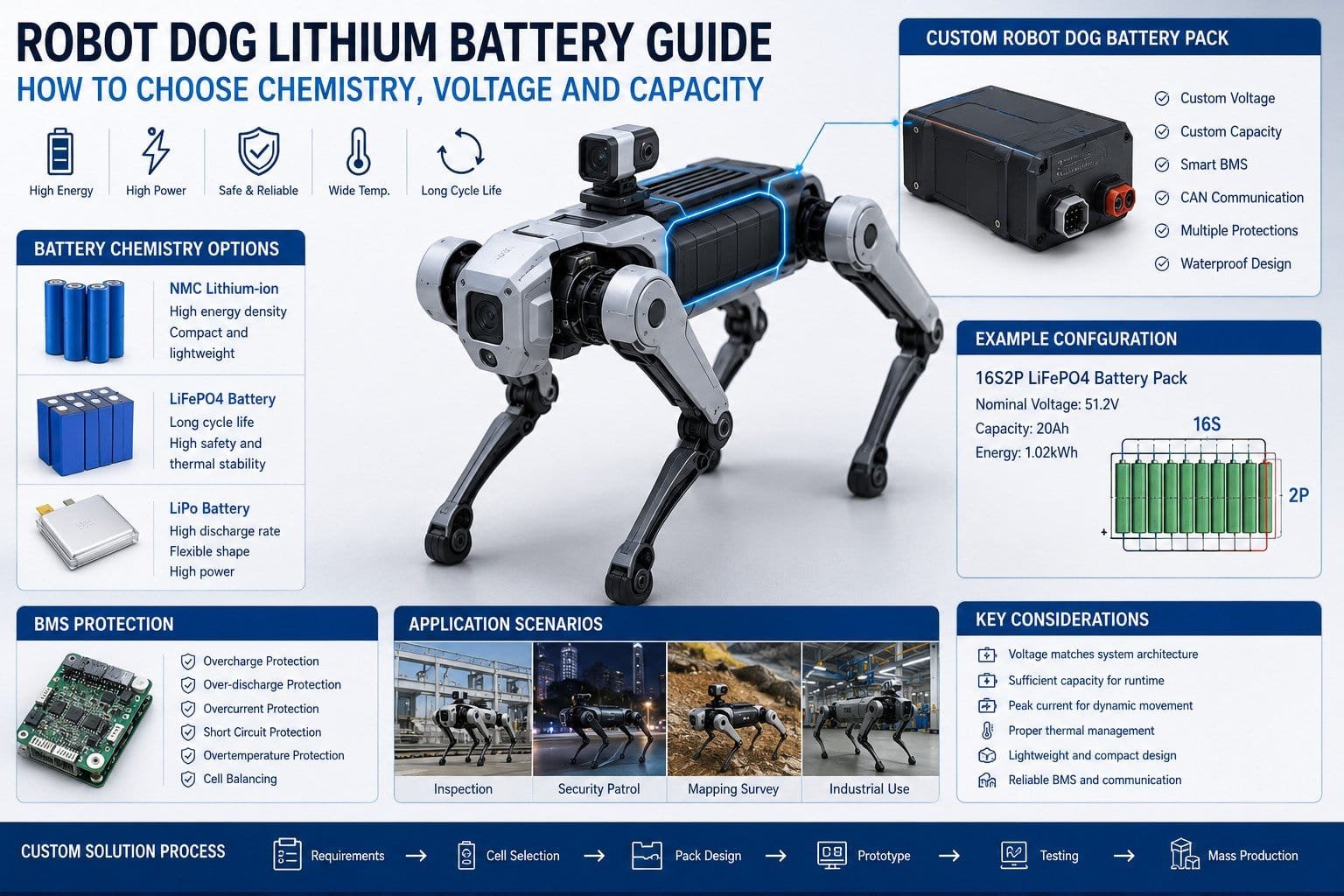
1. What Is a Robot Dog Lithium Battery?
A robot dog lithium battery is a rechargeable battery pack designed to provide electrical power for quadruped robotic systems.
Depending on the robot’s architecture, the battery may supply power to:
- Leg motors and actuators
- モーターコントローラ
- Main control systems
- Cameras
- LiDAR
- Navigation sensors
- 通信モジュール
- Embedded computers
- Cooling fans
- Auxiliary electronics
The power demand changes according to the robot’s movement.
Walking on a flat surface, climbing a slope, accelerating, carrying a payload and recovering balance can all produce different current requirements.
For this reason, a robot battery should be evaluated according to the complete operating profile rather than only its nominal capacity.
2. Key Specifications for a Robot Dog Battery
Before selecting cells, the robot manufacturer should define several electrical and mechanical parameters.
| パラメータ | 要件 |
|---|---|
| 公称電圧 | Voltage required by the robot system |
| Maximum voltage | Maximum battery voltage allowed by the electronics |
| Minimum voltage | 最小動作電圧 |
| 定員 | Required battery capacity in Ah |
| エネルギー | Required energy in Wh |
| 連続電流 | Current required during normal operation |
| ピーク電流 | Short-duration current demand |
| ピークの持続時間 | Duration of the peak load |
| バッテリー重量 | Maximum acceptable battery mass |
| 寸法 | Available battery installation space |
| 温度 | Expected operating and charging range |
| コミュニケーション | CAN, RS485, SMBus or other protocol |
| 充電 | Charger voltage and current |
These specifications provide the foundation for cell selection, battery configuration and BMS design.
3. How to Choose Battery Chemistry
Several lithium battery chemistries can be considered for robot dogs, including NMC lithium-ion, LiFePO4 and lithium polymer batteries.
Each chemistry has different characteristics.
| 化学 | Characteristics | Application Considerations |
|---|---|---|
| エヌエムシー | High energy density and compact design | Mobile robots with weight constraints |
| LiFePO4 | Long cycle life and thermal stability | Industrial robots with frequent operation |
| LiPo | High discharge capability and flexible packaging | Robots with dynamic power requirements |
The appropriate chemistry depends on the robot’s weight, power, operating environment, cycle requirements and available installation space.
3.1 NMC Lithium-Ion Battery
NMC lithium-ion cells can be considered when the robot needs substantial energy within a limited weight or volume.
This can be relevant for:
- 検査ロボット
- Security robots
- Mapping robots
- Field robots
- Research platforms
- Mobile service robots
NMC batteries can provide a useful balance between energy capacity and pack size.
When selecting an NMC cell, however, engineers should evaluate more than energy density. Discharge rating, cycle requirements, operating temperature, cell quality and BMS protection should also be considered.
3.2 LiFePO4 Battery
LiFePO4, or lithium iron phosphate, is frequently considered for industrial battery applications where cycle life and thermal characteristics are important.
主な用途としては、次のようなものが挙げられます:
- Industrial robot dogs
- Outdoor inspection robots
- Autonomous patrol robots
- Agricultural robots
- Warehouse robots
- Mobile industrial equipment
LiFePO4 cells have a nominal voltage of approximately 3.2 V per cell.
例えば、こうだ:
16S LiFePO4
16 × 3.2 V = 51.2 V nominal
This configuration is commonly used for a 48 V-class battery system.
LiFePO4 can be suitable when the robot operates frequently and the battery needs to support repeated charge and discharge cycles.
3.3 Lithium Polymer Battery
Lithium polymer batteries can be considered for robot applications with high short-duration current demand.
A quadruped robot may require increased motor power during:
- 加速
- クライミング
- Jumping
- Rapid movement
- Direction changes
- Balance correction
- Payload handling
The discharge capability of the battery therefore needs to match the motor and controller requirements.
For example, if a 10 Ah battery is rated for 5C discharge:
10 Ah × 5C = 50 A
This is a theoretical current calculation. The actual pack capability must also consider the cell specification, BMS, wiring, connectors, busbars and thermal conditions.
4. How to Select Robot Dog Battery Voltage
Battery voltage must match the robot’s electrical architecture.
Before designing the battery pack, confirm:
- Motor controller input voltage
- Motor operating voltage
- DC/DC converter voltage range
- Maximum battery voltage
- Minimum system voltage
- 充電電圧
- BMS protection thresholds
A battery’s nominal voltage should not be selected independently from the robot’s motor controllers and electronic systems.
For example, a system designed around a 48 V-class DC bus may use a 13S lithium-ion configuration or a 16S LiFePO4 configuration, depending on the required operating voltage range.
The actual configuration should be determined from the system’s electrical specifications.
5. Understanding S and P Battery Configurations
Battery pack configurations are commonly expressed using S そして P.
S = series connection
Series-connected cells increase voltage.
P = parallel connection
Parallel-connected cells increase capacity and current capability.
For example, consider a LiFePO4 battery using 3.2 V, 10 Ah cells.
A 16S2P configuration contains 32 cells.
電圧
16 × 3.2 V = 51.2 V nominal
定員
2 × 10 Ah = 20 Ah
公称エネルギー
51.2 V × 20 Ah = 1,024 Wh
Therefore, the battery is approximately:
51.2 V 20 Ah / 1.02 kWh
The actual usable energy depends on the battery’s voltage range, discharge limits, temperature, BMS settings and system efficiency.
6. How to Calculate Robot Dog Battery Capacity
Battery capacity is normally specified in Ah, while battery energy is specified in Wh.
The basic calculation is:
エネルギー(Wh)=電圧(V)×容量(Ah)
例えば、こうだ:
48 V × 20 Ah = 960 Wh
To estimate operating time:
Operating Time ≈ Battery Energy ÷ Average Power Consumption
If a robot consumes an average of 400 W:
960 Wh ÷ 400 W = 2.4 hours
This is a theoretical calculation.
Actual operating time can be affected by:
- ロボットの重量
- Payload
- Walking speed
- 地形
- Incline
- 加速
- モーターの効率
- コントローラの効率
- Sensor load
- Computing power
- 周囲温度
- バッテリーの状態
- Usable depth of discharge
For an accurate battery specification, robot manufacturers should provide a representative duty cycle.
7. Why Peak Current Matters
Capacity determines how much energy the battery can store, but it does not tell the complete story.
Robot dogs can experience short-duration current peaks when several actuators operate simultaneously.
For example, the robot may require additional power when:
- Starting from a stationary position
- Climbing stairs
- Walking uphill
- Carrying equipment
- Recovering balance
- Accelerating
- Changing direction
If the battery cannot provide the required current, the pack voltage may drop.
Excessive voltage sag can cause problems such as:
- Motor controller faults
- Controller resets
- BMS保護
- Communication interruptions
- Computer shutdown
- Robot movement interruption
Therefore, the battery should be evaluated according to both energy requirements and power requirements.
8. Battery Weight and Robot Performance
Battery weight is an important design parameter for quadruped robots.
A larger battery can provide more energy, but additional battery mass also increases the total robot weight.
This can affect:
- Payload capacity
- モーターの負荷
- Actuator requirements
- Balance
- Center of gravity
- 機械構造
- Operating efficiency
The objective should therefore be to develop a battery that meets the required energy and power targets within the robot’s available weight and installation space.
For mobile robotics, battery energy density and pack-level integration can become important design factors.
9. BMS Design for Robot Dog Batteries
The Battery Management System is an important component of a custom robot battery.
A BMS can provide functions such as:
- 過充電保護
- 過放電保護
- 過電流保護
- 短絡保護
- 過熱保護
- 細胞電位のモニタリング
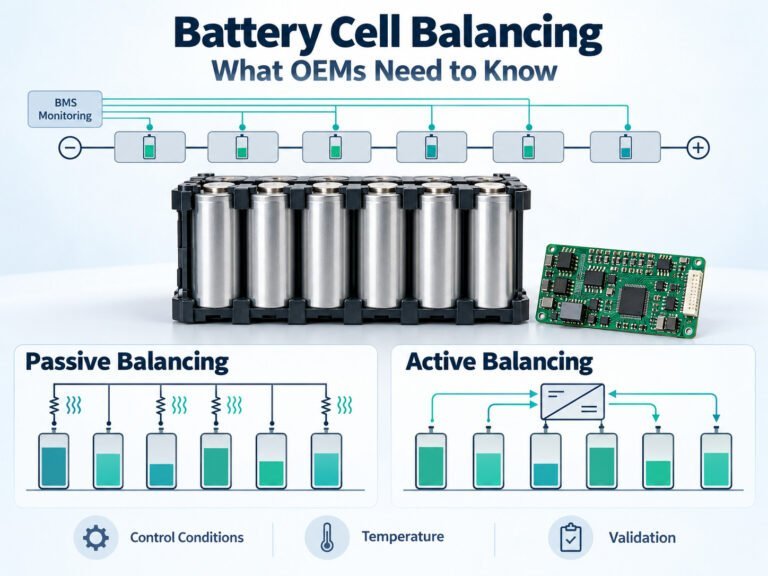
- セルバランシング
- バッテリー状態の監視
For robot applications, the BMS should be selected according to the robot’s current profile.
A battery pack with high peak current requirements may need a BMS with suitable current-handling capability and protection parameters.
9.1 Smart BMS Communication
A smart BMS can provide battery information to the robot controller.
Depending on the system design, communication may include:
- CAN
- RS485
- SMBus
- UART
Available data may include:
- パック電圧
- Pack current
- 充電状態
- 細胞電位
- 細胞温度
- バッテリー温度
- 障害状況
- 充電状況
CAN communication can be useful when the robot’s control system needs battery information during operation.
10. Thermal Management
Robot dogs can operate in environments ranging from indoor laboratories to outdoor industrial sites.
Battery temperature can change according to:
- 放電電流
- 充電電流
- 周囲温度
- 筐体設計
- 稼働時間
- Robot workload
High current operation can generate heat inside the battery pack.
A custom battery design may therefore include:
- 温度センサー
- サーマルパッド
- Heat-conductive materials
- Aluminum enclosures
- セル間隔
- Heat dissipation structures
- BMS temperature protection
Thermal design should be evaluated together with the cell, BMS and enclosure.
11. Mechanical Design of a Robot Dog Battery Pack
Robot dog batteries are often installed in compact spaces.
A custom battery pack may require specific:
- 長さ
- 幅
- 高さ
- 取り付け位置
- コネクタの位置
- Communication port
- 充電ポート
- ロック機構
- ハンドル
- 防水エンクロージャー
The battery also needs to withstand mechanical conditions associated with robot movement.
Internal cell fixation, welding structures, wiring and enclosure design should therefore be evaluated as one integrated system.
For outdoor robot dogs, water and dust protection may also be required.
Depending on the application, an appropriate IP-rated enclosure can be considered.
12. Testing Requirements
Battery testing should reflect the robot’s actual operating environment.
電気試験
Common tests include:
- キャパシティ・テスト
- Charge testing
- 連続放電試験
- ピーク電流試験
- Voltage sag testing
- BMS保護機能の試験
- Cell balancing verification
熱試験
テストには、以下のものが含まれる場合があります:
- 高温運転
- 低温動作
- 充電温度
- 放電温度
- 気温の上昇
機械的試験
For mobile robots, mechanical validation may include:
- 振動試験
- 衝撃試験
- コネクタの試験
- Mounting testing
- Enclosure inspection
For outdoor applications, additional environmental tests may include:
- 耐水性
- Dust resistance
- 湿度
- 温度サイクル試験
Testing should be performed on the complete battery pack rather than relying only on individual cell specifications.
13. Certifications and Transportation Requirements
Certification requirements depend on the battery design, destination market and final application.
For lithium battery transportation, 国連 38.3 is an important requirement for applicable battery shipments.
Depending on the target market and product design, additional requirements may include:
- IEC 62133-2
- CE関連の要件
- RoHS
- UL規格
- Regional battery regulations
The applicable standards should be determined according to the specific product, market and intended use.
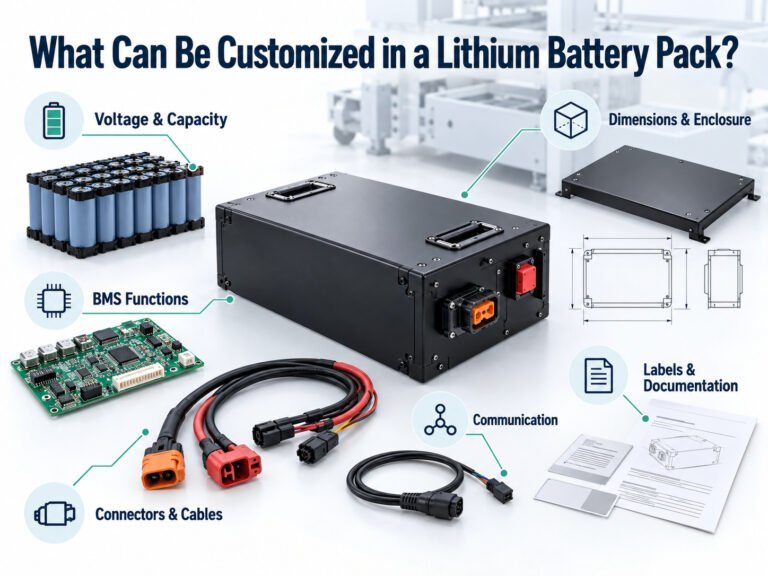
14. Custom Robot Dog Battery Development
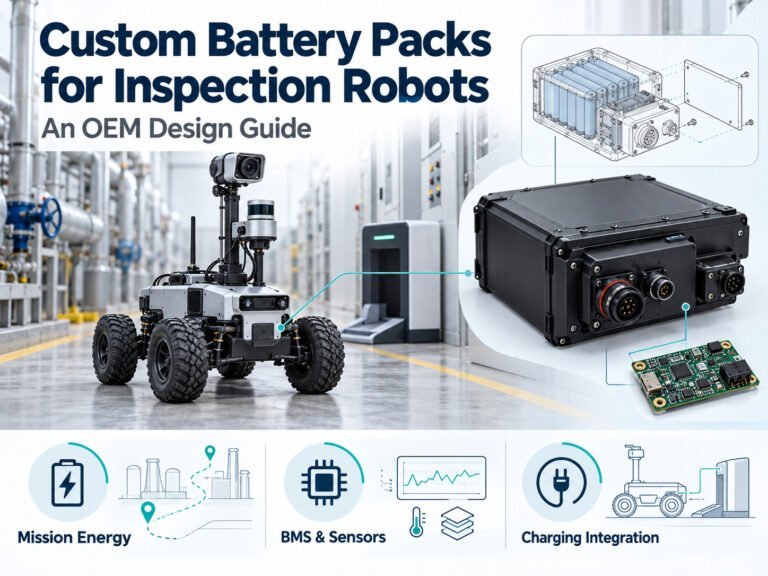
For robot manufacturers, a custom battery supplier can support the development process from cell selection through mass production.
A typical OEM/ODM workflow can include:
Step 1: Define Requirements
Provide:
- 電圧
- 定員
- 連続電流
- ピーク電流
- ピークの持続時間
- 寸法
- 重量
- 動作温度
- 通信要件
Step 2: Select Cells
The battery manufacturer evaluates suitable cell chemistry and cell specifications according to the robot’s requirements.
Step 3: Battery Pack Design
The engineering team develops:
- 直列・並列接続
- ビーエムエス
- 配線
- コネクタ
- 添付資料
- Thermal structure
Step 4: Prototype
A prototype battery is produced for integration with the robot.
Step 5: Testing
The battery is tested under electrical, thermal, mechanical and environmental conditions relevant to the application.
Step 6: Optimization
The battery design can be adjusted according to test results and robot performance.
Step 7: Production
After design validation, the battery can move into pilot production and mass manufacturing.
15. Robot Dog Battery Selection Checklist
Before contacting a battery manufacturer, prepare the following information.
電気的要件
- 公称電圧
- Maximum voltage
- Minimum voltage
- 必要容量
- Average power
- 連続電流
- ピーク電流
- ピークの持続時間
- 充電電圧
- 充電電流
機械的要件
- Maximum dimensions
- Maximum weight
- 設置位置
- 取り付け方法
- コネクタの種類
- コネクタの位置
- Waterproof requirements
Operating Requirements
- 屋内または屋外での運用
- 動作温度
- 地形
- Payload
- Target runtime
- 毎日の営業時間
- Charge/discharge cycles
Communication Requirements
- CAN
- RS485
- SMBus
- UART
- Other protocols
Compliance Requirements
- ターゲット市場
- 輸送に関する要件
- Required certifications
- Product standards
Providing these specifications allows the battery manufacturer to design a pack around the robot instead of selecting a generic battery based only on voltage and capacity.
結論
A robot dog lithium battery needs to balance energy, power, weight, size, safety and system integration.
NMC lithium-ion batteries can be considered for robots where battery weight and package size are important. LiFePO4 can be considered for industrial applications with frequent cycling and long-term operation. Lithium polymer batteries may be suitable for applications with high short-duration discharge requirements.
Voltage should match the robot’s electrical architecture, while capacity should be calculated from actual power consumption and required operating time. Peak current also needs to be evaluated because quadruped robots can generate rapid changes in power demand.
For OEM robot manufacturers, a custom battery pack can integrate the cells, BMS, enclosure, connectors, communication interface and protection functions into one application-specific power system.
The right battery specification begins with the robot’s operating profile and ends with validation of the complete battery pack.
 English
  Chinese
  Japanese
  German
  French
  Korean
