
Modern warehouses need material handling equipment that can adapt to changing workloads, operating schedules, storage layouts, and delivery requirements. Pallet trucks are widely used for moving pallets between receiving areas, storage locations, picking zones, and shipping docks. As warehouse operations become more flexible, the battery system powering an electric pallet truck also becomes an important part of equipment planning.
A suitable lithium battery solution can support flexible charging schedules, reduce routine battery maintenance, and provide different capacity options for various operating conditions. Compared with traditional lead-acid battery systems, lithium-ion and LiFePO4 battery packs can also be designed around specific pallet truck dimensions, voltage requirements, duty cycles, and communication systems.
For warehouse operators, battery selection should not focus only on nominal voltage or amp-hour capacity. The battery should be evaluated as part of the complete pallet truck system.
This article explains how lithium battery solutions can support pallet truck operations, what factors should be considered during battery selection, and how OEM and ODM battery pack development can address different warehouse requirements.
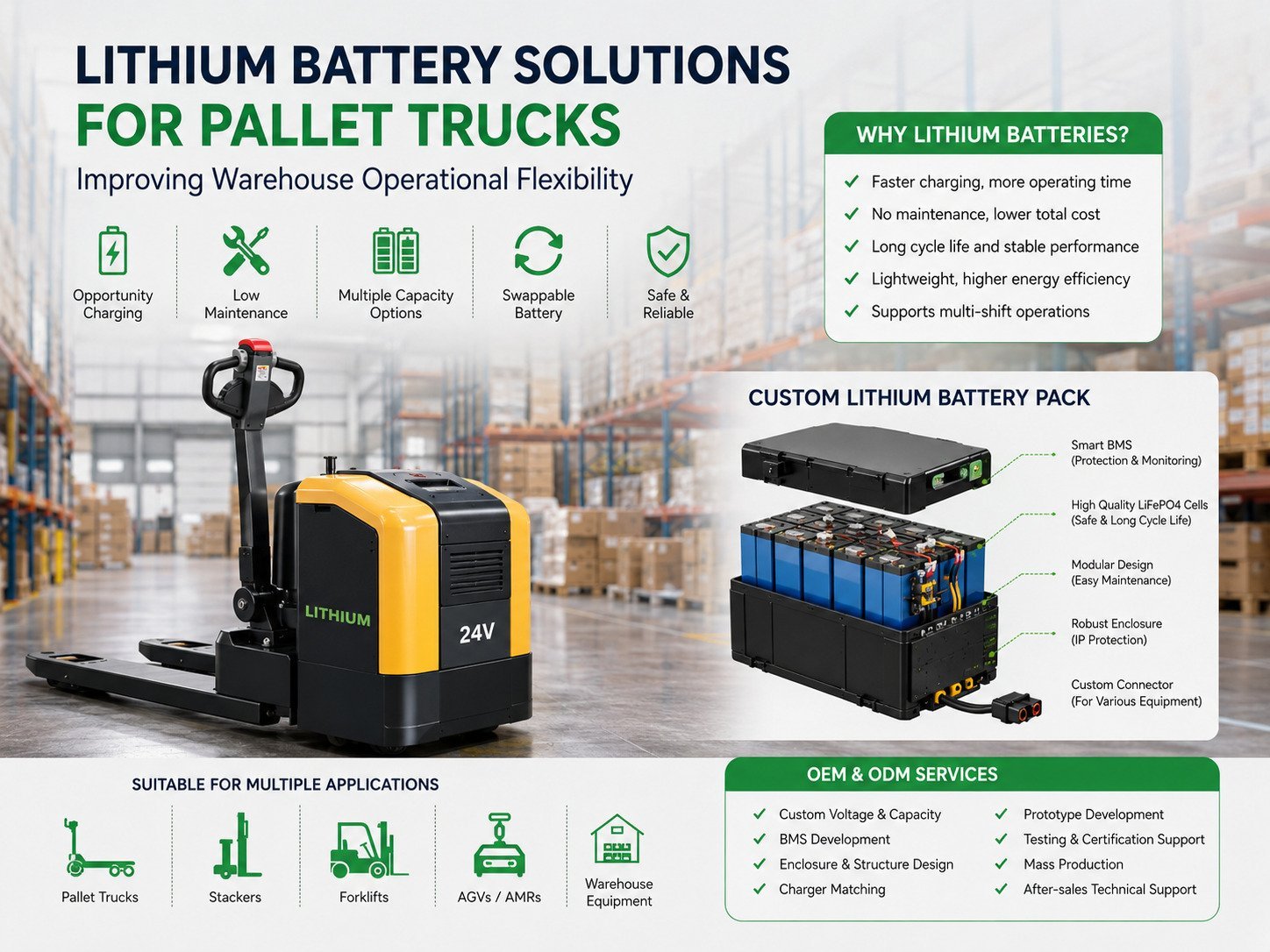
Why Battery Selection Matters for Pallet Truck Operations
An electric pallet truck may operate for several hours each day, depending on warehouse size, pallet weight, travel distance, operator habits, and shift arrangements. The battery therefore has a direct relationship with equipment availability.
A battery with an unsuitable capacity may require frequent charging during working hours. A battery that is physically incompatible with the truck may require mechanical modifications. A battery with an unsuitable BMS or charger may also create communication and charging issues.
For this reason, warehouse operators should evaluate several parameters before purchasing pallet truck batteries:
- バッテリー電圧
- 定格容量
- エネルギー容量
- 連続放電電流
- ピーク放電電流
- バッテリー寸法
- 重量
- コネクタの設定
- 通信プロトコル
- 充電に関する要件
- 動作温度
- IP protection requirements
- BMSの機能
- Battery replacement method
- 認証要件
For example, a 24V battery with a capacity of 100Ah has a nominal energy capacity of approximately 2,400Wh:
24V × 100Ah = 2,400Wh
However, the actual usable energy depends on the battery chemistry, BMS settings, operating temperature, load profile, discharge rate, and system efficiency.
This is why battery capacity should be selected according to the actual application rather than simply choosing the largest available capacity.
How Lithium Batteries Support Warehouse Operational Flexibility
Warehouse flexibility is not only about moving pallets quickly. It also involves how easily equipment can adapt to different working schedules.
Lithium battery systems provide several design options that can support this flexibility.
1. Flexible Charging During Work Breaks
Traditional warehouse battery management often relies on scheduled charging periods. Lithium battery systems can be designed for opportunity charging, allowing operators to charge the battery during suitable idle periods.
For example, a pallet truck may be used during the morning shift, connected to a compatible charger during a break, and returned to service afterward.
The appropriate charging strategy depends on the battery specification and charger design. The battery manufacturer should define acceptable charging current, temperature conditions, and charging procedures.
Opportunity charging can be useful in warehouses where equipment needs to return to operation without waiting for a long charging cycle.
2. Reduced Routine Battery Maintenance
Lead-acid batteries generally require specific maintenance procedures, including electrolyte and water management. Lithium battery systems do not require the same water-filling process.
A properly designed lithium battery pack can integrate:
- バッテリー管理システム
- 細胞電位のモニタリング
- 温度モニタリング
- 過電流保護
- Over-voltage protection
- Under-voltage protection
- 短絡保護
- 充電制御
- State-of-charge monitoring
This can simplify routine battery management and reduce the number of manual maintenance tasks associated with traditional battery systems.
However, lithium batteries still require appropriate inspection, charging, storage, and safety procedures.
LiFePO4 Battery for Electric Pallet Trucks
Lithium iron phosphate, commonly known as LiFePO4 or LFP, is one of the lithium battery chemistries used in industrial applications.
LiFePO4 batteries are suitable for applications where stable operation, cycle performance, thermal characteristics, and safety management are important considerations.
A LiFePO4 pallet truck battery can be configured according to the required voltage and capacity.
Common system configurations may include:
- 24V battery systems
- 36Vバッテリーシステム
- 48Vバッテリーシステム
The actual configuration depends on the pallet truck manufacturer and electrical system.
For example, if a pallet truck is designed around a 24V power system, the battery pack must provide an appropriate voltage range throughout the operating cycle. The number of cells connected in series determines the nominal voltage of the battery pack.
Parallel cell groups can then be used to increase capacity and current capability.
The final configuration should be determined according to the selected cell specification, BMS requirements, available battery space, discharge current, and charger parameters.
Battery Capacity Should Match the Duty Cycle
One of the common mistakes when selecting a pallet truck battery is focusing only on Ah capacity.
A warehouse may have two pallet trucks with the same nominal voltage but completely different energy requirements.
Consider two operating environments:
Warehouse A
- 1日1シフト
- Short travel distances
- Moderate pallet loads
- Frequent idle periods
- 夜間充電
Warehouse B
- 複数のシフト
- Long travel distances
- Higher pallet movement frequency
- Limited charging opportunities
- Extended daily operating time
These two applications may require different battery capacities and charging strategies.
A practical battery assessment should consider:
Daily energy consumption = Average power consumption × Operating time
Other factors should then be considered, including:
- 積載重量
- 移動距離
- Acceleration frequency
- Floor conditions
- 周囲温度
- モーターの効率
- Hydraulic system requirements
- Regenerative braking
- Operator behavior
- Charging availability
This approach can help avoid both under-sizing and unnecessary over-sizing.
Removable Battery Solutions for Pallet Trucks
Battery replacement can be useful in applications where equipment must remain operational for extended periods.
A removable battery pack allows an operator or maintenance team to replace a depleted battery with a charged unit, depending on the equipment design and battery weight.
A swappable battery system may be considered for:
- Multi-shift warehouses
- 物流センター
- High-frequency pallet movement
- Equipment fleets
- Operations with limited charging space
- Applications requiring continuous equipment availability
The battery housing should be designed for secure installation and removal. Mechanical locking, connectors, handles, communication interfaces, and protection structures all need to be considered during development.
Battery weight is also important. A battery that is technically suitable from an electrical perspective may not be practical if operators cannot safely handle it.
For larger battery systems, mechanical lifting or dedicated battery-changing equipment may be required.
Fixed Battery vs. Swappable Battery
Different warehouse environments may benefit from different battery architectures.
| バッテリー構成 | Suitable Application |
|---|---|
| Fixed battery | Standard single-shift operation |
| 取り外し可能なバッテリー | Flexible warehouse operation |
| Swappable battery | Multi-shift applications |
| High-capacity battery | Extended operating periods |
| Opportunity-charging battery | Frequent short charging periods |
| Compact battery pack | Space-limited pallet trucks |
There is no single battery configuration suitable for every pallet truck.
The correct design depends on the equipment structure and operating workflow.
BMS Design for Pallet Truck Batteries
The Battery Management System, or BMS, is a key component of a lithium battery pack.
The BMS monitors and manages the battery cells and can provide protection against abnormal operating conditions.
Typical BMS functions include:
- 細胞電位のモニタリング
- パック電圧の監視
- 電流の監視
- 温度モニタリング
- 過充電保護
- 過放電保護
- 過電流保護
- 短絡保護
- 熱保護
- セルバランシング
- 充電状態の推定
For commercial and industrial pallet trucks, BMS communication can also be important.
Depending on the truck controller, charger, and system architecture, the battery may need to communicate through interfaces such as CAN bus or other communication protocols.
Battery suppliers should therefore confirm the communication requirements before development.
A battery pack that has the correct voltage and capacity may still be unsuitable if the BMS communication does not match the equipment.
Matching the Battery and Charger
The charger should be selected together with the battery rather than treated as a separate accessory.
重要なパラメータには、次のようなものがあります:
- 電池の化学組成
- 公称電圧
- 最大充電電圧
- 推奨充電電流
- 充電可能温度範囲
- 充電コネクタ
- 通信要件
- 充電プロファイル
- 保護機能
For example, an LFP battery requires a charging profile appropriate for LiFePO4 chemistry.
The charger output must also be compatible with the battery’s BMS and electrical specifications.
For an OEM battery project, the battery manufacturer can work with the equipment manufacturer to verify:
Battery → BMS → Charger → Motor Controller → Pallet Truck
This system-level approach helps reduce compatibility issues during integration.
Designing a Compact Battery Pack for Pallet Trucks
Pallet trucks often operate in areas where space is limited.
The battery compartment may have strict requirements for:
- 長さ
- 幅
- 高さ
- コネクタの位置
- 取り付け位置
- ケーブルの配線
- Handle position
- Cooling space
- サービスへのアクセス
Therefore, battery pack design is not simply about putting cells into a box.
A customized battery pack may require:
- 細胞の選択
- Electrical configuration
- BMS selection or development
- 構造設計
- コネクタの選定
- ケーブルの設計
- Enclosure development
- Thermal design
- 機械試験
- 電気試験
- Charging verification
- 機器の統合
For OEM applications, the battery housing can be designed around the available battery compartment.
Battery Safety and Protection
Battery safety should be considered throughout the product development process.
For pallet truck applications, mechanical and electrical protection are both important.
The battery enclosure should provide suitable protection against:
- 影響
- 振動
- ダスト
- 水分
- Cable damage
- Connector damage
- Accidental short circuits
The required protection level depends on the application environment.
A warehouse battery may face vibration from uneven floors, repeated acceleration and braking, pallet impacts, and frequent installation or removal.
Therefore, mechanical fixation and vibration resistance should be included in the validation process.
Testing Lithium Batteries for Pallet Trucks
Testing provides practical evidence that a battery pack meets its design requirements.
Depending on the project, testing may include:
電気試験
- 電圧試験
- キャパシティ・テスト
- 充放電試験
- Over-current protection testing
- Short-circuit protection testing
- BMS function testing
機械的試験
- 振動試験
- 落下試験
- コネクタの試験
- Enclosure inspection
- Mounting structure testing
環境試験
- 高温試験
- 低温試験
- Humidity testing
- Water-resistance testing where required
経年劣化試験
Battery packs can also undergo aging procedures to identify abnormal behavior before shipment.
For industrial battery projects, the testing plan should be based on the intended application, customer requirements, applicable standards, and battery design.
Certification and Compliance Considerations
Battery certification requirements depend on the destination market, battery chemistry, application, transportation method, and final equipment.
For lithium battery products, commonly encountered standards and regulatory requirements may include:
- UN38.3
- IEC 62133-2
- CE関連の要件
- RoHS
- EU電池規則(EU)2023/1542
- UL requirements for applicable markets
- Country-specific transportation or product requirements
For pallet truck battery projects, certification should be considered during the design stage.
This is particularly important for OEM customers because changing the cell configuration, BMS, enclosure, or electrical architecture late in the development process may affect testing and certification requirements.
A battery manufacturer with experience in compliance documentation can help customers identify the applicable requirements before mass production.
Lithium Battery Solutions for Different Warehouse Environments
A battery solution should reflect the warehouse environment.
Small Warehouses
Small warehouses may have one-shift operations and sufficient overnight charging time.
A compact battery with appropriate capacity can be considered, with a focus on:
- コンパクトなサイズ
- Simple charging
- 低メンテナンス
- Easy installation
Distribution Centers
Distribution centers may have higher equipment utilization.
Potential requirements include:
- バッテリー容量の拡大
- チャンスチャージ
- Multiple battery packs
- バッテリー監視
- Fleet-level battery management
Cold Storage Warehouses
Low-temperature environments can affect lithium battery performance and charging behavior.
Battery systems used in cold storage should be designed with the applicable temperature range in mind.
Charging a lithium battery at temperatures below its specified charging range can damage the cells. Therefore, low-temperature protection and suitable charging controls may be required.
Multi-Shift Operations
Multi-shift warehouses may use:
- High-capacity battery packs
- チャンスチャージ
- バッテリー交換
- Multiple battery units
- 専用充電エリア
The appropriate combination depends on the operating schedule and equipment fleet.
OEM and ODM Pallet Truck Battery Solutions
For equipment manufacturers and warehouse solution providers, standard batteries may not always fit the application.
An OEM/ODM battery manufacturer can develop a battery pack based on customer specifications.
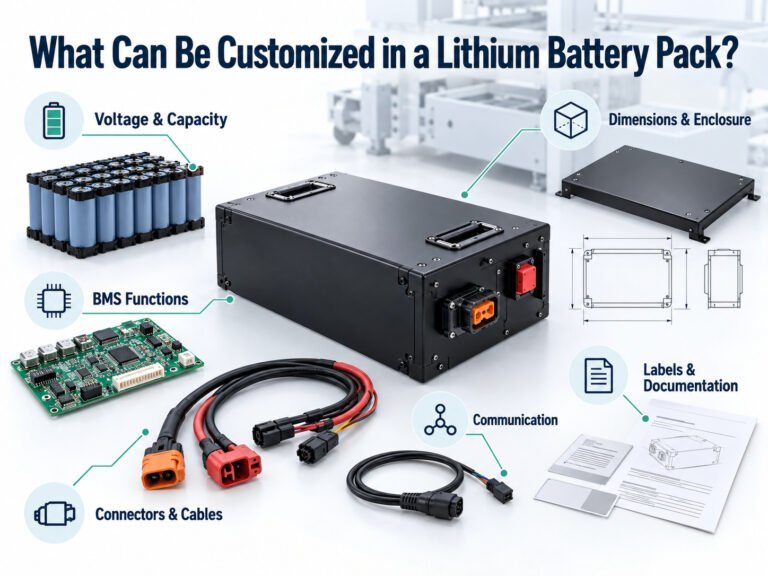
Typical customization options include:
- 電圧
- 定員
- バッテリー寸法
- セルブランド
- 細胞化学
- ビーエムエス
- 通信プロトコル
- コネクタ
- ケーブルの長さ
- 住宅
- 取付構造
- Display or indicator
- 充電器
- Labeling
- パッケージ
The development process can start with the pallet truck’s electrical and mechanical specifications.
役立つ情報には、次のようなものがあります:
Electrical specifications
- 定格電圧
- 動作電圧範囲
- モーター出力
- 最大電流
- 充電電圧
- 充電電流
Mechanical specifications
- 電池ケースの寸法
- 取り付け位置
- コネクタの位置
- Maximum battery weight
- 設置方法
Operating specifications
- 1日あたりの労働時間
- シフト数
- Average load
- Maximum load
- 動作温度
- Charging schedule
With this information, the battery supplier can evaluate the required cell configuration, BMS, enclosure, and charger.
Why Battery Customization Matters for Warehouse Equipment
A pallet truck battery is part of the equipment system.
A standard battery may provide the correct nominal voltage but still create problems if:
- The battery is too large
- The connector is incompatible
- The discharge current is insufficient
- The BMS communication is incorrect
- The charger is not compatible
- The battery is too heavy
- The mounting structure does not match
Customization allows the battery pack to be developed around the actual equipment.
For B2B customers, this can also simplify product integration when multiple pallet truck models use different battery compartments or control systems.
How to Select a Pallet Truck Battery Supplier
When evaluating a battery supplier, buyers should look beyond the battery price.
Important evaluation factors include:
技術力
Can the supplier customize:
- Cell configuration?
- BMS?
- Housing?
- Communication?
- Connectors?
- Charger?
Testing Capability
Ask whether the manufacturer has internal testing procedures for:
- 定員
- 高齢化
- ビーエムエス
- 振動
- 温度
- Waterproofing where required
製造能力
評価:
- Production process
- セルの照合
- Welding process
- 品質管理
- トレーサビリティ
- 最終検査
認証サポート
Confirm whether the supplier can provide the required technical documents and support applicable certification and transportation requirements.
After-Sales Technical Support
For OEM projects, technical support is important during:
- プロトタイプ開発
- インストール
- 機器の統合
- Field testing
- 量産
- Product updates
How Yizhan Develops Custom Lithium Battery Packs
For pallet truck and material handling applications, Dongguan Yizhan Electronics Technology Co., Ltd. provides customized lithium battery pack development for OEM and ODM customers.
The development process can cover:
Requirement Analysis → Battery Design → Cell Selection → BMS Development → Prototype → Testing → Certification Support → Mass Production
Depending on the application, battery packs can be designed with LiFePO4 or other lithium-ion cell configurations.
The engineering process can address electrical, mechanical, thermal, communication, and safety requirements together.
This approach is suitable for customers developing:
- 電動パレットトラック
- パレットジャッキ
- Walkie pallet trucks
- 資材運搬機器
- Warehouse robots
- 無人搬送車
- AMR
- 産業用車両
For projects with specific installation requirements, customers can provide battery compartment drawings, electrical specifications, existing battery samples, or equipment information for technical evaluation.
Frequently Asked Questions About Pallet Truck Batteries
What voltage battery does an electric pallet truck use?
The required voltage depends on the pallet truck model. Common systems include 24V, 36V, and 48V, but the correct voltage must be confirmed from the equipment manufacturer’s specifications.
Is LiFePO4 suitable for pallet trucks?
LiFePO4 can be used for pallet truck applications when the battery voltage, capacity, discharge current, BMS, charger, mechanical structure, and operating environment are properly designed.
Can a lead-acid pallet truck be converted to lithium?
In some applications, a pallet truck can be converted from lead-acid to lithium. The conversion should consider battery dimensions, weight, charger compatibility, BMS communication, controller requirements, and applicable safety or certification requirements.
Can the pallet truck battery be customized?
Yes. OEM battery packs can be customized for voltage, capacity, dimensions, BMS, connectors, communication functions, enclosure design, and other equipment requirements.
What is the difference between a fixed and removable pallet truck battery?
A fixed battery remains installed in the equipment, while a removable battery can be taken out for charging or replacement. Removable designs can be useful where battery swapping is part of the operating workflow.
How do I calculate pallet truck battery capacity?
A basic energy calculation is:
エネルギー(Wh)=電圧(V)×容量(Ah)
Actual battery requirements should also consider operating hours, load, motor power, travel conditions, temperature, charging opportunities, and system efficiency.
Can lithium pallet truck batteries support opportunity charging?
Some lithium battery systems can be designed for opportunity charging. The charging current, battery chemistry, BMS, charger, and manufacturer’s charging specifications must be considered before implementing this strategy.
What certifications are required for lithium pallet truck batteries?
Requirements depend on the destination market and application. UN38.3 is relevant to lithium battery transportation, while other product and market requirements may include IEC, UL, CE, RoHS, and EU Battery Regulation requirements.
Conclusion: Designing the Battery Around the Warehouse Workflow
Warehouse flexibility starts with understanding the complete operating environment.
For pallet trucks, the battery affects equipment availability, charging schedules, maintenance requirements, operating time, equipment weight, and integration with the vehicle’s electrical system.
Lithium-ion and LiFePO4 battery solutions provide several options for warehouse operators, including opportunity charging, removable battery designs, customized capacity, BMS monitoring, and application-specific battery configurations.
For OEM and ODM projects, the battery should be developed around the pallet truck rather than selected only according to voltage and capacity.
A practical development process should consider:
Application → Duty Cycle → Voltage → Capacity → Cell Selection → BMS → Charger → Mechanical Design → Testing → Certification → Production
By treating the battery as part of the complete material handling system, warehouse operators and equipment manufacturers can develop a power solution that fits their operational requirements.
For pallet truck manufacturers, warehouse equipment companies, and material handling solution providers, a customized lithium battery pack can provide the flexibility needed to support different equipment designs, operating schedules, and warehouse environments.
Yizhan provides OEM/ODM lithium battery pack solutions for pallet trucks and material handling equipment, with support covering battery design, BMS integration, prototype development, testing, and production.
 English
  Chinese
  Japanese
  German
  French
  Korean
