
Choosing a medical battery pack supplier is an important step in developing portable medical equipment, diagnostic instruments, patient monitoring systems, and other battery-powered healthcare devices. Unlike general-purpose consumer batteries, medical battery packs must meet specific requirements for electrical performance, mechanical integration, safety, reliability, and regulatory documentation.
For OEM and ODM projects, these requirements become more complex because the battery is often designed around a particular medical device. The supplier needs to understand the equipment’s power architecture, operating environment, charging system, enclosure, and intended use before recommending a battery configuration.
Sustainability also requires more than selecting a rechargeable lithium-ion battery. A sustainable medical battery solution should consider battery chemistry, service life, manufacturing processes, repairability, transportation, documentation, and end-of-life management.
This guide explains how medical equipment manufacturers can evaluate battery pack suppliers and identify the technical capabilities needed for a custom OEM/ODM project.
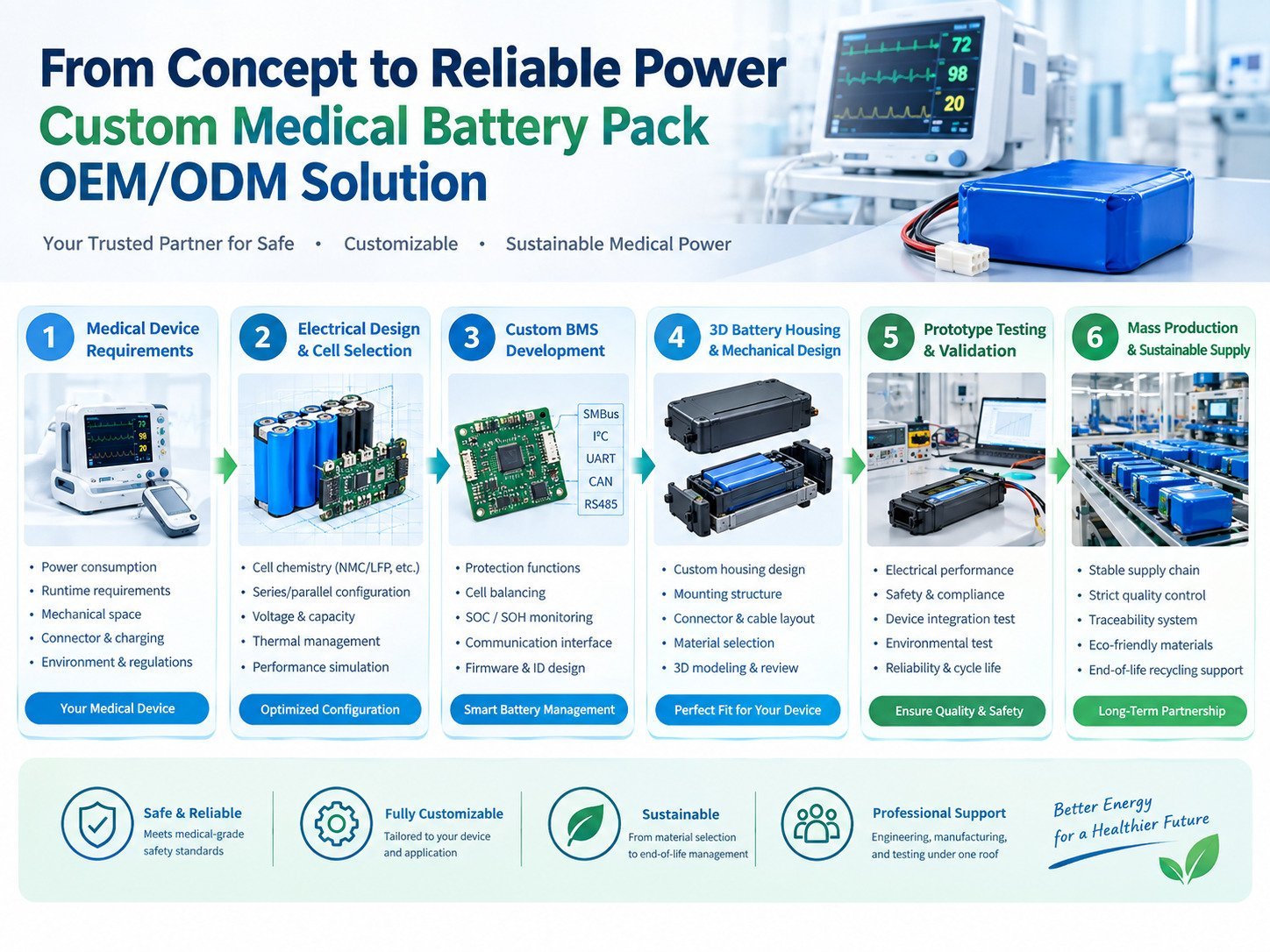
1. What Makes a Medical Battery Pack Different?
A medical battery pack supplies power to equipment that may be used in hospitals, laboratories, clinics, emergency environments, or home healthcare applications. Depending on the device, the battery may support continuous monitoring, short-term backup power, portable operation, or emergency use.
Examples include:
- Patient monitors
- Portable blood analyzers
- 輸液ポンプ
- Portable ultrasound equipment
- Medical suction devices
- AED除細動器
- Diagnostic instruments
- Portable ventilators
- Medical carts
- リハビリ機器
- Medical imaging accessories
- 実験用機器
Each application has a different power profile. A portable blood analyzer may require stable voltage during a measurement cycle, while an AED defibrillator may require a short, high-power discharge during an emergency event. A patient monitor may need several hours of continuous operation, and a medical cart may require a battery that supports repeated charging and discharging.
A suitable supplier must therefore evaluate the complete power system rather than simply recommend a battery with a particular voltage and capacity.
Medical Battery Pack vs. Standard Industrial Battery
A standard industrial battery may be selected primarily according to voltage, capacity, discharge current, and physical dimensions. Medical battery pack development often requires additional consideration of:
| Design Factor | Medical Battery Pack Requirement |
|---|---|
| 電圧 | Must match the equipment’s power input and operating range |
| 定員 | Must support the required runtime under actual load |
| 放電電流 | Must accommodate continuous and peak operating demand |
| ビーエムエス | Protection, monitoring, balancing, and communication functions |
| 機械設計 | Must fit the medical equipment enclosure |
| 充電 | Must be compatible with the device or external charger |
| 安全性 | Electrical, thermal, mechanical, and application-specific requirements |
| Documentation | Traceability, test records, specifications, and compliance documents |
| Serviceability | Battery replacement, maintenance, and lifecycle support |
| 持続可能性 | Cell selection, service life, material use, and end-of-life planning |
The supplier’s ability to manage these requirements during the design stage can affect the equipment’s development schedule, validation process, and future production.
2. Define Your Medical Battery Requirements Before Contacting Suppliers
A medical battery pack supplier can provide a more accurate proposal when the equipment manufacturer supplies technical information at the beginning of the project.
A complete battery specification does not need to be finalized before the first discussion. However, the initial information should describe the equipment’s operating conditions and design constraints.
2.1 Electrical Requirements
The electrical specification should include:
- 公称電圧
- 最大充電電圧
- Minimum operating voltage
- 必要容量
- 連続放電電流
- ピーク放電電流
- Peak current duration
- Expected runtime
- 充電電流
- 充電時間
- Standby current
- 動作温度
- 保存温度
- Expected cycle life
For example, a portable medical analyzer may require a 14.8V lithium-ion battery pack with a specified capacity and a BMS that communicates with the main control board. The final configuration depends on the device’s voltage range, power consumption, enclosure, and charging architecture.
Capacity should be calculated from actual power demand rather than selected only from the battery’s nominal voltage.
For a simplified energy calculation:
Battery Energy (Wh) = Nominal Voltage (V) × Rated Capacity (Ah)
If a device uses a 14.8V, 10Ah battery:
14.8V × 10Ah = 148Wh
The practical runtime will be lower than the theoretical energy divided by the equipment’s power consumption because of conversion losses, discharge conditions, reserve capacity, battery aging, and operating temperature.
A custom battery supplier should help verify the expected runtime through load testing.
2.2 Mechanical Requirements
Medical equipment often has limited internal space. The battery may need to fit inside a molded enclosure, slide into a dedicated compartment, or connect to a docking station.
Provide the supplier with:
- Maximum battery length, width, and height
- 取り付け位置
- コネクタの位置
- Cable exit direction
- 住宅の建材
- Battery insertion direction
- Locking or retention requirements
- 重量制限
- Clearance from other components
- Waterproofing or cleaning requirements
A battery pack that meets the electrical specification but cannot fit the device is not a usable OEM solution.
This is why medical battery pack customization should include both internal battery engineering and external structural design.
3. Evaluate the Supplier’s Customization Capability
Customization is a central part of medical battery pack OEM/ODM development. A supplier should be able to adapt the battery to the medical equipment instead of asking the equipment manufacturer to redesign the product around an existing battery.
3.1 Cell Selection and Battery Configuration
The supplier should understand how cell chemistry, cell format, capacity, discharge capability, and operating temperature affect the medical device.
Common lithium-ion battery chemistries include:
- Lithium-ion NMC
- Lithium iron phosphate, or LiFePO4
- Other lithium-based rechargeable chemistries selected according to application requirements
NMC cells may be considered for applications where energy density and compact size are important. LiFePO4 cells may be considered for applications where thermal characteristics, cycle life, and operating conditions are important.
The appropriate chemistry depends on the complete application. A medical device manufacturer should not select a cell solely because it has a higher nominal capacity.
Cell configuration also affects the pack’s voltage and capacity.
例えば、こうだ:
- 4S1P means four cells connected in series
- 4S2P means four series groups, with two parallel cells in each group
- 3S2P means three series groups, with two parallel cells in each group
The supplier should verify cell compatibility, voltage limits, current requirements, balancing requirements, and charging behavior before confirming the final configuration.
3.2 Custom Battery Housing
The battery housing may be designed according to the equipment’s internal structure.
A custom housing can include:
- ABS or PC enclosure
- 難燃性材料
- Custom battery trays
- Integrated mounting brackets
- Sliding battery rails
- Protective end caps
- Sealing structures
- Custom labels
- Battery identification markings
For medical equipment, the housing should also be evaluated for cleaning procedures, chemical exposure, impact resistance, and repeated battery replacement.
A supplier with 3D design capability can create an initial housing model, review interference with the equipment, and revise the design before sample production.
3.3 Custom BMS Development
The BMS is an important part of a rechargeable medical battery pack. It controls and monitors battery operating conditions and provides protection against specified electrical faults.
Depending on the application, a custom BMS may include:
- 過充電保護
- 過放電保護
- 過電流保護
- 短絡保護
- Overtemperature protection
- Undervoltage protection
- セルバランシング
- 充電状態の推定
- State-of-health monitoring
- Charging control
- Battery identification
- Communication with the medical device
The BMS should be designed around the actual battery configuration and the equipment’s control system.
For example, a medical device may need to display remaining battery percentage, charging status, battery temperature, or battery fault information. The battery supplier should be able to discuss the required communication protocol and data format with the equipment manufacturer’s engineering team.
Common communication interfaces include:
- SMBus
- I²C
- UART
- CAN
- RS485
The appropriate interface depends on the equipment’s hardware and software architecture.
A supplier that only provides a fixed BMS board may not be able to support all OEM/ODM requirements. A supplier with BMS development capability can adapt protection thresholds, communication functions, connector design, and monitoring features to the device.
4. Look for a Supplier That Supports the Complete OEM/ODM Process
Medical battery pack development usually involves several stages. The supplier should be able to support the project from technical discussion to mass production.
Stage 1: Requirements Review
The supplier reviews:
- Medical equipment application
- Electrical specifications
- Mechanical drawings
- Power consumption
- Charging system
- 動作環境
- Required certifications
- Expected annual volume
- Product lifecycle
At this stage, the supplier should identify potential design constraints and request missing information.
Stage 2: Battery Concept Design
The engineering team develops a preliminary solution covering:
- 細胞の選択
- 直列接続と並列接続
- バッテリー容量
- BMS concept
- 住宅の構造
- コネクタの選定
- Cable arrangement
- Charging compatibility
The supplier may provide a technical proposal and preliminary 3D design for review.
Stage 3: Prototype Development
Prototype production allows the equipment manufacturer to verify:
- バッテリー寸法
- Connector compatibility
- Installation process
- Device runtime
- Charging behavior
- BMS communication
- バッテリー重量
- Housing interference
A prototype should be tested in the actual medical equipment whenever possible.
Stage 4: Engineering Validation
Engineering validation examines whether the battery meets the agreed technical requirements.
Typical tests may include:
- キャパシティ・テスト
- 充放電テスト
- 電圧の一貫性
- 内部抵抗試験
- BMS protection testing
- 温度モニタリング
- Connector durability
- 振動試験
- Mechanical installation testing
- 通信テスト
The exact test plan depends on the equipment and applicable standards.
Stage 5: Design Optimization
Based on the validation results, the supplier may revise:
- セルの構成
- BMS parameters
- Housing dimensions
- ケーブルの長さ
- コネクタの種類
- 熱管理
- Charging parameters
- Battery mounting method
The goal is to establish a battery design that can be manufactured consistently and integrated into the equipment.
Stage 6: Pilot Production
Pilot production verifies that the approved design can be produced using the planned manufacturing process.
This stage may include:
- Production process review
- 組み立て検証
- BMSプログラミング
- セルの照合
- Welding quality inspection
- 機能テスト
- Traceability checks
- Packaging review
Stage 7: Mass Production
Once the design and validation requirements are approved, the supplier can begin regular production according to the agreed specifications.
The supplier should maintain control over:
- Approved battery drawings
- BOM
- BMS firmware version
- Cell supplier
- Production process
- Inspection standards
- Packaging requirements
- Change management
This helps prevent unexpected differences between prototype batteries and production batteries.
5. Why BMS Customization Matters in Medical Equipment
The BMS is not simply a protection board. In a medical battery pack, it may also provide information that the equipment uses to manage battery operation.
Protection Parameters
Protection thresholds should be matched to the selected cell chemistry and the battery’s operating conditions.
For example, the BMS may need to respond to:
- Excessive charging voltage
- Excessive discharge current
- Low cell voltage
- High cell temperature
- Short-circuit conditions
The protection settings should be validated against the battery manufacturer’s cell specifications and the equipment’s requirements.
Battery Communication
Some medical equipment uses battery data to estimate remaining operating time or trigger maintenance alerts.
A custom BMS may support communication of:
- 電圧
- 現在
- 温度
- 充電状態
- Battery fault status
- Charge cycle count
- Battery identification
- 残りの容量
The supplier should clarify which data can be measured directly, which values are calculated, and how the information is transmitted.
Battery Identification
For medical equipment with replaceable battery packs, identification functions may help the device recognize approved battery models.
The battery pack may include:
- Model number
- Serial number
- Production date
- 電池の化学組成
- 定格容量
- Firmware version
- Production batch
The identification method should be agreed upon with the equipment manufacturer.
Firmware and Change Control
BMS firmware changes can affect protection behavior, communication, and battery performance. Therefore, firmware versions should be controlled during OEM/ODM production.
A supplier should have a process for:
- Firmware version tracking
- Parameter management
- Test verification
- Change approval
- Production programming
- Software documentation
This is particularly important when the battery is part of a medical device’s validated power system.
6. Check Battery Safety and Compliance Documentation
Medical battery pack suppliers should be able to explain the applicable safety and transportation requirements for the battery design.
The exact standards depend on the battery chemistry, pack structure, intended use, and destination market.
Commonly Discussed Battery Standards
Potentially relevant standards and regulations include:
| Standard or Regulation | Relevance |
|---|---|
| IEC 62133-2 | Safety requirements for portable sealed secondary lithium cells and batteries |
| IEC 62619 | Safety requirements for industrial lithium secondary cells and batteries |
| UL 2054 | Household and commercial battery pack safety requirements |
| UL 2271 | Battery safety requirements for light electric vehicle applications |
| 国連 38.3 | Transport testing requirements for lithium batteries |
| EU電池規則(EU)2023/1542 | Battery sustainability, safety, labeling, and market requirements in the EU |
| RoHS | Restriction of certain hazardous substances in electrical and electronic equipment |
| EMC requirements | Electromagnetic compatibility considerations for the battery and equipment |
Not every standard applies to every medical battery pack. A supplier should help identify which requirements are relevant to the project and confirm the scope of any existing certifications.
For example, a certification for one battery model does not automatically establish compliance for a different battery configuration.
Documentation to Request
Before placing an OEM/ODM order, request relevant documentation such as:
- Battery specification sheet
- Cell datasheet
- BMS specification
- UN 38.3 test summary
- Safety test reports
- MSDS or SDS
- Battery drawings
- 充電に関する要件
- Inspection standards
- 品質管理手順
- Traceability information
- Material declarations
- Applicable compliance certificates
The supplier should explain whether the documents apply to the proposed battery model, the individual cell, or the complete battery pack.
7. How to Evaluate Sustainability in Medical Battery Manufacturing
Sustainability should be considered throughout the battery’s lifecycle.
A medical battery may remain in service for several years, so the design decisions made during development can affect material consumption, replacement frequency, maintenance, and waste.
7.1 Battery Service Life
A battery with an appropriate cycle life can reduce the frequency of replacement under the intended operating conditions.
However, cycle life is affected by:
- 放電深度
- 充電電流
- 動作温度
- Storage conditions
- 細胞化学
- Battery management strategy
The supplier should provide test data under defined conditions rather than relying on a general cycle-life number.
For example, a battery tested at a controlled temperature and a particular discharge rate may produce different results from a battery used continuously in a medical device.
7.2 Repairability and Replaceable Battery Design
A replaceable battery pack can support equipment maintenance and extend the service life of the medical device.
The design may include:
- Replaceable battery modules
- Accessible mounting screws
- Standardized connectors
- Battery identification
- Service instructions
- Replacement battery availability
However, the battery compartment must be designed carefully. Improper replacement can create risks involving incorrect polarity, incompatible voltage, damaged connectors, or inadequate mechanical retention.
For medical equipment, battery replacement procedures should be evaluated as part of the overall device design.
7.3 Material Selection
The battery housing, cable insulation, connectors, and protective components all contribute to the product’s material footprint.
A supplier should be able to discuss:
- Housing materials
- Flame-retardant requirements
- Material declarations
- Restricted substances
- Packaging materials
- Recyclability considerations
- Material consistency across production batches
Material selection must also consider mechanical strength, thermal behavior, chemical resistance, and the equipment’s intended cleaning process.
7.4 Manufacturing Process
A sustainable manufacturing process may involve:
- Reducing unnecessary material waste
- Improving production yield
- Controlling welding defects
- Optimizing packaging
- Maintaining equipment efficiency
- Reducing rework
- Managing production scrap
- Improving traceability
These activities also support consistent battery quality.
For OEM/ODM projects, manufacturing process control is particularly important because the battery design may include custom components that are not interchangeable with standard products.
7.5 Battery End-of-Life Planning
Battery sustainability also includes what happens after the battery is removed from service.
The equipment manufacturer and battery supplier should discuss:
- Battery labeling
- Cell chemistry identification
- Removal instructions
- Collection requirements
- Recycling channels
- Transportation of used batteries
- Applicable regional regulations
For products sold in the European Union, battery sustainability and lifecycle requirements should be reviewed according to the applicable provisions of the EU Battery Regulation.
8. Ask About Quality Control and Testing Capability
A medical battery supplier should have a defined inspection process for incoming materials, battery assembly, and finished packs.
入荷検査
Incoming inspection may include:
- 細胞電位
- セル容量
- 内部抵抗
- 外観
- 寸法
- Batch information
- BMS component verification
- コネクタ検査
Cell matching is important when multiple cells are connected in series or parallel.
Differences in cell voltage, capacity, and internal resistance can affect battery consistency and balancing behavior.
Assembly Inspection
Assembly inspection may include:
- 細胞の配列
- 断熱
- 溶接品質
- ケーブルの配線
- Connector installation
- BMS mounting
- ハウジングアセンブリ
- Label placement
The inspection criteria should be documented and linked to the approved battery drawing.
Finished Battery Testing
Depending on the battery design, finished-pack testing may include:
- 電圧
- 定員
- Charge and discharge
- BMS保護
- コミュニケーション
- Temperature response
- 内部抵抗
- Charging compatibility
- 外観
- 寸法
A supplier should be able to provide inspection records or test reports according to the agreed quality requirements.
経年劣化試験
Aging testing can help identify certain early-stage defects and verify battery behavior after charging and discharging.
The test method should specify:
- Charging conditions
- Discharge conditions
- Test duration
- 温度
- Voltage limits
- Acceptance criteria
The supplier should explain whether aging testing is performed on every battery pack or according to a defined sampling plan.
9. Medical Battery Pack Testing Should Include the Actual Equipment
Battery-level testing is necessary, but it may not reveal every issue that occurs when the battery is connected to the medical device.
Equipment-level testing can identify problems such as:
- Voltage drop during peak load
- Communication errors
- Incorrect remaining-capacity display
- Charging interruptions
- Connector heating
- Battery movement
- Unexpected shutdown
- Electromagnetic interference
- Runtime differences under real operating conditions
For example, a portable medical analyzer may have different power requirements during startup, measurement, data processing, and standby.
A battery that performs well under a constant laboratory load may behave differently during these operating transitions.
The supplier should therefore be prepared to support joint testing with the equipment manufacturer.
Example: Portable Medical Analyzer Battery
A portable blood analyzer may require:
- Stable power during testing
- A compact battery housing
- Replaceable battery access
- Communication with the main control board
- A defined charging process
- バッテリー状態の監視
- Protection against abnormal operating conditions
The battery supplier may need to customize the cell configuration, BMS communication, housing, connector, and charging parameters.
The final battery should be evaluated under the analyzer’s actual operating cycle.
10. Review the Supplier’s Engineering and Manufacturing Resources
The supplier’s technical resources affect its ability to handle custom projects.
Engineering Team
Relevant engineering capabilities may include:
- Battery electrical design
- BMS開発
- 機械設計
- 3D modeling
- 細胞の選択
- Thermal analysis
- プロトタイプ開発
- Testing and validation
- Production engineering
A supplier with multiple engineering disciplines can coordinate battery design decisions more efficiently.
Manufacturing Facilities
The supplier should be able to explain its production capabilities, including:
- 細胞の集合体
- Spot welding
- BMS設置
- Battery housing assembly
- Programming
- 機能テスト
- エージング試験
- 最終検査
- パッケージ
A factory visit or production video may help the equipment manufacturer understand the actual manufacturing process.
Production Flexibility
Medical equipment manufacturers may need different production volumes during product development and commercial launch.
A supplier should discuss its ability to support:
- Prototype quantities
- パイロット生産
- Small-batch orders
- Regular production
- Repeat orders
- Product revisions
- Replacement battery production
The production plan should be based on the battery’s design complexity, material availability, testing requirements, and agreed delivery schedule.
11. Questions to Ask a Medical Battery Pack Supplier
Before selecting a supplier, the equipment manufacturer can use the following checklist.
Technical Questions
- Can you design a battery pack according to our voltage, capacity, and runtime requirements?
- Can you develop a custom BMS?
- Can the BMS communicate with our equipment?
- Can you customize the battery housing and connector?
- Can you provide 3D drawings before prototype production?
- Can you support battery design changes during development?
- Can you test the battery inside our actual medical equipment?
- Can you provide cell and battery test data?
- Can you support replacement battery production?
- Can you help review the applicable battery standards?
Manufacturing Questions
- Where are the cells sourced?
- How are incoming cells inspected?
- How is cell consistency controlled?
- What production testing is performed?
- How is the BMS programmed?
- How are battery changes documented?
- How are battery batches traced?
- What production quantities can you support?
- How are defective batteries handled?
- Can you provide quality records?
Sustainability Questions
- What battery chemistries are available?
- Can the battery design support a longer service life?
- Can the battery be replaced without replacing the complete medical device?
- What materials are used in the housing?
- Can you provide material declarations?
- How is production waste managed?
- Can the battery be labeled for recycling?
- Can you support EU battery compliance documentation?
- Can you provide lifecycle-related technical information?
- How will the supplier support replacement batteries after product launch?
12. Why Customization Should Be Evaluated Before Price
Battery pack price is influenced by many factors:
- 細胞化学
- セル容量
- セルブランド
- Battery configuration
- BMSの機能
- Housing materials
- コネクタの種類
- Production volume
- Testing requirements
- 認証要件
- パッケージ
- Engineering development
Two battery packs with the same nominal voltage and capacity may have different costs because their BMS, structure, connectors, and testing requirements are different.
For medical equipment manufacturers, a low initial quotation may not represent the total project cost if the supplier cannot support engineering changes or equipment-level validation.
A more complete evaluation should consider:
Total Project Cost = Engineering + Prototype + Validation + Production + Documentation + Lifecycle Support
The actual cost structure depends on the project.
A supplier that can provide battery design, BMS development, 3D modeling, prototype production, testing, and mass production may reduce the need to coordinate multiple independent suppliers.
This can simplify communication and help maintain consistency between the approved prototype and production battery.
13. Why Choose Yi Zhan for Medical Battery Pack OEM/ODM?
Dongguan Yizhan Electronics Technology Co., Ltd. provides custom lithium battery pack solutions for medical equipment and other specialized applications.
The company supports battery development from technical requirements to prototype production and mass manufacturing.
Custom Battery Design
Yi Zhan can work with equipment manufacturers to develop battery packs according to:
- 電圧
- 定員
- Runtime
- 寸法
- 重量
- コネクタ
- Cable
- Housing
- ビーエムエス
- 充電に関する要件
The engineering team can review the equipment’s electrical and mechanical requirements before proposing a battery configuration.
Custom 3D Structure
Medical equipment manufacturers can provide enclosure drawings or preliminary mechanical requirements.
The battery design process may include:
- Reviewing the available installation space
- Confirming the battery dimensions
- Designing the battery structure
- Reviewing connector and cable placement
- Preparing 3D design files
- Revising the structure
- Producing samples
This approach allows the battery to be developed around the medical device’s structure.
カスタムBMS
Yi Zhan supports BMS design and battery management functions according to the battery configuration and equipment requirements.
Potential functions include:
- 過充電保護
- 過放電保護
- 過電流保護
- 短絡保護
- 温度保護
- セルバランシング
- バッテリー監視
- Communication interfaces
The final BMS design should be confirmed through technical review and validation.
Prototype to Mass Production
Yi Zhan supports the development process from requirements review to sample production and mass production.
The project may involve:
- 技術相談
- バッテリーの設計
- 3D structure development
- BMS開発
- 試作
- 機能テスト
- Quality inspection
- Production preparation
- 大量生産
This process is suitable for medical equipment manufacturers that need a custom battery rather than a standard off-the-shelf battery.
Battery Testing and Quality Control
Battery testing may include capacity, voltage, charging, discharge, BMS protection, and final inspection according to the approved project requirements.
The testing scope should be confirmed for each battery model.
For medical equipment, the battery should also be evaluated within the actual device to verify electrical compatibility, runtime, charging behavior, and mechanical integration.
Support for Different Medical Applications
Yi Zhan can discuss custom battery requirements for applications such as:
- Portable blood analyzers
- Patient monitoring equipment
- Medical carts
- Diagnostic instruments
- リハビリ機器
- ポータブル医療機器
- Emergency medical equipment
- 実験機器
The battery configuration, chemistry, BMS, and housing should be selected according to each device’s requirements.
14. Final Checklist for Selecting a Sustainable Medical Battery Supplier
Before starting an OEM/ODM medical battery project, confirm the following:
- The supplier understands the medical equipment’s power requirements.
- The supplier can customize voltage and capacity.
- The supplier can select cells according to the application.
- The supplier can design the BMS.
- The supplier can customize the battery housing.
- The supplier can provide 3D design support.
- The supplier can customize connectors and cables.
- The supplier can support prototype production.
- The supplier can perform battery-level testing.
- The supplier can support equipment-level validation.
- The supplier can provide relevant documentation.
- The supplier can explain applicable compliance requirements.
- The supplier can support pilot production.
- The supplier can maintain production traceability.
- The supplier can support replacement batteries.
- The supplier can discuss battery lifecycle and sustainability.
結論
Finding a sustainable medical battery pack supplier requires more than comparing battery prices or selecting a cell with a suitable capacity. The supplier should be able to understand the medical equipment’s power architecture, develop a compatible battery configuration, customize the BMS, design the housing, and support testing from prototype to production.
For OEM/ODM projects, customization capability is particularly important because the battery must work as part of the complete medical device.
A supplier with electrical engineering, mechanical design, BMS development, manufacturing, and testing capabilities can support a more coordinated development process.
Sustainability should also be considered throughout the battery lifecycle, including service life, replaceability, material selection, manufacturing, and end-of-life management.
When evaluating a medical battery pack manufacturer, ask for technical documentation, prototype support, testing capabilities, and a clear development process. These details can help equipment manufacturers select a battery partner that supports both current product development and future production requirements.
よくあるご質問
1. What is a medical battery pack OEM supplier?
A medical battery pack OEM supplier develops and manufactures battery packs according to an equipment manufacturer’s specifications. The supplier may customize the cell configuration, BMS, housing, connector, cable, and battery performance.
2. Can medical battery packs be customized for portable diagnostic equipment?
Yes. Custom battery packs can be designed for portable diagnostic equipment according to voltage, capacity, runtime, dimensions, weight, charging requirements, and communication functions.
3. Why is BMS customization important for medical battery packs?
BMS customization allows the battery management system to match the cell configuration, protection requirements, charging system, and communication architecture of the medical equipment.
4. What documents should I request from a medical battery supplier?
Common documents include battery specifications, cell datasheets, BMS information, safety test reports, UN 38.3 test summaries, SDS or MSDS, battery drawings, and quality inspection records.
5. How can a medical battery pack be made more sustainable?
Sustainability can be supported through suitable cell selection, service-life testing, replaceable battery design, material management, production process control, and end-of-life planning.
6. Can a battery supplier provide 3D design for a medical device battery?
A supplier with mechanical engineering capabilities may provide custom 3D battery housing design based on the equipment’s available installation space and mounting requirements.
7. What is the difference between a standard battery and a custom medical battery pack?
A standard battery typically follows a predefined specification. A custom medical battery pack is developed according to the equipment’s electrical, mechanical, charging, communication, and application requirements.
8. How long does medical battery pack development take?
The development schedule depends on battery complexity, BMS requirements, housing design, component availability, testing, and certification. The supplier should provide a project schedule after reviewing the technical requirements.
9. Can Yi Zhan support small-batch medical battery orders?
Yi Zhan supports custom battery pack development and production for different project stages. The available production quantity and schedule should be confirmed according to the battery design and project requirements.
10. How do I start a custom medical battery pack project?
Prepare the equipment’s voltage, capacity, runtime, dimensions, connector information, charging requirements, and application details. Then contact a battery supplier for a technical review and preliminary battery proposal.

 English
  Chinese
  Japanese
  German
  French
  Korean
