
Beauty devices such as facial massagers, electric cleansing brushes, EMS devices, LED skincare equipment, heating devices and cooling beauty tools often require compact rechargeable batteries.
Although these products are smaller than industrial equipment, their battery design still involves several engineering considerations. Voltage, capacity, discharge current, battery dimensions, charging temperature, connector design, BMS protection and waterproof requirements all affect the performance of the finished device.
For product developers and beauty device manufacturers, selecting a battery should therefore begin with the electrical and mechanical requirements of the device rather than simply choosing a battery based on capacity.
This guide explains the key considerations for designing and sourcing a custom lithium battery for beauty devices.
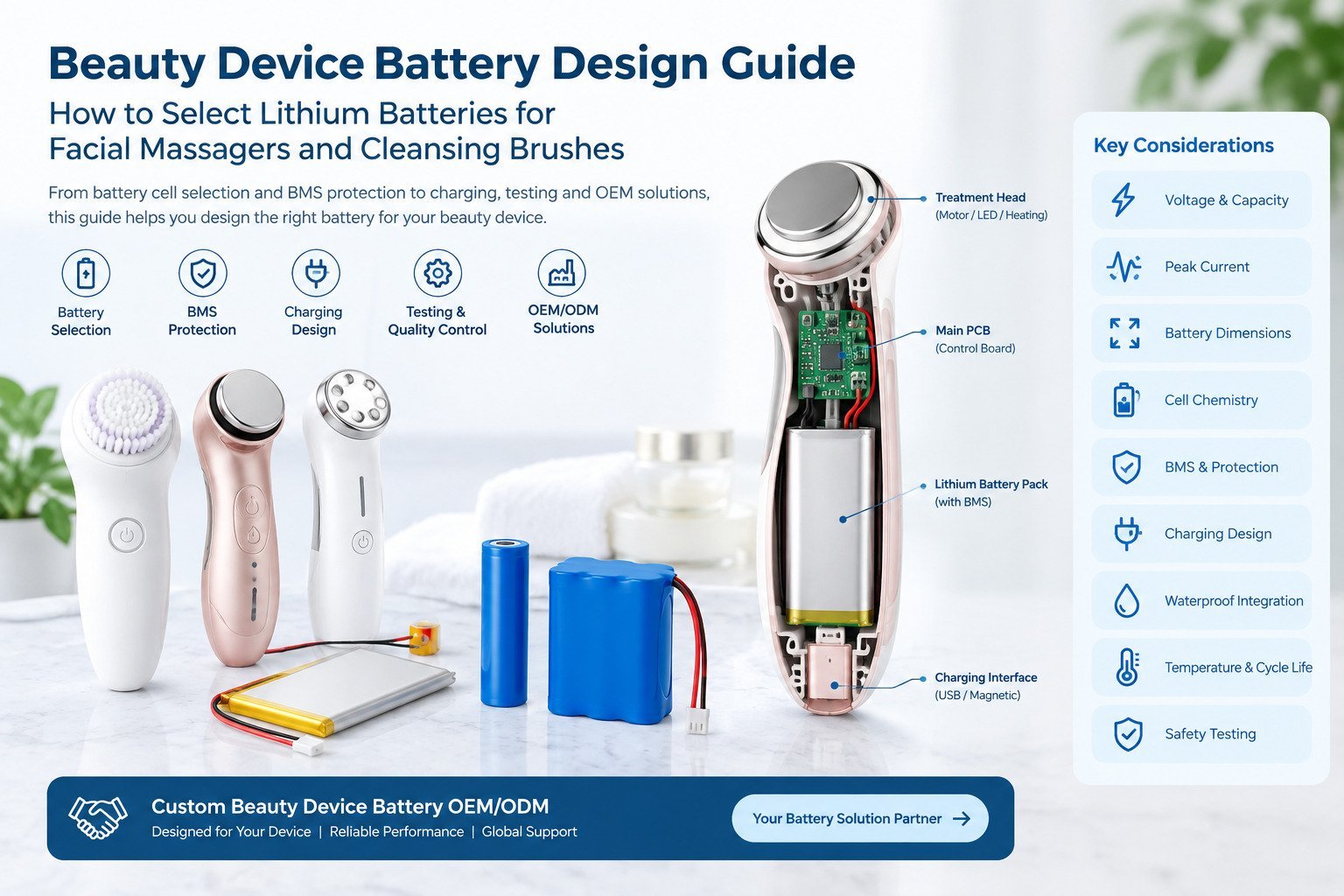
1. Why Battery Design Matters for Beauty Devices
A beauty device usually has limited internal space. The battery must fit within the enclosure while providing sufficient energy for the required operating time.
A typical portable beauty device may contain:
- Lithium battery pack
- Motor or vibration mechanism
- Heating or cooling element
- LED module
- EMS or microcurrent circuit
- Main control board
- Charging circuit
- User interface
- センサー
These components create different electrical loads.
For example, a facial cleansing brush may primarily require power for a vibration motor, while an EMS device may require a battery capable of supporting electronic circuits that generate controlled electrical pulses.
A heating beauty device introduces another requirement because the heating element can create a relatively high power demand.
Therefore, the battery specification should be developed from the complete device load profile.
2. How to Calculate Battery Capacity
Battery capacity is normally specified in milliampere-hours, or mAh.
A basic energy relationship is:
エネルギー(Wh)=電圧(V)×容量(Ah)
For example, a 3.7 V battery with a nominal capacity of 2,000 mAh has approximately:
3.7 V × 2 Ah = 7.4 Wh
However, actual device runtime depends on operating power, conversion efficiency, battery discharge characteristics and operating conditions.
A simplified runtime calculation is:
Runtime ≈ Battery Energy × System Efficiency ÷ Average Device Power
For a beauty device, the average power consumption should be determined from actual operating modes.
For example, a device may have:
- Standby mode
- Low-power mode
- Normal operating mode
- High-power mode
- Heating mode
- 充電モード
The battery should be selected based on the complete operating profile instead of only the maximum current.
3. Determine the Device’s Peak Current
Capacity is not the only battery parameter that matters.
Some beauty devices use small motors or other loads that create startup current or short-duration current peaks.
A battery specification should therefore include:
Continuous Current + Peak Current + Peak Duration
For a facial massager, the motor may require a short current surge when starting.
If the battery has excessive internal resistance, the voltage can drop during the current peak. This may cause:
- Device restart
- Motor speed reduction
- Protection activation
- Controller instability
- Reduced operating performance
Battery cell selection should therefore consider discharge capability and internal resistance as well as capacity.
4. Choosing Between Li-ion and LiPo Batteries
Two common battery configurations for compact beauty devices are lithium-ion cylindrical cells and lithium polymer pouch cells.
Lithium-Ion Cylindrical Cells
Cylindrical cells such as 18650 or 21700 cells have standardized physical formats.
Potential advantages include:
- Defined mechanical dimensions
- Established cell supply
- 複数の容量オプション
- Suitable structural stability
- Availability for different discharge requirements
They can be suitable when the device enclosure can accommodate a cylindrical battery structure.
リチウムポリマー電池
Lithium polymer pouch cells use a flexible pouch format.
They are frequently considered for products with restricted internal space because the battery dimensions can be configured according to the enclosure.
Potential design benefits include:
- Thin battery profiles
- Flexible length and width
- Efficient use of irregular internal space
- Low-profile configurations
- Custom connector and cable arrangements
For beauty devices, the choice between cylindrical and pouch cells should be based on the mechanical structure, electrical requirements, production requirements and expected usage conditions.
5. Common Battery Voltages for Beauty Devices
Many compact rechargeable beauty products use single-cell lithium batteries with a nominal voltage around 3.7 V.
Higher system voltages can be achieved by connecting cells in series.
例えば、こうだ:
1S: approximately 3.7 V nominal
2S: approximately 7.4 V nominal
3S: approximately 11.1 V nominal
The actual charging voltage depends on the selected cell chemistry and battery configuration.
The battery voltage must be compatible with the device’s control electronics and charging architecture.
If the main electronics operate at a lower voltage, a DC-DC converter may be required.
For this reason, battery voltage should be determined together with the electrical architecture of the entire device.
6. Battery Dimensions and Mechanical Design
Mechanical integration is one of the most important aspects of beauty device battery development.
A battery specification should define:
- 長さ
- 幅
- Thickness
- 細胞の配列
- Wire exit position
- コネクタの位置
- コネクタの種類
- ケーブルの長さ
- Protection board dimensions
- Insulation requirements
- Fixing method
For a compact facial massager, even a small change in battery thickness can affect the enclosure design.
During OEM development, engineers can evaluate the available internal space and determine an appropriate battery configuration.
A 3D drawing or physical sample of the device can help engineers evaluate battery placement.
7. BMS and Protection Circuit Design
A Battery Management System, or BMS, is an important part of a rechargeable lithium battery pack.
For small beauty devices, the protection circuit may include functions such as:
- 過充電保護
- 過放電保護
- 過電流保護
- 短絡保護
- 過熱保護
- Cell balancing for applicable multi-cell configurations
The protection strategy should correspond to the selected battery chemistry and device requirements.
For a single-cell beauty device, a protection PCB may be sufficient for the required battery functions.
For multi-cell battery packs, additional monitoring and balancing functions may be required.
8. Charging Design for Beauty Devices
Charging performance affects both user experience and battery service life.
The battery and charging system should be designed together.
重要なパラメータには、次のようなものがあります:
- 充電電圧
- 充電電流
- 充電時間
- 充電温度
- Charging termination method
- Charger specification
- USB or proprietary charging interface
- Battery protection limits
For example, a beauty device using a USB-C input may include a charging management circuit between the USB interface and battery.
The charging circuit must be compatible with the selected battery chemistry and configuration.
The battery manufacturer should receive the charger specification when evaluating a custom battery project.
9. Waterproof Battery Integration
Some facial cleansing brushes and beauty devices are designed for use with water.
In this situation, waterproofing cannot be achieved by simply adding waterproof material around the battery.
The complete device structure needs to be considered.
Potential areas requiring attention include:
- バッテリー収納ケース
- Connector area
- ケーブル出口
- Welding points
- 充電インターフェース
- Housing seams
- PCB protection
- Sealing components
The required IP rating should be defined according to the intended application and product design.
The battery pack itself and the complete device may have different protection requirements.
For example, an IP-rated enclosure does not automatically mean that every internal component independently meets the same IP rating.
10. Battery Operating Temperature
Beauty devices may be used in environments with different temperatures.
Temperature should be considered during:
- 充電
- 排出
- ストレージ
- 交通
Heating beauty devices require additional thermal evaluation because the battery may be located near a heating element.
The battery layout should provide appropriate separation and thermal management between the battery and heat-producing components.
Temperature sensors can also be incorporated into the battery protection system when required.
11. Battery Cycle Life
Rechargeable beauty devices are often used repeatedly over an extended period.
Cycle life depends on multiple factors, including:
- 細胞化学
- Charge rate
- 放電率
- 放電深度
- 動作温度
- 保存温度
- 充電戦略
A product developer should define the expected usage pattern.
For example, using a device for several minutes per day creates a different battery duty cycle from a professional beauty device used continuously throughout the working day.
Battery cycle-life requirements should therefore be based on the actual product usage model.
12. Battery Safety Testing
Battery testing should cover both electrical and mechanical characteristics.
Depending on the application, testing may include:
- キャパシティ・テスト
- 充放電テスト
- 内部抵抗試験
- 保護機能テスト
- エージング試験
- 温度試験
- 振動試験
- Short-circuit protection testing
- Overcharge protection testing
- Mechanical inspection
The final testing plan should be established according to the battery design, target market and applicable standards.
For lithium batteries used in portable products, IEC 62133-2 is an important safety standard covering portable sealed secondary lithium cells and batteries under its applicable scope.
Transportation requirements may also involve UN 38.3 testing.
13. Connector and Cable Selection
The connector is a small component, but it can affect battery reliability and assembly efficiency.
The connector should be selected according to:
- 定格電流
- 定格電圧
- Contact resistance
- 利用可能な設置スペース
- 接続方法
- Mating cycles
- Cable gauge
- Polarity requirements
Cable length should also be controlled according to the device layout.
For mass production, connector specifications should remain consistent with the approved engineering sample.
14. How a Beauty Device Battery OEM Project Works
A typical OEM/ODM battery project can follow several stages.
ステップ1:要件分析
お客様からは以下のものを提供していただきます:
- Device application
- バッテリー電圧
- 必要容量
- 稼働時間
- ピーク電流
- 充電方法
- バッテリー寸法
- Annual demand
- ターゲット市場
ステップ2:セルの選択
Engineers evaluate suitable lithium cells based on capacity, current, dimensions, cycle requirements and supply conditions.
Step 3: Battery Pack Design
エンジニアリングチームは、以下を決定します:
- セルの構成
- バッテリー寸法
- Protection circuit
- ビーエムエス
- コネクタ
- ケーブル
- 断熱
- Housing or packaging
Step 4: Prototype Development
Samples are produced for mechanical and electrical verification.
The customer can evaluate battery fit, charging, runtime and device performance.
Step 5: Testing
The battery undergoes the agreed testing process.
Issues identified during testing can be addressed before mass production.
Step 6: Mass Production
After approval of the final specification, production can proceed according to the agreed quality requirements and delivery schedule.
15. What Information Should You Send to a Battery Manufacturer?
For a faster engineering evaluation, a beauty device manufacturer can provide:
| 要件 | 例 |
|---|---|
| 申し込み | Facial Massager |
| 公称電圧 | 3.7 V |
| 定員 | 2,000 mAh |
| Maximum Current | 2 A |
| 稼働時間 | 60 min/day |
| Battery Size | カスタム |
| セル・タイプ | LiPo |
| コネクタ | カスタム |
| Charging Interface | USB-C |
| Waterproof Requirement | Device-specific |
| ターゲット市場 | EU / USA |
| 年間発行部数 | カスタム |
If the exact battery specification is not available, the device’s electrical and mechanical information can still be used as the starting point for battery development.
16. Beauty Device Battery OEM and ODM Solutions
A custom battery manufacturer can support beauty device companies from initial specification through production.
Typical customization options include:
- 細胞化学
- 電圧
- 定員
- セルの構成
- バッテリー寸法
- ビーエムエス
- Protection circuit
- コネクタ
- ケーブルの長さ
- Wire configuration
- パッケージ
- 通信機能
- Temperature sensing
- 機械構造
These options allow the battery to be designed around the product instead of forcing the product enclosure to accommodate a standard battery.
17. Applications for Custom Beauty Device Batteries
Custom rechargeable lithium batteries can be developed for various personal care products, including:
- Facial massagers
- Facial cleansing brushes
- EMS beauty devices
- Microcurrent devices
- LED skincare devices
- Heating beauty devices
- Cooling beauty devices
- Electric scalp massagers
- Eye massagers
- Portable skincare equipment
- Personal care electronics
Each application requires its own electrical, mechanical and thermal evaluation.
18. Conclusion
Selecting a battery for a beauty device involves more than choosing a suitable mAh value.
A complete battery design should consider voltage, capacity, peak current, cell chemistry, dimensions, BMS protection, charging conditions, temperature, connector design, waterproof integration and applicable testing requirements.
For facial massagers, cleansing brushes and other portable personal care products, a custom lithium battery can be developed around the device’s electrical and mechanical architecture.
For OEM and ODM projects, providing accurate device specifications at the beginning of development helps engineers select cells, define the battery configuration and develop an appropriate protection system.
Dongguan Yizhan Electronics Technology Co., Ltd. provides custom lithium battery OEM/ODM solutions for beauty devices and other portable electronic products. Battery specifications can be customized according to voltage, capacity, dimensions, current, connector, BMS and application requirements.
 English
  Chinese
  Japanese
  German
  French
  Korean
