
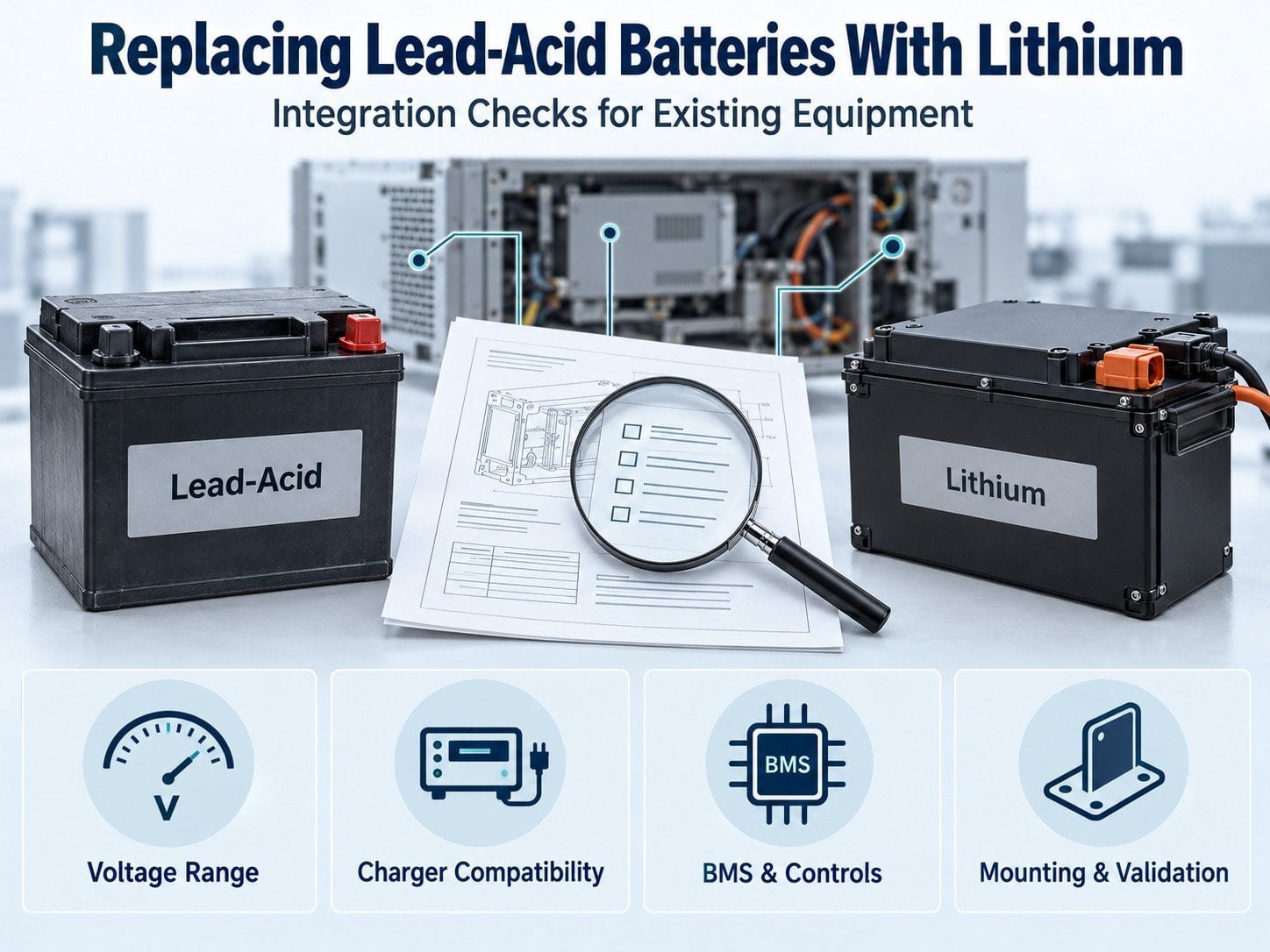
Replacing a lead-acid battery with a lithium battery is a system integration project. Matching the enclosure size and nominal voltage does not establish compatibility.
The equipment’s charger, controller, wiring, protection and operating logic must work with the proposed battery.
This guide explains the information OEMs should collect and the checks needed before approving a conversion.
This article provides project-planning guidance. Installation and configuration should be performed by qualified personnel using the instructions for the selected equipment and battery.
1. Record the Existing System
Begin with the equipment as it is currently configured.
Collect:
- Equipment model and electrical drawings.
- Existing battery type and configuration.
- Charger model and charging profile.
- Controller input-voltage range.
- Continuous and transient current.
- Cable and connector details.
- Battery compartment dimensions.
- Battery mass.
- Operating schedule.
- Environmental conditions.
Include accessories connected directly to the battery.
Identify any undocumented modifications before selecting replacement components.
2. Define the Lithium Battery Chemistry
“Lithium battery” is not a complete specification.
Lithium iron phosphate, or LFP, and other lithium-ion chemistries have their own voltage characteristics and operating requirements.
Specify the cell chemistry, manufacturer, model and series configuration.
The design must establish:
- Full-charge voltage.
- Operating voltage range.
- Charge and discharge current limits.
- Temperature limits.
- Protection requirements.
Do not select a battery solely from a nominal voltage label.
3. Check the Complete Voltage Range
Equipment designed for lead-acid batteries may use voltage thresholds associated with the original configuration.
Révision :
| Objet | What to Confirm |
|---|---|
| Contrôleur | Permitted input range and undervoltage response |
| DC-DC converters | Input limits and startup behavior |
| Contactors and relays | Coil and contact ratings |
| Écrans | Supply requirements and battery indication |
| Chargeur | Output profile and control functions |
| Accessoires | Compatibility across the operating range |
Check voltage during charging, normal discharge and load transients.
The system must tolerate the proposed battery’s approved operating range without relying on repeated protection trips.
4. Review the Existing Charger
A lead-acid charger should not be retained without verification.
Review every charging mode, including:
- Normal charging.
- Float or maintenance charging.
- Equalization.
- Desulfation or reconditioning.
- Temperature compensation.
- Restart after interruption.
Any mode that falls outside the lithium battery’s charging requirements must not be used.
Manufacturer guidance should identify the approved charger or settings. For example, Victron specifies a charging profile matching its battery chemistry and parameters. This guidance applies to its products and does not establish settings for unrelated batteries.
A selectable “lithium” mode still requires confirmation against the actual battery specification.
5. Define BMS Integration
A lithium battery requires a protection architecture appropriate to its construction and application. The BMS may be internal or may form part of an external system.
Confirmer :
- Charge and discharge control.
- Voltage and temperature monitoring.
- Overcurrent and short-circuit protection.
- Warning outputs.
- Communication.
- Fault recovery.
- Sleep and wake-up behavior.
The equipment must have a defined response if the BMS disconnects charging or discharge.
Do not use protective disconnection as the normal charging termination or routine equipment shutdown method.
6. Verify Current Capability
Measure the equipment’s battery-side current during representative operation.
Include:
- Startup.
- Motor acceleration.
- Lifting or actuator operation.
- Sustained load.
- Standby.
- Restart attempts.
For each transient, record magnitude, duration and repetition.
The battery’s current capability must account for cells, BMS components, interconnections, protective devices, cables and connectors.
An ampere-hour rating does not establish current capability.
7. Review Fuses, Cables and Switching Components
Retaining the original wiring requires assessment.
Confirmer :
- Cable size and condition.
- Connector ratings.
- Terminal preparation.
- Protective-device coordination.
- Fuse DC voltage and interrupting ratings.
- Contactor ratings.
- Disconnect procedures.
The proposed battery changes the source characteristics. Existing protection should not be assumed suitable without review.
Do not bypass a fuse or BMS to prevent shutdown.
8. Evaluate Inrush and Precharge
Equipment may contain input capacitors that draw current when the battery is connected.
Determine whether the system needs a controlled connection or precharge function.
Define:
- Connected capacitance.
- Connection sequence.
- Completion criteria.
- Timeout.
- Main-switch operation.
- Fault response.
- Repeated-start behavior.
Precharge requires an engineered circuit and validation. It should not be added as an improvised field modification.
9. Account for Charging From Other Sources
Some equipment receives energy from an alternator, solar controller or another DC source.
Each source must meet the battery’s charging requirements and respond to BMS restrictions.
Where alternator charging is used, assess current control and the consequences of battery disconnection. Manufacturer documentation may specify a DC-DC charger or another approved arrangement.
Do not apply one charging architecture to every installation.
10. Check Regenerative Operation
Some motor systems return energy to the battery during braking or descent.
Confirm whether regeneration is present, then define:
- Permitted charge current.
- Battery voltage limits.
- Temperature restrictions.
- Charge acceptance near full charge.
- Controller response when charging is unavailable.
- DC-bus behavior during BMS disconnection.
A battery that supplies the drive current is not automatically able to accept every regenerative event.
11. Define Usable Energy
Do not assume that matching the original ampere-hour label will reproduce the equipment’s operating time.
Lead-acid capacity is specified under stated discharge conditions. The proposed lithium pack also needs defined capacity and energy measurements.
Use the equipment’s measured duty cycle to establish:
- Task energy.
- Permitted operating window.
- Shutdown reserve.
- Temperature conditions.
- Required performance at the service endpoint.
For preliminary calculations:
Nominal energy (Wh) = nominal voltage (V) × capacity (Ah)
Nominal energy is not a guarantee of usable energy in the equipment.
12. Review Battery Indication
The original battery gauge may estimate charge condition from voltage using a lead-acid profile.
That indication should not be assumed valid for the proposed lithium chemistry.
Define whether the equipment will use:
- BMS-reported state of charge.
- A compatible battery monitor.
- A documented voltage-based indication.
- Defined warning signals.
Validate the display and low-energy behavior under the intended duty cycle.
13. Confirm Mechanical Fit and Equipment Balance
The battery compartment review should include:
- Mounting and retention.
- Terminal clearance.
- Cable routing.
- Connector access.
- Removal procedure.
- Environmental exposure.
- Thermal conditions.
Battery mass may also have a role in equipment balance.
For equipment with specified battery-weight limits or counterbalance requirements, follow the equipment manufacturer’s instructions. Do not treat unused space or a change in mass as automatically acceptable.
Ballast, if required, needs an approved mechanical design.
14. Define Temperature and Storage Requirements
Use the selected battery’s charging, discharge and storage limits.
Do not assume that operating procedures for the original battery remain valid.
Document:
- Charging restrictions.
- Response to temperature warnings.
- Storage charge condition.
- Inspection intervals.
- Standby consumption.
- Wake-up procedure.
If heating is included, specify how it is powered and controlled, and when charging is permitted.
15. Do Not Assume Series or Parallel Compatibility
Individual replacement batteries may have restrictions on series or parallel connection.
Confirm the manufacturer’s approved configuration, including:
- Number of units.
- Matching requirements.
- Wiring arrangement.
- Protection.
- Communication.
- Charging method.
Do not directly connect lead-acid and lithium batteries together unless the complete arrangement is specifically designed and approved for that purpose.
16. Review Documentation and Approval
A battery conversion may affect equipment documentation, warranty conditions and conformity assessment.
Confirm with the equipment manufacturer and relevant assessment body what review is required.
Transport documentation must match the battery design being supplied. UN38.3 testing and test-summary requirements address transport and do not establish compatibility with the equipment.
17. Validate the Complete Installation
Define acceptance criteria before testing.
| Test Area | Verification |
|---|---|
| Voltage compatibility | Operation across the approved battery range |
| Current demand | Continuous and transient loads |
| Charging | Every permitted charging mode |
| Protection de l'environnement | Fault response and recovery |
| Start-up | Inrush, sequencing and controller operation |
| Regeneration | Charge acceptance and bus behavior |
| Battery indication | Display and warnings |
| Thermal behavior | Cells, cables, connectors and electronics |
| Mechanical integration | Retention, access and equipment balance |
| Durée d'exécution | Defined duty-cycle completion |
Record hardware, software, settings and test conditions.
Complete the review before releasing the converted equipment for use.
OEM Conversion Checklist
Prepare the following for the battery supplier:
- Existing system drawings.
- Equipment and charger models.
- Voltage limits.
- Measured load profile.
- Charging-source information.
- Regenerative conditions.
- Installation dimensions.
- Battery mass requirements.
- Control and communication interfaces.
- Environmental conditions.
- Approval and validation responsibilities.
Foire aux questions
Can a Lithium Battery Directly Replace a Lead-Acid Battery?
Only where the specific combination is approved. Matching nominal voltage and dimensions is insufficient.
Can the Existing Charger Be Used?
Only after its complete operating profile is confirmed against the lithium battery requirements.
Does “Drop-In Replacement” Mean No Checks Are Needed?
No. Verify the stated compatibility conditions, including charging, current, mounting and system behavior.
Can the Original Battery Gauge Be Retained?
It requires validation. A lead-acid indication profile may not represent the lithium battery’s charge condition.
Should the Conversion Be Tested in the Equipment?
Yes. Battery data alone does not establish the operation of the complete installation.
Planning the Conversion
Treat the replacement as a documented system change.
Review electrical limits, charging, protection, controls and mechanical requirements. Validate the approved battery–equipment combination before use.


 English
 Chinese
 Japanese
 German
 French
 Korean

