
A reliable battery is an important part of a lawn tractor’s starting and electrical system. The battery provides the electrical power required to start the engine and supports equipment such as lights, displays, control systems, and other electrical components.
When replacing a lawn tractor battery, choosing one based only on physical size can lead to compatibility problems. Voltage, capacity, starting current, dimensions, terminal configuration, battery chemistry, and charging requirements all need to be considered.
This guide explains the main factors to consider when choosing a lawn tractor battery and compares common lead-acid and lithium battery options.
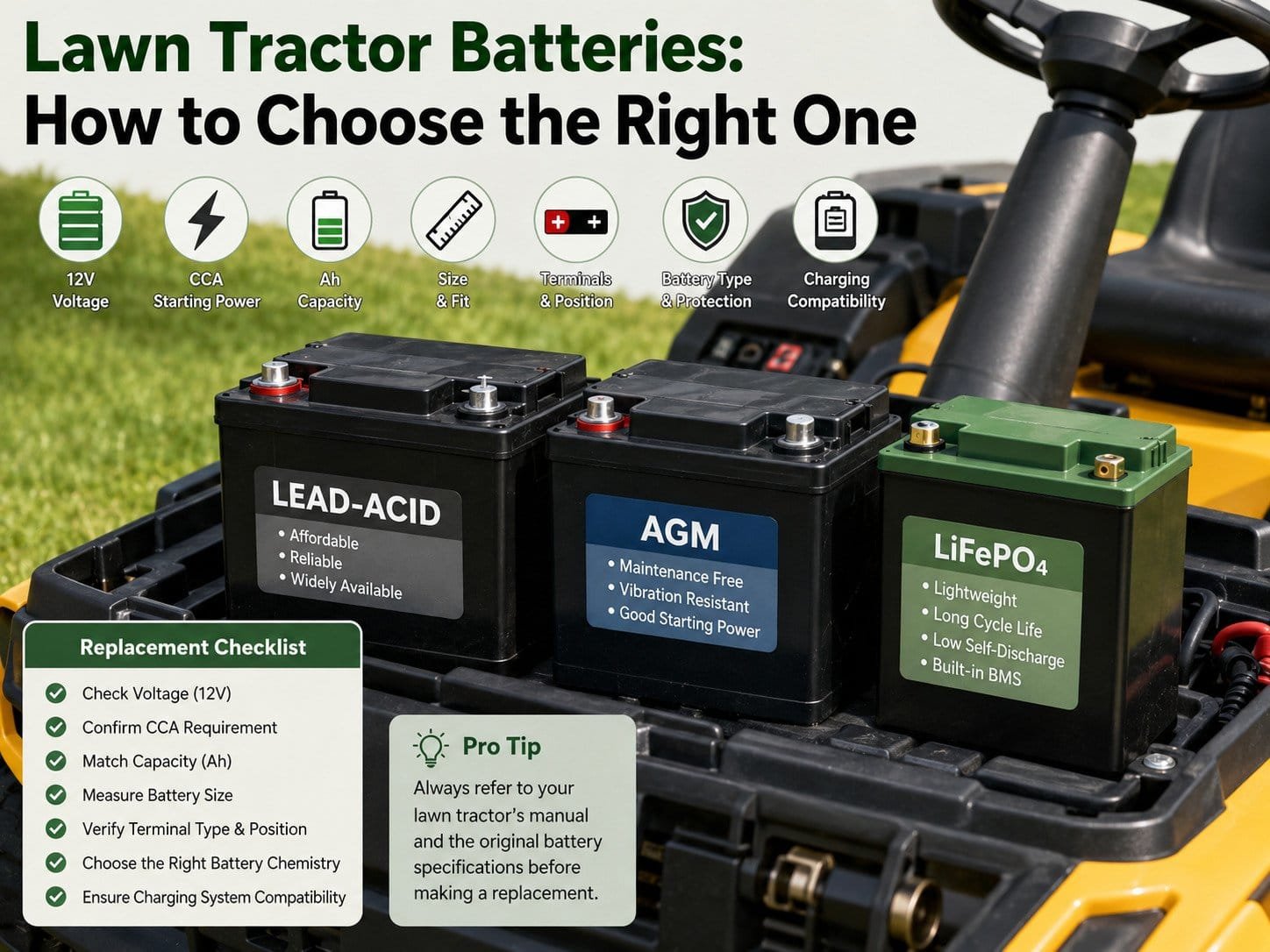
Part 1.What Is a Lawn Tractor Battery?
A lawn tractor battery is a rechargeable battery designed to provide electrical power for starting and operating the electrical system of a lawn tractor.
Many lawn tractors use a 12V battery, although the exact battery specification depends on the tractor manufacturer and model.
Unlike batteries used only for low-power accessories, a lawn tractor starting battery needs to provide sufficient current for the starter motor. It may also need to supply power to lights, electronic controls, safety systems, and other components.
Before purchasing a replacement battery, always check the original battery label and the tractor manufacturer’s specifications.
Part 2.What Type of Battery Does a Lawn Tractor Use?
Several battery chemistries can be found in lawn and garden equipment.
Batteries plomb-acide
Traditional lead-acid batteries are widely used in lawn tractors. They are available in different configurations, including flooded lead-acid and sealed designs.
Their main characteristics include:
- Established battery technology
- Relatively low initial cost
- Availability in many sizes
- Suitable starting performance when correctly specified
- Higher weight than lithium batteries
Flooded lead-acid batteries may require more maintenance than sealed alternatives, while AGM batteries use a sealed construction and generally require less routine maintenance.
AGM Batteries
Absorbent Glass Mat (AGM) batteries are a type of valve-regulated lead-acid battery. The electrolyte is held within a fiberglass mat.
AGM batteries can offer:
- Sealed construction
- Low routine maintenance
- Good vibration resistance
- Suitable starting current
- Compatibility with many existing lawn tractor electrical systems
However, AGM batteries are still relatively heavy compared with lithium alternatives.
Batteries LiFePO4
Lithium iron phosphate, commonly called LiFePO4, is a lithium-ion battery chemistry used in various electric and industrial applications.
For lawn tractor applications, LiFePO4 battery packs can provide advantages such as:
- Poids réduit
- Faible autodécharge
- Longue durée de vie
- Stable electrochemical characteristics
- Integrated Battery Management System (BMS)
However, a LiFePO4 replacement is not automatically compatible with every lawn tractor. The battery voltage, starting-current capability, BMS configuration, charging system, temperature protection, and physical dimensions must all be checked.
Part 3.How to Choose the Right Lawn Tractor Battery
Choosing a suitable battery involves more than matching the battery’s physical dimensions.
1. Check the Battery Voltage
Voltage is one of the first specifications to verify.
A large number of lawn tractors use a 12V electrical system, but you should confirm this from the original battery or equipment manual rather than assuming it.
Installing a battery with an incompatible voltage can cause starting or electrical-system problems.
For a replacement battery, check:
- Tension nominale
- Tension de charge
- Electrical system voltage
- Compatibility with the starter and onboard electronics
If switching from lead-acid to LiFePO4, pay particular attention to the difference between nominal voltage and charging voltage.
2. Check Cold Cranking Amps (CCA)
Cold Cranking Amps (CCA) indicates a battery’s ability to deliver high current for engine starting under specified low-temperature test conditions.
For a lawn tractor with a gasoline engine, starting current can be an important specification.
A battery with insufficient starting capability may cause:
- Slow starter operation
- Difficulty starting the engine
- Voltage drop during starting
- Reduced performance in cold conditions
The replacement battery should meet or exceed the starting-current requirements specified by the tractor manufacturer.
For lithium batteries, manufacturers may use different methods to describe starting or discharge current. Therefore, do not compare a lithium battery’s current rating directly with a lead-acid CCA rating without understanding the test conditions.
3. Consider Battery Capacity
La capacité de la batterie est généralement exprimée en ampère-heure (Ah).
Capacity indicates how much electrical charge a battery can store under specified test conditions. It can influence how long the battery can support electrical loads when the engine is not running.
However, a higher Ah rating does not automatically mean the battery is the right choice.
A suitable battery should balance:
- Required starting current
- Electrical load
- Capacité de la batterie
- Poids
- Conditions de recharge
- Manufacturer specifications
For a lawn tractor used mainly for engine starting, starting performance can be more important than simply choosing the highest available Ah rating.
4. Measure the Battery Dimensions
Physical dimensions are critical when replacing a battery.
Measure:
- Longueur
- Largeur
- Hauteur
- Mounting area
- Terminal clearance
Even when two batteries have the same voltage and capacity, differences in dimensions can prevent proper installation.
The battery should fit securely into the original battery compartment without interfering with cables, covers, moving components, or other electrical parts.
5. Check Terminal Type and Position
Battery terminals must match the tractor’s cables.
Vérifier :
- Terminal type
- Positive terminal position
- Negative terminal position
- Terminal size
- Longueur du câble
- Connection direction
Incorrect terminal positioning can make installation difficult or cause cables to be stretched or routed incorrectly.
Always verify the terminal configuration before ordering a replacement battery.
Part 4.Lead-Acid vs. LiFePO4 for Lawn Tractors
Both lead-acid and LiFePO4 batteries can be suitable for different applications, but they have different characteristics.
| Fonctionnalité | Plomb-acide | LiFePO4 |
|---|---|---|
| Poids | Plus élevé | Inférieur |
| Initial cost | Generally lower | Generally higher |
| Durée du cycle | Generally shorter | Generally longer |
| Self-discharge | Plus élevé | Inférieur |
| Maintenance | Depends on type | Generally low |
| BMS | Usually not integrated | Typically integrated |
| Résistance aux vibrations | Depends on construction | Can be designed for vibration resistance |
| Conditions de recharge | Conventional lead-acid charging | Requires compatible lithium charging |
| Low-temperature charging | Generally more tolerant than lithium | Requires appropriate protection |
The choice depends on the tractor, operating environment, budget, and whether the electrical and charging systems are compatible with the selected battery chemistry.
Part 5.Can You Replace a Lead-Acid Lawn Tractor Battery With LiFePO4?
A lead-acid battery can sometimes be replaced with a LiFePO4 battery, but the replacement should be evaluated as a complete electrical system rather than simply swapping one battery for another.
Several factors should be checked.
Voltage Compatibility
The lithium battery’s voltage must be compatible with the tractor’s electrical system.
A LiFePO4 pack intended for a 12V application typically has a different voltage profile from a conventional 12V lead-acid battery.
Starting Current
The battery must provide sufficient current for the starter motor.
The BMS should also be designed to handle the required peak current without disconnecting the battery during engine starting.
Charging System
This is one of the most important considerations.
A lawn tractor’s charging system may have been designed around lead-acid battery characteristics. When replacing a lead-acid battery with LiFePO4, the charging voltage and charging profile should be evaluated.
A lithium battery should not be connected to an incompatible charger simply because both batteries have a nominal voltage of 12V.
Low-Temperature Charging
LiFePO4 batteries require special consideration during low-temperature charging.
If the equipment may be operated or stored in cold environments, the battery can incorporate appropriate BMS protection, such as low-temperature charging cutoff or other thermal management strategies.
BMS Configuration
The Battery Management System can protect a lithium battery against conditions such as:
- Surcharge
- Surdécharge
- Surintensité
- Court-circuit
- Excessive temperature
- Low-temperature charging
For engine-starting applications, the BMS must also be configured to support the required discharge current.
Part 5.How Long Does a Lawn Tractor Battery Last?
Battery service life varies considerably.
Factors that influence battery life include:
- Chimie des batteries
- Température de fonctionnement
- Starting frequency
- Storage conditions
- Charging practices
- Depth of discharge
- Vibrations
- Maintenance
- Battery quality and design
Lead-acid batteries may experience capacity loss over time due to sulfation, repeated deep discharge, temperature exposure, and other operating conditions.
LiFePO4 batteries can provide a longer cycle life under suitable operating conditions, but actual service life depends on the battery design, cell quality, BMS settings, operating temperature, and charging conditions.
Therefore, there is no single service-life number that applies to every lawn tractor battery.
Part 6.Signs That a Lawn Tractor Battery Needs Replacement
Several symptoms can indicate that a battery should be inspected or replaced.
Slow Engine Cranking
If the starter motor turns more slowly than usual, the battery may have insufficient starting capability.
However, the starter motor, wiring, terminals, or charging system should also be checked before replacing the battery.
Battery Discharges Quickly
If a fully charged battery loses voltage quickly, possible causes include:
- Vieillissement de la batterie
- Excessive parasitic load
- Charging-system problems
- Internal battery damage
Frequent Jump-Starting
Repeated jump-starting can indicate that the battery or charging system requires inspection.
Corroded or Damaged Terminals
Corrosion can increase electrical resistance and affect starting performance. Damaged terminals, cables, or connectors should also be checked.
Visible Battery Damage
Cracks, swelling, leakage, damaged terminals, or other physical damage are reasons to stop using the battery and replace it appropriately.
How to Maintain a Lawn Tractor Battery
Proper maintenance can help improve battery reliability.
Keep Battery Connections Clean
Battery terminals and cable connections should be kept clean and secure. Corrosion and loose connections can increase resistance.
Avoid Unnecessary Deep Discharge
Repeated deep discharge can shorten the service life of many battery types.
If the tractor will not be used for an extended period, follow the battery manufacturer’s recommended storage procedure.
Use the Correct Charger
Use a charger designed for the specific battery chemistry.
A charger designed for conventional lead-acid batteries should not automatically be assumed to be suitable for LiFePO4.
Store the Battery Properly
During long periods of seasonal storage, temperature and battery state of charge should be managed according to the manufacturer’s recommendations.
For lithium batteries, storage conditions should follow the battery manufacturer’s specified voltage and temperature range.
Inspect Before the Mowing Season
Before regular seasonal use, check:
- Tension de la batterie
- État terminal
- Raccordements par câble
- Physical condition
- Charging system
- Starting performance
This can help identify potential problems before the tractor is needed for regular work.
Part 7.How to Choose a Lithium Battery for a Lawn Tractor
If you are considering a LiFePO4 lawn tractor battery, the following specifications deserve particular attention:
- Tension nominale
- Courant de décharge maximal
- Courant de décharge continu
- Battery capacity
- Protection du BMS
- Tension de charge
- Low-temperature charging protection
- Dimensions de la batterie
- Terminal configuration
- Mounting structure
- Température de fonctionnement
- Communication or monitoring requirements, if applicable
For OEM equipment manufacturers, the battery can also be designed around the tractor’s available installation space and electrical requirements.
A custom battery pack may include specific cell configurations, BMS parameters, connectors, housing dimensions, mounting structures, and protection functions.
Part 8.Why Battery Design Matters for Lawn Tractor Applications
A lawn tractor battery operates in an environment that can involve vibration, temperature changes, moisture, dust, and repeated engine starting.
For this reason, the battery design should consider more than energy capacity.
A suitable battery pack may require:
- Mechanical protection
- Secure cell assembly
- Appropriate welding methods
- Protection du BMS
- Reliable connectors
- Construction résistante aux vibrations
- Protection thermique
- Appropriate enclosure design
For lithium battery packs, cell selection and BMS configuration are particularly important because the battery needs to meet both electrical and mechanical requirements.
Part 9.Lawn Tractor Battery Replacement Checklist
Before purchasing a replacement battery, confirm the following information:
- Original battery voltage
- Required starting current
- Battery capacity
- Dimensions de la batterie
- Terminal type
- Terminal position
- Méthode de montage
- Chimie des batteries
- Charging-system compatibility
- Température de fonctionnement
- BMS requirements for lithium batteries
Taking these measurements and specifications from the original equipment can reduce the risk of selecting an incompatible replacement.
Foire aux questions
What voltage is a lawn tractor battery?
Many lawn tractors use 12V batteries, but the exact voltage should be confirmed from the tractor’s manual or original battery label.
Can I use a lithium battery in a lawn tractor?
A lithium battery may be suitable for some lawn tractors if its voltage, starting current, charging requirements, physical dimensions, and BMS configuration are compatible with the equipment.
Is LiFePO4 better than lead-acid for a lawn tractor?
Neither chemistry is universally suitable for every lawn tractor. LiFePO4 can provide lower weight, low self-discharge, and long cycle life, while lead-acid batteries have established compatibility with many conventional starting systems and generally have a lower initial cost.
How many Ah does a lawn tractor battery need?
The required capacity depends on the tractor model and electrical system. The original battery specification or equipment manufacturer’s recommendation should be used as the starting point.
What is CCA on a lawn tractor battery?
CCA, or Cold Cranking Amps, describes a battery’s ability to deliver high starting current under specified cold-temperature test conditions. It is an important specification for engine-starting applications.
Can I replace an AGM battery with LiFePO4?
A replacement may be possible, but voltage, charging characteristics, starting current, BMS protection, dimensions, terminals, and operating temperature must be evaluated before making the change.
Conclusion
Choosing the right lawn tractor battery requires more than matching the battery’s size. Voltage, starting current, capacity, dimensions, terminal configuration, battery chemistry, charging requirements, and operating conditions should all be considered.
For conventional lawn tractors, lead-acid and AGM batteries remain practical options. LiFePO4 batteries can be considered when lower weight, low maintenance, low self-discharge, and longer cycle life are important. However, a lithium replacement should be designed and selected according to the tractor’s electrical and charging system.
For equipment manufacturers and battery distributors, a custom lithium battery pack can be developed around the required voltage, capacity, discharge current, BMS protection, dimensions, connectors, and installation requirements. This approach allows the battery to be evaluated as part of the complete lawn tractor system rather than as an isolated component.
 English
  Chinese
  Japanese
  German
  French
  Korean
