
Infant pulse oximeters are compact medical monitoring devices designed to measure oxygen saturation (SpO₂) and pulse rate in infants and young children.
With the increasing demand for portable healthcare equipment, manufacturers are focusing on smaller designs, longer operating time, and reliable power solutions.
The battery pack is one of the key components affecting device performance. A suitable infant pulse oximeter battery needs to provide stable power output, safety protection, long cycle life, and compatibility with medical device requirements.
For medical device manufacturers, selecting the right custom lithium battery pack supplier is an important step in product development.
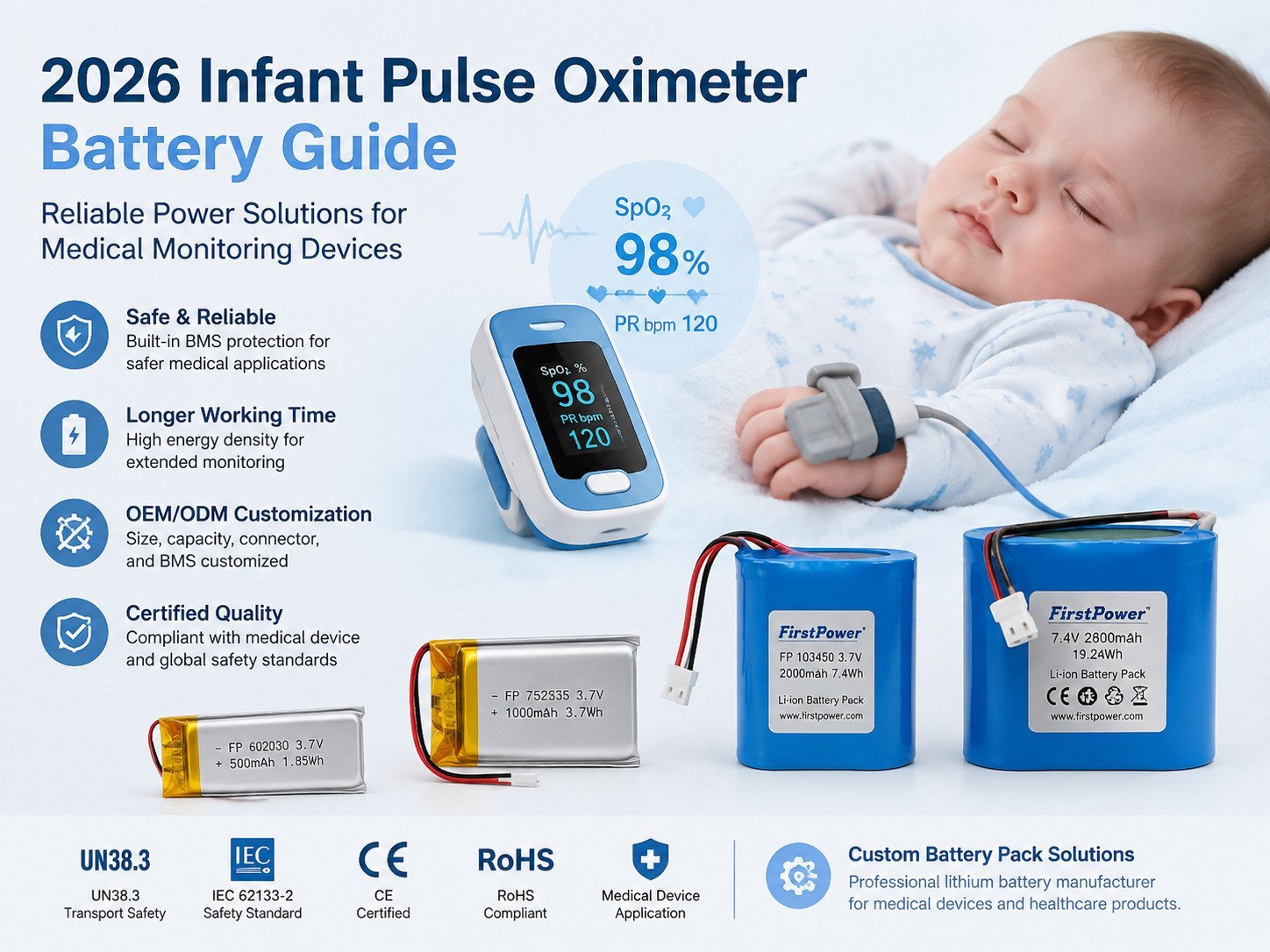 What Type of Battery Is Used in Infant Pulse Oximeters?
The most common battery technologies used in infant pulse oximeters include:
- Lithium polymer battery (Li-Po)
- Lithium-ion battery pack
- 18650 battery pack
- LiFePO4 battery pack
Each battery type has different advantages depending on device design, size requirements, and operating conditions.
Lithium Polymer Battery for Infant Pulse Oximeters
Lithium polymer batteries are widely used in portable medical devices because of their flexible design.
Les avantages sont les suivants
Compact Size
Medical wearable devices often have limited internal space. Li-Po batteries can be customized in different shapes and thicknesses.
Lightweight Structure
The lightweight design helps reduce the overall weight of portable monitoring equipment.
Customized Capacity
Battery manufacturers can design different capacities based on:
- Device power consumption
- Working time requirements
- Product size limitations
Common applications:
- Baby wearable monitors
- Infant pulse oximeters
- Portable healthcare devices
How to Choose the Right Battery Capacity for a Pulse Oximeter?
Battery capacity directly affects device operating time.
Le calcul de base :
Battery Capacity (mAh) = Working Current (mA) × Operating Time (h)
Par exemple :
A pulse oximeter consumes approximately:
- 100mA operating current
- 10 hours working time
The theoretical battery requirement:
100mA × 10h = 1000mAh
However, battery selection should also consider:
- Vieillissement de la batterie
- Conditions de température
- Efficacité de la charge
- Safety protection limits
Why BMS Is Important for Medical Device Battery Packs?
A Battery Management System (BMS) is an essential part of rechargeable lithium battery packs.
For infant pulse oximeter applications, BMS helps improve battery safety and reliability.
Important BMS functions include:
Protection contre les surcharges
Prevents excessive charging voltage.
Protection contre la décharge excessive
Helps prevent battery damage caused by deep discharge.
Protection contre les surintensités
Protects against abnormal current conditions.
Contrôle de la température
Allows the battery pack to operate within suitable temperature ranges.
Safety Requirements for Infant Pulse Oximeter Batteries
Medical devices require stable and reliable battery performance.
Important battery safety considerations include:
Cellules de batterie de haute qualité
Battery manufacturers should evaluate:
- Cohérence cellulaire
- Résistance interne
- Capacity tolerance
- Supplier reliability
Battery Pack Protection Design
A customized medical battery pack may include:
- Protective circuit design
- Insulation materials
- Structural protection
- Tests de sécurité
Battery Testing Process
Professional battery manufacturers usually perform:
- Cell inspection
- PACK assembly testing
- Charging and discharging tests
- Tests de vieillissement
- Test de la fonction de protection
What Certifications Are Required for Infant Pulse Oximeter Batteries?
Certification requirements depend on the application and destination market.
Parmi les exigences courantes, on peut citer :
UN38.3
Required for lithium battery transportation compliance.
IEC 62133-2
A common lithium battery safety testing standard.
CE
Commonly required for products entering European markets.
RoHS
Ensures compliance with restrictions on hazardous substances.
Other regional requirements may include:
- UL certifications
- PSE
- KC
Custom Lithium Battery Pack Solutions for Infant Medical Devices
Medical equipment manufacturers often require customized battery solutions instead of standard batteries.
A professional battery OEM supplier can provide:
Battery Design
Y compris :
- Dimensions de la batterie
- Voltage configuration
- Capacity selection
Développement du BMS
Y compris :
- Fonctions de protection
- Communication options
- Battery monitoring
Mechanical Customization
Y compris :
- Choix des connecteurs
- Cable design
- Label customization
- Conception d'emballages
How to Select a Reliable Infant Pulse Oximeter Battery Manufacturer?
When choosing a battery supplier, manufacturers should evaluate:
1. Battery Manufacturing Experience
Check whether the supplier has experience with:
- Dispositifs médicaux
- Équipements portables
- Blocs-batteries au lithium sur mesure
2. Quality Control System
Important capabilities include:
- Contrôle des cellules à l'arrivée
- Assemblage automatisé
- Tests de vieillissement
- Contrôle final
3. OEM/ODM Capability
A suitable supplier should support:
- Développement de prototypes
- Production en petites séries
- Production de masse
- Custom battery solutions
Future Trends of Infant Pulse Oximeter Batteries in 2026
Smaller Battery Designs
Medical devices are becoming more compact, creating demand for:
- Thin batteries
- Flexible battery structures
- Higher energy density solutions
Gestion intelligente de la batterie
Future battery systems may include:
- Battery status monitoring
- Fonctions de communication
- Intelligent power management
Durée de fonctionnement plus longue
Manufacturers are focusing on improving:
- Battery efficiency
- Performances de recharge
- Continuous monitoring capability
FAQ
Q1: What battery is commonly used in infant pulse oximeters?
Most infant pulse oximeters use lithium polymer batteries or lithium-ion battery packs because they provide compact size, stable output, and rechargeable performance.
Q2: How long does an infant pulse oximeter battery last?
Battery runtime depends on capacity, device power consumption, display type, and communication functions. Customized battery packs can be designed according to required operating time.
Q3: Can a battery pack be customized for medical devices?
Yes. Battery manufacturers can customize voltage, capacity, dimensions, connectors, and BMS functions according to the medical equipment design.
Q4: What certifications are needed for lithium batteries used in medical equipment?
Common requirements include UN38.3, IEC 62133-2, CE, and RoHS. Additional requirements depend on the target market.
Q5: Why choose a custom lithium battery pack instead of standard batteries?
Les batteries sur mesure permettent aux fabricants d'optimiser :
- Device size
- Battery performance
- Mesures de sécurité
- Product design flexibility
Conclusion
Choosing the right battery for an infant pulse oximeter requires careful consideration of battery chemistry, capacity, safety protection, certifications, and customization capability.
For medical device manufacturers, partnering with an experienced fabricant de batteries au lithium sur mesure can help create reliable and application-specific power solutions.


 English
  Chinese
  Japanese
  German
  French
  Korean
