
Choosing a battery for an electric go-kart involves balancing power delivery, runtime, weight, and operating costs. A battery with sufficient capacity may still experience significant voltage sag during acceleration. A battery with a high discharge rating may require trade-offs in cooling, service life, or pack weight.
For frequently used rental karts, lithium iron phosphate is a reasonable starting point for evaluation. Vehicles with strict weight and space limits may benefit from an NMC battery. Racing karts with short periods of high power demand may warrant evaluating high-discharge pouch cells. These are selection directions, however, rather than guarantees. The final choice should be based on data for the specific cells and complete battery pack.
This article uses publicly available technical information and engineering calculations to explain the selection process. It does not report testing on a specific kart. All calculation examples are hypothetical and should not be interpreted as product performance claims.

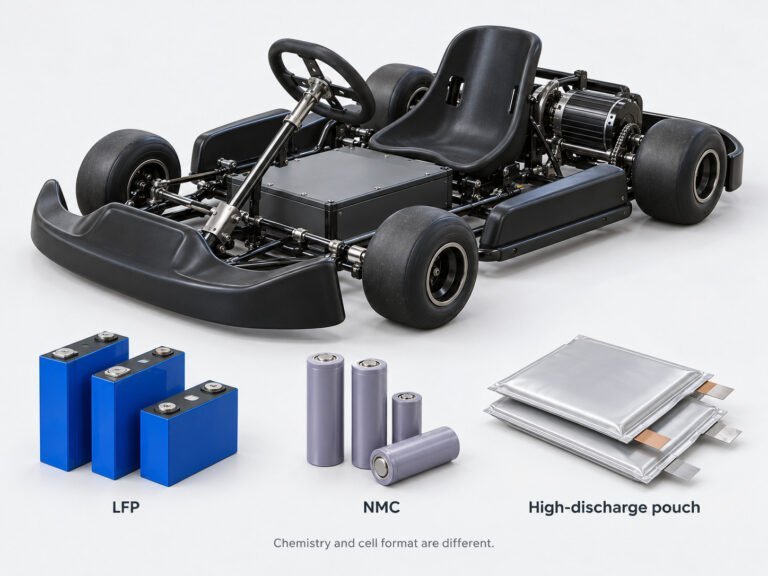
Part 1.LiFePO4, NMC, and High-Discharge Pouch Batteries: What Is the Difference?
An important distinction comes first: LiFePO4 and NMC describe battery chemistries. “Pouch” describes a cell’s packaging, while “high-discharge” describes its current delivery capability.
These are not three mutually exclusive categories. Both NMC and LiFePO4 cells can use pouch packaging. When purchasing a battery, the term “pouch battery” does not replace the need to identify its chemistry, operating voltage, and discharge limits.
| Comparison | Lithium Iron Phosphate (LFP/LiFePO4) | Nickel Manganese Cobalt (NMC/NCM) | High-Discharge Pouch Cells |
|---|---|---|---|
| General characteristics | Typically offer favorable thermal stability and cycle life | Typically offer higher energy density | Designed for higher current delivery; performance depends on chemistry and cell model |
| Go-kart applications to evaluate | Rental fleets and frequently used training karts | Vehicles with demanding weight, space, and runtime requirements | Racing applications with repeated acceleration and short periods of high power demand |
| Key items to verify | Continuous discharge capability, pack weight, and low-temperature performance | Temperature rise, service life, protection, and cooling | Continuous and pulse ratings, voltage sag, temperature rise, and mechanical support |
| Common misconception | Every LFP cell is suitable for high-current use | Every NMC cell delivers high power | Pouch packaging automatically means lower weight, greater safety, or longer life |
These chemistry comparisons describe general tendencies. They do not replace a comparison of specific cell models. CATL’s published industry overview similarly identifies higher energy density as a general advantage of ternary batteries, and thermal stability and cycle life as general advantages of LFP batteries. Reference: CATL Industry Overview
Part 2.LiFePO4: An Option for Karts That Prioritize Operational Life
Rental karts may run multiple sessions each day, repeatedly exposing the battery to acceleration, braking, charging, and temperature changes. In this setting, reliable operation and replacement intervals often have more commercial significance than maximum short-term output.
LiFePO4 is worth evaluating, but it is important to distinguish energy-storage cells from cells designed for demanding power applications. Storing sufficient energy does not necessarily mean a cell can continuously deliver the current a kart requires.
Suppliers should provide continuous discharge limits, pulse discharge conditions, temperature-rise curves, and cycle-test conditions for the actual cell model. Service-life data measured under low-rate energy-storage conditions should not be presented as a life expectancy for repeated high-current acceleration.
LFP’s favorable thermal stability does not eliminate the need for protection. Short circuits, overcharging, loose connections, and mechanical damage still require appropriate electrical protection and pack design.
Part 3.NMC: An Option for Vehicles with Weight and Space Limits
NMC batteries are worth comparing when battery space is limited or when a vehicle needs more usable energy within a given weight allowance.
The comparison should use complete-pack Wh/kg and Wh/L, rather than cell-level figures alone. Enclosures, interconnections, the battery management system, cooling components, and mounting structures add weight and occupy space.
Energy density also differs from power capability. When purchasing an NMC battery, determine whether its cells prioritize energy capacity or high-power output.
For example, Molicel’s P50B specification lists a continuous discharge current with an 80°C cutoff condition. This illustrates why a current rating must be read together with its temperature limits. It should not be adopted directly as the permitted operating current of a go-kart battery pack.
Part 4.High-Discharge Pouch Cells: An Option for Repeated High-Current Demand
The value of a high-discharge pouch cell depends on whether it can deliver the required current while keeping voltage sag and temperature rise within acceptable limits.
Discharge rate is commonly expressed as a C-rate:
Discharge current (A) = Capacity (Ah) × C-rate
For example, a 20Ah battery rated at 10C corresponds to 200A. This calculation explains the rating; it does not establish that the battery can deliver 200A continuously in a vehicle.
Before purchasing, confirm:
- Does 10C refer to continuous discharge or a short pulse?
- How long may each pulse last, and what interval is required between pulses?
- What ambient temperature, starting state of charge, and cutoff voltage were used?
- Does the rating apply to a single cell or the assembled battery pack?
Pouch cells also require mounting, mechanical support, and expansion management that meet the cell manufacturer’s requirements. Vibration, compression, and stress on cell tabs can affect reliability. A thin, lightweight package does not remove the need for mechanical protection.
A high discharge rating does not imply an equivalent charging rate. Charging limits must be verified separately.
Part 5.Start Electric Go-Kart Battery Sizing with These Three Parameters
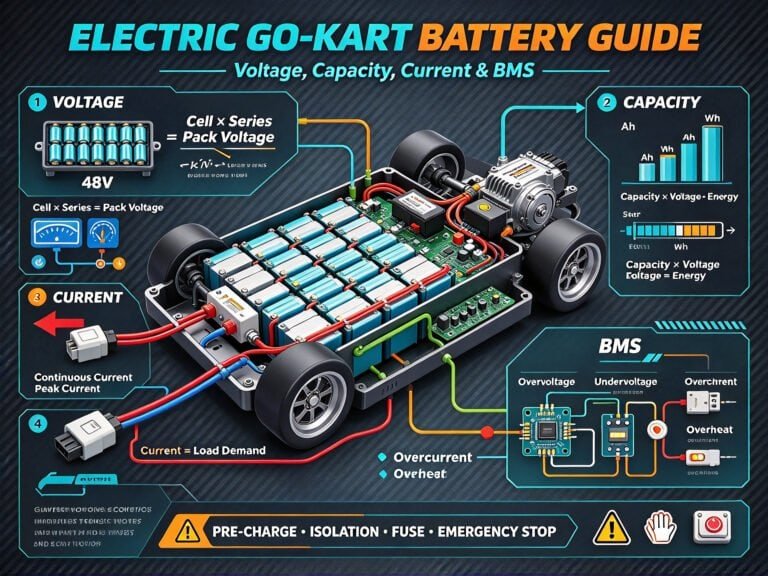
1. Operating Voltage: Check Both Full Charge and Low State of Charge
Nominal labels such as “48V” or “72V” do not fully describe a battery’s operating voltage range. Different chemistries and series cell counts produce different fully charged voltages and discharge limits.
Check the battery’s maximum charge voltage, the controller’s permitted input range, its low-voltage protection threshold, and the charger specifications.
If the kart uses regenerative braking, also verify the battery’s charge acceptance near full charge and how the controller limits regenerative current.
2. Discharge Current: Calculate from Battery-Side Power
Battery current can be estimated as:
Current (A) = Battery-side power (W) ÷ Voltage under load (V)
Suppose a kart requires 12kW of peak battery-side power, and its battery voltage during acceleration is 64V:
12,000 ÷ 64 ≈ 188A
If voltage under load falls to 60V, the current required for the same power rises to approximately 200A.
This is why sizing should not rely solely on nominal voltage or the motor’s nameplate power. Use the controller’s battery-current limit and actual operating records to establish continuous and peak current requirements separately.
If the available figure describes mechanical motor output, account for motor and controller efficiency when estimating battery-side input power. Motor phase current and battery current are different quantities and should not be used interchangeably.
3. Capacity: Estimate from Average Power and Target Runtime
A kart does not operate at peak power throughout a session. Runtime estimates should use average battery-side power:
Required usable energy (kWh) = Average power (kW) × Operating time (h)
Assume an average power draw of 4kW and a target runtime of 20 minutes:
4 × 20 ÷ 60 ≈ 1.33kWh
If the design assumes that 80% of nominal energy will be used, the required nominal energy is approximately:
1.33 ÷ 0.8 ≈ 1.67kWh
The 80% figure is an example assumption, not a universal requirement. Actual sizing should also account for temperature, aging, early low-voltage cutoff under load, and the remaining charge required for operations.
For go-karts, runtime in minutes or sessions is often more useful than a range claim in kilometers.
Part 6.The BMS and Cooling System Determine Whether the Pack Can Deliver
A cell’s ability to supply high current does not mean the complete battery pack can supply the same current. The battery management system (BMS), busbars, wiring, connectors, fuses, and contactors must all support the intended operating conditions.
For example, if the cell configuration supports 200A continuously but the BMS permits only 100A continuously, the pack cannot be treated as a 200A system. Conversely, installing a higher-current BMS does not increase the cells’ current capability.
BMS voltage, temperature, and current settings should match the cells. Its protection functions should also coordinate with the controller’s power reduction and shutdown behavior. The design must address both fault protection and vehicle operation.
Cooling evaluation should cover consecutive sessions. Passing one short test does not demonstrate that the battery will maintain the same output through repeated operation in hot weather.
Resistive heat generation can be approximated as:
Heat generation power = Current² × Resistance
With the same resistance, doubling current produces four times as much resistive heat. Connection resistance, heat-transfer paths, and operating duration can therefore affect performance in later sessions.
Part 7.How Should Rental, Training, and Racing Karts Differ?
The following suggestions are based on operating priorities. They are not universal performance guarantees for any battery category.
| Application | Main Priorities | Battery Options to Evaluate | Acceptance-Test Focus |
|---|---|---|---|
| Commercial rentals | Availability, consistent operation, and maintenance costs | LFP packs designed to meet the required current | Temperature rise over consecutive sessions, charging or swapping efficiency, and capacity loss |
| Regular training | Consistent output, suitable runtime, and manageable cost | Compare both LFP and NMC packs | Performance late in a session, pack weight, and maintenance access |
| Performance or racing | Weight, peak power, and acceleration voltage sag | High-power NMC or high-discharge pouch-cell packs | Repeated acceleration, output at low charge, and thermal power reduction |
For fleet operation, compare costs per session. Include purchase, replacement, maintenance, and downtime. Comparing purchase price alone can overlook differences in service life and availability.
Part 8.What Information Should You Request Before Buying?
A battery proposal should include enough information to evaluate the complete system:
- Cell identification: Manufacturer, model, chemistry, and original datasheet.
- Pack specifications: Nominal and maximum charge voltage, Ah, Wh, weight, and dimensions.
- Current capability: Continuous current, peak current, permitted duration, and test conditions.
- Performance curves: Voltage, temperature rise, and usable capacity at the intended load.
- Protection design: BMS thresholds, temperature monitoring, fusing, and disconnect arrangements.
- Service-life conditions: Temperature, charge and discharge rates, depth of discharge, and the defined end-of-life threshold.
- Vehicle validation: Vibration, mounting, required water protection, and operating data from the intended track.
Transport and application requirements should be checked for the sales region and intended use. UN 38.3 concerns lithium-battery transport testing; it does not by itself establish that a battery meets a go-kart’s performance, safety, or durability requirements.
Frequently Asked Questions
Is a higher discharge rating always better for an electric go-kart?
No. Once the rating adequately covers continuous and peak current demand, compare temperature rise, weight, capacity, service life, and cost. A high C-rate label alone does not establish complete-pack performance.
Do batteries with the same Ah rating provide the same runtime?
Not necessarily. Nominal energy is approximately voltage multiplied by Ah, so batteries with different voltages can store different amounts of energy despite having the same Ah rating. Runtime also depends on usable capacity, voltage sag, and average power demand.
Can LiFePO4 batteries be used in racing karts?
They can be evaluated for that purpose. Suitability depends on the specific cells’ power capability, complete-pack weight, and track conditions. The LFP chemistry label alone is insufficient to accept or reject a design.
Why does the kart shut down during acceleration when charge remains?
Possible causes include cell voltage sag triggering low-voltage protection, overcurrent, overheating, or a connection fault. Review voltage, current, temperature, and BMS fault records instead of relying only on the displayed remaining charge.
Can a final battery choice be made without test data?
An initial shortlist can be developed, but runtime, temperature rise, lap times, and service life cannot be reliably promised without validation. Final selection should include pack and vehicle testing at full charge, low charge, elevated temperatures, and over consecutive sessions.
A practical selection process starts with voltage and current requirements, followed by usable energy needs. Chemistry, pack weight, cooling, and service life can then be compared against those requirements. A battery solution becomes a credible purchasing choice when it meets the intended operating conditions and is supported by verifiable documentation and testing.

 English
  Chinese
  Japanese
  German
  French
  Korean
