
Modern warehouses increasingly use AGVs to transport materials, pallets, components, and finished products between different areas. Unlike equipment operating for only a few hours per day, AGVs in automated warehouses may operate continuously across multiple shifts.
This creates a higher demand for battery reliability.
For a warehouse operating 24 hours a day, battery selection is not only about rated voltage and capacity. The battery needs to support frequent charging and discharging, repeated short operating cycles, temperature changes, and continuous communication with the AGV control system.
LiFePO4, also known as lithium iron phosphate, is one battery chemistry that can be considered for these applications because of its cycle performance, thermal characteristics, and suitability for repeated charging and discharging.
IEC 62619 specifically covers safety requirements and testing for secondary lithium cells and batteries used in industrial applications, including AGVs.
So, how can warehouse operators extend AGV-Batterie life while maintaining continuous operation?
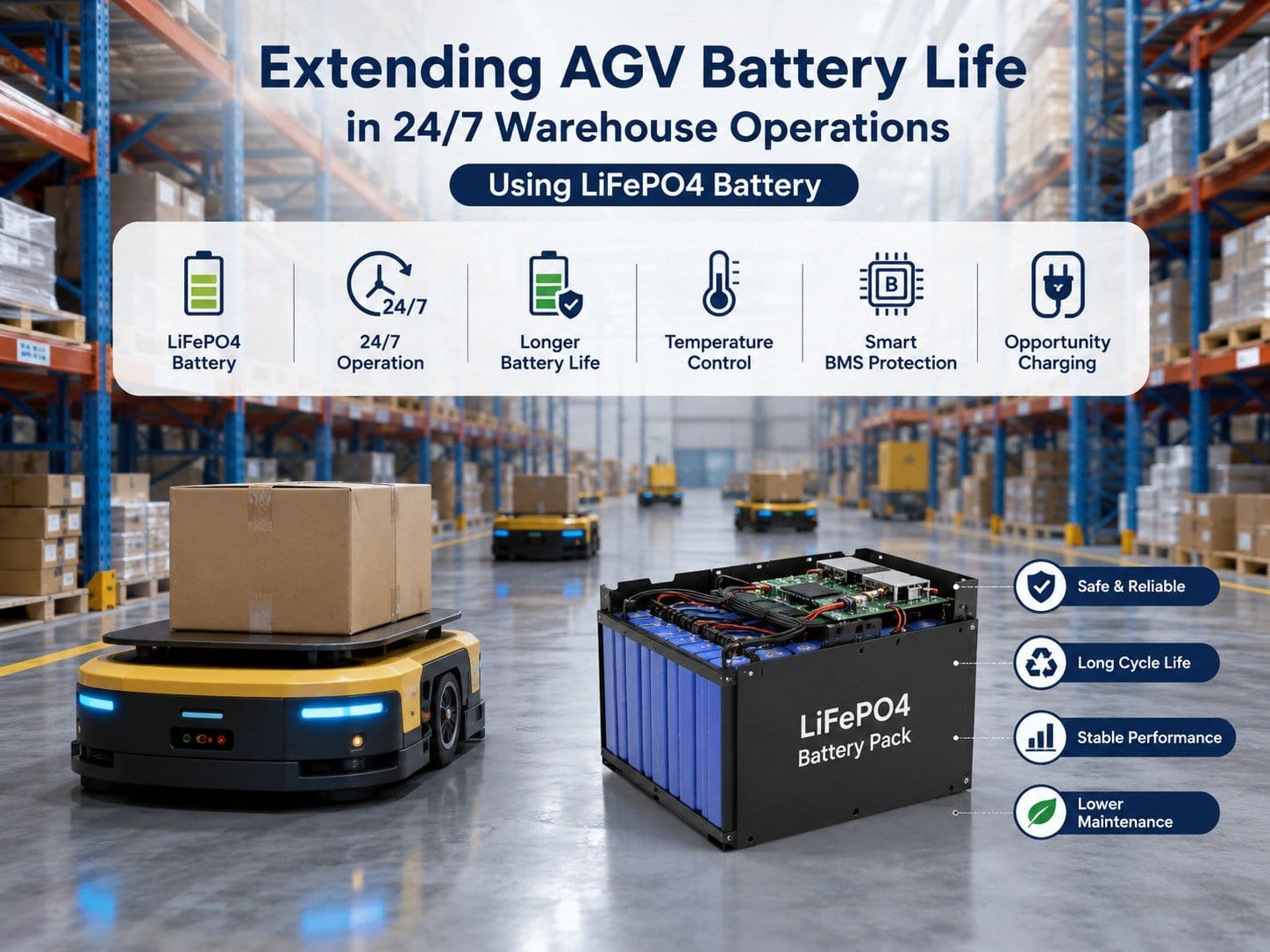
1. Choose a Battery Chemistry Suitable for Continuous AGV Operation
The first step in extending battery life is choosing the appropriate battery chemistry.
For AGV applications, LiFePO4-Batterien can be suitable when the system prioritizes repeated cycling, stable operation, and safety characteristics over maximum energy density.
Compared with conventional lead-acid batteries, lithium battery systems can also support opportunity charging, allowing AGVs to recharge during scheduled short breaks rather than waiting for a complete charging cycle.
For example, an AGV can be programmed to return to a charging station when its battery reaches a predetermined state of charge, recharge for a short period, and then return to operation.
This operating method can reduce the need for deep discharge.
However, battery life still depends on the specific cell, charging current, operating temperature, depth of discharge, BMS configuration, and overall pack design. Therefore, manufacturers should avoid evaluating battery life only by looking at the chemistry name.
2. Avoid Frequent Deep Discharge
Depth of discharge, or DoD, is an important factor affecting rechargeable battery aging.
If an AGV regularly uses most of the available battery capacity before charging, the battery experiences deeper cycles. Reducing the depth of each operating cycle can help reduce battery stress.
For example, instead of allowing an AGV to operate until the battery reaches a very low state of charge, the control system can schedule charging before the battery reaches the lower operating limit.
This is particularly useful for 24/7 warehouses.
A practical operating strategy can include:
- Setting an appropriate low-SOC charging threshold
- Avoiding unnecessary deep discharge
- Using opportunity charging during planned idle periods
- Defining charging and discharge limits in the BMS
- Matching battery capacity with the actual AGV workload
The exact SOC and DoD limits should be determined according to the selected cells and battery manufacturer’s specifications rather than using one fixed value for every AGV.
3. Use Opportunity Charging Correctly
One advantage of lithium batteries in AGV systems is their suitability for frequent charging during operation intervals.
Instead of waiting until the battery is nearly empty, an AGV can return to a charging station during:
- Loading and unloading
- Shift transitions
- Scheduled rest periods
- Low-demand periods
- Waiting periods between missions
This is often called Opportunitätskosten.
For a 24/7 warehouse, opportunity charging can help maintain the battery within a suitable operating range and reduce the need for deep discharge.
However, frequent charging does not automatically mean longer battery life. The charging current, charging temperature, charger compatibility, SOC range, and BMS settings all need to be considered.
The charging system should therefore be designed together with the battery pack instead of selecting the charger separately.
4. Match the Charger to the LiFePO4 Battery Pack
Using an unsuitable charger can affect both battery performance and safety.
The charger should match the battery’s:
- Nennspannung
- Maximum charging voltage
- Recommended charging current
- Chemie der Batterie
- BMS communication requirements
- Charging temperature range
For example, a LiFePO4 battery pack designed for a 48V AGV system requires a charger with charging parameters specifically matched to the pack configuration.
The charging profile should also be compatible with the BMS.
In an automated warehouse, the charging station and AGV control system can be integrated so that charging begins, stops, or adjusts according to the battery’s operating condition.
This can reduce unnecessary charging stress and improve battery management.
5. Select a BMS Designed for AGV Applications
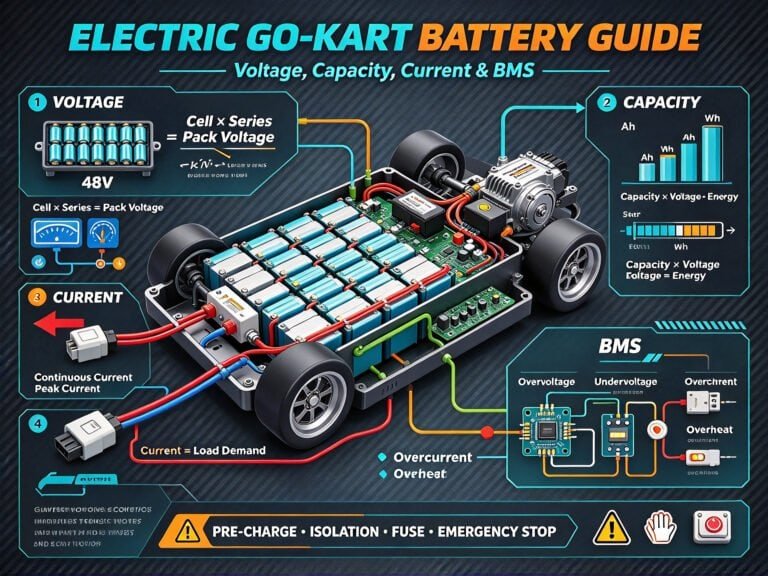
The Battery Management System is one of the most important components of an AGV lithium battery pack.
A suitable BMS can monitor and manage parameters such as:
- Spannung einer einzelnen Zelle
- Pack-Spannung
- Ladestrom
- Entladestrom
- Cell temperature
- Batterietemperatur
- Ladezustand
- Fault conditions
Depending on the AGV system, the BMS can also communicate with the vehicle controller through interfaces such as CAN or RS485.
This communication allows the AGV system to obtain battery information and adjust operation according to the battery condition.
For example, when the battery reaches a predefined SOC threshold, the AGV control system can automatically schedule the vehicle for charging.
For industrial applications, IEC 62619:2022 provides safety requirements and tests for secondary lithium cells and batteries, and its scope explicitly includes motive applications such as AGVs.
6. Control Battery Temperature
Temperature is another important factor in battery life.
AGVs may operate in warehouses with different environmental conditions. Although indoor warehouses are generally more controlled than outdoor environments, battery temperature can still increase because of:
- High charging current
- Dauerbetrieb
- High discharge current
- Schlechte Belüftung
- High ambient temperature
LiFePO4 batteries have a relatively stable thermal and chemical profile, but this does not eliminate the need for temperature management.
The battery pack should include appropriate temperature monitoring.
If the battery temperature becomes too high, the BMS can reduce charging or discharging current or stop operation according to the configured protection strategy.
Cold environments also need attention. The allowable charging temperature should follow the battery manufacturer’s specifications. If the battery operates in a low-temperature warehouse, a heating function may need to be considered.
7. Avoid Oversizing and Undersizing the Battery
Battery capacity should be calculated according to the actual AGV workload.
An undersized battery may need to operate at high discharge rates and may require frequent charging.
An oversized battery, on the other hand, can increase system weight, cost, and installation requirements without necessarily improving operational efficiency.
Battery sizing should consider:
AGV Power Consumption
Determine the average and peak power required by the AGV.
Operating Hours
Calculate the expected operating time during each shift.
Travel Distance
Longer travel distances generally increase energy consumption.
Load Weight
The AGV’s energy requirements can change significantly depending on payload.
Charging Opportunities
Determine how often the AGV can return to the charging station.
End-of-Life Capacity
Battery sizing should also consider capacity degradation over the battery’s service life rather than only its initial capacity.
A properly sized battery can reduce unnecessary stress and provide a more predictable operating schedule.
8. Use Battery Data to Manage the AGV Fleet
For large warehouses, battery management should not stop at individual battery packs.
Battery data can be integrated into fleet management systems.
Useful parameters include:
- SOC
- SOH
- Spannung
- Aktuell
- Temperatur
- Charge cycles
- Fault records
- Charging history
By monitoring these parameters, operators can identify abnormal battery behavior before it becomes an operational problem.
For example, if one AGV begins showing faster capacity loss than other vehicles in the same fleet, maintenance personnel can investigate possible causes such as excessive load, abnormal charging, temperature problems, or BMS faults.
This changes battery maintenance from reactive replacement to condition-based management.
9. Maintain Consistent Charging and Operating Conditions
A battery management strategy should be consistent across the warehouse.
Operators should define charging procedures and operating limits for the AGV fleet.
Important practices include:
- Use chargers compatible with the battery pack.
- Follow the manufacturer’s charging parameters.
- Avoid unnecessary deep discharge.
- Monitor battery temperature.
- Keep charging connectors clean and secure.
- Check abnormal voltage or temperature readings.
- Review battery fault records regularly.
- Inspect battery packs according to the maintenance schedule.
For automated warehouses, these procedures can be incorporated into the AGV fleet management system.
10. Design the Battery Pack for the AGV From the Beginning
Battery life is not determined by the cells alone.
A complete AGV battery pack includes multiple components and design decisions:
Cell → Cell configuration → BMS → Busbars → Protection components → Enclosure → Connector → Communication → Charger
Each part can affect battery performance.
For example, the battery manufacturer needs to consider:
- Erforderliche Spannung
- Erforderliche Kapazität
- Maximaler Dauerstrom
- Spitzenstrom
- Ladestrom
- Pack dimensions
- Installationsverfahren
- Steckertyp
- Kommunikationsprotokoll
- Betriebstemperatur
- Protection requirements
- AGV controller compatibility
This is why AGV battery development should ideally begin during the vehicle design stage rather than after the AGV has already been finalized.
11. Why LiFePO4 Is Considered for 24/7 AGV Operations
LiFePO4 batteries are commonly considered for AGV and AMR applications because the chemistry can support repeated cycling and frequent charging when the battery is properly designed and operated.
AGV industry sources also identify LiFePO4 as a battery chemistry used in continuous AGV/AMR applications, particularly where frequent charging and repeated cycling are required.
The main considerations include:
Cycle Performance
AGVs can perform many charge-discharge cycles during their service life. LiFePO4 is suitable for applications requiring repeated cycling.
Thermal Characteristics
LiFePO4 chemistry has characteristics that make it suitable for applications where thermal stability is an important design consideration.
Gelegenheitsladung
A properly designed LiFePO4 battery pack can be integrated with frequent charging strategies.
BMS-Integration
A smart BMS can monitor battery status and communicate with the AGV control system.
Industrielle Anwendungen
IEC 62619:2022 specifically includes AGV batteries within its industrial application scope.
12. A Practical Battery Strategy for 24/7 Warehouses
For warehouses operating around the clock, a practical AGV battery strategy can be structured around five areas:
| Area | Recommended Approach |
|---|---|
| Chemie der Batterie | Consider LiFePO4 for repeated-cycle applications |
| Akkukapazität | Size according to actual workload and charging opportunities |
| Aufladen | Use compatible chargers and planned opportunity charging |
| BMS | Monitor voltage, current, temperature, SOC and faults |
| Wartung | Monitor battery data and inspect abnormal conditions |
The goal is not simply to maximize the rated capacity of the battery.
The goal is to create a battery system that matches the AGV’s operating pattern.
13. What AGV Manufacturers Should Discuss With a Battery Supplier
Before ordering a customized AGV battery pack, manufacturers should provide the battery supplier with detailed application information.
At minimum, this should include:
- AGV model
- Nominal system voltage
- Erforderliche Kapazität
- Durchschnittliche Leistungsaufnahme
- Spitzenstrom
- Tägliche Öffnungszeiten
- Number of operating cycles
- Ladehäufigkeit
- Aufladezeit
- Warehouse temperature range
- Battery installation dimensions
- Kommunikationsprotokoll
- Required protection functions
- Expected battery service life
With this information, the battery manufacturer can evaluate the cell configuration, BMS, charger, enclosure, connectors, and thermal management requirements together.
This approach is generally more reliable than selecting a standard battery based only on voltage and Ah capacity.
Schlussfolgerung
For a warehouse operating 24 hours a day, AGV battery life depends on more than the battery chemistry.
LiFePO4 can be a suitable option for AGV applications that require repeated cycling, frequent charging, and stable operation. However, battery performance still depends on the complete system design.
To extend AGV battery life, manufacturers and warehouse operators should focus on:
- Choosing an appropriate LiFePO4 cell and battery configuration
- Matching battery capacity to the AGV workload
- Avoiding unnecessary deep discharge
- Using appropriate opportunity charging
- Matching the charger to the battery
- Configuring a suitable BMS
- Monitoring temperature
- Tracking SOC and SOH
- Maintaining consistent charging practices
- Designing the battery pack around the AGV from the beginning
A well-designed AGV battery system should not only provide sufficient energy. It should also work together with the AGV, charger, BMS, and warehouse management system to support continuous operation.
For AGV manufacturers and system integrators, battery selection should therefore be treated as part of the overall AGV system design rather than simply a component purchasing decision.
 English
  Chinese
  Japanese
  German
  French
  Korean
