
With the development of electric boats, yachts, fishing boats, houseboats, and marine energy storage systems, traditional lead-acid batteries are gradually being replaced by more advanced lithium batteries. Among them, lithium iron phosphate (LiFePO4) batteries have become the preferred solution for modern marine power and energy storage systems due to their high safety, long lifespan, high efficiency, and excellent environmental adaptability.
Compared to lead-acid batteries and ternary lithium batteries, lithium iron phosphate batteries are better suited to the needs of long-term ship operation, harsh environments, and safety and reliability.
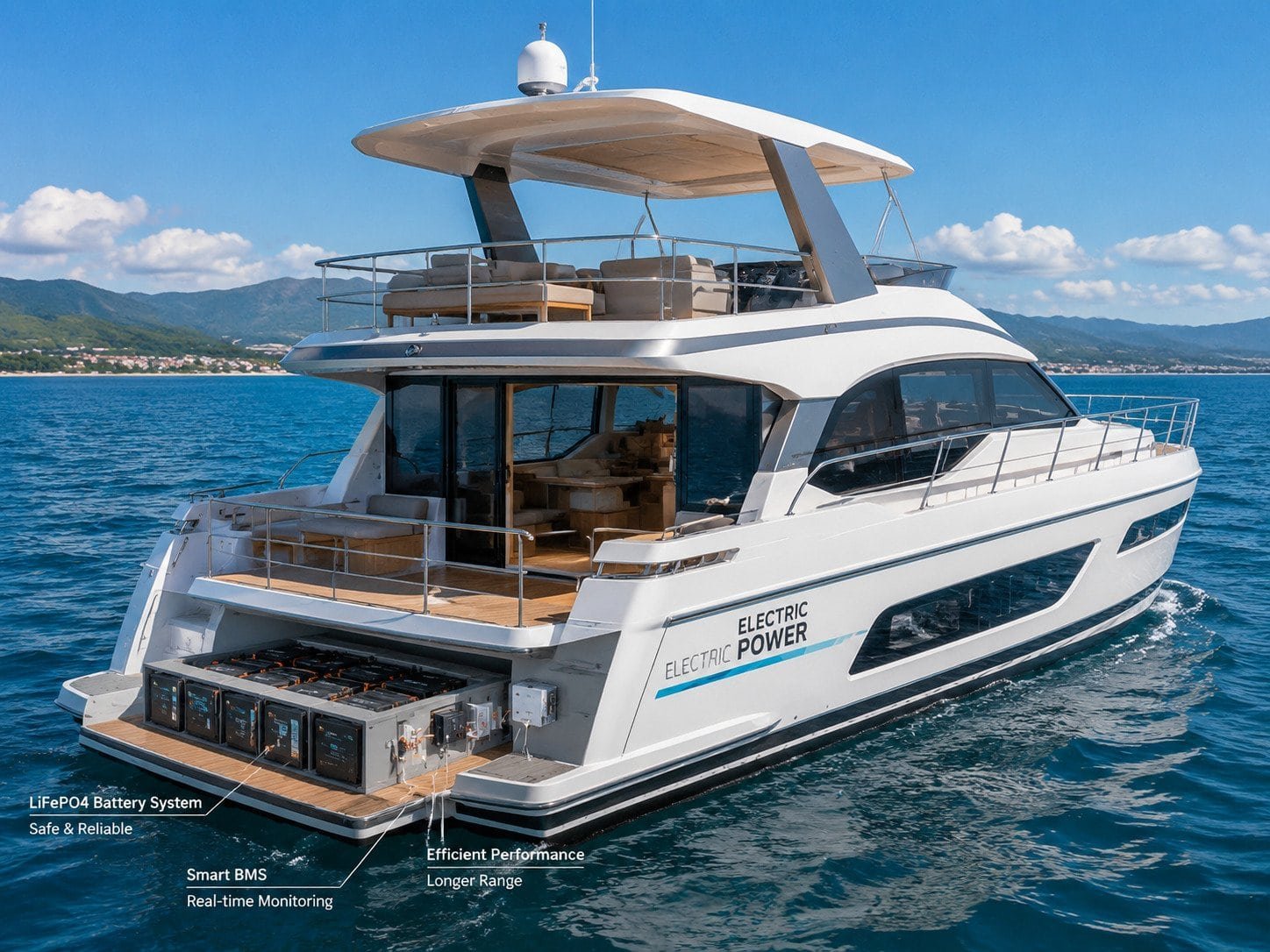
Part 1. Superior safety: More suitable for the enclosed environment of ships.
Marine batteries are typically installed in space-constrained locations such as engine rooms and storage compartments. Once thermal runaway occurs, the difficulty of maintenance and escape is far greater than that of land-based equipment.
Lithium iron phosphate batteries use stable lithium iron phosphate cathode material:
High thermal stability
Not prone to thermal runaway
The structure is more stable under high temperature conditions
It performs better in extreme tests such as needle puncture and compression.
Compared to ternary lithium batteries (NMC), LiFePO4 batteries have a higher oxygen release temperature and a more stable chemical structure, making them more widely used in fields with high safety requirements, such as ships, RVs, and energy storage.
部分 2. Safety surpasses all lithium batteries, suitable for high-risk aquatic environments (most critical).
Ship cabins are enclosed and cramped, making escape and firefighting extremely difficult after a fire breaks out. The window of opportunity for fire rescue at sea is extremely short, and the requirements for explosion-proof and flame-retardant batteries are extremely high.
2.1 . Lithium iron phosphate (LFP) has an extremely stable chemical structure . Its olivine crystal structure is strongly bonded, and its thermal runaway temperature is ≥800℃ . In contrast, ternary lithium batteries are highly susceptible to thermal runaway, deflagration, and even explosion at around 200℃. When a LFP cell is punctured, impacted, squeezed, or slightly submerged in seawater and short-circuited, it will mostly only produce slight smoke and will not violently deflagrate. Ternary lithium batteries, however, are extremely prone to igniting violently, releasing large amounts of toxic fumes, which can easily cause suffocation in enclosed ship cabins.
2.2 . High resistance to damage and fault tolerance: Ships are subject to constant sea roughness, hull vibration, and equipment impacts, posing a risk of battery pack damage from impacts and scratches. Lithium iron phosphate batteries have stronger resistance to physical damage; even if a small leak or short circuit is caused by salt spray corrosion, the probability of a chain reaction fire is extremely low. In contrast, the risk of fire increases sharply once the outer casing of ternary lithium batteries is corroded and damaged.
部分 3. Ultra-long cycle life, suitable for high-frequency charging and discharging operation mode of ships.
Inland waterway cargo ships, port tugboats, fishing boats, and ferries frequently dock, undergoing multiple fast charging and deep charging/discharging cycles per day, placing extremely high demands on cycle life.
3.1 . Lithium iron phosphate batteries typically have 2,000 to 5,000 cycles , while high-quality marine cells can reach 6,000 cycles; ternary lithium batteries generally have only 1,000 to 1,800 cycles, and lead-acid batteries have only 300 to 500 cycles.
3.2 . Based on the calculation of 1 to 2 complete charge and discharge cycles per day for inland waterway vessels, lithium iron phosphate batteries can be used for 5 to 10 years , while ternary lithium batteries generally need to be replaced in 3 to 5 years; this significantly reduces the downtime costs of major ship overhauls and battery replacements.
3.3Supports deep discharge: Safely discharges to 80%~90%; lead-acid batteries can only discharge up to 50%, and long-term full charge and discharge cycles are not recommended for ternary lithium batteries, as the actual usable capacity is significantly reduced. For the same nominal capacity, lithium iron phosphate batteries can deliver more usable energy .
部分 4. Resistant to harsh marine environments: resistant to salt spray, vibration, and wide temperature range.
Ships are exposed to environments with high humidity, salt spray corrosion, continuous hull vibration, and large temperature differences between day and night for extended periods.
4.1 . Vibration resistance and durability : The crystal structure has strong toughness and will not easily cause cell delamination or internal micro-short circuits under long-term turbulence and ship resonance, making it suitable for vibration conditions throughout the entire voyage.
4.2 . Strong temperature adaptability : The normal operating range is -25℃ to 45℃. It can operate stably in the high temperature of the engine room in summer and the low temperature of the river surface in the north in winter. It will not accelerate the degradation or increase the thermal risk in high temperature environments.
4.3 . With the help of a sealed PACK+BMS for protection, it can be designed to be fully waterproof and corrosion resistant, suitable for corrosive environments with alternating fresh and salt water in coastal areas and rivers.
部分 5. Lower total lifecycle costs; shipping companies, with their heavy asset base, prioritize long-term cost savings.
Replacing marine batteries is costly and manual disassembly and assembly are complex, so lifespan is an important indicator.
Ordinary lead-acid batteries:
Cycle life is approximately 300-500 cycles.
Limited deep discharge capability
Easy vulcanization leads to a decrease in capacity.
Lithium iron phosphate batteries:
The cycle life can reach 3000 to 6000 times or more.
Supports 80%-100% depth of discharge (DOD)
The service life is usually 8 to 10 years or more.
例如
A set of 100Ah lead-acid batteries may need to be replaced after 2 to 3 years, while LiFePO4 batteries of the same capacity can operate stably for a long time, significantly reducing long-term operating costs.
5.1 . Extremely simple maintenance : No water replenishment or equalization maintenance is required, unlike lead-acid batteries which require regular water replenishment and maintenance; the matching marine BMS can remotely monitor the voltage and temperature of each cell, resulting in minimal daily maintenance workload.
5.2 Although the initial purchase price is higher than that of lead-acid batteries, the lifespan is more than three times that of lead-acid batteries. The annual electricity cost and replacement cost are far lower than those of lead-acid batteries. Compared with ternary lithium batteries, the replacement frequency is halved, resulting in a significant long-term overall cost advantage.
部分 6. Stable discharge, adaptable to varying load conditions on ships
Ship load fluctuates greatly: the propulsion motor draws a large current at startup, and the daily loads such as air conditioning, navigation, and water pumps fluctuate greatly.
6.1 . Lithium iron phosphate has a stable voltage platform at high discharge rates, low voltage drop at high current output, and uninterrupted propulsion power;
6.2 . Strong charging acceptance capability, high efficiency of port fast charging and shore power replenishment, can be fully charged in a short time when docked, and is suitable for the “run a distance, stop at port for fast charging” operation rhythm of inland waterway vessels;
6.3 . Low self-discharge rate. Even when ships are out of service for many days or anchored for extended periods, the power loss is minimal, eliminating the need for frequent recharging.
部分 7. Excellent adaptability to low and high temperatures.
The marine environment is complex:
High temperatures in tropical seas
Low temperatures in cold regions
Long-term humid environment
High-quality marine LiFePO4 batteries typically support:
Operating temperature:
Discharge: -20℃~60℃
Charging: 0℃~45℃ (expandable with low-temperature heating function)
Also equipped with intelligent BMS:
温度监测
过充电保护
过放电保护
短路保护
Current protection
Ensure long-term stable operation.
部分 8. Intelligent BMS simplifies ship energy management.
Modern ships are becoming increasingly intelligent, and battery management systems (BMS) have become a core component.
Marine LiFePO4 batteries can support:
CAN 通信
RS485通信
蓝牙APP监控
SOC remaining battery display
实时监控电压、电流和温度
Users can check at any time:
🔋 Remaining Battery Power
⚡ Current Power
🌡 Battery Temperature
🔧 State of Health (SOH)
Make ship energy management more transparent.
部分 9. More suitable for solar-powered + energy storage ship systems
More and more ships are adopting:
Solar panel + LiFePO4 battery + motor system
Develop green energy solutions.
应用包括
electric yacht
Solar-powered boat
Auxiliary power supply for fishing boats
Marine lighting systems
Backup power supply for communication equipment
Electricity for living on board
LiFePO4 can be charged and discharged daily, making it ideal for renewable energy storage.
部分 10. The protection level is more suitable for marine environments.
The ship’s environment includes:
Salt spray
湿度
Water vapor
vibration
Professional marine lithium iron phosphate batteries typically use:
IP65/IP67/IP68 protection design
earthquake-resistant structure
Corrosion-resistant casing
High-reliability connectors
Improve long-term reliability at sea.
第11部分。. LiFePO4 vs lead-acid batteries vs ternary lithium batteries
| project | 磷酸铁锂 | 铅酸 | Ternary lithium NMC |
| Security | ⭐⭐⭐⭐⭐ | ⭐⭐⭐ | ⭐⭐⭐ |
| 周期寿命 | 3000-6000 times | 300-500 times | 1000-2000 times |
| 重量 | light | 重型 | light |
| Depth of discharge | 高 | 低 | 高 |
| thermal stability | excellent | generally | 降低 |
| Ship suitability | ⭐⭐⭐⭐⭐ | ⭐⭐ | ⭐⭐⭐ |
Typical LiFePO4 battery solutions for marine applications
Electric boat power battery
48V / 72V / 96V system
High magnification output
Long battery life
Yacht energy storage batteries
12V / 24V / 48V
Supports lighting, refrigerators, air conditioners and other equipment.
Auxiliary power supply for fishing boats
Long-term power supply
维护要求低
Marine solar energy storage
High cycle life
24/7 Energy Management
LiFePO4 will become a core component of ship energy.
With the global trend towards greening and electrification in shipping, ships are upgrading from traditional fuel oil and lead-acid energy to efficient and safe lithium battery systems.
Lithium iron phosphate batteries have the following advantages:
✅ Safer
✅ 使用寿命更长
✅ Lighter weight
✅ Lower maintenance costs
✅ 更高的能源效率
It is becoming an ideal choice for electric boats, yachts and marine energy storage systems.
For marine energy systems requiring long-term reliable operation, LiFePO4 is not just a battery, but a stable, efficient, and sustainable marine propulsion solution.
 English
  Chinese
  Japanese
  German
  French
  Korean
