
Industrial robots, autonomous mobile robots (AMRs), automated guided vehicles (AGVs), inspection robots, warehouse robots, and service robots depend on reliable battery systems to maintain stable operation throughout their working cycles. Unlike consumer electronics, industrial robots may operate for multiple shifts, perform repeated acceleration and braking, carry different payloads, and work in environments with vibration, dust, moisture, or temperature changes.
For these applications, a rechargeable battery pack is more than an energy storage component. The battery must work together with the robot’s motors, controller, sensors, communication system, charging equipment, and safety architecture.
设计合理的 industrial robot battery pack should therefore consider voltage, capacity, discharge current, cycle life, battery chemistry, BMS functions, communication protocols, mechanical structure, thermal management, and operating environment.
This guide explains how to select and design a durable rechargeable lithium battery pack for industrial robots and how OEM/ODM battery customization can address different robotic applications.
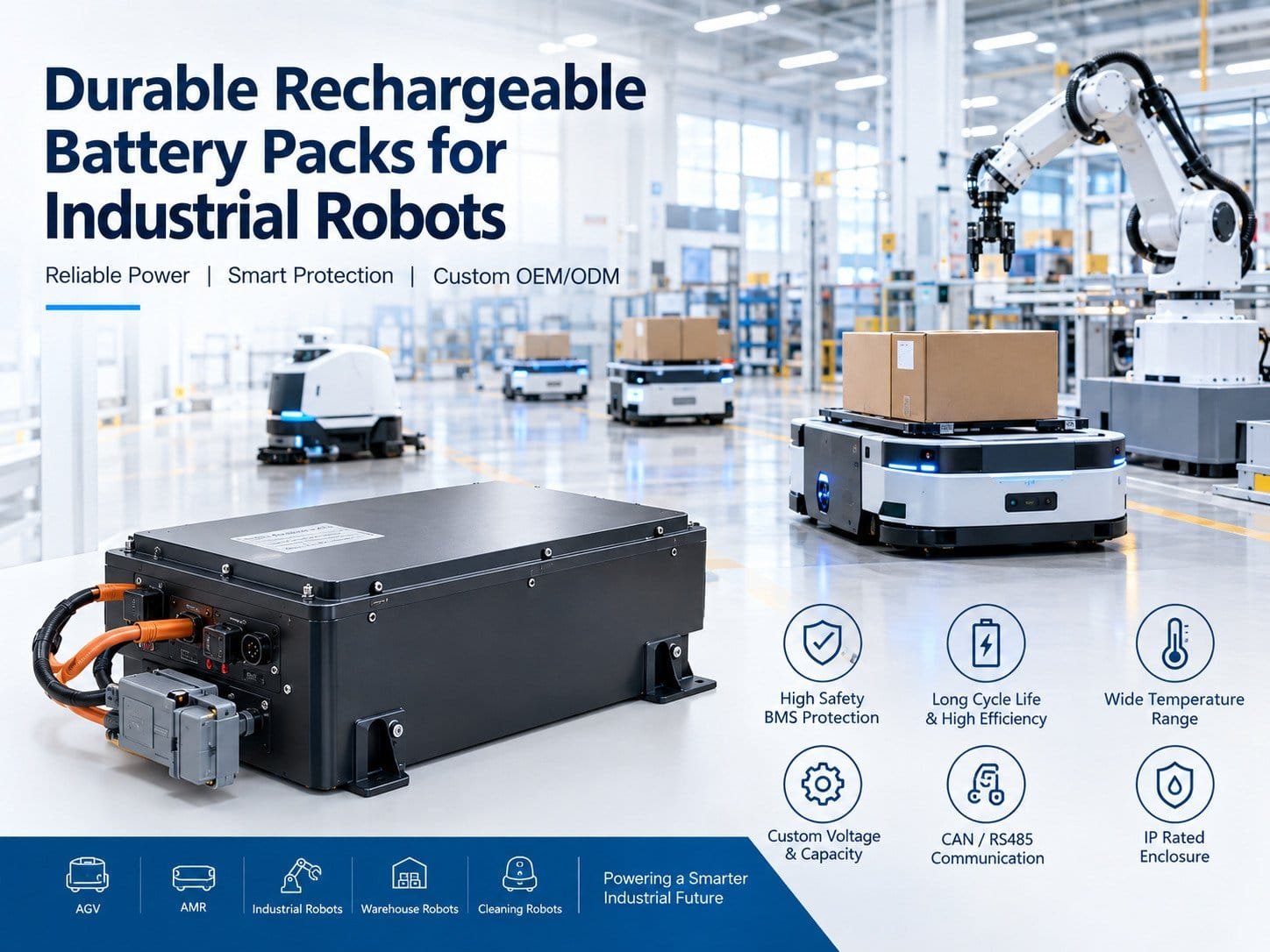
What Is an Industrial Robot Battery Pack?
An industrial robot battery pack is a rechargeable battery system designed to provide electrical power to robotic equipment and its supporting electronics.
Depending on the robot architecture, the battery may supply power to:
- Drive motors
- Servo motors
- Motor controllers
- Robotic arms
- Lifting mechanisms
- Navigation systems
- Cameras
- LiDAR sensors
- Industrial computers
- Wireless communication modules
- Safety systems
- Cooling or heating components
- Auxiliary equipment
A complete battery pack can include several components:
- 电池单元
- 电池管理系统 (BMS)
- Cell holders or structural supports
- Busbars and nickel strips
- 线束
- 连接器
- 温度传感器
- Protective enclosure
- 充电接口
- 通信接口
- Mechanical mounting components
The battery configuration is normally expressed using a combination of series and parallel cell arrangements, such as 10S4P, 13S4P, or 16S8P, depending on the required voltage, capacity, current, and available installation space.
Why Battery Design Matters for Industrial Robots
Industrial robots often have a different energy profile from stationary equipment.
A warehouse AMR, for example, may continuously accelerate, decelerate, turn, stop, and restart while transporting goods. An inspection robot may operate outdoors and experience temperature fluctuations. A robotic platform may also have a high instantaneous current demand when climbing a ramp or carrying a heavy payload.
This creates several battery design requirements.
1. Stable voltage output
The robot controller and electronic components require an appropriate voltage range.
A battery with excessive voltage drop under load can cause:
- Motor performance reduction
- Controller alarms
- Communication interruptions
- Unexpected shutdown
- Reduced operating time
Therefore, the battery should be selected according to both the nominal system voltage and the actual voltage range required by the robot.
2. Sufficient peak current
The average current consumption of a robot does not tell the whole story.
Motors can require substantially higher current during:
- 开始
- 加速度
- 攀岩
- 转动
- 举重
- Heavy-load operation
- Sudden changes in motion
The battery pack and BMS should therefore be capable of supporting the required continuous and peak current.
3. Repeated charge and discharge
Robots used in warehouses and factories can complete multiple operating cycles per day.
The battery chemistry, cell selection, charging strategy, temperature control, and depth of discharge all influence service life.
4. Protection against operating conditions
Industrial environments can expose batteries to:
- 振动
- 机械冲击
- 灰尘
- 湿度
- 温度变化
- Electromagnetic interference
- Frequent charging
The battery enclosure and internal construction should be designed around the actual environment rather than using a generic consumer battery housing.
Choosing the Right Battery Chemistry for Industrial Robots
Lithium-ion batteries are widely used in mobile robotic equipment because they provide a combination of energy density, power capability, rechargeable performance, and flexible packaging.
Different lithium battery chemistries can be considered depending on the application.
Lithium-Ion NMC Battery
NMC batteries use nickel, manganese, and cobalt-based cathode materials.
Their characteristics can include:
- 高能量密度
- Compact battery size
- 良好的功率性能
- Flexible cylindrical-cell configurations
NMC battery packs can be suitable when installation space and weight are important design considerations.
Applications may include:
- Mobile robots
- 检测机器人
- 仓库机器人
- Compact AGVs
- Robotic platforms
However, the battery system must incorporate appropriate protection and thermal management according to the cell specifications and application requirements.
LiFePO4 Battery for Industrial Robots
Lithium iron phosphate, or LiFePO4 (LFP), is another important chemistry for industrial battery applications.
LFP batteries are commonly considered when the application prioritizes:
- 循环寿命长
- 热稳定性
- Safety characteristics
- Frequent charging and discharging
- 稳定运行
LiFePO4 battery packs can be particularly suitable for equipment that operates for long periods or completes frequent charge-discharge cycles.
潜在的应用包括:
- AGV
- AMR
- 仓库机器人
- Autonomous transport robots
- Industrial mobile platforms
- Floor-cleaning robots
- Heavy-duty robotic equipment
The trade-off is that LFP generally has lower energy density than some conventional NMC lithium-ion cells. Therefore, battery chemistry should be selected according to the robot’s available installation space, weight limitations, operating time, and power requirements.
How to Calculate Battery Capacity for an Industrial Robot
Selecting battery capacity based only on the motor rating can result in an inaccurate design.
A more practical approach is to evaluate the robot’s actual energy consumption.
重要参数包括:
- Average operating power
- 峰值功率
- 电机效率
- Controller consumption
- Sensor consumption
- Communication equipment
- Auxiliary loads
- 工作时间
- 充电频率
- Battery discharge efficiency
- 所需能量储备
一个基本的计算方法是:
Required Energy = Average Power × Operating Time
For example, if a robot consumes an average of 500 W and needs to operate for 6 hours:
500 W × 6 h = 3,000 Wh
A practical battery design should then account for system efficiency, usable battery capacity, operating conditions, and an appropriate energy reserve.
If the battery system voltage is 48 V, a simplified calculation would be:
Required Capacity = 3,000 Wh ÷ 48 V = 62.5 Ah
The actual battery specification may therefore need to be higher than 48 V 62.5 Ah depending on the robot’s operating profile and required reserve.
This is only a preliminary calculation. Final battery sizing should be based on measured energy consumption and the complete duty cycle.
Continuous Current and Peak Current
容量只是选择电池时需要考虑的因素之一。.
A robot battery also needs to satisfy its current requirements.
For example, a robot may have:
- Average current: 10 A
- Continuous current: 20 A
- Peak current: 50 A
A battery pack rated only for its average current may not perform properly during acceleration or heavy-load operation.
When designing the battery, engineers should evaluate:
Continuous Current
The current required during normal operation.
Peak Current
The temporary current required during acceleration, climbing, lifting, or other high-load events.
BMS Current Rating
The BMS must be capable of managing the expected current without unnecessary protection cutoffs.
Cell Discharge Capability
The individual cells must also support the required current.
The final current capability of the battery pack depends on cell characteristics, series-parallel configuration, temperature, wiring, protection components, and BMS design.
BMS Design for Industrial Robot Battery Packs
The Battery Management System is one of the most important components of a rechargeable robot battery.
A BMS monitors and manages the battery to help maintain safe operating conditions.
Typical BMS functions include:
- 过充电保护
- 过放电保护
- 过流保护
- 短路保护
- 过温保护
- Under-temperature protection
- 电池电压监测
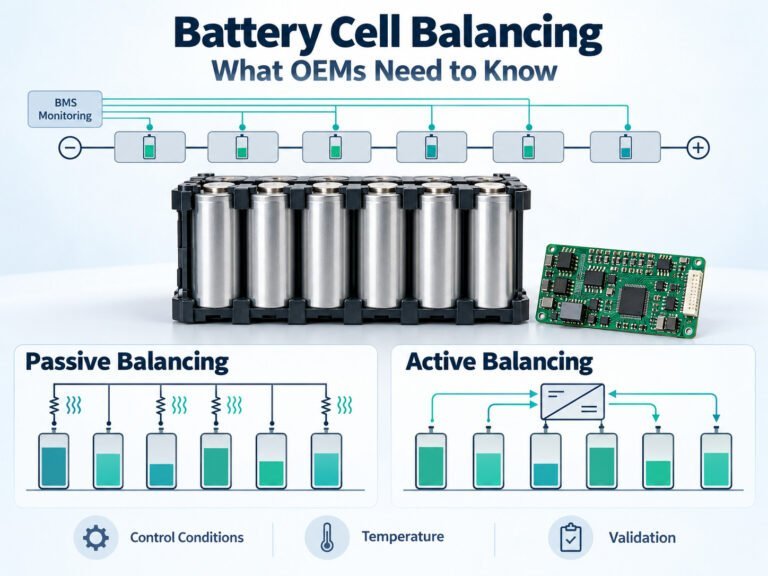
- 细胞平衡
- State of Charge (SOC) monitoring
- State of Health (SOH) estimation
For industrial robots, a smart BMS can provide additional information to the robot controller.
例如
- 电池电压
- 电池电流
- 剩余容量
- 充电状态
- 温度
- 故障状态
- Cycle count
- SOC
- SOH
This information can help the robot’s control system make decisions about operation and charging.
CAN Bus and RS485 Communication
Industrial robotic systems frequently require communication between the battery and the main controller.
Depending on the robot architecture, battery packs can be designed with communication interfaces such as:
CAN总线
CAN is widely used in industrial and mobile equipment.
A CAN-enabled battery can communicate information such as:
- 电压
- 当前
- SOC
- 温度
- 故障代码
- 充电状态
- BMS status
RS485
RS485 can also be used for battery communication in industrial equipment, especially where a specific communication architecture or protocol is required.
The important point is that the communication protocol should be defined during the battery design stage.
A custom battery supplier may need information about:
- 通信协议
- Baud rate
- CAN ID
- 数据格式
- Message structure
- Voltage and current scaling
- Fault definitions
- SOC calculation method
This prevents communication problems during system integration.
Battery Pack Mechanical Design
Industrial robots have limited internal installation space, and the battery must often fit around motors, controllers, structural components, and wiring.
Therefore, mechanical design is an important part of battery customization.
A custom battery pack can be designed according to:
- 长度
- 宽度
- 高度
- 安装孔
- 连接器位置
- 电缆出口
- Battery orientation
- 外壳材料
- Weight limitation
- 安装方法
Common battery housing materials include:
- ABS
- PC
- Aluminum
- Steel
- Custom engineering plastics
For industrial environments, the enclosure can also be designed with appropriate sealing and structural reinforcement.
IP Protection for Robot Battery Packs
The required IP rating depends on the robot’s operating environment.
For indoor warehouse robots, the battery may only need protection against dust and accidental liquid exposure.
Outdoor or industrial robots may require higher protection against:
- 灰尘
- 雨
- Water spray
- Cleaning processes
- 泥浆
- 湿度
Depending on the application, battery pack designs may incorporate IP-rated housings and sealing structures.
例如 IP67 battery enclosure is designed to provide dust protection and protection against temporary immersion under specified test conditions.
However, the IP rating should not be selected simply because a higher number sounds better. The appropriate rating depends on the actual environment, sealing design, connectors, cable exits, pressure equalization requirements, and testing conditions.
Thermal Management for Robot Batteries
Temperature has a direct effect on battery performance and service life.
Industrial robots may operate in:
- Cold warehouses
- Temperature-controlled facilities
- Hot factories
- Outdoor environments
- Refrigerated logistics areas
Battery design should therefore consider:
- 工作温度
- 充电温度
- 储存温度
- Heat generated during high-current operation
- Cooling conditions
- Temperature sensor placement
For high-power battery packs, thermal analysis may be necessary to identify potential hot spots.
The BMS can use temperature sensors to prevent charging or discharging when battery temperature moves outside the specified operating range.
For low-temperature applications, battery heating may also be considered when required by the duty cycle.
Charging Requirements for Industrial Robot Batteries
The charging system should be designed together with the battery rather than treated as a separate component.
Charging strategies can include:
标准充电
The robot returns to a charging station after completing its operating cycle.
自动充电
An AGV or AMR automatically connects to a charging station when its battery reaches a defined SOC.
机会充电
The robot charges for short periods during breaks or low-demand intervals.
快速充电
The battery receives a higher charging current to reduce downtime.
The appropriate charging method depends on:
- 电池化学
- Cell specifications
- Required operating time
- Available charging time
- 电池容量
- 热工条件
- BMS 配置
- 充电器规格
Charging current should always remain within the battery manufacturer’s specified limits.
Cycle Life and Battery Durability
Battery cycle life is affected by many factors rather than one fixed number.
Important variables include:
- 放电深度
- Charge rate
- 放电速率
- 工作温度
- 细胞化学
- 细胞质量
- 充电策略
- Mechanical conditions
- 储存条件
For example, regularly discharging a battery to a very low SOC may produce different aging behavior than operating within a narrower SOC window.
For robots that operate continuously, battery life should therefore be evaluated based on the actual duty cycle rather than relying solely on a generic cycle-life figure.
A battery manufacturer can conduct cycle testing under defined conditions to evaluate capacity retention over repeated charge-discharge cycles.
Safety Features for Industrial Robot Battery Packs
Battery safety requires both electrical and mechanical protection.
A properly designed battery system may incorporate:
Electrical Protection
- 过充电保护
- 过放电保护
- 过流保护
- 短路保护
- 过温保护
Cell-Level Management
- 电池电压监测
- 细胞平衡
- 温度监测
Mechanical Protection
- Cell fixation
- 隔热
- Anti-vibration construction
- Protective enclosure
- Connector protection
- Cable strain relief
For industrial robots exposed to vibration and repeated movement, mechanical reliability is particularly important.
The battery should not only work electrically. Its cells, busbars, connectors, wiring, and enclosure must also remain mechanically stable throughout the expected operating conditions.
Testing Industrial Robot Battery Packs
Testing should be performed according to the intended application and applicable standards.
Typical battery pack testing can include:
- 能力测试
- 充放电测试
- 内部电阻测试
- BMS保护测试
- 温度测试
- 老化测试
- 振动测试
- Drop or mechanical testing where applicable
- Waterproof testing where applicable
- 通信测试
- Connector testing
- 绝缘测试
For export applications, the required certifications and transportation requirements should also be considered.
Depending on the market and application, battery products may need to address standards or certifications such as:
- UN38.3
- IEC 62133-2
- CE
- RoHS
- 与UL相关的要求
- 欧盟《电池法规》的要求
- Application-specific standards
The exact requirements depend on battery chemistry, product configuration, destination market, and end application.
Industrial Robot Battery Applications
Rechargeable lithium battery packs can be customized for different types of robotic equipment.
AGV Battery
AGVs typically operate on predefined routes in factories, warehouses, and logistics facilities.
Battery requirements may include:
- 稳定电压
- High cycle life
- Reliable BMS
- CAN 通信
- Automatic charging compatibility
- Compact installation
- Vibration resistance
AMR Battery
AMRs use autonomous navigation and may operate continuously in warehouses or production facilities.
Battery design may need to account for:
- Frequent acceleration and deceleration
- Variable payloads
- Long operating shifts
- 高充电频率
- Navigation electronics
- Wireless communication
- Autonomous charging
Inspection Robot Battery
Inspection robots may operate in industrial facilities, outdoor areas, infrastructure sites, or other environments.
Important factors can include:
- 运行时间长
- 环境保护
- Temperature tolerance
- 紧凑型设计
- 通信能力
Warehouse Robot Battery
Warehouse robots may operate for extended periods with repeated movement cycles.
Battery design can focus on:
- 周期寿命
- 充电效率
- 能源产能
- 峰值电流
- Compact packaging
- Automated charging
Cleaning Robot Battery
Commercial and industrial cleaning robots may operate in environments where water, dust, and cleaning chemicals are present.
The battery enclosure, connectors, and sealing system therefore require careful consideration.
How to Choose a Custom Industrial Robot Battery Manufacturer
Selecting a battery manufacturer should involve more than comparing the quoted battery capacity.
A suitable OEM/ODM partner should be able to understand the complete application.
Important evaluation points include:
1. Battery Cell Selection
Ask which cell brands, models, chemistry, capacity, and discharge characteristics are available.
2. BMS Development
The supplier should be able to configure or develop a BMS according to the battery’s electrical and communication requirements.
3. Mechanical Customization
The battery should be designed around the robot’s available installation space.
4. Prototype Capability
A prototype allows the robot manufacturer to verify:
- 尺寸
- 连接器位置
- Electrical performance
- 交流
- 安装
- 运行时间
before mass production.
5. Testing Capability
Battery suppliers should have appropriate equipment for capacity, aging, BMS, temperature, vibration, and other application-specific testing.
6.认证支持
For international projects, the manufacturer should understand the certification and transportation requirements relevant to the destination market.
7. Production Traceability
Battery production should have appropriate processes for:
- Cell inspection
- 细胞匹配
- 焊接
- BMS assembly
- 包装组件
- 功能测试
- 老龄化
- 最终检查
Industrial Robot Battery OEM/ODM Process
A structured OEM/ODM process can reduce integration problems.
Step 1: Define the Robot Requirements
Provide:
- 额定电压
- 所需容量
- 连续电流
- 峰值电流
- 运行时间
- 充电方式
- 工作温度
- Installation dimensions
- 通信协议
Step 2: Battery Configuration
The manufacturer evaluates:
- 电池化学
- 细胞模型
- Series-parallel configuration
- BMS
- 保护组件
- 附件
Step 3: 3D and Mechanical Design
The battery housing and mounting structure are developed around the robot’s available space.
Step 4: Prototype Production
A prototype battery is produced for electrical, mechanical, and communication verification.
Step 5: Testing
The prototype undergoes relevant testing according to the application requirements.
Step 6: Robot Integration
The battery is installed in the robot for real operating tests.
The manufacturer can then evaluate:
- 运行时
- 峰值电流
- 电压稳定性
- 温度
- 充电
- 交流
- 机械稳定性
Step 7: Mass Production
After the design is approved, production specifications and quality-control procedures are finalized for volume manufacturing.
How to Improve Industrial Robot Battery Life
Several system-level strategies can help improve battery utilization.
Avoid unnecessary deep discharge
Operating within an appropriate SOC range can reduce stress on the battery.
Control charging conditions
Charging should follow the cell and battery manufacturer’s specifications.
Monitor temperature
Temperature data can help identify abnormal operating conditions.
Match the battery to the motor load
An undersized battery may experience excessive current demand and voltage drop.
Use appropriate BMS parameters
BMS thresholds should be configured according to the selected cells and system requirements.
Reduce mechanical stress
Proper cell fixation, enclosure design, and connector protection are important for mobile robots.
Collect operating data
Monitoring SOC, current, temperature, and fault information can help identify battery performance trends and maintenance requirements.
常见问题
What type of battery is suitable for industrial robots?
Lithium-ion and LiFePO4 batteries are commonly considered for industrial robotic applications. The appropriate chemistry depends on required energy density, cycle life, power output, operating environment, weight, and available space.
Can a robot battery pack be customized?
Yes. A battery pack can be customized in terms of voltage, capacity, dimensions, cell configuration, BMS, connectors, communication interface, enclosure, wiring, and mounting structure.
Can an industrial robot battery communicate with the robot controller?
Yes. Battery packs can be designed with communication interfaces such as CAN or RS485 when required. The communication protocol and data structure need to be defined during development.
How long can an industrial robot battery operate?
Runtime depends on battery energy and the robot’s actual power consumption.
一个简化的计算方法是:
Runtime = Battery Energy × System Efficiency ÷ Average Power Consumption
Actual runtime should be verified through testing because robot power consumption varies with payload, speed, acceleration, terrain, and operating conditions.
Is LiFePO4 suitable for AGVs and AMRs?
LiFePO4 can be considered for AGV and AMR applications where cycle life, thermal stability, and frequent charge-discharge operation are important. The battery size and weight should be evaluated because LFP generally has lower energy density than some NMC lithium-ion systems.
What BMS functions are needed for a robot battery?
Typical functions include overcharge, over-discharge, overcurrent, short-circuit, temperature protection, cell balancing, SOC monitoring, and fault monitoring. Industrial systems may also require CAN or RS485 communication.
Can the battery support automatic charging?
Yes. The battery can be designed around automatic charging systems, provided that the charging voltage, current, connector, BMS, and communication requirements are defined during development.
What information should I provide to a battery manufacturer?
A battery manufacturer normally needs information such as:
- Required voltage
- Capacity or runtime
- 连续电流
- 峰值电流
- 充电电压
- 充电电流
- 尺寸
- Weight limitation
- 工作温度
- 通信要求
- Connector requirements
- 安装方法
- Application environment
The more complete the application information, the easier it is to develop a battery that fits the robot system.
Custom Industrial Robot Battery Packs from Yizhan
For industrial robot applications, battery design should be developed around the complete equipment rather than based on a standard battery specification.
东莞一展电子科技有限公司 provides rechargeable lithium battery pack OEM/ODM solutions for industrial and mobile equipment.
Our customization capabilities can cover:
- Lithium-ion battery packs
- LiFePO4 battery packs
- 自定义电压和容量
- Cylindrical and prismatic cells
- 智能 BMS
- CAN/RS485 通信
- 定制连接器
- Wiring harnesses
- Custom battery housings
- IP-rated battery pack designs
- 原型开发
- Capacity and aging testing
- Application-specific battery testing
The battery development process can start from the robot’s electrical requirements, installation dimensions, operating profile, and communication specifications.
For AGVs, AMRs, warehouse robots, inspection robots, cleaning robots, and other mobile industrial equipment, a custom battery pack can be developed to match the actual system requirements.
结论
A durable rechargeable battery pack for an industrial robot requires more than sufficient capacity.
The battery system should be designed around the robot’s complete operating profile, including voltage, energy consumption, continuous current, peak current, cycle life, charging strategy, temperature, mechanical conditions, BMS protection, communication, and installation space.
For applications with frequent daily operation, selecting the appropriate cell chemistry and configuration is only the first step. BMS design, thermal management, mechanical protection, testing, and system integration are equally important.
For robot manufacturers and automation companies, working with an experienced industrial robot battery OEM/ODM manufacturer can make it possible to develop a battery pack around the actual robot instead of modifying the robot around a standard battery.
A properly engineered rechargeable lithium battery pack can provide a practical power solution for the long-term operation of AGVs, AMRs, warehouse robots, inspection robots, and other industrial robotic systems.
 English
  Chinese
  Japanese
  German
  French
  Korean
