
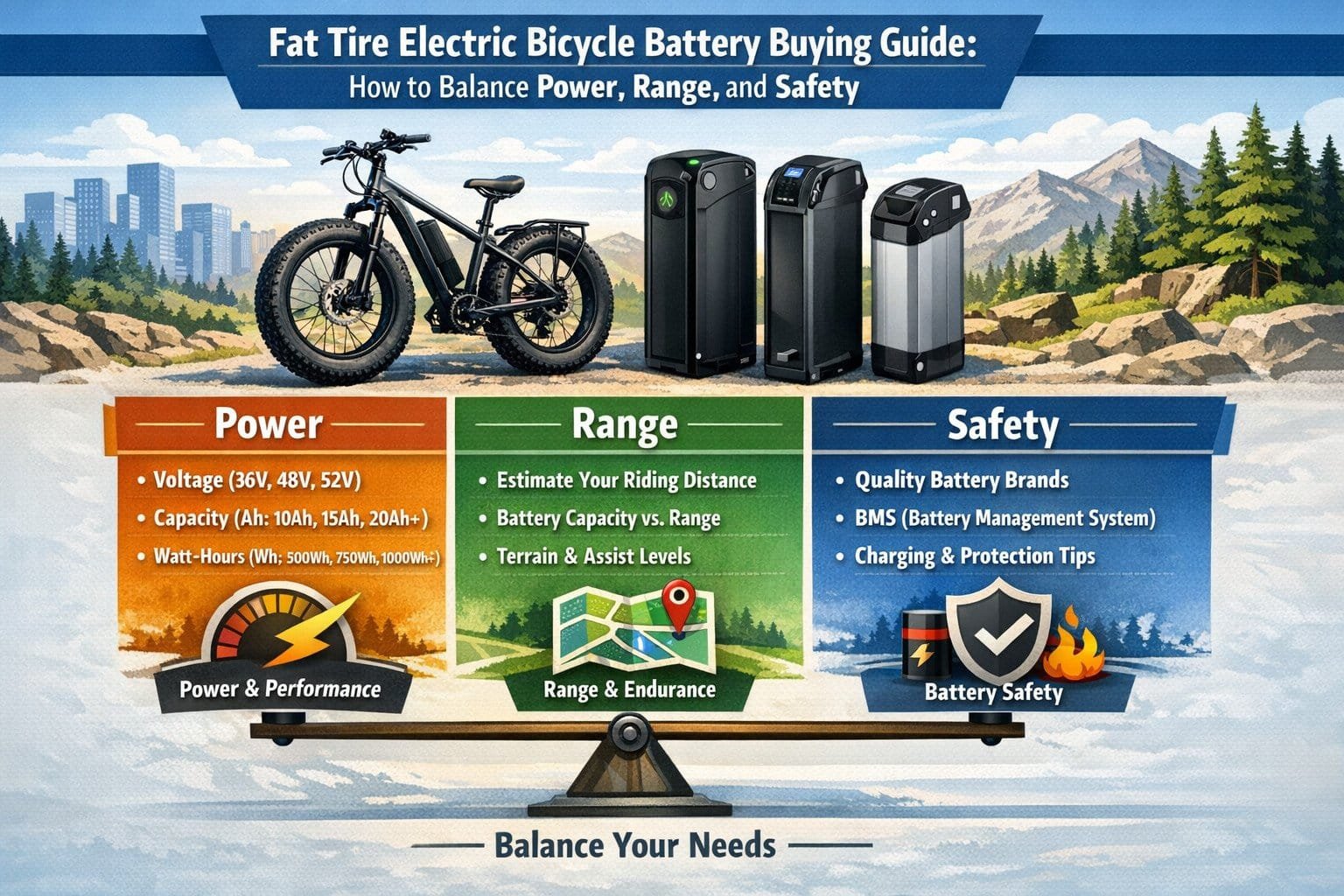
In recent years, fat tire electric bicycles (Fat Tire E-Bikes) have been widely used in sand, snow, mountainous terrain, and complex road conditions due to their excellent passability and stability. Compared to ordinary electric bicycles, fat tire models are heavier, have greater resistance, and require higher power, which places higher demands on the battery system.
This article, based on years of experience in custom electric bicycle battery design, provides this fat tire electric bicycle battery buying guide to help brands, manufacturers, and buyers make safer and more efficient battery choices.
Part 1. What are the special requirements of fat tire electric bicycles for batteries?
Compared to ordinary city commuter eBikes, fat tire electric bicycles usually have the following characteristics:
Wider tires (4.0–5.0 inches), resulting in greater rolling resistance
Higher overall vehicle weight
Often used for climbing, off-roading, sand, or snow
Higher motor power (500W–1000W or even higher)
Therefore, their batteries must simultaneously meet:
Higher power output capability
Greater capacity and range
Stronger structure and safety design
Part 2.Common Battery Voltage Choices for Fat Tire Electric Bicycles
1. 36V Battery
Suitable for entry-level or light-duty fat tire models
Limited power performance, not suitable for high-intensity off-roading
2. 48V Battery (Mainstream Choice)
Balance of power and range
Suitable for 500W–750W motors
Most widely used in the market
3. 52V / 60V Battery
For high-performance fat tire eBikes
Strong climbing ability, faster acceleration
Requires higher demands on BMS and cell consistency
Recommendation: For most fat tire electric bicycles, a 48V lithium battery is the best choice in terms of cost-effectiveness and reliability.
Part 3. How to Choose the Right Battery Capacity?
The battery capacity of fat tire electric bicycles is usually higher than that of ordinary models:
Usage Scenario Recommended Capacity
City + Light Off-road 48V 13Ah–15Ah
Mountain / Sand 48V 17Ah–20Ah
Long Range / Adventure ≥ 48V 20Ah
Capacity recommendations should be based on Wh (watt-hours), not just Ah.
Part 4. Battery Cell Type and Discharge Performance
Fat tire eBikes require high instantaneous current output during starting and climbing, which places high demands on the battery cells:
High discharge rate capability
Low internal resistance
High consistency
Dongguan Yizhan Electronics typically uses high-rate 18650/21700 lithium-ion battery cells in its fat tire battery projects, balancing range and power output.
Part 5. Safety Design Highlights of Fat Tire Electric Bicycle Batteries
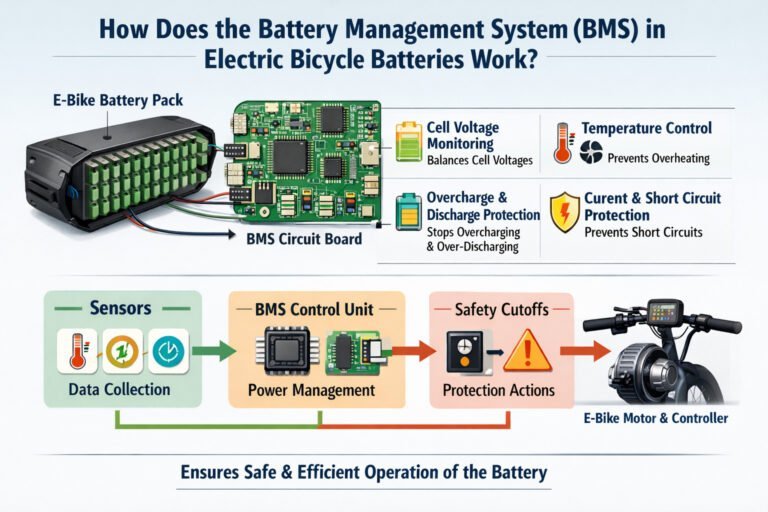
1. Intelligent BMS is essential
과충전/과방전 방지
Overcurrent/short-circuit protection
Temperature monitoring and protection
2. Structure and shock resistance design
Strengthened internal fixing structure
Adaptable to vibration and impact from complex road conditions
3. Waterproof and dustproof capabilities
Recommended to meet at least IP65
Suitable for outdoor use in rain, snow, and muddy environments
Part 6. Fat Tire Electric Bicycle Battery Shape and Installation Methods
Common structures include:
다운 튜브 배터리
Frame integrated battery
Rear rack battery
Yizhan Electronics can provide customized casings, battery sizes, and interface designs based on the overall vehicle structure to ensure a perfect match with the entire vehicle.
Part 7. Why Choose Dongguan Yizhan Electronics Technology Co., Ltd.?
As a manufacturer specializing in customized lithium batteries, Yizhan Electronics has significant advantages in the field of fat tire electric bicycle batteries:
✅ 48V/52V/60V battery customization experience
✅ High power output, suitable for high-torque motors
✅ Intelligent BMS + multiple safety protections
✅ Supports OEM/ODM brand customization
✅ Complies with export standards such as UN38.3, CE, EN 50604
✅ Strict aging and safety testing procedures
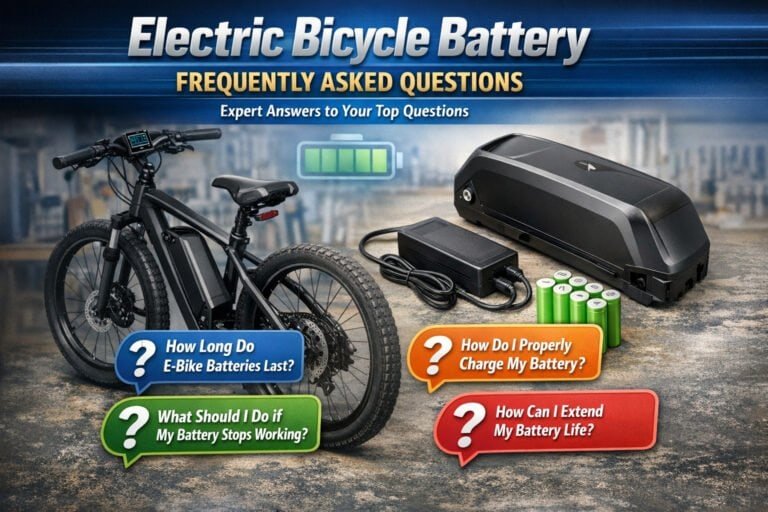
FAQ: Frequently Asked Questions about Fat Tire Electric Bicycle Batteries
Q1: Can ordinary eBike batteries be used for fat tire electric bicycles?
A: Not recommended. Ordinary batteries lack sufficient power and structural strength, which may affect performance and safety.
Q2: Is bigger capacity always better?
A: Not necessarily. A balance needs to be struck between weight, range, and overall vehicle balance.
Q3: What special requirements does a fat tire battery have for the BMS?
A: It needs to support higher current and more precise temperature control protection.
Q4: Does Yizhan Electronics support customized fat tire battery casings?
A: Yes, the structure and interfaces can be customized according to the frame and brand requirements.
Q5: What is the typical battery life?
A: Under normal use, the cycle life is usually 500–800 cycles.
Fat tire electric bicycles have much higher battery requirements than ordinary models. Only when the voltage, capacity, power output, and safety design are fully matched can the advantages of fat tire eBikes be truly realized.
Dongguan Yizhan Electronics Technology Co., Ltd. is committed to providing high-safety, high-power, and customizable lithium battery solutions for fat tire electric bicycle brands and manufacturers, helping customers create more reliable and competitive products.
 English
  Chinese
  Japanese
  German
  French
  Korean
