
Warehouse picking robots are used in logistics centers, distribution facilities, e-commerce fulfillment operations, and industrial warehouses. These robotic systems support activities such as order picking, material transport, tote handling, and movement between storage locations and workstations.
Depending on the equipment design, warehouse picking robots may use autonomous mobile platforms, lifting mechanisms, conveyor modules, or robotic arms.
The battery pack supplies electrical power to the robot’s drive motors, controllers, sensors, communication equipment, and material-handling mechanisms.
For robot manufacturers and automation system integrators, custom lithium battery packs for warehouse picking robots must be evaluated according to electrical demand, operating schedules, charging requirements, and installation conditions.
This article explains the battery design parameters involved in warehouse picking robot applications, including voltage, capacity, discharge current, Battery Management System (BMS) functions, communication, charging, and mechanical integration.
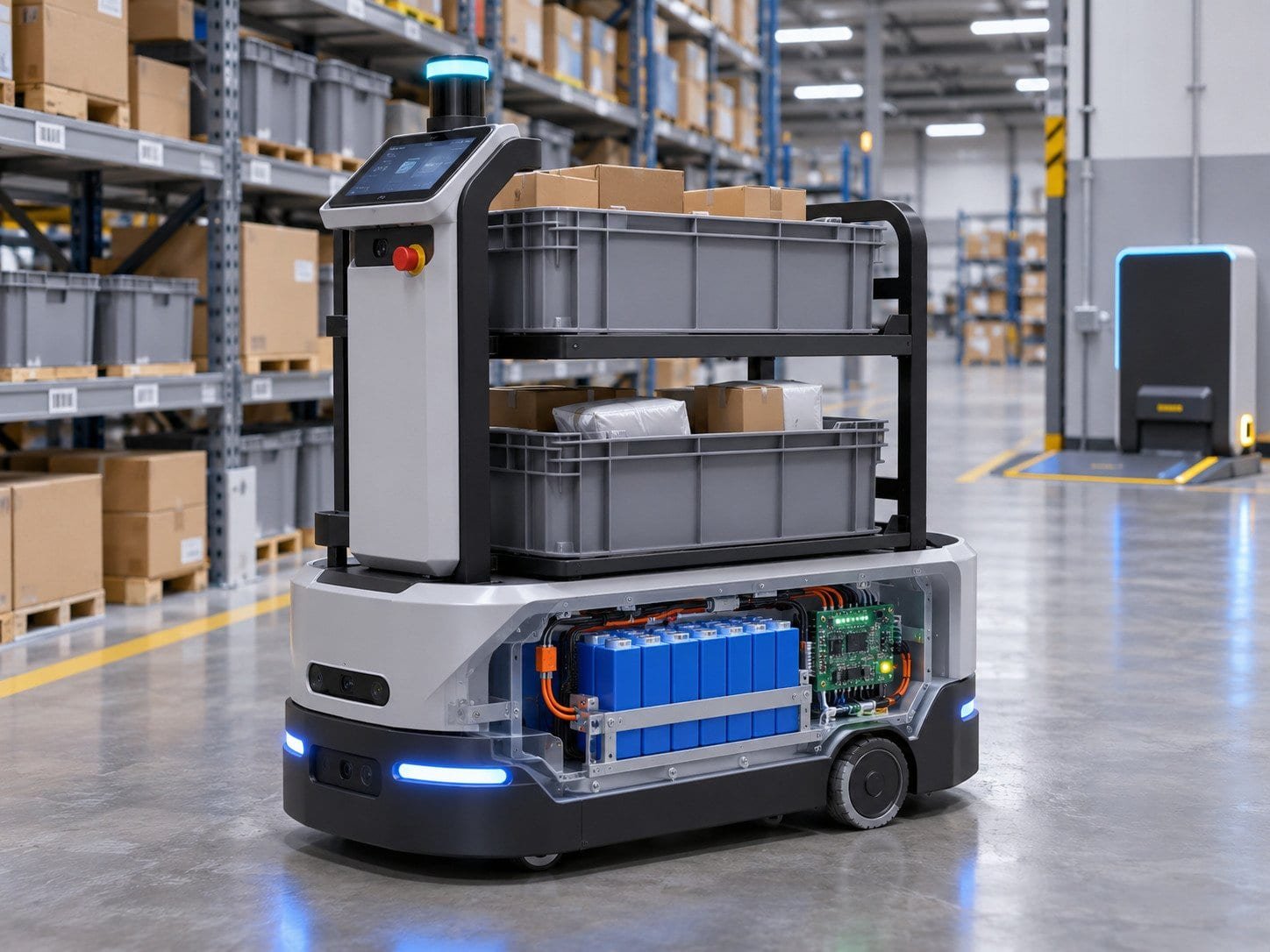
1. Battery Applications in Warehouse Picking Robots
Warehouse picking robots include several equipment configurations.
Autonomous Mobile Picking Robots
Autonomous mobile picking robots transport items, totes, or collection containers between warehouse locations.
The battery provides power for the mobile platform, navigation equipment, control electronics, and any installed material-handling mechanisms.
Battery selection depends on the robot’s operating cycle, payload, travel distance, and electrical load.
Mobile Manipulation Robots
Some warehouse robots combine an autonomous mobile platform with a robotic arm or gripping mechanism.
These systems use battery energy for both movement and manipulation.
The battery design should account for drive motors, robotic joints, end effectors, sensors, and control systems.
Tote and Bin Transport Robots
Tote-handling robots transport containers between storage locations, picking stations, and other warehouse areas.
The equipment may include lifting mechanisms, conveyors, or transfer devices.
The battery pack must support the current required by these mechanisms during the specified operating cycle.
Warehouse Shuttle and Mobile Transport Systems
Warehouse shuttle systems and mobile transport robots may use battery power for travel, positioning, and load-handling functions.
Battery configuration depends on the equipment architecture and its charging system.
Each application requires an electrical load assessment before selecting the battery cells and pack structure.
2. Selecting Battery Voltage for Warehouse Picking Robots
Battery voltage is determined by the robot’s electrical architecture.
Components such as traction motors, lifting mechanisms, onboard computers, and DC-DC converters may operate at different voltages.
The battery must be compatible with the robot’s main power system.
Depending on the design, warehouse robots may use 24V, 36V, or 48V-class battery systems.
Lithium Battery Voltage Configurations
En voici quelques exemples :
| Configuration | Composition chimique des batteries | Tension nominale |
|---|---|---|
| 7S | Ternary Lithium-Ion | 25.2V |
| 10S | Ternary Lithium-Ion | 36V |
| 13S | Ternary Lithium-Ion | 46.8V |
| 8S | LiFePO4 | 25.6V |
| 12S | LiFePO4 | 38.4V |
| 15S | LiFePO4 | 48.0V |
| 16S | LiFePO4 | 51.2V |
These examples use nominal cell voltages of 3.6V for ternary lithium-ion cells and 3.2V for LiFePO4 cells.
The values are illustrative and do not represent specific production battery models.
Voltage Compatibility Requirements
Before selecting the battery configuration, the equipment manufacturer should confirm:
- Nominal system voltage
- Permitted battery voltage range
- Motor controller input voltage
- DC-DC converter requirements
- Maximum charging voltage
- Minimum operating voltage
- Battery protection limits
- Charging station specifications
A robot designed around a nominal 48V system cannot automatically accept every lithium battery configuration marketed as 48V.
The complete operating voltage range must be evaluated.
3. Calculating Battery Capacity and Runtime
Battery capacity is determined by the energy required during robot operation.
Warehouse picking robots may use electrical power for navigation, material handling, lifting, manipulation, and communication.
The average electrical load depends on the operating cycle.
Main Electrical Loads
Battery-powered systems may include:
- Traction motors
- Motor controllers
- Lifting motors
- Robotic arms and grippers
- Conveyor mechanisms
- Capteurs LiDAR
- Appareils photo
- Onboard computers
- Wireless communication equipment
- Safety-related electronic systems
- Auxiliary electrical components
The battery energy calculation should account for the components operating during each task.
Battery Energy Calculation
Nominal battery energy can be calculated using:
Battery Energy (Wh) = Nominal Voltage (V) × Battery Capacity (Ah)
For example, a theoretical 51.2V 50Ah battery has:
51.2V × 50Ah = 2,560Wh
The calculated value represents nominal energy.
Actual usable energy depends on discharge conditions, battery protection limits, operating temperature, and cell characteristics.
Example: Warehouse Picking Robot Runtime
Assume a warehouse picking robot has the following illustrative average electrical loads:
| Component | Average Power |
|---|---|
| Drive Motors | 180W |
| Lifting and Picking Mechanisms | 120W |
| Navigation Sensors | 35W |
| Control Computer | 45W |
| Communication and Auxiliary Equipment | 20W |
| Total | 400W |
For an operating period of five hours:
Required Usable Energy = 400W × 5h = 2,000Wh
Assuming a nominal 51.2V battery:
Theoretical Capacity = 2,000Wh ÷ 51.2V = 39.1Ah
If the design calculation assumes 90% usable energy:
Required Nominal Capacity = 2,000Wh ÷ (51.2V × 0.90)
Required Nominal Capacity ≈ 43.4Ah
The 90% usable energy fraction is an illustrative assumption.
Actual battery capacity should be selected according to validated energy consumption, operating limits, electrical losses, aging requirements, and the required energy reserve.
These calculations do not represent a tested battery product or guaranteed robot runtime.
4. Warehouse Robot Duty Cycle and Battery Energy Demand
Warehouse robots operate according to task assignments and programmed routes.
Their power demand can change throughout the working cycle.
Typical Operating Modes
A picking robot may operate in the following modes:
- Traveling without a payload
- Traveling with a payload
- Accelerating and decelerating
- Positioning at a picking location
- Lifting or manipulating items
- Waiting for task assignments
- Traveling to a charging station
- Charging
Each operating mode has an associated electrical load.
Duty Cycle Energy Calculation
The total energy demand can be calculated by adding the energy consumed during each operating mode.
Total Energy (Wh) = Σ [Power (W) × Operating Time (h)]
Par exemple :
| Operating Mode | Average Power | La durée | L'énergie |
|---|---|---|---|
| Traveling | 350W | 2 hours | 700Wh |
| Picking and Handling | 500W | 1 hour | 500Wh |
| Waiting and Standby | 60W | 1 hour | 60Wh |
| Total | — | 4 hours | 1,260Wh |
The average power is:
1,260Wh ÷ 4h = 315W
This example represents a theoretical duty cycle.
The actual battery configuration should be calculated from the robot manufacturer’s operating data or measured power profile.
Battery Reserve for Task Completion
Warehouse robots may require an energy reserve to complete assigned tasks and reach the charging station.
The reserve should account for travel distance, payload, operating conditions, and the charging strategy.
A defined SOC threshold may be used by the robot controller to initiate a return-to-charge operation.
The BMS and controller should be evaluated together to establish battery status reporting requirements.
5. Continuous and Peak Discharge Current Requirements
Battery capacity determines the nominal charge available, but it does not establish the pack’s discharge current capability.
Warehouse picking robots may require short-duration current pulses during movement or lifting operations.
Courant de décharge continu
Continuous current is the current required during sustained operation.
It affects:
- Sélection des cellules
- Parallel cell configuration
- BMS current rating
- Power cables
- Busbars
- Connecteurs
- Thermal design
Courant de décharge de pointe
Peak current may occur during:
- Motor startup
- Robot acceleration
- Levage de la charge utile
- Robotic arm movement
- Conveyor activation
- Sudden changes in mechanical load
Peak current should be defined using current amplitude, duration, and repetition frequency.
Example Battery Electrical Requirements
| Paramètres | Illustrative Value |
|---|---|
| Tension nominale | 51.2V |
| Capacité de la batterie | 50Ah |
| Courant de décharge continu | 50A |
| Courant de décharge de pointe | 120A |
| Peak Duration | 3 seconds |
These values are engineering examples and do not represent an existing certified battery product.
The selected battery cells, BMS, power connections, and thermal structure must be evaluated against the actual equipment current profile.
6. LiFePO4 and Ternary Lithium-Ion Battery Cell Selection
Warehouse picking robot battery packs may use LiFePO4 or ternary lithium-ion cells according to the equipment requirements.
Battery chemistry selection should consider electrical performance, mechanical limitations, charging requirements, and environmental conditions.
Cellules de batterie LiFePO4
LiFePO4 cells are used in industrial battery systems and mobile equipment applications.
Cell selection parameters include:
- Tension nominale
- Capacité nominale
- Continuous current capability
- Pulse discharge capability
- Courant de charge
- Température de fonctionnement
- Cell dimensions
- Terminal configuration
- Manufacturer cycle life specifications
Prismatic LiFePO4 cells can be evaluated for battery compartments that accommodate their dimensions and terminal structures.
Ternary Lithium-Ion Battery Cells
Ternary lithium-ion batteries, including NMC chemistry, are used in robotics and electric mobility equipment.
Cylindrical cell formats may be considered for battery designs with specified packaging dimensions.
Selection should account for cell capacity, discharge current, temperature limits, voltage range, and mechanical configuration.
Series and Parallel Configuration
Series connections determine the pack voltage.
Parallel connections determine the combined nominal capacity and contribute to current capability.
The final cell arrangement must consider electrical insulation, thermal conditions, mechanical retention, and current distribution.
7. Battery Management System Requirements
A Battery Management System monitors battery conditions and provides protection functions according to the selected hardware and software configuration.
Warehouse picking robot applications may require:
- Surveillance du potentiel cellulaire
- Protection contre les surcharges
- Protection contre la surcharge
- Protection contre les surintensités
- Protection contre les courts-circuits
- Charging temperature protection
- Discharging temperature protection
- Équilibre cellulaire
- Battery fault reporting
State of Charge Monitoring
Warehouse automation systems may use battery State of Charge (SOC) information to coordinate robot operation and charging.
SOC estimation depends on the BMS measurement method, firmware, battery characteristics, and operating conditions.
The required SOC reporting accuracy should be defined in the technical specification.
State of Health Information
Some applications require State of Health (SOH) reporting for battery maintenance planning.
SOH availability depends on the selected BMS and its implemented algorithms.
It should not be assumed that every BMS supports SOH reporting.
Battery Temperature Monitoring
NTC temperature sensors may be installed at selected locations within the pack.
Temperature monitoring and protection thresholds should be based on cell manufacturer specifications and battery operating conditions.
8. CAN Communication for Warehouse Robot Batteries
Warehouse picking robots may require the battery to transmit operating information to the main controller.
Depending on the system, communication interfaces may include CAN, UART, or RS485.
A CAN-equipped BMS can transmit specified battery information according to an agreed protocol.
Battery Data Reporting
Depending on the BMS configuration, reported information may include:
- Total battery voltage
- Charge and discharge current
- SOC
- Température de la batterie
- Statut de protection
- Informations sur les pannes
CAN Protocol Requirements
The robot manufacturer should provide:
- CAN bit rate
- CAN message identifiers
- Frame format
- Signal definitions
- Transmission intervals
- Connector pin assignments
The communication protocol must be confirmed during the system integration process.
Monitoring and Control
In a monitoring-only configuration, CAN is used to transmit battery information.
CAN communication does not automatically control charging or discharging.
Projects requiring communication-based control must define the necessary BMS hardware, firmware, and protocol functions separately.
9. Automatic Charging and Opportunity Charging
Charging strategy influences warehouse robot battery capacity, operational scheduling, and charger interface design.
Warehouse robots may use automatic charging stations, manually connected chargers, or removable battery systems.
Automatic Docking and Charging
An automatic charging system may allow a robot to travel to a defined charging station and connect through an approved electrical interface.
The battery system should be compatible with the charger and robot controller.
Required charging parameters include:
- Tension de charge
- Courant de charge
- Charging temperature limits
- Charging termination conditions
- Protection behavior
- Charging connection design
Recharge à la demande
Opportunity charging refers to charging the battery during available intervals between operating tasks.
For example, a warehouse robot may charge during scheduled idle periods.
The feasibility of this arrangement depends on battery cell charging specifications, charging power, thermal conditions, and the available charging time.
Charging Contact Design
Automatic charging systems may use electrical contacts, mating connectors, or other specified charging interfaces.
The design should consider:
- Electrical current rating
- Contact alignment
- Connection resistance
- Mechanical wear
- Protection against unintended contact
- Charging interruption behavior
The battery, charging station, and robot controller must be evaluated as a complete system.
10. Swappable Battery Pack Design
Some warehouse robots use removable battery packs to support specific maintenance or operating arrangements.
A swappable battery design requires coordinated electrical and mechanical interfaces.
Mechanical Requirements
The equipment manufacturer should confirm:
- Dimensions de la batterie
- Installation orientation
- Mounting and locking mechanism
- Battery mass
- Handle requirements
- Insertion and removal clearance
- Connector mating arrangement
Electrical Requirements
Removable battery systems may require:
- Defined connector polarity
- Suitable connector current rating
- Pre-charge arrangements, where required
- Power isolation provisions
- Battery identification signals
- Protection against unintended disconnection
Hot-Swapping
A removable battery is not automatically suitable for hot-swapping.
Battery replacement while the robot remains electrically powered requires a specifically designed power architecture, protection arrangement, and system-level validation.
Hot-swapping capability must be confirmed as an independent project requirement.
11. Mechanical Battery Pack Design for Warehouse Robots
Warehouse robots may have limited internal space due to motors, sensors, control electronics, and material-handling mechanisms.
The battery pack must fit within the equipment’s defined installation area.
Dimensions de la batterie
Customers should provide the maximum allowable:
Longueur × Largeur × Hauteur
The dimensional specification should account for connectors, cables, mounting structures, and maintenance access.
Battery Mounting
The battery should be secured according to the robot’s mechanical design.
Mounting structures should consider specified vibration, movement, and operating loads.
Battery Weight and Robot Stability
Battery weight and installation position may influence the robot’s center of gravity, traction, braking, and payload handling.
These factors should be evaluated together with the robot’s mechanical structure.
Connectors and Cable Routing
Power and signal connections should be designed according to current requirements, available installation space, and service conditions.
Connector selection should consider electrical ratings, mating requirements, vibration, and mechanical retention.
12. Thermal Management and Warehouse Operating Conditions
Battery cells and electrical components generate heat during charging and discharging.
Thermal design should consider the robot’s operating cycle and the battery compartment environment.
Thermal Design Factors
Relevant factors include:
- Courant continu
- Peak current duration
- Courant de charge
- Disposition des cellules
- Résistance interne
- Enclosure construction
- Température ambiante
- Heat dissipation paths
Température de charge
Charging must follow the selected cell manufacturer’s temperature limits.
The BMS should provide the temperature monitoring and protective functions defined in the battery specification.
Environmental Conditions
Warehouse robots may operate around dust, humidity, cleaning equipment, and temperature variations.
Enclosure sealing and protection should be determined according to the installation environment.
An IP rating should be specified only when required and verified according to the applicable test conditions.
13. Battery Testing and Applicable Standards
Custom battery development may involve electrical, mechanical, thermal, and communication testing.
The applicable requirements depend on the battery application, robot classification, and target market.
Electrical Validation
Les examens peuvent inclure :
- Essais de capacité
- Energy measurement
- Continuous discharge testing
- Peak discharge testing
- Charging verification
- BMS protection verification
Mechanical and Environmental Validation
Les examens peuvent inclure :
- Battery enclosure inspection
- Mounting verification
- Essais de vibration
- Connector assessment
- Essais de température
- Ingress protection testing, where applicable
Integration Validation
Robot-level testing may include:
- Operating runtime
- SOC data reporting
- Communication CAN
- Compatibilité des chargeurs
- Amarrage automatique
- Charging interruption
- Fault response
Standards and Regulatory Requirements
| Standard / Requirement | General Purpose |
|---|---|
| IEC 62619 | Safety requirements for industrial secondary lithium cells and batteries |
| UN38.3 | Lithium battery transportation testing |
| IEC 60529 | Enclosure ingress protection classification |
| ISO 3691-4 | Safety requirements for driverless industrial trucks and their systems, where applicable |
| Applicable EU Product Requirements | Requirements determined by equipment classification and target market |
The relevant standards and editions should be confirmed for the individual project.
Battery testing does not automatically establish compliance for the complete warehouse robot.
14. Information Required for a Custom Warehouse Robot Battery Quotation
Warehouse robot manufacturers requesting a custom battery pack should provide the following information.
| Objet | Required Information |
|---|---|
| Robot Application | Picking robot, mobile manipulator, tote transport robot, or other warehouse robot |
| Tension nominale | V |
| Operating Voltage Range | Minimum and maximum voltage |
| Capacité de la batterie | Ah or Wh |
| Durée d'exécution requise | Hours |
| Average Power Consumption | W |
| Courant de décharge continu | A |
| Courant de décharge de pointe | A and duration |
| Composition chimique des batteries | LiFePO4 or ternary lithium-ion |
| Dimensions de la batterie | Maximum length × width × height |
| Battery Mass | Required mass range or limit |
| BMS Requirements | Protection, monitoring, and balancing |
| Communication | CAN, UART, RS485, or specified protocol |
| Méthode de chargement | Automatic docking, external charging, or battery swapping |
| Charging Voltage and Current | V and A |
| Connecteurs | Power and communication connections |
| Environmental Requirements | Temperature, dust, moisture, and IP requirements |
| Mechanical Requirements | Mounting, vibration, and removal requirements |
| Certification | Applicable standards and target market |
| Prototype Quantity | Sample requirements |
| Production Forecast | Estimated annual demand |
| Delivery Destination | Country and address |
Electrical drawings, battery compartment drawings, and communication protocol documents can support battery configuration evaluation.
15. Custom Warehouse Robot Battery Pack Development at Dongguan Yizhan Electronics Technology Co., Ltd.
Dongguan Yizhan Electronics Technology Co. Ltd. provides OEM and ODM lithium battery pack development and manufacturing services for robotics, industrial equipment, electric mobility, and energy storage applications.
For warehouse picking robot projects, the battery configuration can be evaluated according to the robot’s electrical power requirements, runtime, current demand, installation dimensions, and charging arrangement.
Our battery customization services include:
- LiFePO4 and ternary lithium-ion battery configurations
- Customized voltage and capacity
- Sélection des cellules de batterie
- BMS configuration according to project requirements
- CAN, UART, and RS485 communication options
- Contrôle de la température
- Customized power and signal connectors
- Plastic and metal battery enclosures
- Battery pack assembly
- Technical documentation and testing coordination
Battery communication functions, charging interfaces, mechanical structures, and environmental protection requirements are evaluated according to the individual project specification.
For OEM and ODM development projects, customers can provide their equipment drawings, electrical requirements, and production plans for technical evaluation.
Conclusion
Custom lithium battery pack design for warehouse picking robots requires an evaluation of electrical loads, battery capacity, current demand, BMS functionality, communication interfaces, and charging arrangements.
Robot traction systems, lifting mechanisms, robotic arms, navigation electronics, and control systems determine the electrical power requirements.
Battery installation dimensions, mounting, thermal conditions, and charging interfaces influence the pack configuration.
For warehouse robot manufacturers, battery development should begin with the confirmed equipment specifications and operating cycle.
Looking for a custom lithium battery pack for a warehouse picking robot?
Contact Dongguan Yizhan Electronics Technology Co. Ltd. with your robot’s voltage, capacity, operating time, continuous and peak current, battery dimensions, BMS communication requirements, charging method, and estimated production quantity.

 English
 Chinese
 Japanese
 German
 French
 Korean

