
Lithium iron phosphate batteries, commonly known as LiFePO4 batteries or LFP batteries, are used in industrial equipment, AGVs, AMRs, golf carts, forklifts, energy storage systems, marine equipment, robotics, and other applications that require rechargeable power.
However, an off-the-shelf LiFePO4 battery does not always match the electrical and mechanical requirements of a specific device. Voltage, capacity, discharge current, battery dimensions, communication, connector configuration, and installation method can all vary between applications.
A custom LiFePO4 battery pack provides a way to develop the battery around the equipment rather than modifying the equipment around a standard battery.
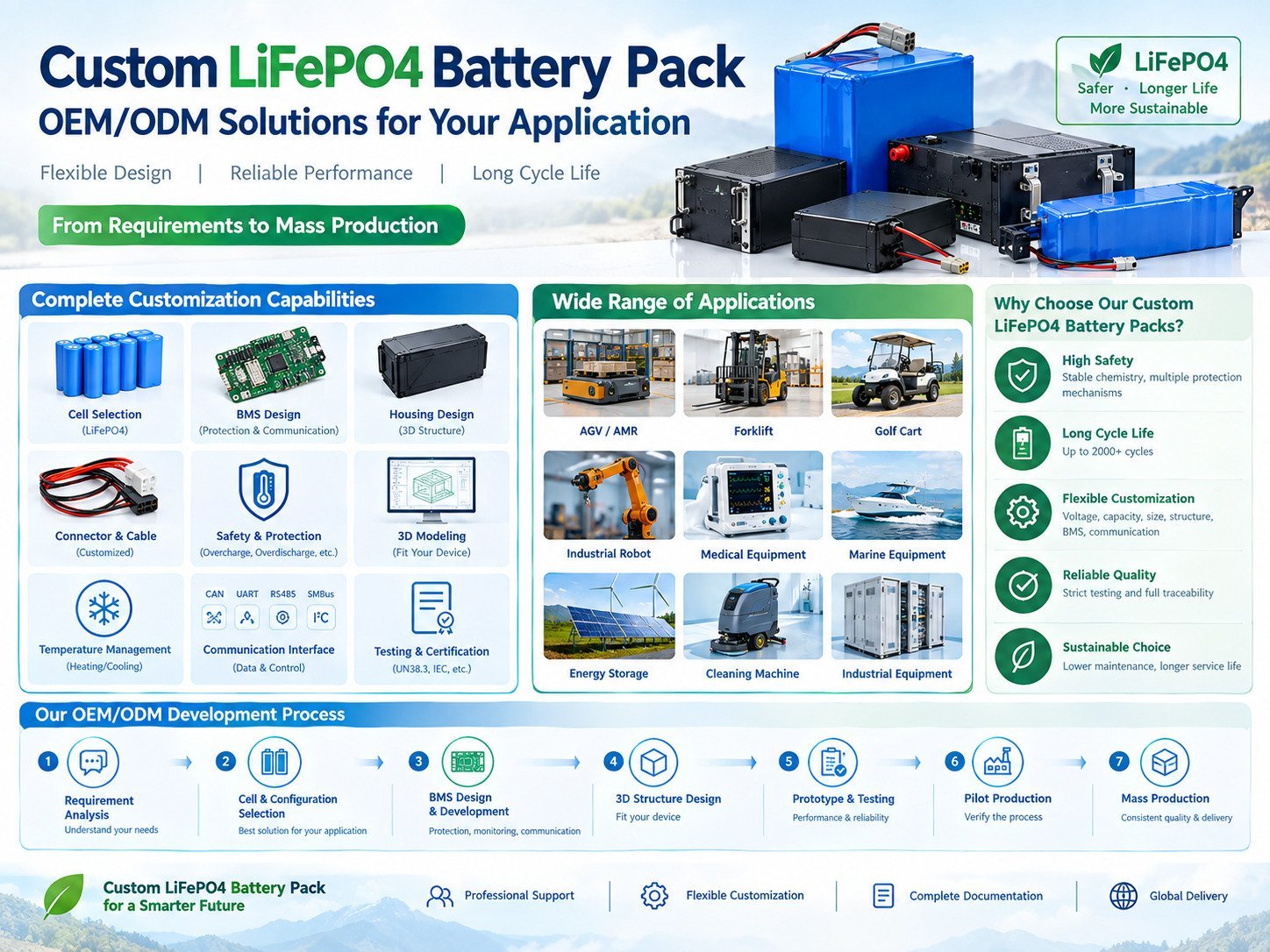
For OEM and ODM projects, customization can cover the cell configuration, BMS, housing, wiring, connectors, communication functions, charging requirements, and production process.
This guide explains how to develop a custom LiFePO4 battery pack and what equipment manufacturers should consider when selecting an LFP battery supplier.
1. What Is a Custom LiFePO4 Battery Pack?
A custom LiFePO4 battery pack is a rechargeable battery system designed according to the electrical, mechanical, and operating requirements of a specific application.
A typical LFP battery pack can include:
- Cellules LiFePO4
- Système de gestion de la batterie (BMS)
- Protection components
- Busbars or cell connections
- Capteurs de température
- Cables
- Connecteurs
- Insulation materials
- Battery housing
- Labels
- Interface de communication
The battery configuration can be customized according to the required voltage and capacity.
For example, a 12.8V LiFePO4 battery is commonly configured with four cells connected in series. A 25.6V battery can use eight cells in series, while a 51.2V battery can use sixteen cells in series.
The exact configuration depends on the selected cell specifications and application requirements.
A custom battery pack can also be designed around the equipment’s physical space.
This is particularly useful when the battery needs to fit inside:
- AGV
- AMR
- Robots industriels
- Voiturettes de golf
- Chariots élévateurs
- Transpalettes
- Équipement maritime
- Machines de nettoyage
- Energy storage equipment
- Matériel médical
2. Why Choose LiFePO4 for Custom Battery Applications?
LiFePO4 is one type of lithium-ion battery chemistry. Its characteristics make it suitable for applications where cycle life, thermal characteristics, operating stability, and repeated charging are important considerations.
Cycle de vie
LFP batteries can be designed for repeated charge and discharge operation.
Actual cycle life depends on factors such as:
- Depth of discharge
- Courant de charge
- Courant de décharge
- Température de fonctionnement
- Qualité des cellules
- Charging strategy
- Paramètres du BMS
- Storage conditions
Therefore, cycle-life specifications should always be evaluated together with the test conditions.
Thermal Characteristics
LiFePO4 cells have different thermal characteristics from some other lithium-ion chemistries.
Battery design still needs to consider:
- Température de charge
- Température de décharge
- Cell spacing
- Conception des logements
- Current demand
- Production de chaleur
- Contrôle de la température
The BMS can monitor battery temperature and implement the specified protection strategy.
Suitable for Repeated Industrial Operation
Many industrial applications require batteries to charge and discharge regularly.
Examples include:
- AGVs moving materials between workstations
- AMRs operating in warehouses
- Transpalettes électriques
- Chariots élévateurs
- Voiturettes de golf
- Industrial cleaning machines
- Robotic equipment
For these applications, battery capacity and charging strategy need to be designed around the actual operating cycle.
3. How to Select the Voltage of a Custom LiFePO4 Battery
Battery voltage should match the equipment’s electrical architecture.
Common LFP battery configurations include:
| Battery Configuration | Tension nominale |
|---|---|
| 4S | 12.8V |
| 8S | 25.6V |
| 12S | 38.4V |
| 16S | 51.2V |
| 20S | 64V |
| 24S | 76.8V |
The nominal voltage is calculated from the number of cells connected in series.
Par exemple :
3.2V × 16 = 51.2V
Therefore, a 16S LiFePO4 battery has a nominal voltage of approximately 51.2V.
The fully charged voltage is different from the nominal voltage. For a typical LiFePO4 cell with a charging voltage around 3.65V:
3.65V × 16 = 58.4V
This means that the equipment, charger, BMS, wiring, connectors, and other components must be compatible with the actual operating voltage range.
When developing a custom LFP battery, engineers should evaluate the complete voltage range rather than using the nominal voltage alone.
4. How to Calculate LiFePO4 Battery Capacity
Battery capacity is generally specified in Ah.
Common custom LFP battery capacities include:
- 20Ah
- 30Ah
- 40 Ah
- 50Ah
- 60Ah
- 100Ah
- 200Ah
- 300Ah
- 400Ah
- 500Ah
The required capacity should be calculated according to the equipment’s power consumption and operating time.
A simplified calculation is:
Battery Energy (Wh) = Battery Voltage (V) × Battery Capacity (Ah)
Par exemple :
51.2V × 100Ah = 5,120Wh
The theoretical energy is approximately 5.12kWh.
If the equipment consumes an average of 1kW, a simplified runtime calculation would be:
5.12kWh ÷ 1kW = 5.12 hours
Actual runtime will differ because of:
- Equipment efficiency
- Battery discharge conditions
- BMS protection limits
- Température
- Vieillissement de la batterie
- Peak loads
- Power conversion losses
- Required energy reserve
For OEM/ODM projects, it is better to calculate capacity using the equipment’s actual operating profile.
5. Custom LiFePO4 Battery Cell Configuration
The cell configuration determines the voltage and capacity of the battery pack.
Two basic concepts are:
Series connection = increases voltage
Parallel connection = increases capacity
For example, a 16S1P battery uses 16 cells connected in series.
If each cell has a nominal voltage of 3.2V:
3.2V × 16 = 51.2V
If the cells have a capacity of 100Ah, the pack capacity is approximately 100Ah.
A 16S2P configuration uses two cells in parallel within each series group.
If each cell has a capacity of 50Ah:
50Ah × 2 = 100Ah
The complete pack would therefore have a nominal configuration of approximately 51.2V 100Ah.
The actual design depends on cell availability, current requirements, dimensions, thermal conditions, and target battery performance.
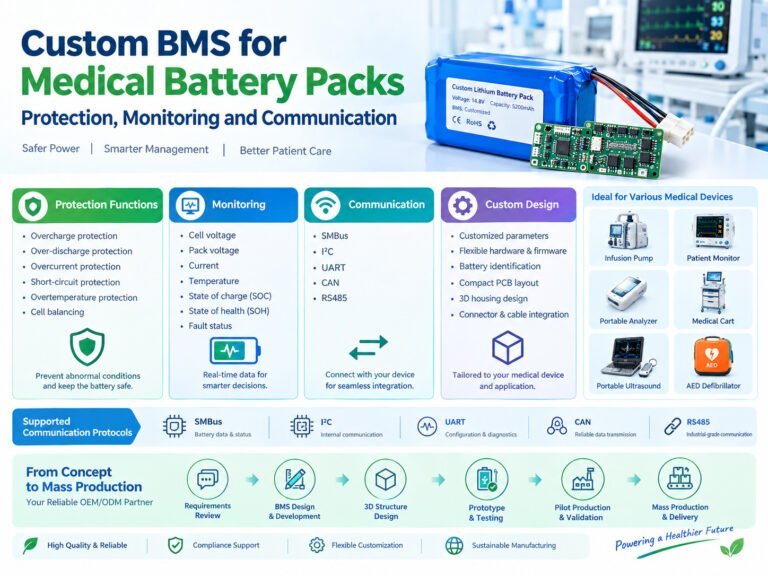
6. Custom BMS for LiFePO4 Battery Packs
The BMS is an important component of a custom LiFePO4 battery pack.
It monitors battery conditions and provides protection and management functions according to the battery design.
Les fonctions courantes d'un système de gestion de batterie (BMS) comprennent :
- Protection contre les surcharges
- Protection contre la surcharge
- Protection contre les surintensités
- Protection contre les courts-circuits
- Overtemperature protection
- Protection contre le froid
- Surveillance du potentiel cellulaire
- Pack voltage monitoring
- Current monitoring
- Équilibre cellulaire
- SOC estimation
- SOH estimation
- Communication
- Battery identification
Cell Voltage Monitoring
For a series-connected LFP battery, the BMS should monitor individual cell or cell-group voltage.
This allows the system to detect differences between cells rather than relying only on total pack voltage.
Équilibre cellulaire
Cells in a series battery pack can develop voltage differences due to variations in:
- Capacité
- Résistance interne
- Température
- Aging
- Charging behavior
A BMS can use balancing functions to manage these differences according to the battery design.
Contrôle de la température
Temperature sensors can be installed at appropriate locations within the battery pack.
The BMS can monitor temperature during:
- Charging
- Discharging
- Standby
- High-load operation
The battery management strategy should be determined according to the cell manufacturer’s specifications and the application requirements.
7. Smart BMS Communication for Industrial Equipment
Some LFP battery packs need to communicate with the equipment controller.
A custom BMS can support communication interfaces such as:
- CAN
- RS485
- UART
- SMBus
- I²C
The exact interface depends on the equipment architecture.
CAN Communication
CAN is commonly used in industrial control systems and mobile equipment.
A custom LFP battery BMS may transmit:
- Tension de la batterie
- Battery current
- SOC
- Température
- État des défauts
- État de charge
- Battery identification
- Capacité restante
For an AGV or AMR, the vehicle controller can use battery information to manage operating conditions and charging decisions.
RS485
RS485 can be used in certain industrial systems where communication between the battery and controller is required.
The protocol and data structure should be defined during the engineering stage.
Custom Communication Protocol
OEM customers may have an existing communication protocol.
In this situation, the BMS firmware may need to be adapted to match:
- Communication speed
- Data format
- Command structure
- Fault codes
- Battery identification
- SOC format
- État de charge
- Communication timeout
This is one area where a custom BMS can provide functionality that a standard battery cannot.
8. Custom LiFePO4 Battery Housing Design
Electrical specifications are only part of a battery design.
The battery also needs to fit the equipment.
A custom LFP battery housing may be designed according to:
- Longueur
- Largeur
- Hauteur
- Points de fixation
- Battery compartment
- Position du connecteur
- Cable outlet
- Handle
- Locking mechanism
- Installation direction
- Service requirements
3D Battery Design
3D modeling can help engineers verify the battery structure before prototype production.
A custom battery 3D design can include:
- Disposition des cellules
- BMS position
- Housing dimensions
- Emplacement du connecteur
- Acheminement des câbles
- Supports de fixation
- Fixing points
- Battery removal space
For equipment manufacturers with an existing battery compartment, providing a 3D model or mechanical drawing can help the battery supplier develop the pack around the available space.
9. Custom LiFePO4 Battery Pack for AGV and AMR
AGVs and AMRs are common applications for LFP battery systems.
These vehicles may operate for long periods and repeatedly accelerate, decelerate, stop, and start.
The battery design should therefore consider:
- Operating voltage
- Continuous current
- Peak current
- Horaires d'ouverture quotidiens
- Fréquence de recharge
- Mode de recharge
- Poids de la batterie
- Dimensions de la batterie
- Communication
- Température de fonctionnement
A custom BMS can communicate battery status to the AGV or AMR controller.
Depending on the system architecture, the battery may report:
- SOC
- Tension
- Actuel
- Température
- État des défauts
- Cycle information
For automated warehouse equipment, battery replacement and charging strategy should also be considered during the mechanical design stage.
10. Custom LiFePO4 Battery for Golf Carts
Golf carts may use LFP battery systems as an alternative to traditional lead-acid batteries.
A custom battery can be designed according to:
- Existing battery compartment
- Motor voltage
- Capacité requise
- Caractéristiques techniques du chargeur
- Poids de la batterie
- BMS requirements
- Display requirements
- Communication
For a golf cart conversion project, simply replacing a lead-acid battery with an LFP battery is not always sufficient.
The engineering team should verify:
- Battery voltage compatibility
- Charger compatibility
- Peak motor current
- Section du câble
- Connector rating
- BMS current capability
- Mechanical installation
- Battery mounting
A custom battery supplier can review these requirements before confirming the battery configuration.
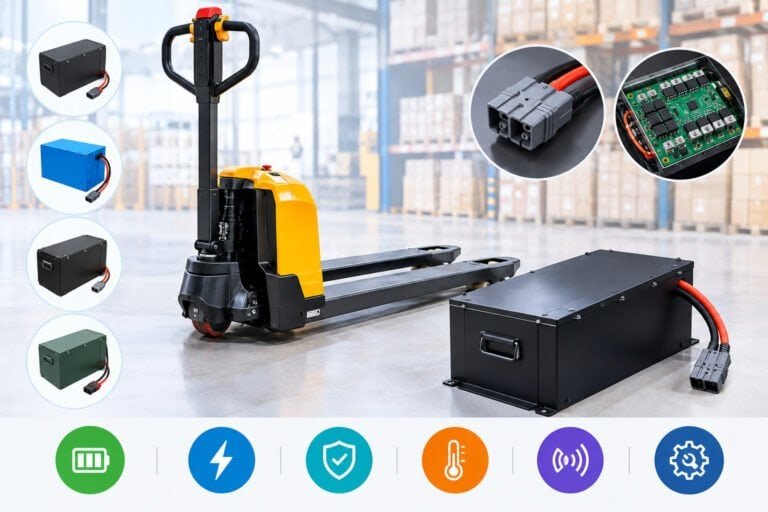
11. Custom LiFePO4 Battery for Forklifts and Pallet Trucks
Material-handling equipment can have demanding operating cycles.
Parmi les applications, on peut citer :
- Chariots élévateurs électriques
- Transpalettes
- Pallet jacks
- Walkie stackers
- Tow tractors
- Warehouse vehicles
A custom LFP battery for material-handling equipment may require:
- High capacity
- High discharge current
- Communication CAN
- Battery display
- Charging management
- Contrôle de la température
- Rugged housing
- Easy replacement
The battery structure may also need to withstand vibration and repeated handling.
For fleet applications, battery identification and SOC communication can help operators monitor battery status.
12. Custom LiFePO4 Battery for Robotics
Robots require a battery that fits within a defined mechanical envelope while supplying power to motors, controllers, sensors, and communication systems.
A custom robot battery may need to balance:
- Energy capacity
- Peak current
- Poids
- Dimensions
- Production de chaleur
- BMS functionality
- Communication
For mobile robots, the battery may also need to support quick replacement or charging.
A custom battery housing can be designed according to the robot’s internal structure.
The BMS can communicate battery information with the robot controller through the selected communication interface.
13. Custom LiFePO4 Marine Battery
Marine applications require additional attention to the operating environment.
A custom marine LFP battery may need to consider:
- Water exposure
- Humidité
- Vibrations
- Température
- Corrosion
- Installation location
- Boîtier de batterie
- Charging system
- Suivi
Depending on the application, the battery housing can incorporate appropriate sealing and mechanical protection.
For marine equipment, the complete battery system should be evaluated under the expected environmental conditions.
14. LiFePO4 Battery Testing
Custom LFP battery testing should cover both the battery itself and its integration with the equipment.
Electrical Testing
Les examens peuvent inclure :
- Open-circuit voltage
- Capacité
- Charge
- Décharge
- Résistance interne
- Actuel
- Cohérence de la tension
BMS Testing
BMS testing may verify:
- Protection contre les surcharges
- Protection contre la surcharge
- Protection contre les surintensités
- Protection contre les courts-circuits
- Protection de la température
- Équilibre cellulaire
- Communication
- SOC reporting
Mechanical Testing
Depending on the application, mechanical testing may include:
- Vibrations
- Impact
- Connector retention
- Housing strength
- Installation and removal
- Cable durability
Essais environnementaux
The test program may include:
- High-temperature operation
- Fonctionnement à basse température
- Temperature cycling
- Storage testing
- Humidity exposure
- Water-resistance testing where applicable
The exact testing requirements should be established according to the battery design, equipment application, and target market.
15. LiFePO4 Battery Charging Design
Charging parameters are important because LFP batteries use a different charging voltage profile from other lithium-ion chemistries.
The charger should be compatible with:
- Chimie des batteries
- Series configuration
- Tension de charge
- Courant de charge
- BMS
- Equipment power system
For example, a typical 16S LFP battery has a nominal voltage of approximately 51.2V, while its full-charge voltage may be around 58.4V when using a 3.65V maximum cell voltage.
Therefore, the charger must be selected according to the battery’s specified charging requirements.
A battery supplier should review the charger and battery as a complete system during an OEM/ODM project.
16. LiFePO4 Battery Operating Temperature
Temperature affects battery performance, charging, and service life.
The actual operating range depends on the selected cell and battery design.
Parmi les facteurs importants, on peut citer :
- Température de charge
- Température de décharge
- Température de stockage
- BMS temperature thresholds
- Heating requirements
- Exigences en matière de refroidissement
For equipment used in cold environments, the battery design may require additional temperature management.
Possible solutions can include:
- Capteurs de température
- Heating elements
- Insulated housing
- BMS temperature control
- Low-temperature charging protection
The final solution should be based on the cell manufacturer’s specifications and the equipment’s operating conditions.
17. Custom LiFePO4 Battery OEM/ODM Development Process
A structured development process helps convert the equipment requirements into a production battery.
Étape 1 : Analyse des besoins
The customer provides:
- Equipment application
- Tension
- Capacité
- Runtime
- Continuous current
- Peak current
- Dimensions
- Weight requirements
- Connecteur
- Mode de recharge
- Exigences en matière de communication
- Environnement opérationnel
Étape 2 : Sélection des cellules
The supplier evaluates suitable LFP cells according to:
- Capacité
- Actuel
- Taille
- Température
- Cycle requirements
- Supply availability
Step 3: Battery Configuration
The engineering team determines:
- Series connection
- Parallel connection
- Total capacity
- Plage de tension
- Current capability
Step 4: BMS Design
The BMS is selected, configured, or developed according to:
- Configuration des cellules
- Protection requirements
- Communication
- Contrôle de la température
- Balancing
- SOC requirements
Step 5: 3D Structural Design
The battery housing and internal layout are developed around the equipment.
Step 6: Prototype Production
Samples are manufactured for:
- Contrôles électriques
- Mechanical verification
- Tests du système de gestion de la batterie (BMS)
- Equipment integration
Step 7: Equipment-Level Validation
The battery is installed into the actual equipment.
Engineers can evaluate:
- Runtime
- Charging
- Peak load
- Communication
- Température
- Installation
- Remplacement de la batterie
Step 8: Design Optimization
Based on test results, the supplier may adjust:
- Configuration des cellules
- BMS
- Housing
- Connecteur
- Cable
- Charging parameters
Step 9: Pilot Production
A pilot batch verifies the production process and inspection standards.
Step 10: Mass Production
After approval, the battery enters regular production according to the approved specifications and quality requirements.
18. How to Choose a Custom LiFePO4 Battery Manufacturer
When evaluating an LFP battery manufacturer, look beyond the battery quotation.
Check Cell Selection Capability
Ask whether the supplier can recommend cells according to the application’s voltage, capacity, current, temperature, and space requirements.
Check BMS Development Capability
Ask whether the supplier can customize:
- Protection parameters
- Communication
- SOC
- Contrôle de la température
- Équilibre cellulaire
- Battery identification
Check Mechanical Design Capability
Ask whether the supplier can provide:
- Custom housing
- 3D design
- Mounting structure
- Connector placement
- Cable customization
Check Prototype Capability
A supplier should be able to produce engineering samples before mass production.
Check Testing Capability
Ask what testing is performed on:
- Cells
- BMS
- Battery packs
- Finished products
Check Production Capability
The supplier should be able to explain its process for:
- Cell assembly
- Soudage
- Installation du système de gestion de batterie (BMS)
- Programming
- Aging
- Contrôle final
- Emballage
Check Documentation
Depending on the application and market, relevant documents may include:
- Battery specification
- Cell datasheet
- BMS specification
- UN 38.3 test summary
- SDS/MSDS
- Safety test reports
- Compliance documentation
- Inspection records
The applicability of specific standards and documents should be confirmed for the final battery design.
19. Custom LiFePO4 Battery Packs from Yi Zhan
Dongguan Yizhan Electronics Technology Co., Ltd. provides LiFePO4 battery pack OEM/ODM services for industrial equipment and other specialized applications.
The company can work with customers on battery requirements including:
- Tension
- Capacité
- Configuration des cellules
- BMS
- Communication
- Housing
- Connecteur
- Cable
- 3D structure
- Tests
- Emballage
Custom LFP Battery Configuration
Battery configurations can be developed according to the equipment’s voltage and capacity requirements.
Potential applications include:
- AGV
- AMR
- Robots industriels
- Voiturettes de golf
- Chariots élévateurs
- Transpalettes
- Tow tractors
- Équipement maritime
- Stockage d'énergie
- Industrial cleaning equipment
BMS sur mesure
The BMS can be designed or configured according to the battery’s electrical requirements.
Functions may include:
- Cell monitoring
- Voltage protection
- Current protection
- Contrôle de la température
- Équilibre cellulaire
- SOC
- Communication
The final BMS functions and parameters are confirmed according to the project requirements.
Custom 3D Design
For equipment with limited battery space, the battery structure can be developed around the customer’s mechanical requirements.
The engineering process can include:
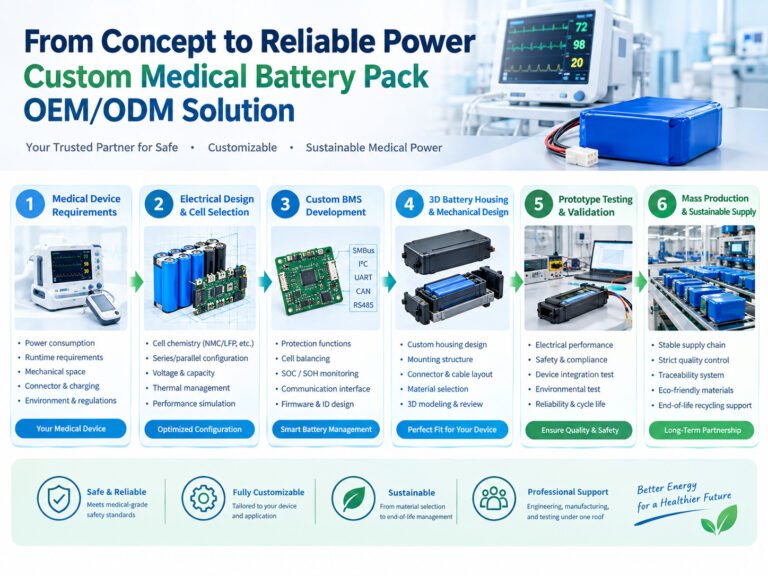
Requirement → Battery Configuration → BMS Design → 3D Design → Prototype → Testing → Production
This allows the battery supplier to address electrical and mechanical requirements within the same development process.
OEM/ODM Manufacturing
For OEM/ODM projects, the development process can include technical consultation, battery design, prototype development, testing, pilot production, and mass manufacturing.
This approach is suitable for equipment manufacturers that need a battery pack designed specifically for their product rather than a standard LFP battery.
20. FAQ About Custom LiFePO4 Battery Packs
What is a custom LiFePO4 battery pack?
A custom LiFePO4 battery pack is an LFP battery designed according to a specific device’s voltage, capacity, current, dimensions, BMS, connector, communication, and installation requirements.
What voltages can be customized for LiFePO4 batteries?
LFP battery packs can be configured for different voltage levels by changing the number of cells connected in series. Common configurations include 12.8V, 25.6V, 51.2V, and other application-specific voltages.
Can the BMS be customized?
Yes. Depending on the project, BMS functions such as protection, cell balancing, temperature monitoring, SOC, battery identification, and communication can be customized or configured.
Can LiFePO4 batteries support CAN communication?
Yes. A suitable BMS can support CAN communication when required by the equipment architecture.
Can the LiFePO4 battery housing be customized?
Yes. The housing can be designed according to the equipment’s available space, mounting method, connector position, and battery replacement requirements.
Can I order a 24V LiFePO4 battery pack?
Yes. A common LFP configuration for a 24V-class battery is 8S, with a nominal voltage of approximately 25.6V.
Can I order a 48V LiFePO4 battery pack?
Yes. A common LFP configuration for a 48V-class battery is 16S, with a nominal voltage of approximately 51.2V.
Are LiFePO4 batteries suitable for AGVs?
LFP batteries can be used in AGV applications. The battery should be designed according to the AGV’s voltage, current, operating cycle, charging method, dimensions, weight, and communication requirements.
Are LiFePO4 batteries suitable for forklifts?
LFP battery systems can be designed for electric forklifts and other material-handling equipment. The battery configuration should account for motor current, operating cycle, charging requirements, installation space, and BMS functions.
How do I start a custom LiFePO4 battery project?
Provide the equipment application, required voltage, capacity, current, dimensions, connector, charging method, and operating environment. A battery engineering team can then evaluate the battery configuration and BMS requirements.
Conclusion
Custom LiFePO4 battery development involves much more than selecting an LFP cell with a suitable capacity.
The complete battery system needs to be designed around the equipment’s electrical and mechanical requirements.
Parmi les facteurs importants à prendre en compte lors de la conception, on peut citer :
- Chimie cellulaire
- Configuration des cellules
- Tension
- Capacité
- Courant de décharge
- BMS
- Communication
- Charging
- Température
- Housing
- Connecteur
- Tests
- Production
For OEM/ODM projects, customization capability is particularly important when the equipment has a specific battery compartment, communication protocol, current requirement, or battery replacement system.
A battery manufacturer with cell selection, BMS development, 3D structural design, prototype production, testing, and mass manufacturing capabilities can support the battery development process from initial requirements through production.
For AGVs, AMRs, forklifts, golf carts, robots, marine equipment, energy storage systems, and other industrial applications, a custom LiFePO4 battery pack can be developed according to the equipment’s actual operating requirements.
The starting point is not simply choosing a battery capacity. It is defining how the battery needs to work with the complete equipment system.
 English
  Chinese
  Japanese
  German
  French
  Korean
