
With the rapid development of smart manufacturing, intelligent warehousing, and automated material handling, AGVs (Automated Guided Vehicles) have increasingly higher requirements for battery systems. Compared with standard batteries, customized lithium battery solutions are usually more suitable for AGV applications because AGVs require batteries that match their specific structure, operating time, load capacity, electrical system, and working environment.
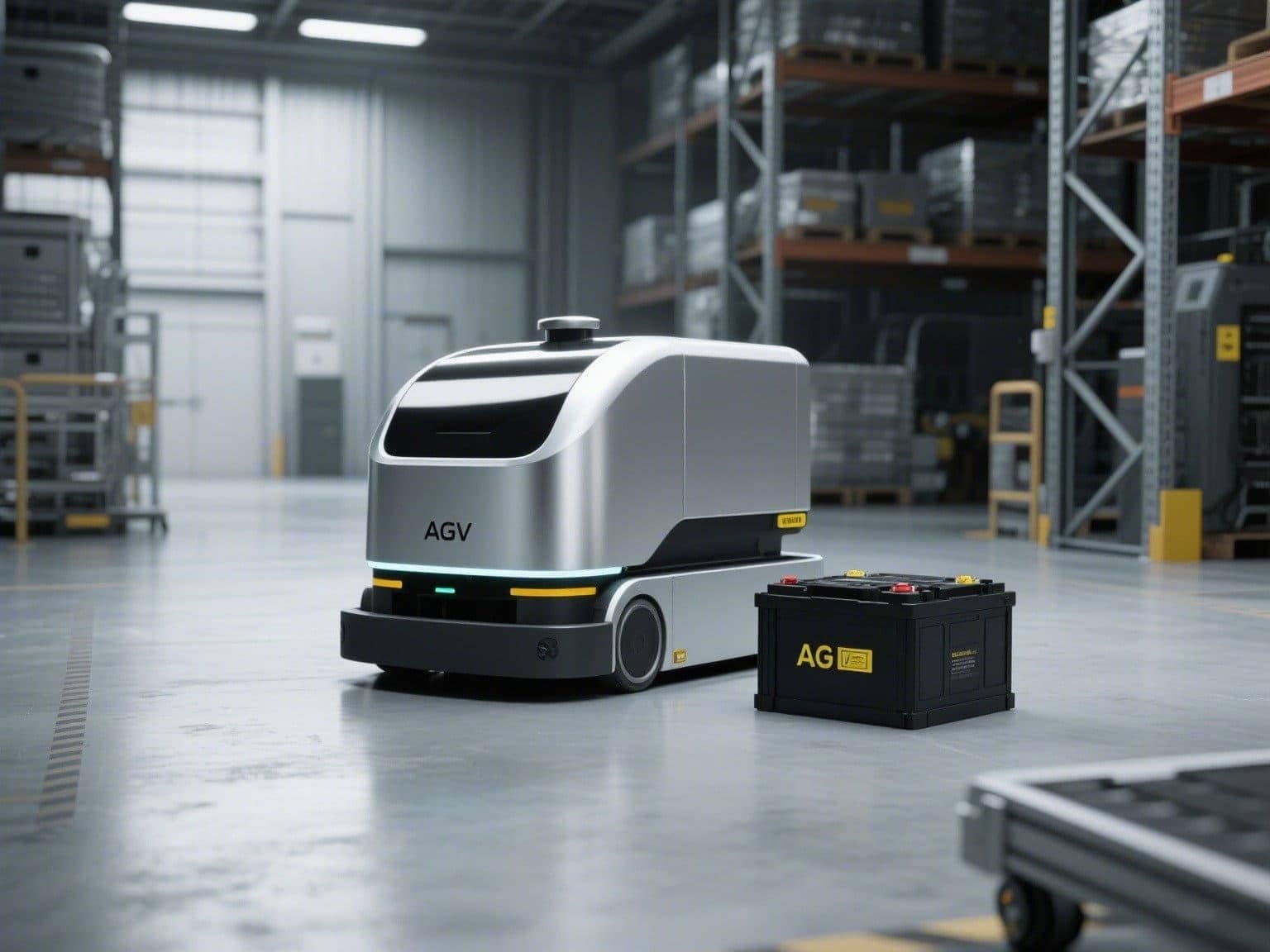
Part 1. Why Do AGVs Require Customized Battery Solutions?
AGVs are not standardized devices. Different application scenarios have different battery requirements, including:
- Warehouse transportation AGVs
- Logistics handling AGVs
- Heavy-duty forklift AGVs
- Medical delivery robots
- Factory production line AMRs
- Cold storage AGVs
Each application requires different battery specifications.
| Requirements | Batterie standard | Customized Lithium Battery |
|---|---|---|
| Adaptation de la tension | Fixed specifications | Designed according to system requirements |
| Capacity selection | Limited options | Precisely matched to applications |
| Espace d'installation | Standard dimensions | Customized battery structure |
| Protocole de communication | Basic interface | CAN/RS485 and other options |
| Environnement de travail | General conditions | Low-temperature, waterproof, dustproof designs |
| Durée du cycle | General design | Optimized for specific working conditions |
AGVs may operate continuously for 8–24 hours per day with frequent charging and discharging cycles. Therefore, the battery is not only a power source but also a key component affecting overall equipment efficiency.
Part 2. Customized Batteries Improve AGV Operating Time
One of the most important concerns for AGVs is:
How long can the vehicle operate on a single charge?
A customized battery solution can be designed according to:
- AGV load weight
- Puissance du moteur
- Horaires de travail
- Driving speed
- Fréquence de recharge
The battery system can be optimized by selecting the appropriate:
- Voltage (24V / 36V / 48V / 72V)
- Capacité (Ah)
- Chimie des batteries
- Discharge rate
For example, if a warehouse AGV operates 16 hours per day, an undersized battery may require frequent charging, reducing equipment utilization.
A customized solution can increase energy capacity and optimize battery performance, helping reduce downtime and improve operational efficiency.
Part 3. Customized Battery Dimensions Fit AGV Designs Better
AGV internal space is often limited.
Standard batteries may have issues such as:
- Incompatible dimensions
- Improper mounting positions
- Unbalanced weight distribution
- Restrictions on equipment design
Customized lithium battery packs can be designed based on AGV structures, including:
- Compact rectangular battery packs
- Slim battery designs
- Slide-in battery packs
- Quick-change battery systems
- Bottom-mounted battery solutions
This allows OEM manufacturers to maximize available space inside the vehicle.
Part 4. Customized BMS Improves AGV Reliability
Since AGVs often operate automatically without human supervision, the Battery Management System (BMS) plays a critical role.
A customized BMS can provide:
Battery Protection Functions
- Protection contre les surcharges
- Protection contre la surcharge
- Protection contre les surintensités
- Protection contre les courts-circuits
- Protection contre les températures élevées/basses
Smart Communication Functions
Support:
- CAN
- CAN FD
- RS485
- UART
- Modbus
The AGV control system can monitor real-time battery information, including:
- SOC (état de charge)
- SOH (état de santé)
- Tension
- Actuel
- Température
- Fault alerts
This enables intelligent energy management and predictive maintenance.
Part 5. Customized Battery Cells Meet High-Frequency AGV Operation
AGVs are designed for frequent and continuous operation.
General consumer lithium batteries may not meet requirements such as:
- Longues heures de fonctionnement
- High-frequency cycling
- Sortie à courant élevé
Industrial AGV batteries usually use:
LiFePO4 Battery Technology
Avantages :
✅ Long cycle life
✅ Good thermal stability
✅ High discharge capability
✅ Suitable for industrial applications
Common applications:
- AGV
- Robots AMR
- Automated forklifts
- Smart logistics equipment
NMC Lithium Battery Technology
Avantages :
✅ Higher energy density
✅ Format compact
✅ Lower weight
Convient pour :
- Space-limited robots
- Mobile automation equipment
Part 6. Customized Batteries Support Challenging Industrial Environments
Many AGVs operate in demanding environments.
Cold Storage AGVs
Require:
- Low-temperature discharge performance
- Systèmes de chauffage
- Anti-condensation design
Some customized solutions can operate in temperatures as low as -20°C or below.
Factory AGVs
Require:
- Protection contre la poussière
- Résistance aux chocs
- Étanchéité
Battery packs can be designed with:
- IP65
- IP67
- IP68 protection ratings
to improve reliability in harsh environments.
Part 7. Customized Batteries Enable Automatic Battery Swapping
Modern AGV systems increasingly adopt:
- Automatic charging
- Fast battery replacement
- Systèmes à double batterie
Customized battery solutions can include:
- Quick connectors
- Battery locking structures
- Hot-swappable designs
- Battery identification systems
When battery power is low, the AGV can automatically return to a charging station or replacement station, reducing downtime.
Part 8. Key Parameters When Selecting Customized AGV Batteries
OEM manufacturers should evaluate the following factors when selecting an AGV battery supplier.
Electrical Parameters
- Rated voltage
- Capacité nominale
- Courant de décharge continu maximal
- Courant de décharge maximal
Mechanical Parameters
- Dimensions de la batterie
- Méthode d'installation
- Weight limitations
Intelligent Battery Management
- BMS communication protocol
- Data monitoring capability
- Software compatibility
Certifications de sécurité
Les certifications les plus courantes sont les suivantes
- UN38.3
- IEC 62133-2
- CE
- RoHS
- UL-related certifications
Part 9. Standard Battery vs Customized AGV Battery
| Comparaison | Standard Lithium Battery | Customized AGV Battery |
|---|---|---|
| Development time | Plus rapide | Requires engineering design |
| Initial cost | Inférieur | Adjusted according to requirements |
| Compatibilité | Général | Highly optimized |
| Performances | Standard application | Designed for specific conditions |
| Gestion intelligente | Basic functions | Advanced monitoring options |
| Future upgrades | Limitée | Flexible expansion |
For AGV OEM manufacturers, customized battery solutions are usually more suitable for achieving long-term stable operation and improving product competitiveness.
Conclusion: Customized Lithium Battery Solutions Are a Better Choice for AGVs
AGVs are highly integrated automation systems, and their batteries must work together with:
- Motor systems
- Systèmes de contrôle
- Mechanical structures
- Working environments
- Operating schedules
A customized lithium battery solution can help AGVs achieve:
- Durée de fonctionnement plus longue
- Fiabilité améliorée
- Enhanced safety
- Better system integration
- Réduction des temps d'arrêt
For AGV, AMR, automated forklift, and smart logistics equipment manufacturers, selecting a lithium battery supplier with capabilities in cell selection, PACK design, BMS development, testing, and certification support can help create reliable battery solutions for industrial applications.
Dongguan Yizhan Electronics Technology Co., Ltd. (FirstPower) provides customized lithium battery PACK solutions for AGV and AMR applications, supporting 24V–72V systems, battery cell selection, intelligent BMS development, structural design, and mass production.
 English
  Chinese
  Japanese
  German
  French
  Korean
