
Battery pack design starts with the electrical requirements of the application. Voltage, capacity, discharge current, operating time, available installation space, charging requirements, and battery management all affect the final configuration.
Two basic electrical connection methods are used in lithium battery packs: series connection und parallel connection. Series connections increase the battery pack voltage, while parallel connections increase capacity and current capability.
For engineers and equipment manufacturers, understanding the difference between series and parallel connections is important when developing a custom lithium battery pack.
This article explains how series and parallel battery configurations work, how to calculate voltage and capacity, how series-parallel configurations are designed, and how BMS selection relates to the battery structure.
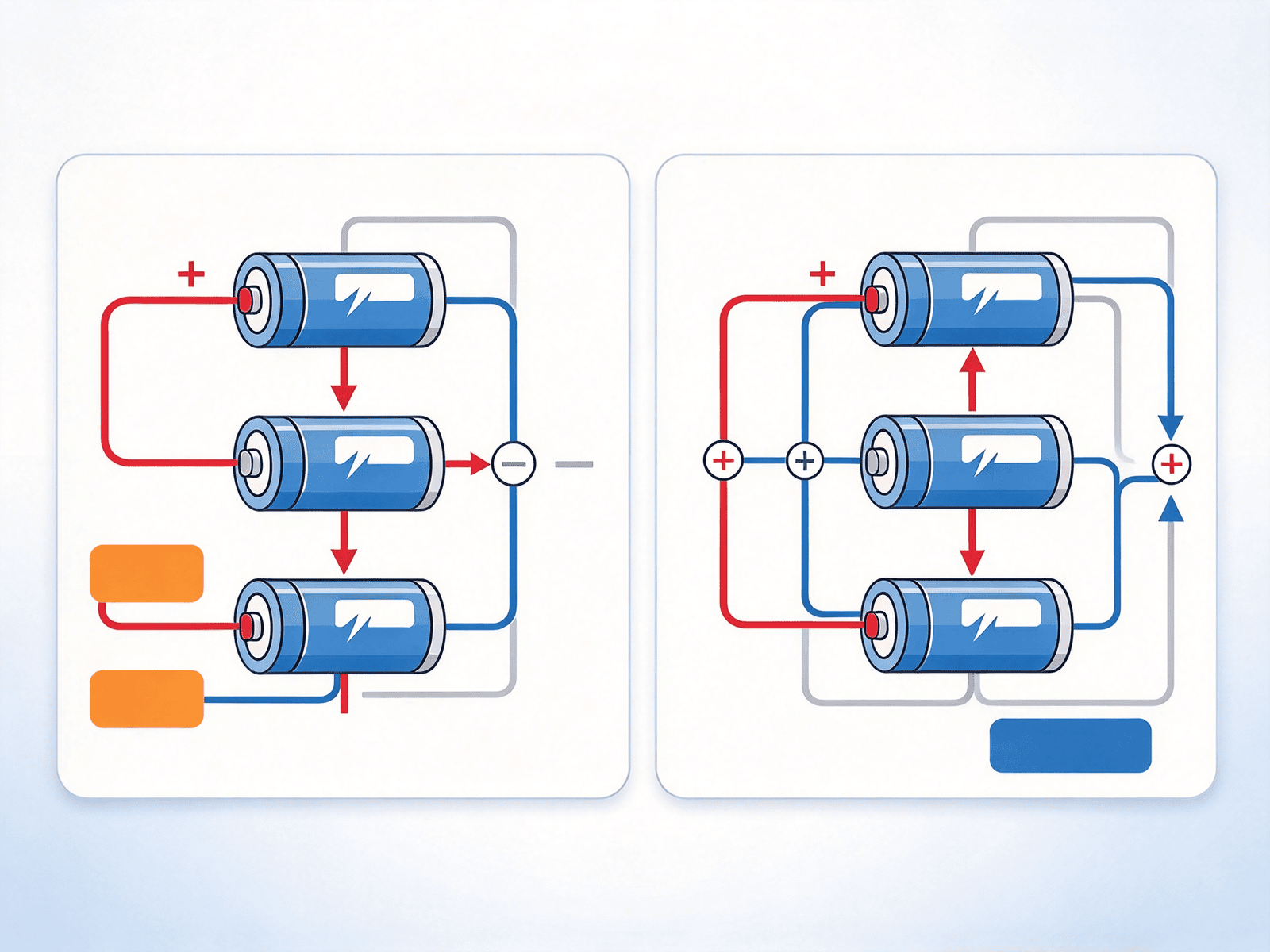
What Is a Series Battery Connection?
A series battery connection connects the positive terminal of one cell or battery to the negative terminal of another.
The voltage of each connected unit adds together, while the Ah capacity remains based on the capacity of one parallel group.
For example, four lithium-ion cells rated at 3.7V and 5Ah can be connected in series:
3.7V × 4 = 14.8V
The resulting battery configuration is:
14.8V 5Ah
The capacity does not become 20Ah because the cells are connected in series rather than parallel.
A simplified series connection looks like this:
(-) Cell 1 (+) → (-) Cell 2 (+) → (-) Cell 3 (+) → (-) Cell 4 (+)The total voltage is determined by the number of cells or cell groups connected in series.
What Does “S” Mean in a Battery Pack?
In battery terminology, S represents the number of series-connected cells or cell groups.
Zum Beispiel:
- 10S = 10 cells or parallel groups connected in series
- 13S = 13 cells or parallel groups connected in series
- 16S = 16 cells or parallel groups connected in series
- 20S = 20 cells or parallel groups connected in series
For a standard 3.7V nominal lithium-ion cell:
13S × 3.7V = 48.1V nominal
This is commonly referred to as a 48V-class battery pack.
However, the actual voltage range depends on the cell chemistry and charging voltage. Therefore, battery design should not rely only on the nominal voltage printed on a product specification.
What Is a Parallel Battery Connection?
A parallel battery connection connects positive terminals together and negative terminals together.
The voltage remains based on one cell or one series group, while the capacity increases according to the number of parallel cells.
For example, four 3.7V 5Ah cells connected in parallel provide:
3.7V 20Ah
The configuration can be described as 1S4P.
A simplified parallel connection looks like this:
        (+) Cell 1 (-)
         |         |
        (+) Cell 2 (-)
         |         |
        (+) Cell 3 (-)
         |         |
        (+) Cell 4 (-)
All positive terminals are connected together, and all negative terminals are connected together.
What Does “P” Mean in a Battery Pack?
P represents the number of cells connected in parallel within a group.
Zum Beispiel:
- 1P = one cell per parallel group
- 2P = two cells per parallel group
- 4P = four cells per parallel group
- 8P = eight cells per parallel group
If each cell has a capacity of 5Ah:
4P = 5Ah × 4 = 20Ah
The voltage of the parallel group remains the same as the individual cell.
Series vs. Parallel Battery Connections
The main difference can be summarized as follows:
| Konfiguration | Spannung | Kapazität | Main Function |
|---|---|---|---|
| Series | Increases | Remains based on parallel group | Meet voltage requirements |
| Parallel | Remains based on series group | Increases | Meet capacity and current requirements |
| Series + Parallel | Increases | Increases | Build a battery pack around system requirements |
For a custom battery pack, engineers often combine both methods.
This creates a series-parallel battery configuration.
What Is a Series-Parallel Battery Pack?
A series-parallel configuration combines cells into parallel groups and then connects those groups in series.
For example, a 13S4P battery configuration contains:
- 13 series groups
- 4 cells in parallel within each group
- 52 cells in total
If each cell is:
3.7V, 5Ah
The nominal battery pack specification is approximately:
48.1V 20Ah
Berechnung:
Voltage = 3.7V × 13 = 48.1V
Capacity = 5Ah × 4 = 20Ah
Total cells = 13 × 4 = 52 cells
This configuration can be used as a starting point for applications that require a 48V-class battery with a 20Ah capacity.
The actual battery design also needs to consider cell discharge capability, thermal conditions, BMS current rating, charger specifications, mechanical structure, wiring, connectors, and equipment communication requirements.
How to Calculate Battery Pack Energy
Voltage and Ah capacity are important, but they do not directly represent the total energy stored in a battery.
Battery energy is commonly expressed in watt-hours:
Wh = V × Ah
For a 48.1V 20Ah battery:
48.1V × 20Ah = 962Wh
Therefore, the nominal energy is approximately 962Wh.
For practical applications, usable energy can be affected by:
- Discharge cutoff voltage
- BMS-Schutz-Einstellungen
- Entladungsstrom
- Betriebstemperatur
- Zelleigenschaften
- Battery age
- Systemeffizienz
- Required reserve capacity
For this reason, the nominal Wh value should not automatically be treated as the actual runtime available to equipment.
Series Connection and BMS Design
Series-connected lithium battery packs require a BMS designed for the corresponding series configuration.
Zum Beispiel:
- 10S battery → 10S BMS
- 13S battery → 13S BMS
- 16S battery → 16S BMS
- 20S battery → 20S BMS
A BMS can monitor cell or group voltage and provide protection functions such as:
- Schutz vor Überladung
- Schutz vor Überentladung
- Überstromschutz
- Kurzschlussschutz
- Temperaturschutz
- Zellausgleich
For industrial battery packs, the BMS may also support communication interfaces such as:
- CAN
- UART
- RS485
The communication protocol needs to be compatible with the equipment controller or charging system when communication is required.
Why Cell Matching Matters in Series Battery Packs
When multiple cells are connected in series, the cells operate as part of the same electrical system.
Differences in cell capacity, internal resistance, voltage, and aging behavior can affect pack performance.
A battery manufacturer may evaluate parameters such as:
- Cell capacity
- Innerer Widerstand
- Open-circuit voltage
- Production batch
- Cell chemistry
- Cycle history
- Temperature behavior
Cell matching is particularly relevant for battery packs containing many series-connected cells.
For custom lithium battery production, the cell selection process should be defined according to the required voltage, capacity, current, cycle requirements, temperature range, and application.
Series and Parallel Connections for Different Applications
Different equipment has different battery requirements.
E-Bike Battery Packs
E-bikes commonly use lithium-ion battery packs in configurations designed around system voltage, motor power, available frame space, and required riding range.
A 48V-class e-bike battery may use a configuration such as 13S with an appropriate number of parallel cells.
The battery design may also include:
- Custom housing
- Mounting rail
- Anschluss
- Intelligente BMS
- Kommunikationsschnittstelle
- Anschluss zum Aufladen
- Battery indicator
- Mechanical locking system
The final configuration should match the e-bike controller and charger.
AGV and AMR Batteries
Automated guided vehicles and autonomous mobile robots may require battery packs with specific voltage, capacity, discharge current, communication, and charging requirements.
A custom series-parallel configuration allows the battery manufacturer to design the pack around the available battery compartment.
BMS communication can also be integrated with the vehicle control system when required.
Golfwagen-Batterien
Golf carts require battery systems designed around motor voltage, operating time, charging equipment, installation dimensions, and discharge current.
Lithium iron phosphate (LiFePO4) chemistry is used in many industrial and mobility battery applications.
The battery pack configuration depends on the required system voltage and energy capacity.
Industrieausrüstung
Forklifts, pallet trucks, cleaning machines, medical equipment, backup power systems, and other industrial devices can require different battery architectures.
A battery pack manufacturer may design the series-parallel configuration based on:
Equipment voltage + required Ah + discharge current + installation space + BMS requirements
Series vs. Parallel: Common Design Mistakes
Understanding S and P values is only the first step in battery pack design.
Several technical factors should be checked before production.
1. Using Cells With Different Specifications
Cells with different capacities, chemistries, or electrical characteristics should not simply be combined into one battery pack.
The cell specification needs to be consistent with the intended configuration.
2. Selecting the BMS Only by Voltage
A BMS is not selected only according to nominal voltage.
The design should also consider:
- Series count
- Kontinuierlicher Entladestrom
- Spitzenstrom
- Ladestrom
- Temperatursensoren
- Kommunikation
- Protection thresholds
- Balancing requirements
3. Ignoring Peak Current
A device may have a normal operating current and a much higher startup or acceleration current.
Motors, AGVs, robots, power tools, and other equipment can generate short-duration current peaks.
The battery cells, BMS, wiring, connectors, and protection devices all need to support the intended operating conditions.
4. Focusing Only on Ah
A battery with the required Ah rating may still be unsuitable if the voltage, current, physical dimensions, or communication protocol does not match the equipment.
Battery selection should consider the complete electrical and mechanical system.
How to Choose Between Series and Parallel
The design process normally starts with the equipment requirements rather than the number of cells.
Step 1: Confirm System Voltage
Determine the equipment’s required operating voltage and acceptable voltage range.
Step 2: Confirm Energy Requirement
Estimate the required operating time and calculate the required nominal energy.
Step 3: Confirm Discharge Current
Check continuous and peak current requirements.
Step 4: Select Cell Chemistry
Depending on the application, the design may use lithium-ion, LiFePO4, or another suitable chemistry.
Step 5: Determine S/P Configuration
The series count establishes the voltage range.
The parallel count establishes capacity and contributes to current capability.
Step 6: Design the BMS
The BMS should match the series count and electrical requirements.
Step 7: Design the Mechanical Structure
The battery housing, connectors, mounting structure, cable routing, thermal management, and protection components should fit the equipment.
Step 8: Test the Battery Pack
Die Tests können Folgendes umfassen:
- Prüfung der Kapazität
- Prüfung von Ladung und Entladung
- Prüfung des BMS-Schutzes
- Prüfung der Spannungskonstanz
- Temperaturprüfung
- Alterungsprüfung
- Kommunikationstests
- Mechanical inspection
Custom Series-Parallel Lithium Battery Pack Design
A custom lithium battery pack is not simply a group of cells connected together.
The electrical architecture, cell selection, BMS, mechanical structure, charging system, thermal management, and protection design need to work as one system.
Unter Dongguan Yizhan Electronics Technology Co, Ltd., custom lithium battery pack development can be based on the requirements of the target equipment.
The design process can include:
Requirement Analysis → Electrical Design → Cell Selection → BMS Design → 3D/Structural Design → Prototype → Testing → Mass Production
Customers can provide information such as:
- Gerätetyp
- Erforderliche Spannung
- Erforderliche Kapazität
- Motor or equipment power
- Kontinuierlicher Entladestrom
- Spitzenableitstrom
- Installation dimensions
- Connector information
- Kommunikationsprotokoll
- Charger specification
- Expected quantity
Photos of the equipment and original battery can also help engineers evaluate the mechanical and electrical requirements.
For OEM and ODM battery projects, the S/P configuration can then be developed according to the actual application requirements.
FAQ: Series and Parallel Battery Connections
Does series connection increase battery capacity?
No. Series connection increases voltage. The Ah capacity remains based on the capacity of each parallel group.
Does parallel connection increase voltage?
Normally, no. Parallel connection keeps the voltage at the level of the connected cell or series group while increasing capacity.
What does 13S4P mean?
13S4P means 13 series-connected groups, with 4 cells connected in parallel within each group.
Is a 48V battery always the same?
No. Two batteries labeled as 48V may have different cell configurations, capacities, discharge currents, BMS functions, connectors, dimensions, and communication protocols.
Can batteries with different capacities be connected in parallel?
Battery packs should not be connected together simply because their nominal voltage is the same. Cell chemistry, voltage, state of charge, internal resistance, BMS behavior, and electrical specifications need to be considered.
How do I calculate battery energy?
Use the nominal voltage multiplied by the nominal Ah capacity:
Wh = V × Ah
The result represents nominal energy, while actual usable energy depends on operating conditions and system design.
Schlussfolgerung
Series and parallel connections serve different functions in lithium battery pack design.
Series configuration establishes battery voltage. Parallel configuration establishes capacity and supports the required current capability.
Most custom lithium battery packs use a combination of series and parallel connections to meet the electrical requirements of the target equipment.
However, the S/P configuration is only one part of the engineering process. Cell selection, BMS design, charging requirements, thermal management, mechanical structure, connectors, communication, and testing also need to be considered.
For an OEM/ODM battery project, providing the equipment voltage, capacity, power, current, dimensions, connector, and original battery information gives the battery manufacturer the technical information needed to evaluate the appropriate battery architecture.


 English
  Chinese
  Japanese
  German
  French
  Korean
