
Trolling motors are widely used on fishing boats, recreational boats, kayaks, and other small electric boats. As the main power source for a trolling motor, the battery’s voltage, capacity, discharge performance, and weight can all affect the overall boating experience.
Today, the two main battery options for trolling motors are lead-acid batteries and lithium batteries. Deep-cycle lead-acid batteries have been used in marine applications for many years, while lithium batteries, particularly LiFePO4 batteries, are increasingly being used for trolling motors and small marine propulsion systems.
So, what are the differences between lead-acid and lithium batteries for trolling motors? Which type is more suitable for different applications? This article compares the two technologies in terms of voltage, capacity, weight, discharge performance, charging, cycle life, and maintenance.
What Is a Trolling Motor Battery?
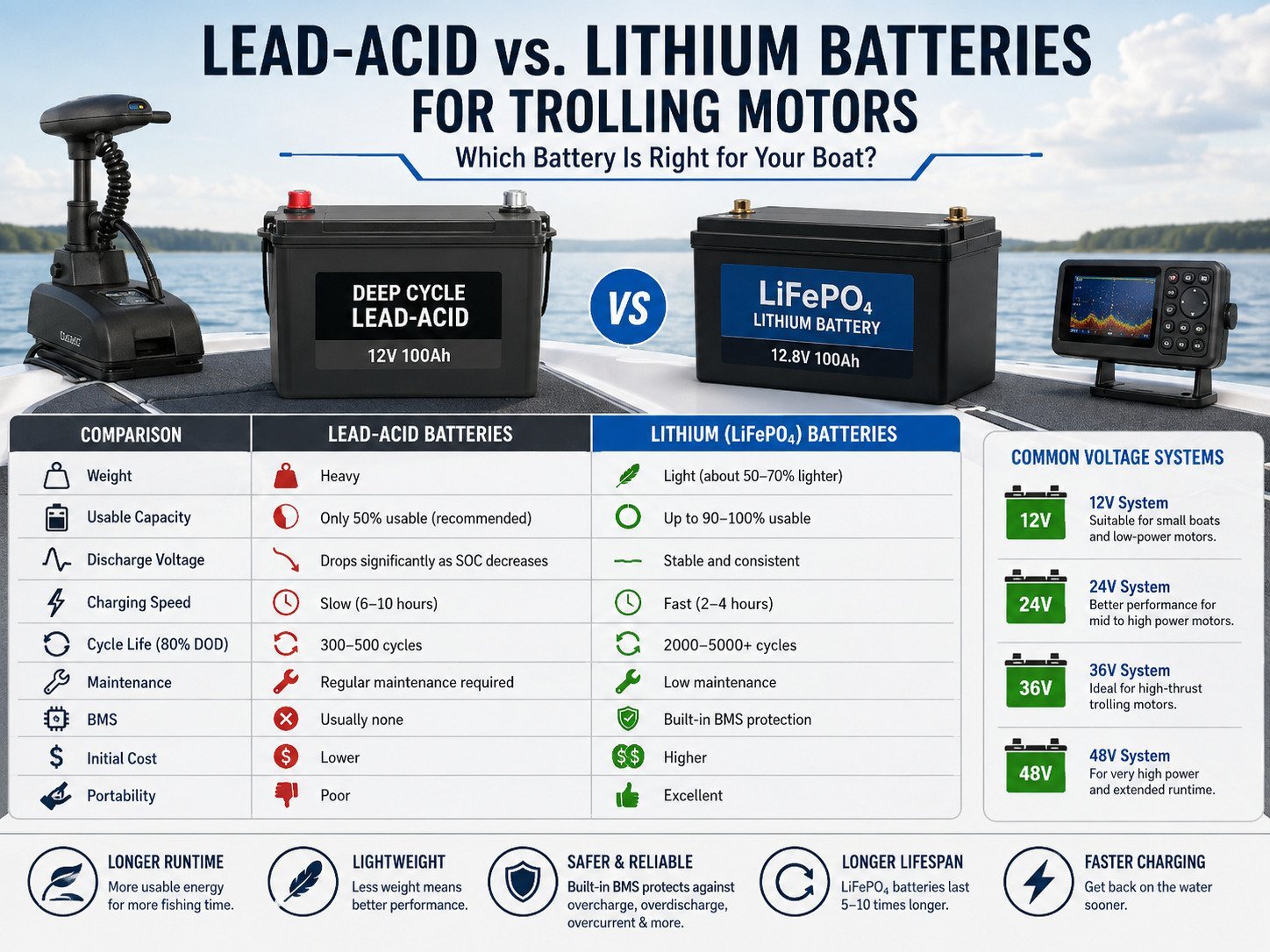
A trolling motor typically uses a DC battery system. Depending on the motor’s rated voltage, common systems include 12V, 24V, and 36V. Some higher-power systems may also use 48V.
Zum Beispiel:
- 12V trolling motors generally use a 12V battery system.
- 24V trolling motors generally use a 24V battery system.
- 36V trolling motors generally use a 36V battery system.
- 48V trolling motors require a compatible 48V battery system.
Battery capacity is normally measured in ampere-hours (Ah). For example, a 12V 100Ah battery has approximately 1.2kWh of nominal energy.
However, runtime cannot be determined by Ah alone. Motor power, operating speed, boat weight, water conditions, wind, and actual usable battery capacity can all affect runtime.
Therefore, selecting a trolling motor battery requires consideration of voltage, capacity, continuous discharge current, and operating conditions.
Part 1.Lead-Acid Batteries for Trolling Motors
Deep-cycle lead-acid batteries have traditionally been used as power sources for trolling motors. Common types include AGM, gel, and other deep-cycle lead-acid batteries.
Lead-acid batteries have mature technology, broad market availability, and generally lower initial purchase costs.
Advantages of Lead-Acid Batteries
Lead-acid batteries can still be suitable for trolling motors that are used occasionally or for relatively short periods.
First, lead-acid battery technology is well established and replacement batteries are widely available.
Second, the initial purchase cost is generally lower than that of a lithium battery with a similar nominal energy rating.
Lead-acid batteries also have established charging and operating methods, and many traditional marine systems are already designed around this battery technology.
Limitations of Lead-Acid Batteries
One of the main characteristics of lead-acid batteries is their relatively high weight.
For a trolling motor that requires a large battery capacity, multiple batteries may be needed. The additional battery weight increases the total load of the boat and can take up more installation space.
Lead-acid batteries can also be affected by deep discharge. Frequent deep discharging may accelerate capacity degradation, so proper charging and discharge management are important.
As the number of charge and discharge cycles increases, the available capacity of a lead-acid battery gradually decreases.
Part 2.Lithium Batteries for Trolling Motors
Lithium batteries are increasingly being used in trolling motors and small marine applications. LiFePO4, or lithium iron phosphate, is one of the commonly considered lithium battery chemistries.
LiFePO4 batteries offer good cycle performance, relatively high energy density, and stable discharge characteristics, making them suitable for applications involving frequent charge and discharge cycles.
A complete lithium battery for a trolling motor typically includes battery cells, a battery management system (BMS), an enclosure, connectors, wiring, and other protection components.
Key Characteristics of LiFePO4 Batteries
Compared with traditional lead-acid batteries, LiFePO4 batteries are generally lighter for the same nominal voltage and capacity.
For fishing boats and kayaks where weight is an important consideration, reducing battery weight can leave more payload capacity for passengers, fishing equipment, and other gear.
Another characteristic is relatively stable voltage during discharge.
A trolling motor requires continuous electrical power during operation. Significant voltage reduction as the battery state of charge decreases can affect motor performance. Within its normal operating range, a LiFePO4 battery can maintain a relatively stable discharge voltage.
Part 3.Lead-Acid vs. Lithium Batteries for Trolling Motors
1. Weight
Weight is an important factor when selecting a trolling motor battery.
Lead-acid batteries generally have lower energy density, so achieving the same nominal energy requires more battery weight.
Lithium batteries generally have higher energy density, allowing a lighter battery configuration for the same nominal voltage and capacity.
This can be particularly useful for users who frequently need to remove, transport, or install the battery.
2. Usable Capacity
Nominal capacity does not always equal usable capacity.
For example, a 100Ah battery has a nominal capacity of 100Ah, but the actual usable capacity can be affected by depth of discharge, load, temperature, and battery condition.
Frequent deep discharge can accelerate degradation in lead-acid batteries.
LiFePO4 batteries generally provide a higher usable capacity and are suitable for applications that require deeper discharge.
However, actual usable capacity should always be evaluated according to the manufacturer’s discharge curves and operating conditions.
3. Discharge Performance
Trolling motors can require relatively high current during acceleration or operation at higher power levels.
Therefore, battery selection should not focus only on Ah capacity. The battery’s continuous discharge current and peak discharge capability should also be checked.
Lithium batteries can be designed with specific cell configurations and BMS parameters to meet different current requirements.
For higher-power trolling motors, battery designers need to consider the motor’s rated power, maximum current, cell configuration, busbars, wiring, connectors, and BMS specifications.
4. Charging Time
Lead-acid batteries generally require longer charging times and need to be charged according to their specified charging profiles.
LiFePO4 batteries can support efficient charging, but the charger must be compatible with the battery’s voltage and chemistry.
For example, a 12V LiFePO4 battery should not simply be connected to any 12V lead-acid battery charger.
For 24V, 36V, and 48V systems, the charger should also match the actual battery configuration and charging voltage requirements.
5. Cycle Life
Battery cycle life is affected by depth of discharge, charging method, temperature, current, and storage conditions.
Traditional lead-acid batteries can experience noticeable capacity degradation under frequent deep-cycle operation.
LiFePO4 batteries generally offer good cycle performance and are suitable for applications involving frequent charging and discharging.
However, cycle life should not be determined by battery chemistry alone. Cell quality, BMS settings, battery structure, charging conditions, and operating environment can all affect actual service life.
Part 5.How to Choose the Right Lithium Battery Capacity for a Trolling Motor?
Battery capacity should be selected according to the trolling motor’s power and the required operating time.
A simple estimation formula is:
Runtime (hours) ≈ Battery Energy (Wh) ÷ Actual Motor Power (W)
Battery energy can be estimated as:
Battery Energy (Wh) = Battery Voltage (V) × Battery Capacity (Ah)
For example, a 12.8V 100Ah LiFePO4 battery has approximately:
12.8 × 100 = 1,280Wh
of nominal energy.
If the trolling motor consumes an average of 400W, the theoretical runtime would be:
1,280 ÷ 400 = 3.2 hours
Actual runtime is usually lower than the theoretical calculation because the motor may not operate at a constant power level. Water current, boat weight, wind, speed, operating mode, and battery temperature can also affect energy consumption.
Therefore, it is advisable to include an appropriate capacity margin when selecting a battery.
Part 6.How to Choose a Battery for 12V, 24V, and 36V Trolling Motors?
12V Trolling Motors
12V systems have a relatively simple configuration and are commonly used for smaller boats and lower-power trolling motors.
Typical options include 12V LiFePO4 batteries with capacities such as 50Ah or 100Ah, depending on the motor and desired runtime.
24V Trolling Motors
24V systems are commonly used with higher-power trolling motors.
A dedicated 24V lithium battery can be used, or two compatible 12V batteries can be connected in series to create a 24V system.
When using batteries in series, the batteries should have compatible specifications and should be installed and operated according to the battery manufacturer’s requirements.
36V Trolling Motors
36V systems are commonly used for higher-power trolling motors.
A traditional configuration may use three 12V lead-acid batteries connected in series.
For LiFePO4 systems, a dedicated 36V battery pack or an appropriate series configuration can be used depending on the motor’s requirements.
Part 7.What Should You Consider When Choosing a Lithium Trolling Motor Battery?
1. Spannungskompatibilität
First, confirm the rated voltage of the trolling motor.
Battery capacity should not be considered separately from voltage requirements.
2. Capacity
Capacity determines how much energy the battery can store.
If longer operating time is required, a higher Ah capacity can be considered. However, the battery’s dimensions, weight, and available installation space must also be checked.
3. Maximum Discharge Current
The battery’s continuous discharge current should meet the trolling motor’s maximum operating current.
If the BMS discharge current rating is too low, the battery may trigger overcurrent protection when the motor operates under a high load.
4. BMS Protection
LiFePO4 batteries generally use a battery management system.
The BMS can monitor battery voltage, current, and temperature and provide protection against conditions such as overcharge, over-discharge, overcurrent, short circuit, and abnormal temperature.
For marine applications, additional consideration should be given to moisture protection, water exposure, connectors, and wiring.
5. Low-Temperature Charging Protection
If the battery will be used in cold environments, low-temperature charging protection should be considered.
Charging LiFePO4 batteries at low temperatures can cause lithium plating under certain conditions. A properly designed BMS can include low-temperature charging protection.
6. Water and Moisture Protection
Marine environments can involve water splashes, humidity, and condensation.
Therefore, the battery enclosure, connectors, wiring, and sealing structure should be designed according to the actual operating environment.
If the battery is installed in an area exposed to water, an appropriate IP rating should be selected based on the application.
Part 8.When Is a Lead-Acid Battery Still Suitable?
Lead-acid batteries still have practical applications even as lithium battery adoption increases.
A lead-acid battery may be considered when users prioritize:
- Lower initial purchase cost
- Infrequent use
- Less concern about battery weight
- Existing equipment designed for lead-acid batteries
- Short operating periods
For small trolling motors that are only used occasionally, the lower initial cost of lead-acid batteries may make them a practical option.
Part 9.When Is a LiFePO4 Battery More Suitable?
If a trolling motor is used frequently or the user places greater importance on battery weight, usable capacity, charging efficiency, and cycle performance, LiFePO4 can be considered.
It can be suitable for applications such as:
- Fishing boats
- Kayaks
- Small electric boats
- Recreational boats
- Extended marine operation
- Equipment with frequent charge and discharge cycles
LiFePO4 batteries can also be designed in different voltage and capacity configurations to meet specific trolling motor requirements.
Part 10.How to Choose a Trolling Motor Battery Supplier?
For individual users, the key factors include battery voltage, capacity, BMS specifications, charger compatibility, enclosure design, and water protection.
For boat manufacturers, trolling motor manufacturers, and OEM customers, additional factors may include battery pack structure, cell selection, BMS communication, connectors, mounting dimensions, and certification requirements.
A customized trolling motor lithium battery should be designed according to the equipment specifications rather than selected solely based on Ah capacity.
A custom battery design may consider:
- Rated voltage
- Akkukapazität
- Kontinuierlicher Entladestrom
- Spitzenableitstrom
- Abmessungen der Batterie
- Montageverfahren
- Kommunikationsprotokoll
- BMS-Funktionen
- IP-Einstufung
- Charger specifications
- Betriebstemperatur
- Marine operating environment
FAQ
Is LiFePO4 suitable for trolling motors?
Yes. LiFePO4 batteries can be used for trolling motors when the battery voltage, current, BMS, and other specifications are compatible with the motor. Their cycle performance, weight, and discharge characteristics make them suitable for many marine applications.
Should I use a lead-acid or lithium battery for a trolling motor?
Both options can be used. Lead-acid batteries generally have a lower initial purchase cost, while LiFePO4 batteries offer different characteristics in terms of weight, usable capacity, and cycle performance. The appropriate choice depends on usage frequency, budget, boat payload, and required runtime.
Can a 12V trolling motor use a 12V LiFePO4 battery?
In many cases, yes. However, the motor’s input voltage range, maximum current, and manufacturer requirements should be checked before selecting the battery. A compatible LiFePO4 charger should also be used.
How long can a 100Ah lithium battery run a trolling motor?
Runtime depends on the motor’s actual power consumption.
Eine einfache Berechnung lautet:
Runtime ≈ Battery Voltage × Capacity ÷ Actual Power Consumption
Actual runtime can vary depending on boat weight, water conditions, wind, speed, operating mode, and battery temperature.
Does a LiFePO4 trolling motor battery need a BMS?
Yes. A BMS can monitor battery voltage, current, and temperature and provide protection functions appropriate for the battery design.
Schlussfolgerung
Both lead-acid and lithium batteries can be used for trolling motors, but they have different characteristics and application considerations.
Lead-acid batteries offer mature technology and generally lower initial purchase costs, making them suitable for some low-frequency applications where battery weight is less important.
LiFePO4 batteries provide an alternative for users who need lower battery weight, higher usable capacity, stable discharge characteristics, and frequent cycling. They can be particularly useful for trolling motors that are used regularly or for longer operating periods.
For OEMs and marine equipment manufacturers, battery selection should go beyond Ah capacity. Voltage, maximum discharge current, BMS configuration, battery dimensions, water protection, charging requirements, and operating conditions should all be considered.
By designing the battery pack according to the actual power requirements and operating conditions of the trolling motor, manufacturers can develop a battery solution that balances runtime, weight, installation space, and service requirements.
 English
  Chinese
  Japanese
  German
  French
  Korean
