
LiFePO4 stands for lithium iron phosphate. It is a lithium-ion battery chemistry that uses lithium iron phosphate as the cathode material.
Compared with other lithium-ion chemistries, LiFePO4-Batterien are known for their thermal stability, relatively long cycle life, and stable voltage characteristics. These properties make them suitable for applications that require repeated charging and discharging.
A LiFePO4 battery pack normally consists of:
- LiFePO4 battery cells
- Batterie-Management-System (BMS)
- Busbars or nickel/copper connections
- Wiring and connectors
- Fuse or other protection components
- Batteriegehäuse
- Optional communication interface
- Optional heating or thermal management system
The final performance of the battery pack depends on how these components are selected and integrated.
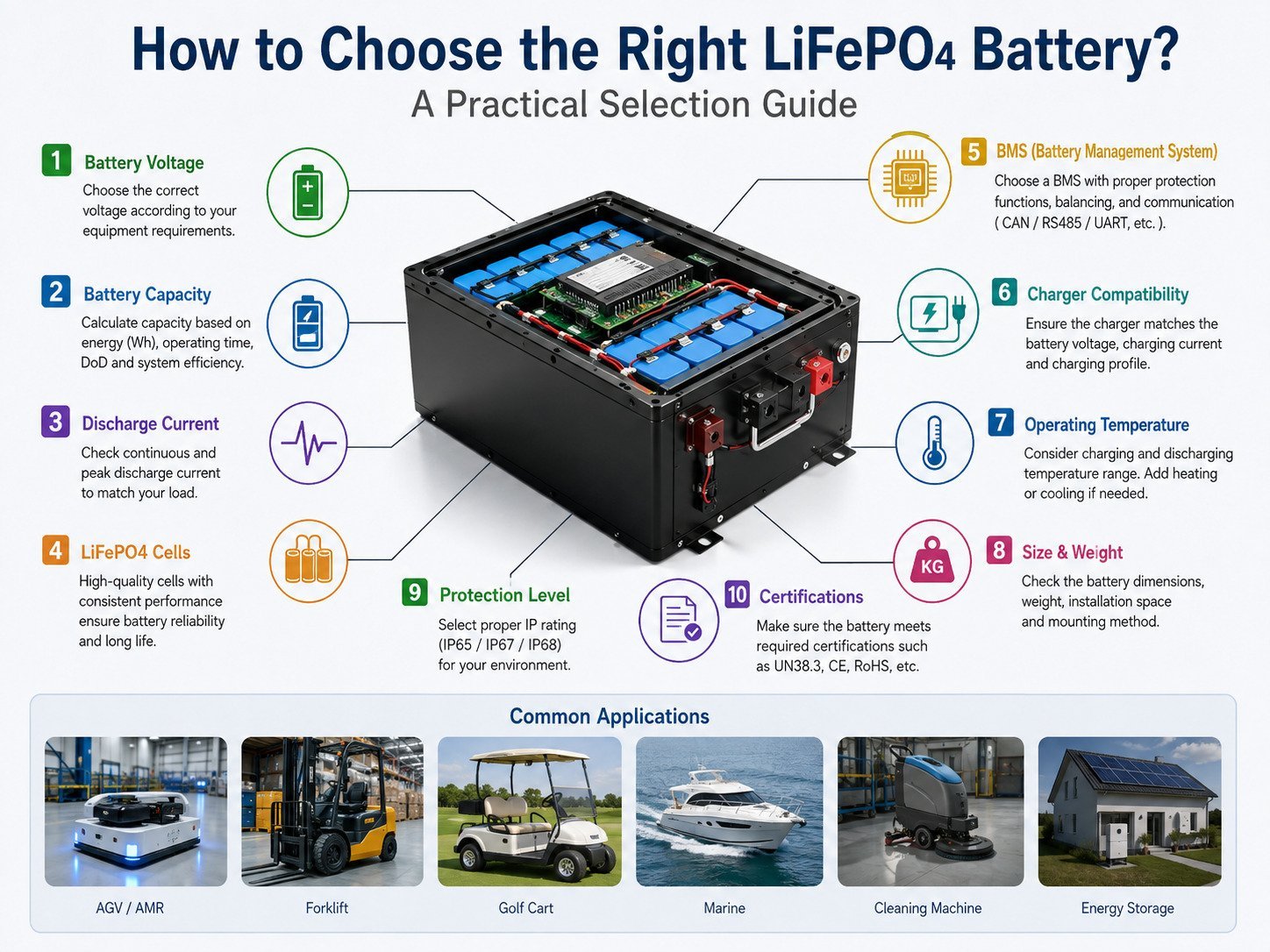
Part 1. Why Is LiFePO4 Used in So Many Applications?
Different equipment manufacturers choose LiFePO4 batteries for different reasons.
Common considerations include:
Lange Lebensdauer
LiFePO4 cells can support repeated charge and discharge cycles when operated within their specified voltage, temperature, and current ranges.
Thermische Stabilität
LiFePO4 chemistry has good thermal stability compared with some other lithium-ion chemistries. However, appropriate BMS protection, mechanical design, and thermal management are still required.
Stabile Entladungseigenschaften
LiFePO4 batteries maintain a relatively stable voltage during much of their discharge cycle. This characteristic can be useful for equipment that requires stable power output.
Geringerer Wartungsaufwand
Compared with traditional lead-acid batteries, LiFePO4 battery systems generally do not require electrolyte maintenance or regular watering.
However, LiFePO4 is not automatically the right choice for every application. Battery selection should always be based on the equipment’s actual electrical and environmental requirements.
Part 2. Determine the Required Battery Voltage
Voltage is one of the first specifications to determine.
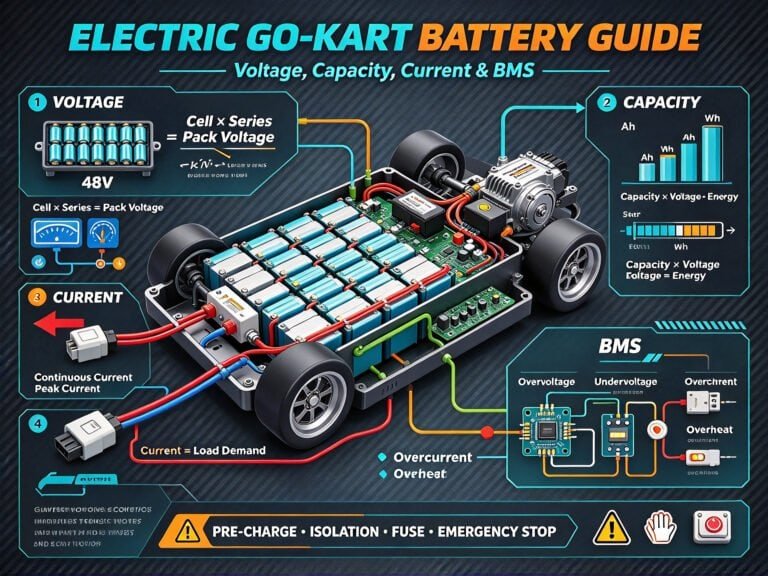
A typical LiFePO4 cell has a nominal voltage of approximately 3.2V. Cells can be connected in series to create battery packs with different voltage levels.
Common configurations include:
| Konfiguration | Nennspannung | Typische Anwendungen |
|---|---|---|
| 4S | 12.8V | Marine, RV, small energy systems |
| 8S | 25.6V | AGV, robotics, industrial equipment |
| 16S | 51.2V | Energy storage, forklifts, golf carts |
| 20S | 64V | Electric vehicles and industrial equipment |
| 24S | 76.8V | Selected high-voltage equipment |
The correct configuration depends on the voltage requirements of the equipment.
For example, if an inverter is designed for a 48V-class battery system, a 51.2V LiFePO4 battery may be used when it is compatible with the inverter’s input voltage range.
Before selecting a battery, check the voltage requirements of:
- Motor controller
- Inverter
- Ladegerät
- DC-DC converter
- Equipment control system
- Other connected electronics
Do not select a battery based only on its nominal voltage.
Part 3.Calculate the Required Battery Capacity
Battery capacity is normally expressed in ampere-hours (Ah).
The basic relationship between voltage, capacity, and energy is:
Energie (Wh) = Spannung (V) × Kapazität (Ah)
Zum Beispiel:
51.2V × 100Ah = 5,120Wh
This means a 51.2V 100Ah battery has a nominal energy of approximately 5.12kWh.
However, the required capacity should not be calculated from energy consumption alone.
You should also consider:
- Durchschnittliche Leistungsaufnahme
- Peak power consumption
- Betriebsstunden
- Daily usage
- Ladehäufigkeit
- Allowable depth of discharge
- Systemeffizienz
- Ambient temperature
- Batteriealterung
For example, if equipment consumes an average of 1kW and needs to operate for five hours, the theoretical energy requirement is approximately 5kWh.
The actual battery capacity may need to be higher to account for system losses and operating conditions.
Part 4. Check Continuous and Peak Discharge Current
Capacity is only one part of battery selection.
The battery must also provide enough current for the equipment.
This is particularly important for:
- Elektro-Gabelstapler
- Golfwagen
- AGVs
- AMRs
- Elektrische Fahrzeuge
- Marine motors
- Industrial motors
- Robotik
A motor may have a relatively low average power consumption but require a much higher current during startup or acceleration.
Therefore, check both:
Kontinuierlicher Entladestrom
und
Spitzenableitstrom
For example, a battery may have a continuous discharge rating of 100A but a peak discharge rating of 200A for a limited period.
The duration of the peak current is also important.
A supplier should be able to clarify whether the stated current is:
- Continuous
- 10 seconds
- 30 seconds
- 1 minute
- Or another defined period
The BMS rating should also be evaluated together with the actual capability of the cells, busbars, cables, connectors, and protection devices.
Part 5.Select the Appropriate LiFePO4 Cells
Battery cells are the foundation of a LiFePO4 battery pack.
When evaluating cells, consider:
Cell capacity
Common LiFePO4 cells are available in different capacities, such as cylindrical, prismatic, and pouch formats.
The appropriate format depends on the battery design and application.
Konsistenz der Zellen
Cells connected in the same battery pack should have consistent electrical characteristics.
Zu den wichtigen Parametern gehören:
- Spannung
- Innerer Widerstand
- Kapazität
- Self-discharge characteristics
Poor consistency between cells can affect battery performance and balancing requirements.
Cell quality control
For OEM battery projects, it is useful to ask the manufacturer about:
- Cell manufacturer
- Cell model
- Production batch
- Capacity test data
- Internal resistance data
- Incoming inspection process
Rather than relying only on terms such as “Grade A,” buyers should request specific cell information and test documentation.
Part 6.Choose the Right Battery Management System
The Battery Management System, or BMS, monitors and protects the battery pack.
A BMS may provide functions such as:
- Schutz vor Überladung
- Schutz vor Überentladung
- Überstromschutz
- Kurzschlussschutz
- Schutz vor Überhitzung
- Kälteschutz
- Zellausgleich
- Spannungsüberwachung
- Stromüberwachung
- Schätzung des Ladezustands (SOC)
For industrial equipment, BMS communication can also be important.
Depending on the equipment, the battery may support:
- CAN
- CAN-FD
- RS485
- UART
- Modbus
Communication allows the battery to exchange information with the equipment controller.
For example, an AGV may need battery information such as:
- SOC
- Spannung
- Aktuell
- Temperatur
- Fehlerstatus
- Verbleibende Kapazität
The BMS should therefore be selected according to the equipment’s control architecture rather than simply based on its rated current.
Part 7. Make Sure the Charger Matches the Battery
The charger must be compatible with the LiFePO4 battery’s voltage and charging requirements.
For example, a 4S LiFePO4 battery has a nominal voltage of approximately 12.8V and a full-charge voltage of approximately 14.6V under commonly used charging conditions.
A 16S LiFePO4 battery has a nominal voltage of approximately 51.2V and a full-charge voltage of approximately 58.4V.
Therefore:
Battery voltage + charger voltage + BMS charging settings
need to be compatible.
When replacing a lead-acid battery with a LiFePO4 battery, do not assume that the original charger can always be reused.
The charger should be checked for:
- Output voltage
- Output current
- Charging profile
- Anschluss
- Kommunikationsanforderungen
- Temperaturbedingungen
Part 8.Consider Operating Temperature
Temperature has an important influence on battery performance and service life.
Before selecting a LiFePO4 battery, determine:
- Minimum operating temperature
- Maximum operating temperature
- Minimum charging temperature
- Maximum charging temperature
- Lagertemperatur
Low-temperature charging deserves particular attention.
Charging a lithium battery at temperatures below the manufacturer’s specified limit can cause lithium plating and affect cell performance.
For equipment used in cold environments, a battery may require:
- Low-temperature charging protection
- Heating elements
- Temperatursensoren
- Insulated battery housing
- BMS temperature control
Applications such as cold-storage AGVs, outdoor equipment, and winter marine systems may require a battery design specifically adapted to low temperatures.
High-temperature applications also require appropriate thermal management.
Part 9. Evaluate Depth of Discharge
Depth of Discharge, or DoD, describes how much of the battery’s usable capacity is consumed during a discharge cycle.
For example, using 80Ah from a 100Ah battery represents an 80% DoD.
Operating conditions have an impact on battery aging. A battery operated under moderate DoD and suitable temperature conditions may have a different service life from the same battery operated under deep discharge and high temperatures.
For this reason, cycle-life claims should always be reviewed together with their test conditions.
Ask the supplier:
- What DoD was used?
- What charging current was used?
- What discharge current was used?
- At what temperature?
- What capacity retention was used as the end-of-life criterion?
This provides more useful information than comparing cycle-life numbers alone.
Part 10. Check the Battery Size and Weight
Battery capacity is not the only physical consideration.
The battery must fit the equipment.
Before requesting a battery pack, prepare the following information:
- Maximum length
- Maximum width
- Maximum height
- Installation direction
- Befestigungslöcher
- Anschlussposition
- Cable outlet position
- Maximum acceptable weight
- Battery compartment structure
This is particularly important for:
- AGVs
- AMRs
- Roboter
- E-Fahrräder
- Medizinische Ausrüstung
- Reinigungsmaschinen
- Marine equipment
A battery manufacturer can use these requirements to design the internal cell arrangement and enclosure.
Part 11. Select the Appropriate Protection Level
Outdoor and industrial equipment may require protection against dust and water.
The required IP rating depends on the installation environment.
Zum Beispiel:
- Indoor industrial equipment may have moderate environmental requirements.
- Outdoor equipment may require higher protection against water and dust.
- Marine equipment may require additional sealing and corrosion considerations.
- Floor cleaning machines may be exposed to water during operation.
IP ratings such as IP65, IP67, or IP68 may be considered for specific applications, but the final rating should be confirmed through appropriate design and testing.
An IP rating should not be selected simply because a higher number sounds better. The actual environmental conditions and applicable testing requirements should determine the design target.
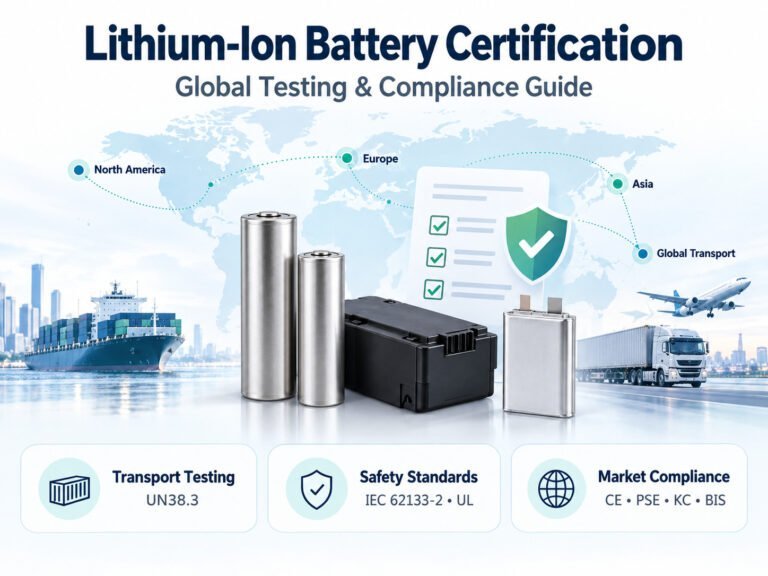
Part 12. Consider Certifications and Transportation Requirements
If the battery will be used in an export product, certification and transportation requirements should be considered early in the project.
Depending on the market and application, requirements may include:
- UN38.3
- IEC 62133-2
- CE
- RoHS
- UL-Normen
- FCC
- PSE
- KC
- Applicable regional battery regulations
UN38.3 is particularly relevant to the transportation of lithium batteries.
The exact certification requirements depend on the battery type, equipment, destination market, transportation method, and applicable regulations.
For OEM projects, it is better to determine certification requirements during product development rather than after the battery design has been finalized.
Part 13. Choose Between a Standard and Custom LiFePO4 Battery
A standard battery may be suitable when the equipment uses a common voltage and capacity and has sufficient installation space.
A custom LiFePO4 battery may be more appropriate when the equipment requires:
- Benutzerdefinierte Spannung
- Individuelle Kapazität
- High discharge current
- Sonderabmessungen
- Kundenspezifische Steckverbinder
- CAN-Kommunikation
- RS485-Kommunikation
- Betrieb bei niedrigen Temperaturen
- Heating function
- Waterproof enclosure
- Special mounting structure
For OEM equipment, the battery should be considered as part of the overall electrical and mechanical system.
A custom battery design can coordinate the cells, BMS, enclosure, connectors, wiring, protection devices, and communication interface with the equipment.
How to Choose a LiFePO4 Battery for Different Applications?
Verschiedene Anwendungen stellen unterschiedliche Anforderungen an den Akku.
| Anmeldung | Key Selection Factors |
|---|---|
| AGV | Capacity, peak current, communication, dimensions |
| AMR | Weight, capacity, BMS communication, cycle conditions |
| Electric Forklift | Capacity, discharge current, charging method, weight |
| Golfwagen | Voltage, capacity, discharge current, dimensions |
| Schiffsausrüstung | Capacity, protection, temperature, BMS |
| Robot | Weight, dimensions, peak current, communication |
| Cleaning Machine | Capacity, weight, charging, water resistance |
| Energiespeicherung | Energy capacity, BMS, thermal management, cycle conditions |
| Electric Vehicle | Voltage, capacity, peak current, BMS, dimensions |
The same LiFePO4 chemistry can therefore require very different battery pack designs depending on the application.
Part 14. What Information Should You Provide to a LiFePO4 Battery Manufacturer?
For an accurate battery proposal, equipment manufacturers should provide as much technical information as possible.
A useful battery specification sheet can include:
Electrical requirements
- Nennspannung
- Erforderliche Kapazität
- Dauerstrom
- Spitzenstrom
- Peak current duration
- Ladespannung
- Ladestrom
Mechanical requirements
- Maximum dimensions
- Maximum weight
- Montageverfahren
- Steckertyp
- Cable length
- Einbaulage
Environmental requirements
- Betriebstemperatur
- Ladetemperatur
- Lagertemperatur
- Luftfeuchtigkeit
- Water exposure
- Vibration
Kommunikationsanforderungen
- CAN
- CAN-FD
- RS485
- UART
- Modbus
- Other protocols
Zertifizierungsanforderungen
- Target market
- Transportation requirements
- Product certification
- Applicable battery regulations
The more complete the technical information, the easier it is to develop a battery that matches the equipment.
Common Mistakes When Choosing a LiFePO4 Battery
Choosing only by capacity
A 100Ah battery is not necessarily suitable simply because the equipment previously used a 100Ah battery.
Voltage, current, size, BMS, and charging requirements also need to match.
Ignoring peak current
Motor-driven equipment can have high startup or acceleration current.
Ignoring peak current can result in unexpected BMS protection.
Reusing an incompatible charger
A charger designed for another battery chemistry may not be suitable for LiFePO4.
Always verify the charging voltage and charging profile.
Comparing cycle life without test conditions
Cycle-life numbers without DoD, temperature, current, and end-of-life criteria provide limited information.
Selecting the battery after the equipment is finished
For OEM products, late-stage battery integration can create mechanical, electrical, and certification problems.
Battery requirements should be considered during equipment development.
LiFePO4 Battery Selection Checklist
Before placing an order, confirm the following:
- Battery chemistry: LiFePO4
- Nennspannung
- Nennkapazität
- Kontinuierlicher Entladestrom
- Spitzenableitstrom
- Ladespannung
- Ladestrom
- BMS protection functions
- Kommunikationsprotokoll
- Betriebstemperatur
- Ladetemperatur
- Abmessungen der Batterie
- Gewicht der Batterie
- Steckertyp
- IP protection requirement
- Required certifications
- Transportation requirements
- Expected operating cycle
- Installationsverfahren
This information can help reduce compatibility issues during battery procurement and product development.
Frequently Asked Questions About LiFePO4 Battery Selection
Is LiFePO4 better than other lithium-ion batteries?
There is no single battery chemistry that is suitable for every application.
LiFePO4 is often selected when thermal stability, cycle performance, safety characteristics, and cost considerations are important. Other lithium-ion chemistries may be more suitable when higher energy density or other specific characteristics are required.
The appropriate chemistry depends on the application.
How do I calculate LiFePO4 battery capacity?
Eine einfache Berechnung lautet:
Battery Energy = Voltage × Capacity
Zum Beispiel:
51.2V × 100Ah = 5.12kWh
The actual required capacity should also account for operating time, system efficiency, DoD, temperature, and aging.
Can I replace a lead-acid battery with a LiFePO4 battery?
In many applications, lead-acid batteries can be replaced with LiFePO4 batteries, but the replacement should not be treated as a simple one-for-one swap.
Überprüfen:
- Spannung
- Ladegerät
- BMS
- Entladungsstrom
- Abmessungen
- Gewicht
- Kommunikation
- Equipment compatibility
How long does a LiFePO4 battery last?
Service life depends on operating conditions, including temperature, charging and discharging current, DoD, storage conditions, and cell characteristics.
The cycle-life specification should therefore be reviewed together with its test conditions.
Does a LiFePO4 battery need a BMS?
Yes. A properly designed LiFePO4 battery pack generally requires a BMS or an equivalent battery protection and monitoring system.
The BMS can monitor cell voltage, current, and temperature while providing protection functions according to the battery design.
Can LiFePO4 batteries be used in cold environments?
They can be used in cold environments when the battery is designed for the required temperature range.
Low-temperature charging requires particular attention. A battery used below the specified charging temperature may require a heating system or other temperature-control solution.
What is the difference between 12V and 12.8V LiFePO4 batteries?
A typical 12V-class LiFePO4 battery consists of four 3.2V nominal cells connected in series:
3.2V × 4 = 12.8V
Therefore, 12.8V is commonly used as the nominal voltage for a 12V-class LiFePO4 battery.
Schlussfolgerung
Choosing the right LiFePO4 battery requires a complete evaluation of the equipment and operating environment.
Zu den wichtigsten Faktoren zählen:
Voltage + Capacity + Discharge Current + BMS + Charger + Temperature + Dimensions + Protection + Certification
For standard applications, these parameters can help identify a suitable battery specification.
For OEM and industrial applications, the battery should be designed together with the equipment’s electrical system, mechanical structure, communication requirements, and operating environment.
A well-matched LiFePO4 battery is not simply a battery with the right Ah rating. It is a battery system whose cells, BMS, charger, enclosure, protection components, and communication functions work together with the equipment.
For manufacturers developing AGVs, AMRs, robots, forklifts, golf carts, marine equipment, cleaning machines, electric vehicles, or other industrial products, defining these requirements during the product development stage can make battery integration and certification more straightforward.
 English
  Chinese
  Japanese
  German
  French
  Korean
