
As 锂电池 applications continue to expand across electric bicycles, electric scooters, robots, energy storage systems, and industrial equipment, performance in cold weather has become a critical concern for manufacturers, brand owners, and end users alike. Low temperatures can significantly affect battery capacity, power output, safety, and long-term lifespan if not properly managed.
This article provides a comprehensive, practical guide on how to protect lithium batteries in cold weather, covering electrochemical fundamentals, real-world risks, design strategies, charging and storage practices, and long-term maintenance recommendations.
1. Why Cold Weather Affects Lithium Batteries
Lithium batteries rely on electrochemical reactions that are highly temperature-dependent. When ambient temperature drops, several internal processes slow down simultaneously.
1.1 Reduced Ion Mobility
At low temperatures, lithium ions move more slowly through the electrolyte and between the anode and cathode. This increases internal resistance and limits the battery’s ability to deliver current efficiently.
1.2 Increased Internal Resistance
Cold conditions cause a rise in internal resistance, which leads to:
Lower available power
负载下的电压下陷
Reduced acceleration and climbing ability in electric vehicles
1.3 Temporary Capacity Loss
A lithium battery may appear to “lose” capacity in winter. In most cases, this capacity is not permanently lost but temporarily inaccessible due to slowed chemical reactions.
1.4 Risk of Lithium Plating During Charging
Charging a lithium battery at low temperatures, especially below 0°C, can cause lithium ions to deposit as metallic lithium on the anode surface. This phenomenon, known as lithium plating, is one of the most serious cold-weather risks, as it can:
Permanently reduce capacity
Increase internal short-circuit risk
Accelerate battery aging
2. Common Cold-Weather Problems in Lithium Battery Applications
2.1 Electric Bicycles and Scooters
Shortened riding range
Sudden power cut-off under load
Slow or failed charging in unheated environments
Battery shutdown triggered by BMS low-temperature protection
2.2 Robots and AGVs
Reduced peak current output
Decreased operational time per charge
Performance instability during early startup
2.3 Energy Storage Systems
Lower charge acceptance
Inefficient energy release
Higher system losses in winter conditions
Understanding these issues is the first step toward effective protection.
3. Safe Operating Temperature Ranges for Lithium Batteries
While different lithium chemistries have slightly different tolerances, general guidelines apply.
3.1 Typical Temperature Ranges
Discharge:
Recommended: -10°C to 45°C
Optimal: 10°C to 30°C
Charging:
Recommended: 0°C to 45°C
Optimal: 10°C to 30°C
Charging below freezing is the most dangerous scenario and must be carefully controlled through system design and user guidance.
4. Battery Chemistry Matters in Cold Weather
Not all lithium batteries behave the same in winter.
4.1 Lithium Iron Phosphate (LiFePO4)
优势
卓越的热稳定性
降低热失控风险
循环寿命长
局限性:
Reduced low-temperature discharge performance
Poor cold charging tolerance without heating
LiFePO4 is widely used in industrial and energy storage applications, where safety and longevity are priorities.
4.2 Ternary Lithium (NCM / NCA)
优势
更高的能量密度
Better low-temperature discharge performance
局限性:
More sensitive to overcharge and thermal stress
Requires more advanced BMS protection
5. The Role of the BMS in Cold Weather Protection
A high-quality Battery Management System (BMS) is the first line of defense against cold-weather damage.
5.1 Temperature Monitoring
Modern BMS systems use multiple temperature sensors placed near:
Cell groups
Charge/discharge terminals
Internal hotspots
This allows real-time thermal awareness rather than relying on ambient temperature alone.
5.2 Low-Temperature Charge Protection
A properly configured BMS will:
Block charging below a defined temperature threshold
Gradually resume charging once the battery warms up
Prevent lithium plating damage
5.3 Smart Power Limiting
Instead of abrupt shutdowns, advanced BMS solutions can:
Limit discharge current in cold conditions
Maintain system stability
Protect cells while allowing partial operation
6. Structural and Mechanical Design for Cold Protection
Battery performance in winter is not only about electronics. Physical design plays a critical role.
6.1 Insulated Battery Enclosures
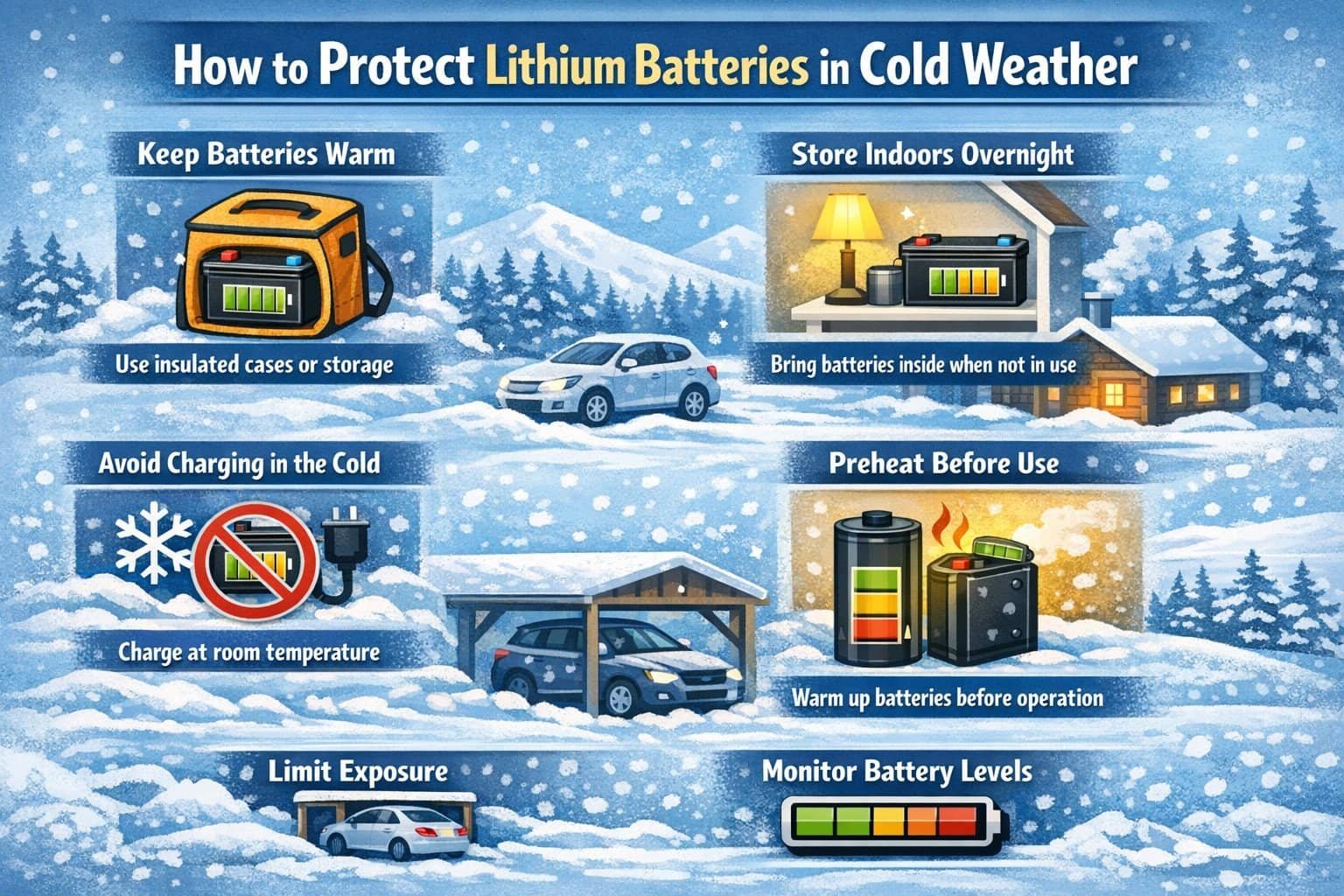
Well-designed housings help retain heat generated during operation. Effective insulation materials can significantly slow temperature drop during idle periods.
6.2 Internal Thermal Buffering
Using:
Foam separators
Thermal pads
Air-gap optimization
helps reduce direct exposure of cells to external cold air.
6.3 Vibration and Expansion Control
Cold temperatures cause materials to contract. Proper mechanical tolerances prevent:
Cell deformation
Weld stress
Connector fatigue
These design considerations are standard in Yizhan Electronics’ battery pack engineering process.
7. Active Heating Solutions for Extreme Cold
For applications operating below -10°C, passive insulation may not be enough.
7.1 Self-Heating Battery Systems
Self-heating batteries use internal heaters powered by the battery itself to raise cell temperature before charging or discharging.
优势
Enables safe charging below freezing
Improves winter performance consistency
Reduces permanent capacity loss
7.2 External Heating Integration
Some systems rely on:
Vehicle power systems
Grid-connected heating
Intelligent thermal controllers
8. Proper Charging Practices in Cold Weather
User behavior plays a significant role in battery protection.
8.1 Avoid Charging in Freezing Environments
Whenever possible:
Charge batteries indoors
Allow batteries to warm up naturally before charging
8.2 Use the Correct Charger
A charger matched to the battery’s voltage, current, and BMS communication protocol ensures:
Controlled current ramp-up
Proper termination
Reduced stress in cold conditions
8.3 Let the Battery Rest After Use
After riding or operation in the cold:
Allow 30–60 minutes before charging
This stabilizes internal temperature and voltage
9. Cold-Weather Storage Recommendations
Many lithium batteries are damaged not during use, but during improper winter storage.
9.1 Ideal Storage Temperature
Recommended: 10°C to 25°C
Avoid long-term storage below 0°C
9.2 Storage State of Charge (SOC)
Ideal SOC: 40%–60%
Avoid storing fully charged or fully discharged batteries
9.3 Periodic Inspection
For long winter storage:
Check voltage every 2–3 months
Recharge if SOC drops below safe threshold
10. Long-Term Effects of Cold Exposure
Repeated cold misuse can lead to:
Permanent capacity loss
增加内部阻力
Shortened cycle life
Higher failure rates
While a single cold event may not cause immediate failure, cumulative damage is often irreversible.
11. Application-Specific Cold Protection Strategies
11.1 E-Bike and Micromobility Brands
Emphasize user education
Integrate smart BMS temperature protection
Offer insulated or removable battery designs
11.2 Industrial Equipment and Robots
Design for controlled charging environments
Integrate heating or thermal management
Prioritize stable discharge over peak power
11.3 Energy Storage Systems
Install in temperature-controlled enclosures
Use LiFePO4 with conservative charge limits
Employ system-level thermal management
12. Yizhan Electronics’ Approach to Cold-Weather Battery Design
At Yizhan Electronics, we do not treat cold weather as an afterthought. It is a core part of our battery design philosophy.
Our approach includes:
Application-specific chemistry selection
Customized BMS temperature strategies
Structural insulation and thermal optimization
Optional heating solutions
Extensive low-temperature testing and validation
We work closely with our clients to ensure their battery systems perform reliably, safely, and consistently, even in harsh winter environments.
13. Conclusion: Cold Weather Protection Is a System-Level Challenge
Protecting lithium batteries in cold weather is not about a single feature or component. It requires a holistic system-level approach that combines chemistry, electronics, structure, user behavior, and environmental understanding.
With proper design, intelligent BMS control, and correct usage practices, lithium batteries can operate safely and effectively even in demanding winter conditions.
As a professional lithium battery pack manufacturer, Yizhan Electronics remains committed to delivering reliable, climate-adapted battery solutions that power mobility, industry, and energy systems around the world, no matter the season.



 English
  Chinese
  Japanese
  German
  French
  Korean
