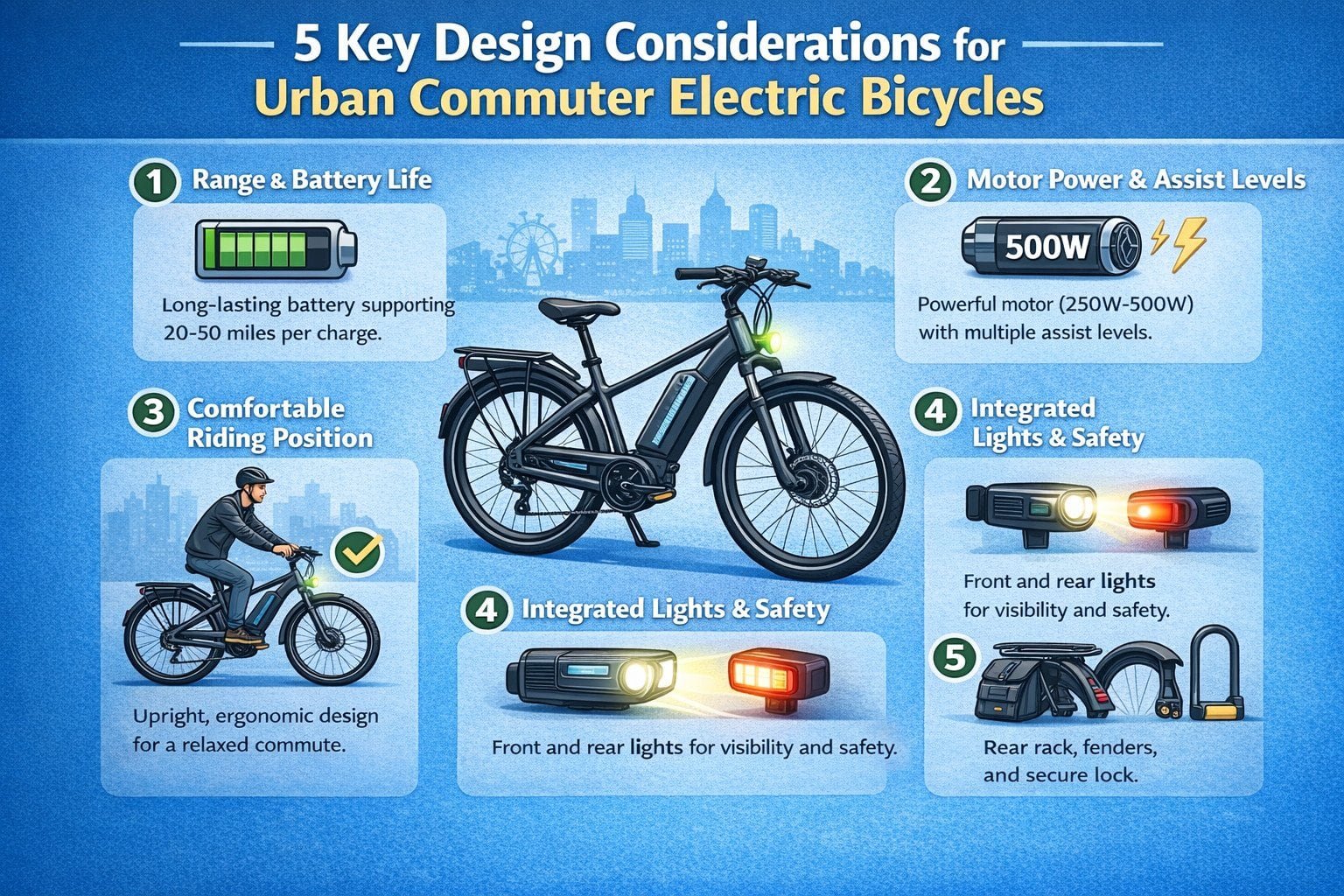
5 Key Design Considerations for Urban Commuter Electric Bicycles

With increasing urban traffic congestion, urban commuter electric bicycles are becoming the preferred mode of transportation for more and more users. Compared to mountain electric bicycles or high-performance off-road models, urban commuter electric bicycles emphasize safety, stability, comfort, and long-term reliability.

As a manufacturer specializing in customized lithium batteries, Yizhan Electronics has found through its long-term service to domestic and international electric bicycle brands that:

The design of the battery system often directly determines whether an urban commuter electric bicycle is truly “easy to ride, durable, and easy to maintain.”

This article will start from the overall vehicle design logic and focus on analyzing 5 key design considerations for urban commuter electric bicycles, and provide professional suggestions based on battery solutions.

5 Key Design Considerations for Urban Commuter Electric Bicycles

Part 1.Range and Battery Capacity: Meeting the Real Needs of “Daily Commuting”

Typical Usage Scenarios for Urban Commuting

Urban commuter users typically have the following characteristics:

Single-trip commuting distance: 5–20 km

Usage frequency: Almost daily

Charging habits: Centralized charging at night

Key focus: Stability, no excessive overestimation of capacity, long lifespan

This means that urban commuter electric bicycles do not pursue extremely large capacity, but rather “reasonable range + long cycle life.”

Battery Capacity Design Suggestions

Common configuration range:

36V 10Ah–15Ah: Suitable for short-distance commuting

48V 10Ah–14Ah: Suitable for medium commuting distances and users with slightly heavier loads

In urban commuter models, Yizhan Electronics usually prioritizes:

High-consistency cylindrical or prismatic battery cells

Prioritizing cycle life and stability as design goals

Avoiding “excessive capacity stacking” leading to uncontrolled weight and cost

Part 2.Battery Safety: The First Priority in Urban Environments

Urban commuter electric bicycles are usually:

Parked in underground garages, stairwells, and indoors

Used by a wide range of people, with low safety tolerance

More susceptible to high temperatures, rain, and collisions

Therefore, battery safety must be the top priority.

1. Key Safety Design Points

智能 BMS(电池管理系统)

过充电保护

过放电保护

Overcurrent/short circuit protection

温度监控和异常停机

Structural safety design

Internal shock absorption and cushioning

Battery cell compartmentalization

Reinforced mounting brackets to prevent loosening during prolonged riding

Yizhan Electronics utilizes a multi-protection BMS + reinforced structural design in its urban commuting battery solutions, effectively reducing thermal runaway and usage risks.

Part 3. Waterproofing and Environmental Adaptability: Details Not to Be Overlooked in Urban Cycling

The urban environment is more “harsh” than imagined

Riding in the rain

Waterlogged roads

Damp underground parking garages

Frequent temperature changes

If the battery’s protection level is insufficient, it can easily lead to:

Water ingress at the interface

BMS corrosion

Significantly shortened battery life

Waterproof Design Suggestions

Urban commuting electric bicycle batteries should at least meet IP65, ideally IP67:

Sealed structure design

Waterproof and breathable valve

Waterproof connector

Integrated housing molding

Yizhan Electronics can customize battery solutions with different waterproof ratings based on the overall vehicle structure, improving protection without sacrificing heat dissipation performance.

Part 4. Battery Shape and Vehicle Integration: Key Factors Affecting Riding Experience

Urban commuting requires both “good looks + practicality”

For urban users, electric bicycles are not only a means of transportation but also a part of daily life:

Is the appearance simple and clean?

Does the battery affect getting on and off the bike?

Is the center of gravity reasonable? 2. Mainstream Battery Structure Solutions

下管电池

Low center of gravity, stable riding

Clean appearance, high market acceptance

后支架电池

Suitable for traditional commuter models

Easy maintenance

Yizhan Electronics Support:

Battery size developed in conjunction with the frame

OEM/ODM appearance customization

Collaborative structural matching design with vehicle manufacturers

Part 5.Lifespan and Maintainability: Determining the Long-Term Cost of the Entire Vehicle

Urban commuter electric bicycles emphasize:

Long-term use

Low maintenance costs

Stable and consistent performance output

Key Factors Affecting Battery Lifespan

Cell consistency

BMS balancing capability

Charge and discharge rate matching

Heat dissipation and structural design

Yizhan Electronics’ Design Philosophy

Strict cell sorting

Aging test and capacity matching

Supports replaceable and maintainable structural design

Provides after-sales maintenance space for brand customers

This not only extends battery life but also reduces overall after-sales costs for the brand.

Conclusion: For urban commuter electric bicycles, the battery is not an “accessory,” but a core system.

In the design of urban commuter electric bicycles, the battery system is not simply a power supply component, but a core module that directly affects safety, experience, and product lifecycle.

Yizhan Electronics focuses on:

Lithium batteries for urban commuter electric bicycles

Customized battery solutions

OEM/ODM project support

Compliance design for overseas markets

If you are developing or upgrading urban commuter electric bicycle products, a stable, safe, and highly compatible battery solution will be an important component of your product’s competitiveness.

FAQ | Common Questions about Urban Commuter Electric Bicycle Design and Battery Selection

What capacity battery is generally needed for urban commuter electric bicycles?

Most urban commuter electric bicycles have a single ride distance of 5–20 kilometers, and common battery configurations are 36V 10Ah–15Ah or 48V 10Ah–14Ah.

Yizhan Electronics will customize a more reasonable capacity solution based on the vehicle weight, motor power, and actual commuting scenarios, avoiding blindly pursuing large capacity which leads to increased weight and cost.

Why do urban commuter electric bicycles have higher safety requirements for batteries?

Urban commuter electric bicycles are usually parked indoors, in underground garages, or in public areas.  If a battery safety problem occurs, the risks are higher. Therefore, the battery must have:

Overcharge, over-discharge, overcurrent, and short-circuit protection

Temperature monitoring and abnormal power-off function

Yizhan Electronics provides multi-protection smart BMS for commuter vehicles, ensuring long-term safe and stable use.

Is the battery waterproof rating important for urban commuter electric bicycles?

Very important. Urban riding often encounters rain, puddles, and humid environments.

It is recommended that urban commuter electric bicycle batteries have at least an IP65 protection rating. For areas with heavy rainfall or high humidity, an IP67 waterproof design is recommended.

Yizhan Electronics can customize battery casings and sealing solutions with different waterproof ratings based on the overall vehicle structure.

Which battery structure is more suitable for urban commuter electric bicycles?

Currently, the mainstream solutions include:

Down tube integrated battery: Low center of gravity, simple appearance, stable riding

Rear rack battery: Convenient maintenance, suitable for traditional commuter models

Yizhan Electronics supports the simultaneous design of battery size and structure with the vehicle frame, ensuring a balance between appearance, center of gravity, and safety.

How long does a battery typically last?

Under normal use and reasonable charging and discharging conditions, high-quality urban commuter electric bicycle lithium batteries can usually achieve:

600–1000 charge-discharge cycles

A service life of approximately 3–5 years

Yizhan Electronics effectively improves battery consistency and actual service life through cell sorting, capacity matching, and aging tests.

Can urban commuter electric bicycle batteries be customized?

Yes.

Yizhan Electronics provides OEM/ODM lithium battery customization services, including:

Voltage and capacity customization

Shell structure and size matching

BMS function customization

Waterproof, shockproof, and interface solution design

Suitable for different urban commuter electric bicycle platforms and overseas market needs.

Discover the 5 key design considerations for urban commuter electric bicycles, including comfort, battery range, safety, durability, and smart features for daily city riding.
2026-02-10
+
Learn practical tips to avoid overcharging and deep discharging lithium batteries. Proper charging habits and battery management can extend battery lifespan, improve safety, and ensure stable performance
2026-02-09
+
Discover the key advantages of marine lithium batteries, including high energy density, long cycle life, advanced BMS safety, and environmental benefits. A professional insight from Dongguan Yizhan Electronics Technology Co., Ltd.
2026-02-06
+
Learn how to choose the right lithium battery for Bafang Electric Bicycle Conversion Kit. Voltage, capacity, BMS compatibility, and safety insights.
2026-02-02
+