What are the battery certifications? EU and US international standards
Author:
qystars
Date:
Lithium batteries have become a mainstay of the modern energy industry . However, to ensure safety, performance, and sustainability, different regions have established strict certification and regulatory standards for lithium batteries. However, certification requirements vary from country to country. For example, the EU requires EN and IEC certification, while the US requires UL certification. This article details the basic certification requirements for lithium batteries in different countries.
1.EU Certification Standards
EU lithium battery certification requirements primarily include CE certification, the new battery regulation (EU 2023/1542), and UN38.3 transport certification. CE certification indicates compliance with EU safety and environmental requirements and requires passing electromagnetic compatibility (EMC) testing. The new regulations impose stricter requirements on battery carbon footprint, recycled content, design for recycling, performance, and durability. UN38.3 is a mandatory safety certification for lithium batteries shipped by air.
1.1 CE Certification
To be sold in the EU market, lithium batteries must bear the CE mark, indicating compliance with European safety, environmental, and health standards.
Relevant EU directives include:
– EMC Directive (2014/30/EU) – Ensures electromagnetic compatibility.
– LVD Directive (2014/35/EU) – Electrical safety of equipment operating in the 50–1000V range.
– RoHS Directive (2011/65/EU + Amendment 2015/863) – Restricts hazardous substances such as lead, mercury, and cadmium.
– Batteries Regulation (EU) 2023/1542 – The latest EU battery regulation, replacing Directive 2006/66/EC and effective from 2024, focuses on sustainability, recycling, and carbon footprint transparency.
1.2 EN 62133-2:2017 Safety Standard
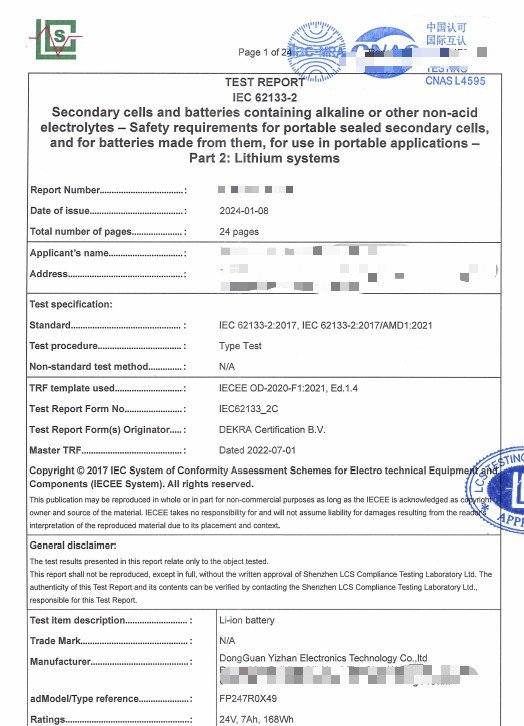
This is the core safety standard for rechargeable lithium-ion batteries used in portable devices. It includes tests for overcharge, short circuit, thermal abuse, and drop safety.
1.3 UN 38.3 Transport Testing:
All lithium batteries shipped by air, sea, or land must pass UN 38.3 testing to ensure safe transport under extreme conditions.
1.4 EN 50604-1 for E-Bike Batteries:
For e-bikes and light electric mobility devices, the EU requires compliance with EN 50604-1, which tests for mechanical and electrical safety.
1.5 Environmental Compliance: RoHS and REACH:
RoHS restricts hazardous substances, while REACH regulates the use of chemicals in batteries.
1.6 Battery Regulation (EU) 2023/1542 Key Points
– Carbon footprint declaration
– Mandatory recycled material content
– Digital battery passport by 2027
– Recycling and reusability requirements
2. US Certification Standards
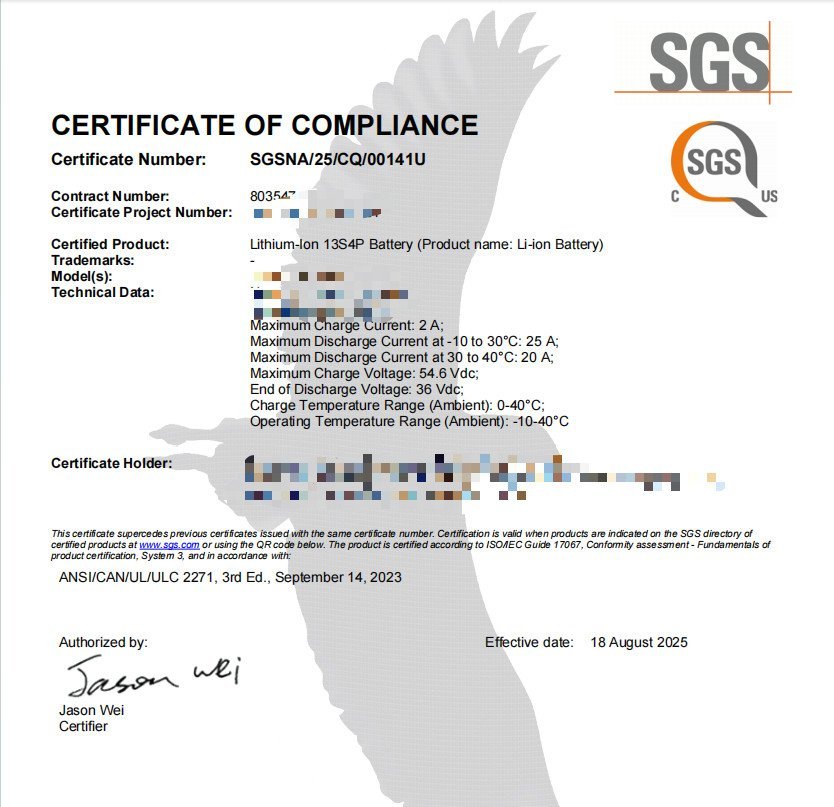
US UL certification requirements for lithium batteries need to determine the applicable UL standards based on the specific application of the battery. Common standards include UL 1642 (battery cell standard) and UL 2054 (portable secondary lithium battery standard), while UL 2849 (electric bicycles) and UL 2271 (electric bicycle lithium batteries) may also be applicable. At the same time, it is necessary to ensure that the product complies with other regulatory requirements, such as UN38.3 transportation testing and the US Department of Transportation (DOT) regulations on hazardous materials.
2.1 Specific UL standards and scope of application
UL 1642: Standard for lithium-ion batteries.
UL 2054 : Standard for Portable Secondary Lithium Batteries.
UL 2849 : Electric Bicycle Electrical Systems.
UL 2271 : Standard for lithium-ion batteries for use in light electric vehicles (LEVs), such as e-bikes and e-scooters.
UL 2056 : Mainly for mobile power (power bank) products.
UL 1973 : Applicable to energy storage systems, stationary or non-stationary power sources excluding vehicle power batteries.
UL 4200A : Safetyrequirements for consumer products containing button or coin cells.
2.2 FCC Compliance
Battery packs with intelligent BMS circuitry must comply with FCC Part 15 EMI standards.
2.3 DOT / UN 38.3 Transportation
The U.S. Department of Transportation enforces UN 38.3 compliance for both domestic and international transportation.
2.4 Environmental Standards
Many U.S. states regulate hazardous materials and mandate recycling programs.
3. Japan: PSE and JIS Standards
3.1 PSE Marking
Japan’s DENAN Law requires electrical products, including lithium batteries, to bear the PSE mark.
3.2 JIS C8714
defines safety requirements for rechargeable lithium-ion batteries and is consistent with IEC 62133.
4. South Korea: KC Certification
4.1 KC Mark Overview
The KC (Korea Certification) mark is mandatory for electrical products, including lithium batteries.
4.2 Key Test Standards
– KC 62133-2 – Safety of Lithium-ion Cells and Batteries
– UN 38.3 – Transport Safety
– K61000-6-1 / 6-3 – EMC Compatibility
4.3 Energy Efficiency and Recycling
Manufacturers must comply with South Korea’s Extended Producer Responsibility (EPR) recycling policy.
5. China: National and International Certifications
5.1 GB/T Standards
China has several GB/T standards for lithium battery safety and performance, such as GB/T 31241-2022 and GB/T 36972-2018.
5.2 UN 38.3 Compliance
All batteries exported must pass UN 38.3 testing.
5.3 CCC Certification
Certain categories, such as electric vehicles and storage batteries, require CCC certification.
6. Global Standards and Future Trends
6.1 IEC and ISO Standards
– IEC 62133-2 – Safety of Lithium-ion Batteries
– IEC 62619 – Safety of Industrial Batteries
– ISO 12405 – Electric Vehicle Battery Testing
– IEC 61960 – Performance Standards
6.2 The Rise of Sustainability and Digital Traceability
– Battery Passports for Traceability
– Recycled Material Disclosure
– Carbon Footprint Declarations
At Dongguan Yizhan Electronics Technology Co., Ltd., our battery packs are fully certified to meet international compliance and safety standards. We have obtained certifications including UL2271, EN50604, IEC 62133-2, CE, FCC, UN38.3, and ECE R136, ensuring exceptional safety, reliability, and global market access.
ensuring all battery packs meet international export requirements.
In addition, our operations are managed under ISO 9001, and ISO 14001 quality and environmental management systems.
With over 12 years of industry expertise and advanced automated production, Dongguan Yizhan Electronics Technology Co., Ltd.is your trusted partner for reliable, high-performance, and scalable battery solutions tailored to your needs.
Dongguan Yizhan Electronic Technology Co., Ltd. hosted EVE Energy experts for specialized training on prismatic lithium-ion power batteries for passenger vehicles, enhancing technical expertise and ensuring high-performance, safe battery solutions for LEVs, industrial equipment, robotics, and energy storage applications.
A complete guide to EU Battery Regulation 2023/1542 and EN 50604-1 safety standards. Learn how Dongguan Yizhan Electronics Technology Co., Ltd. helps companies ensure compliance when exporting lithium batteries to Europe.
Learn how to choose the best drone battery for industrial UAVs. Compare LiPo, Li-ion and LiFePO4 batteries, key specifications, safety tips, and buying advice for longer flight time.
Discover how lithium batteries power e-bikes, industrial robots, renewable energy systems, medical devices, and marine equipment. Learn how customized lithium battery solutions improve performance, safety, and lifespan.








 English
  Chinese
  Japanese
  German
  French
  Korean
