
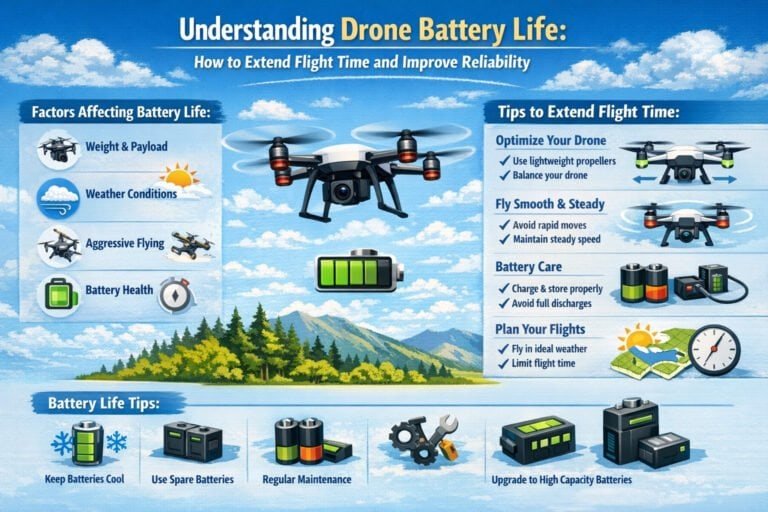
With the widespread application of drones in aerial photography, surveying, agricultural plant protection, inspection, and logistics, drone battery life has become a critical factor affecting flight safety, operational efficiency, and overall operating costs. As the core power source of drones, battery performance and lifespan directly determine flight time and operational stability.
This article provides a systematic analysis of the factors affecting drone battery life from a professional perspective and shares practical suggestions for extending battery life.

Part 1.What is Drone Battery Life?
Drone battery life typically includes two aspects:
Cycle Life
Refers to the number of complete charge-discharge cycles a battery can complete under normal charging and discharging conditions (e.g., 300 times, 500 times, etc.).
Service Life (Time Life)
Even if the battery does not reach its maximum cycle count, its capacity will naturally degrade over time, generally 2–3 years, depending on usage and storage methods.
For commercial drones, battery life directly impacts maintenance frequency and long-term operating costs.
Part 2.Common Drone Battery Types and Lifespan Comparison
Currently, mainstream drones mainly use lithium batteries, with common types as follows:
| Battery Type | Features | Typical Cycle Life | Application Scenarios | |
| Lithium Polymer Battery (LiPo) | High discharge rate, lightweight | 300–500 cycles | Aerial photography drones, racing drones | |
| Lithium-ion Battery (Li-ion) | High energy density, long endurance | 500–800 cycles | Industrial drones, long-endurance drones | |
| Lithium Iron Phosphate Battery (LiFePO₄) | High safety, long lifespan | Over 2000 cycles | Special industrial applications, custom drones |
Yizhan Electronics recommends: Choose the appropriate battery system based on flight time, load, and operating environment, rather than simply pursuing high capacity.
Part 3.6 Key Factors Affecting Drone Battery Life
1.Charge and Discharge Rate (C Rate)
The take-off and acceleration phases of a drone require extremely high instantaneous discharge capacity from the battery. Long-term high-rate discharge will accelerate battery cell aging.
2.Overcharging and Over-discharging
Frequently charging the battery to 100% or discharging it to extremely low voltage will significantly shorten battery life.
👉 Smart BMS can effectively avoid this problem.
3. Operating Temperature
High temperature: Accelerates the chemical reaction of the battery cell, shortening its lifespan.
Low temperature: Reduces capacity and increases internal resistance.
The optimal operating temperature for drone batteries is generally 15°C–35°C.
4.Battery Cell Quality
High-quality brand battery cells perform more stably in terms of consistency, safety, and cycle life, which is fundamental to determining battery lifespan.
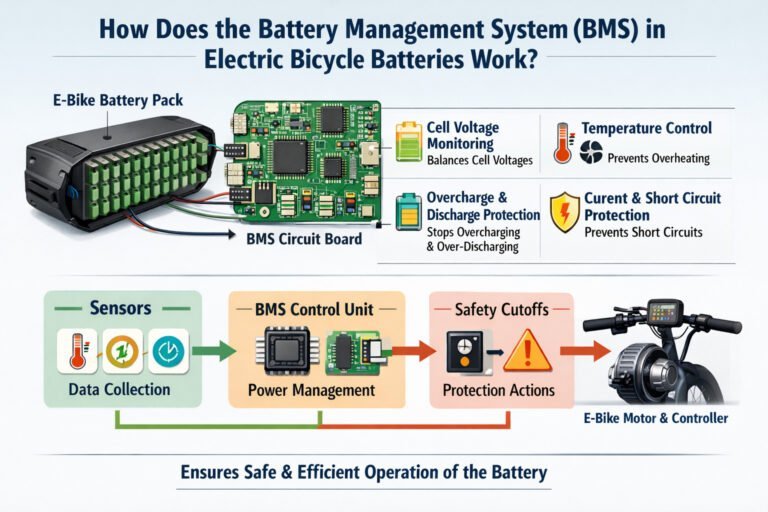
5.BMS (Battery Management System)
An intelligent BMS can monitor voltage, current, and temperature in real time, preventing abnormal operating conditions and is key to extending battery life.
6.Storage Method
Storing the battery fully charged or completely discharged for extended periods will accelerate battery degradation.
Part 4.How to Effectively Extend Drone Battery Lifespan?
Dongguan Yizhan Electronics provides the following practical suggestions from a manufacturing and application perspective:
Avoid long-term storage at full charge (recommended storage charge level: 40%–60%)
Avoid deep discharge; replace or charge the battery promptly after flight
Use the original or compatible charger
Avoid charging or flying in high-temperature environments
Regularly check the battery status; discontinue use immediately if swelling or abnormal capacity is detected
Choose a customized battery solution with an intelligent BMS
Part 5.Advantages of Yizhan Electronics Drone Battery Solutions
As a professional lithium battery manufacturer, Yizhan Electronics provides safe, stable, and customizable battery solutions for the drone industry:
✅ Supports LiPo / Li-ion / LiFePO₄ multi-system customization
✅ High-consistency cell selection to improve cycle life
✅ Intelligent BMS: Overcharge, over-discharge, overcurrent, short circuit, and temperature control protection
✅ Supports voltage, capacity, size, and interface OEM/ODM customization
✅ Strict aging tests and factory inspections to ensure flight reliability
Our drone batteries are widely used in aerial photography, surveying, inspection, and industrial-grade drone projects.
FAQ: Common Questions about Drone Battery Lifespan
Q1: How long do drone batteries usually last?
A: Under proper use, they can typically last for 300–800 cycles, with a lifespan of approximately 2–3 years.
Q2: How much capacity loss requires battery replacement?
A: When the actual capacity drops to 70%–80% of the initial capacity, it is recommended to replace the battery to ensure flight safety.
Q3: Can different batches of drone batteries be mixed?
A: Not recommended. Poor cell consistency may lead to voltage imbalance and safety risks.
Q4: How to protect drone batteries in low-temperature environments?
A: Properly preheat the battery before flight, choose low-temperature resistant battery cells, or opt for a customized low-temperature solution.
Q5: Does Yizhan Electronics support custom drone battery solutions?
A: Yes, we provide OEM/ODM customization services based on flight time, load, size, and environmental requirements.
Drone battery life depends not only on capacity but also on battery cell quality, BMS design, usage habits, and operating environment. Choosing the right battery type and using it scientifically is key to ensuring flight safety and reducing operating costs.
Dongguan Yizhan Electronics Technology Co., Ltd. is committed to providing highly reliable and long-lasting lithium battery solutions for the drone industry, helping customers achieve more stable and efficient flight applications.
 English
  Chinese
  Japanese
  German
  French
  Korean
