
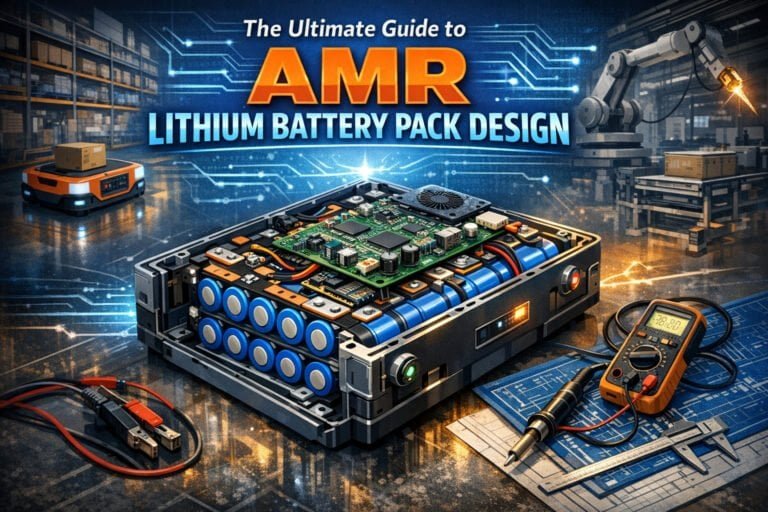
The rapid expansion of the Autonomous Mobile Robot market is reshaping global automation. From smart warehouses and manufacturing plants to hospitals and cold-chain logistics centers, AMRs are redefining how materials move and operations scale.
Behind every precise navigation maneuver and every heavy payload lift lies a silent yet mission-critical system: the lithium battery pack.
Unlike conventional power solutions, AMR lithium batteries must withstand continuous operation, rapid charging cycles, high peak loads, extreme temperatures, and real-time communication with fleet management systems. As deployment grows in complexity, battery systems are evolving from simple energy storage units into intelligent power platforms.
This guide provides a deep technical exploration of AMR battery challenges, advanced design solutions, and future development trends.

1. Market Trends Driving Demand for Advanced AMR Batteries
Global automation growth is fueled by:E-commerce expansion,Labor shortages,Industry 4.0 transformation,AI-based warehouse optimization,Robotics-as-a-Service (RaaS) models
These trends push AMRs toward:
24/7 continuous operation
Faster opportunity charging
Higher AI computing loads
Larger fleet deployments
As a result, batteries must deliver:
Longer cycle life
Higher energy density
Greater peak power output
Wide temperature adaptability
Smart communication capabilities
Battery performance now directly impacts uptime, operational cost, and system reliability.
2. Key Design Challenges in AMR Lithium Battery Systems
2.1 BMS Complexity and Energy Prediction
Compared to consumer electronics, AMR battery management systems are significantly more sophisticated.
An advanced AMR battery must integrate:
Real-time SOC estimation
SOH monitoring
Remaining runtime prediction
Fault logging
CAN / RS485 communication
Fleet system integration
Shallow charge and discharge cycles introduce SOC estimation challenges. High transient currents during acceleration and lifting demand dynamic protection algorithms.
2.2 Thermal Management Under Extreme Conditions
Unlike traditional Automated Guided Vehicle systems operating on fixed paths, AMRs navigate unpredictable environments including:
High-temperature industrial workshops
Cold storage facilities (-30°C)
Poorly ventilated enclosed structures
Temperature fluctuations cause:
Accelerated aging at high temperatures
Capacity reduction at low temperatures
Voltage imbalance
Thermal shutdown risks
Our solutions include:
Multi-point temperature sensing
High-efficiency thermal interface materials
PTC heating systems
Thermal path simulation modeling
Fire-resistant structural isolation
2.3 High Peak Power and Load Management
AMRs experience frequent power spikes during:
Acceleration
Deceleration
Payload lifting
Steering corrections
These spikes require:
Low-resistance busbar design
Symmetrical current paths
High C-rate cells
Dynamic current limiting algorithms
Without optimized architecture, voltage sag can interrupt navigation systems or AI processing modules.
2.4 Modular Scalability and Platform Standardization
The AMR industry lacks unified battery standards. Voltage platforms range from:24V,36V,48V,60V,72V.
Each robot model may require different form factors and interfaces.
Yizhan addresses this through:
Standardized modular battery platforms
Multi-capacity configurations within single housing dimensions
Parallel architecture with intelligent CAN ID coordination
Custom mechanical designs including slim, L-shaped, U-shaped, and under-motor configurations
3. Core Technologies Behind High-Performance AMR Batteries
3.1 Cell Chemistry Selection
Chemistry Advantages Applications
LiFePO4 (LFP) Long cycle life, superior safety Warehouse AMRs
NMC High energy density, lightweight Medical and compact robots
Sodium-ion Strong low-temperature performance Cold chain logistics
Solid-state Enhanced safety and density High-end precision robots
Each chemistry balances energy density, safety, cost, and temperature performance.
3.2 Electrical Architecture Optimization
Advanced AMR battery packs incorporate:
10C–20C discharge capability
1C–2C fast charging support
DC-DC dual voltage outputs (e.g., 48V + 12V)
Electrical isolation between high and low voltage domains
This ensures stable power supply for both motors and AI control systems.
3.3 Mechanical and Structural Engineering
Battery enclosures must withstand vibration, impact, and harsh environments.
Design elements include:
Aluminum alloy or PC-ABS housings
IP67–IP68 protection ratings
Shock-resistant internal reinforcement
Heat-resistant insulation layers
3.4 Communication Integration
Our AMR lithium battery systems support:CAN,CAN FD,RS485,Modbus-RTU,BLE for maintenance.
Reliable data transmission ensures seamless integration with robotic fleet management systems.
4. Case Study:
A European warehouse automation company required a high-performance 48V lithium battery pack for a heavy-duty Autonomous Mobile Robot operating 24/7 with 800 kg payload capacity. The system needed to deliver stable voltage under 300A peak loads, fit within strict space constraints, support CAN communication, and achieve over 3000 cycles at 80% DOD.
To meet these requirements, a 48V 60Ah LiFePO4 battery pack was engineered with low-resistance busbar architecture, symmetrical current paths, and a custom intelligent BMS featuring high-accuracy SOC estimation, active balancing, and real-time fault diagnostics. The design also incorporated multi-point thermal monitoring and an IP65 aluminum enclosure for industrial durability.
The final solution exceeded performance targets,
After deployment, the customer reported a 22% reduction in unexpected downtime and a 15% improvement in fleet scheduling efficiency. The project demonstrated that optimizing internal resistance, thermal control, and intelligent BMS algorithms is critical for ensuring long-term reliability and operational efficiency in industrial AMR battery systems.
5. Advanced Technologies for Next-Generation AMR Batteries
5.1 AI-Driven BMS Algorithms
Artificial intelligence enhances:
SOC accuracy
Remaining useful life (RUL) prediction
Failure detection modeling
Adaptive current control
AI transforms battery systems into predictive energy platforms rather than reactive power units.
5.2 IoT and Edge Computing Integration
Edge-enabled BMS systems process data locally while synchronizing with cloud platforms.
Benefits include:
Reduced latency
Lower bandwidth usage
Predictive maintenance support
Fleet-wide optimization
5G and TSN networks further accelerate real-time battery communication.
5.3 Hot-Swappable Battery Technology
For high-throughput warehouses, downtime is unacceptable.
Hot-swappable architecture provides:
Zero-interruption battery replacement
Spark-free pre-charge circuits
Redundant power paths
Safe handshake communication
This dramatically reduces total cost of ownership.
5.4 Future Outlook: Solid-State Battery Technology
Emerging solid-state batteries promise:
Higher energy density
Greater structural stability
Extended lifespan
Reduced fire risk
As commercialization advances, these technologies will reshape high-end AMR applications.
6. Safety Certifications and Compliance
Yizhan AMR lithium battery packs comply with:
UN 38.3
IEC 62133-2
IEC 62619
UL 2054
ISO 3691-4
Compliance ensures safe global transportation and deployment in industrial environments.
Why Choose Yizhan as Your AMR Battery Partner?
At Dongguan Yizhan Electronics Technology Co., Ltd., we combine:
Custom battery pack engineering
Advanced BMS algorithm development
Wide temperature battery technology
Modular scalable platforms
International certification expertise
We collaborate directly with robotics engineering teams to design optimized lithium battery systems that reduce downtime, improve operational efficiency, and lower total ownership cost.
Conclusion
In the era of intelligent automation, AMR performance depends heavily on battery reliability, intelligence, and scalability. The right battery platform not only powers movement but also enables predictive maintenance, AI scheduling, and uninterrupted operation.
If you are developing next-generation Autonomous Mobile Robots, partnering with an experienced custom AMR lithium battery manufacturer is critical.
Yizhan is ready to engineer your next high-performance AMR power solution.
Frequently Asked Questions (FAQ) About AMR Lithium Battery Packs
1. What type of lithium battery is best for AMR applications?
For most industrial Autonomous Mobile Robots, LiFePO4 (LFP) and NMC are the two dominant chemistries.
LiFePO4 offers longer cycle life (3000–5000 cycles), enhanced thermal stability, and higher safety margins. It is widely used in warehouse AMRs.
NMC provides higher energy density and lighter weight, making it suitable for compact or medical robots.
Battery selection depends on runtime requirements, weight constraints, discharge rate, and operating temperature range.
2. What voltage is commonly used in AMR battery systems?
The most common voltage platforms in the US and European markets are:
24V
36V
48V (most widely adopted)
60V
48V systems have become the industry standard for mid-to-heavy-duty warehouse AMRs due to optimized efficiency and motor compatibility.
3. How long does an AMR lithium battery last?
Cycle life depends on chemistry and depth of discharge (DOD).
Typical values:
LiFePO4: 3000–5000 cycles at 80% DOD
NMC: 1500–2500 cycles at 80% DOD
In 24/7 warehouse operation, this usually translates to 3–5 years of service life under proper BMS management.
4. What certifications are required for AMR lithium batteries in the US and Europe?
Industrial AMR battery packs typically require:
UL 2054
IEC 62619
UN 38.3
CE Marking
For warehouse robots operating under driverless regulations, compliance with
ISO 3691-4
may also be required.
Certification is critical for import clearance, insurance approval, and commercial deployment.
 English
  Chinese
  Japanese
  German
  French
  Korean
