Practical Tips to Avoid Overcharging and Deep Discharging

In the daily use of electric bicycles, electric scooters, drones, AGVs, and energy storage devices, overcharging and deep discharging are two major reasons for shortened lithium battery life and increased safety risks. Many battery problems do not stem from the product itself, but from incorrect usage and management.

This article, based on years of experience in battery research and development, BMS design, and practical applications, systematically analyzes the dangers of overcharging and deep discharging and shares practical prevention techniques to help businesses and users extend battery life and improve safety.

Overcharging and Deep Discharging

Part 1. What are Overcharging and Deep Discharging?

1. Overcharging

This refers to continued charging of the battery after it has reached its designed maximum voltage, which may lead to:

Cell overheating

Uncontrolled internal chemical reactions

Battery swelling or even thermal runaway

2. Deep Discharging

This refers to the battery voltage being discharged below the safe lower limit, which may cause:

Irreversible damage to the cell structure

Rapid capacity degradation

Inability to charge normally again

Note: Both of these situations will significantly shorten battery cycle life and increase safety hazards.

Part 2. Main Dangers of Overcharging and Deep Discharging

Significantly reduced battery cycle life

Poor cell consistency and unstable performance

BMS frequently entering protection mode

In severe cases, causing fire or equipment damage

For B2B customers, this is not only a product problem but may also lead to after-sales costs and brand risks.

Part 3.6 Key Tips to Avoid Overcharging

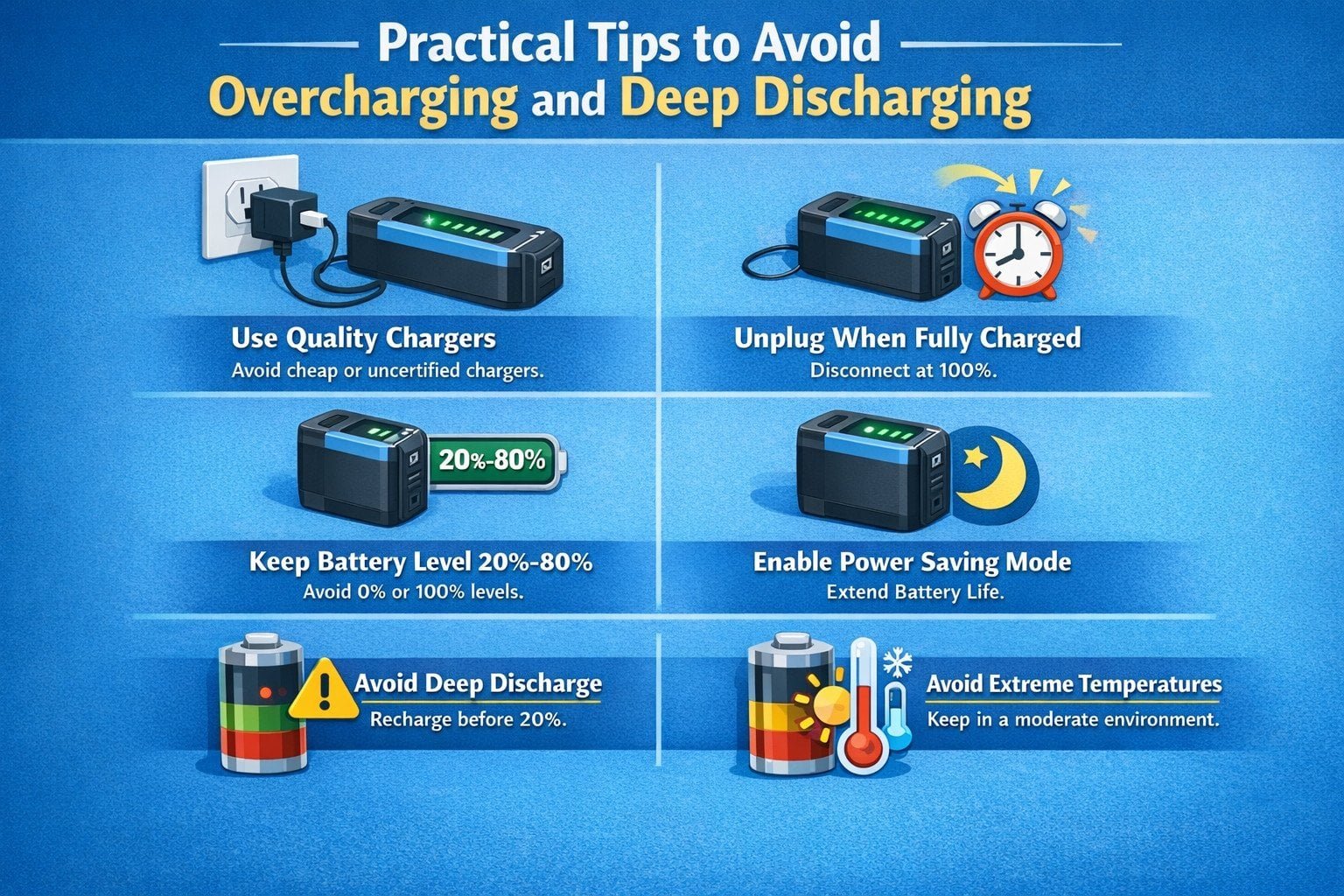
1. Use a matching charger

Ensure that the charger voltage and current parameters match the battery design, and avoid using non-original or mismatched charging equipment.

2. Avoid prolonged “overnight charging

The battery should be disconnected from the power supply promptly after being fully charged to avoid prolonged exposure to high voltage.

3. Choose batteries with intelligent BMS

An intelligent BMS can automatically cut off charging when the battery is fully charged, preventing the risk of overcharging.

4. Control the charging environment temperature

It is recommended to charge in an environment of 10°C–35°C, avoiding charging under high-temperature conditions.

5. Do not charge the battery in an abnormal state

If you find the battery swelling, overheating, or emitting an unusual odor, stop charging immediately. 6. Regularly inspect charging equipment

Aging or substandard chargers may cause abnormal output, leading to overcharging.

Part 4. 6 Practical Tips to Avoid Deep Discharge

1. Do not let the battery completely drain

When the device shows a significant decrease in power or a low battery warning, charge it promptly.

2. Avoid long-term storage with low battery

Leaving the battery in a low-power state for extended periods can easily cause irreversible damage.

3. Maintain a reasonable charge level during storage

It is recommended to maintain a charge level of 40%–60% during storage.

4. Reduce usage intensity in low-temperature environments

Battery capacity decreases at low temperatures, making deep discharge more likely.

5. Use a BMS with low-voltage protection

The BMS will automatically cut off power when the voltage approaches the lower limit to prevent over-discharge.

6. Regularly maintain batteries that are not used for extended periods

Check the voltage every 2–3 months and recharge as needed.

Part 5. How does Yizhan Electronics prevent overcharging and over-discharging from the source?

At the product design and manufacturing stage, Dongguan Yizhan Electronics has made safety control a core standard:

✅ High-consistency cell screening to reduce voltage deviation

✅ Intelligent BMS for precise control of charging and discharging thresholds

✅ Multiple protections: overcharge/over-discharge/overcurrent/overtemperature

✅ Aging test and function verification before shipment

✅ Support for parameter customization for different application scenarios

These designs not only improve safety but also significantly extend the overall battery life.

Part 6. Management Suggestions for Enterprises and End Users

Establish standardized charging and discharging operating procedures

Provide basic battery usage training for employees and users

Clearly state charging and discharging precautions in the product manual

Choose a reliable battery supplier with technical support

Scientific management is an effective way to reduce battery failure rates.

Part 7. FAQ: Common Questions about Charging and Discharging Management

Q1: Can the battery be charged to 100% every time?

A: Yes, but it is not recommended to use or store the battery at full charge for extended periods.

Q2: Does letting the battery drain until it automatically shuts down count as deep discharge?

A: Some devices have protection, but doing this frequently will still affect battery life.

Q3: Is it better to charge less often?

A: Reasonable shallow charging and discharging is actually more beneficial for extending battery life.

Q4: Can BMS completely prevent human error?

A: BMS can significantly reduce risks, but proper usage is still very important.

Q5: Does Yizhan Electronics provide charging and discharging usage guidelines?

A: Yes, we can provide customers with complete usage and maintenance advice.


Overcharging and deep discharging are the main factors affecting the lifespan and safety of lithium batteries. By adopting correct usage habits, reasonable storage methods, and choosing high-quality battery products with intelligent BMS, risks can be significantly reduced and service life extended.

Dongguan Yizhan Electronics Technology Co., Ltd. always adheres to the principle of “safety and reliability first,” providing customers with high-quality, customizable lithium battery solutions to help products achieve longer lifespan and more stable performance.


Discover the 5 key design considerations for urban commuter electric bicycles, including comfort, battery range, safety, durability, and smart features for daily city riding.
2026-02-10
+
Learn practical tips to avoid overcharging and deep discharging lithium batteries. Proper charging habits and battery management can extend battery lifespan, improve safety, and ensure stable performance
2026-02-09
+
Discover the key advantages of marine lithium batteries, including high energy density, long cycle life, advanced BMS safety, and environmental benefits. A professional insight from Dongguan Yizhan Electronics Technology Co., Ltd.
2026-02-06
+
Learn how to choose the right lithium battery for Bafang Electric Bicycle Conversion Kit. Voltage, capacity, BMS compatibility, and safety insights.
2026-02-02
+