
With the widespread application of lithium batteries in electric bicycles, electric scooters, drones, AGVs, and energy storage equipment, battery storage safety is becoming a topic of great concern for businesses and users. Improper storage methods can lead to battery aging, swelling, and even fire accidents.
This article, based on years of experience in lithium battery research and development and safety testing, systematically explains how to effectively prevent fire risks caused by batteries during storage, from both technical and practical perspectives.

Part 1.Why Does Battery Storage Pose a Fire Risk?
Although lithium batteries are not in operation during storage, they still contain energy and undergo chemical reactions internally. If the environment or conditions are inappropriate, the following risks may arise:
Internal short circuit leading to thermal runaway
High-temperature environment accelerating cell aging
Overcharging or over-discharging causing battery structural instability
Battery being subjected to pressure, moisture, or casing damage
Once thermal runaway occurs, the battery may rapidly heat up, smoke, or even ignite.
Part 2.Common Causes of Battery Storage Fires
High Storage Temperature
Long-term exposure to high temperatures (such as in a sealed warehouse or a car exposed to direct sunlight) accelerates internal chemical reactions in the battery, increasing the risk of fire.
Long-Term Storage at Full Charge or Over-Discharge
Storing batteries at full charge accelerates cell aging, while over-discharging can damage the battery’s internal structure.
Stacking Multiple Batteries or Metal Contact
Battery terminals coming into contact with metal or colliding with each other can cause short circuits.
Damaged Battery Casing or Insulation Layer
Minor damage during transportation or use may gradually worsen during storage.
Lack of BMS Protection
Batteries without intelligent BMS cannot monitor voltage and temperature in real time, posing potential safety hazards.
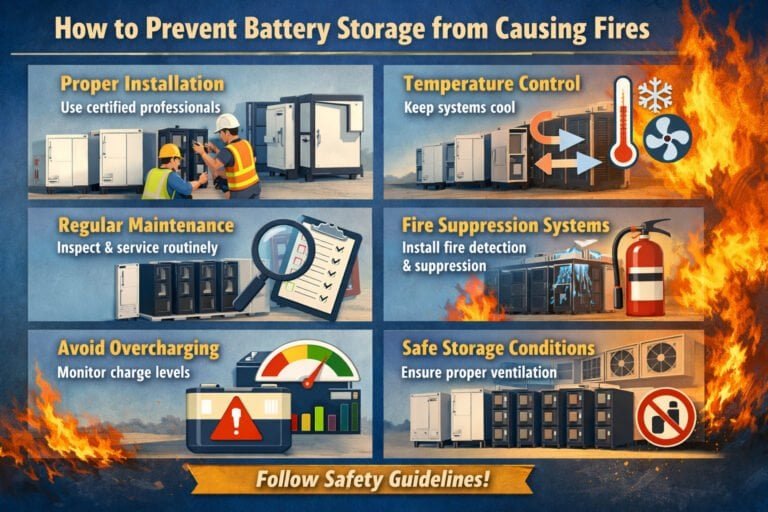
Part 3.8 Key Measures to Prevent Battery Storage Fires
-
Control Storage Temperature and Humidity
Recommended storage temperature: 15°C–25°C
Avoid direct sunlight and high-humidity environments
-
Maintain Reasonable Storage Charge Level
Recommended battery storage charge level: 40%–60%
Avoid long-term storage at full charge or completely discharged state
-
Use Fireproof and Anti-Static Storage Containers
Use fireproof battery boxes or dedicated storage cabinets to reduce the risk of accidents.
4. Avoid terminal short circuits
Use terminal protective covers or insulating materials to prevent the positive and negative terminals from contacting metal objects.
-
Regularly check battery status
Check the voltage, appearance, and for any swelling or unusual odors every 1–3 months.
-
Store in separate areas by type
Batteries of different models and batches should be stored in separate areas to avoid mixing.
-
Keep away from flammable materials
Battery storage areas should be kept away from cardboard boxes, oils, and chemical solvents.
-
Choose batteries with intelligent BMS
An intelligent BMS can automatically cut off power in abnormal situations, significantly reducing storage risks.
Part 4.How does Yizhan Electronics ensure battery storage safety?
Dongguan Yizhan Electronics has incorporated storage safety as a core standard in its product design and manufacturing stages:
✅ High-consistency cell screening to reduce the probability of internal short circuits
✅ Intelligent BMS for real-time monitoring of voltage, current, and temperature
✅ Multiple protections: overcharge, over-discharge, short circuit, and over-temperature protection
✅ Aging test and safety test before shipment
✅ Support for fire-resistant structures and customized casing designs
Our battery products are widely used in electric bicycles, scooters, AGVs, drones, and energy storage systems, and have good long-term storage stability.
Enterprise Warehousing and Transportation Safety Recommendations
For B2B customers, Yizhan Electronics recommends implementing safety management in warehousing and logistics:
Establish battery storage SOPs
Equip with temperature and humidity monitoring systems
Regular safety training Comply with UN38.3, MSDS, and other transportation regulations
Standardized warehousing management not only reduces fire risks but also helps in passing audits by international customers and third parties.
FAQ: Common Questions about Battery Storage Safety
Q1: Can batteries be stored fully charged for a long time?
A: Not recommended. Long-term full charge will accelerate aging. A storage charge level of 40%–60% is recommended.
Q2: Do batteries need to be charged during storage?
A: If the voltage is below the safe range, appropriate charging should be performed to avoid over-discharge.
Q3: Can batteries be stacked for storage?
A: Direct stacking is not recommended. Use isolation layers or separate storage racks.
Q4: Can swollen batteries still be stored or used?
A: No, they should be immediately isolated and handled according to regulations.
Q5: Does Yizhan Electronics provide storage safety guidance?
A: Yes, we can provide customers with technical guidance on battery storage, transportation, and usage.
Batteries also pose safety risks during storage, and proper storage methods are crucial in preventing fire accidents. By rationally controlling temperature, charge level, environment, and selecting high-safety battery products, the risk of storage-related fires can be significantly reduced.
Dongguan Yizhan Electronics Technology Co., Ltd. always prioritizes safety, providing customers with highly reliable lithium batteries and professional technical support to help businesses achieve long-term, safe, and stable battery applications.
 English
  Chinese
  Japanese
  German
  French
  Korean
