
With the rapid popularization of electric skateboards for urban commuting, leisure, and short-distance travel, electric skateboard batteries have become a core component determining the overall performance, safety, and lifespan of the board. Whether you are a brand owner, a manufacturer, or a professional rider, choosing the right battery solution is crucial.
This article, based on years of experience in customizing batteries for electric skateboards and light electric vehicles, provides you with this ultimate guide to electric skateboard batteries, comprehensively analyzing battery types, key parameters, safety considerations, and selection recommendations.
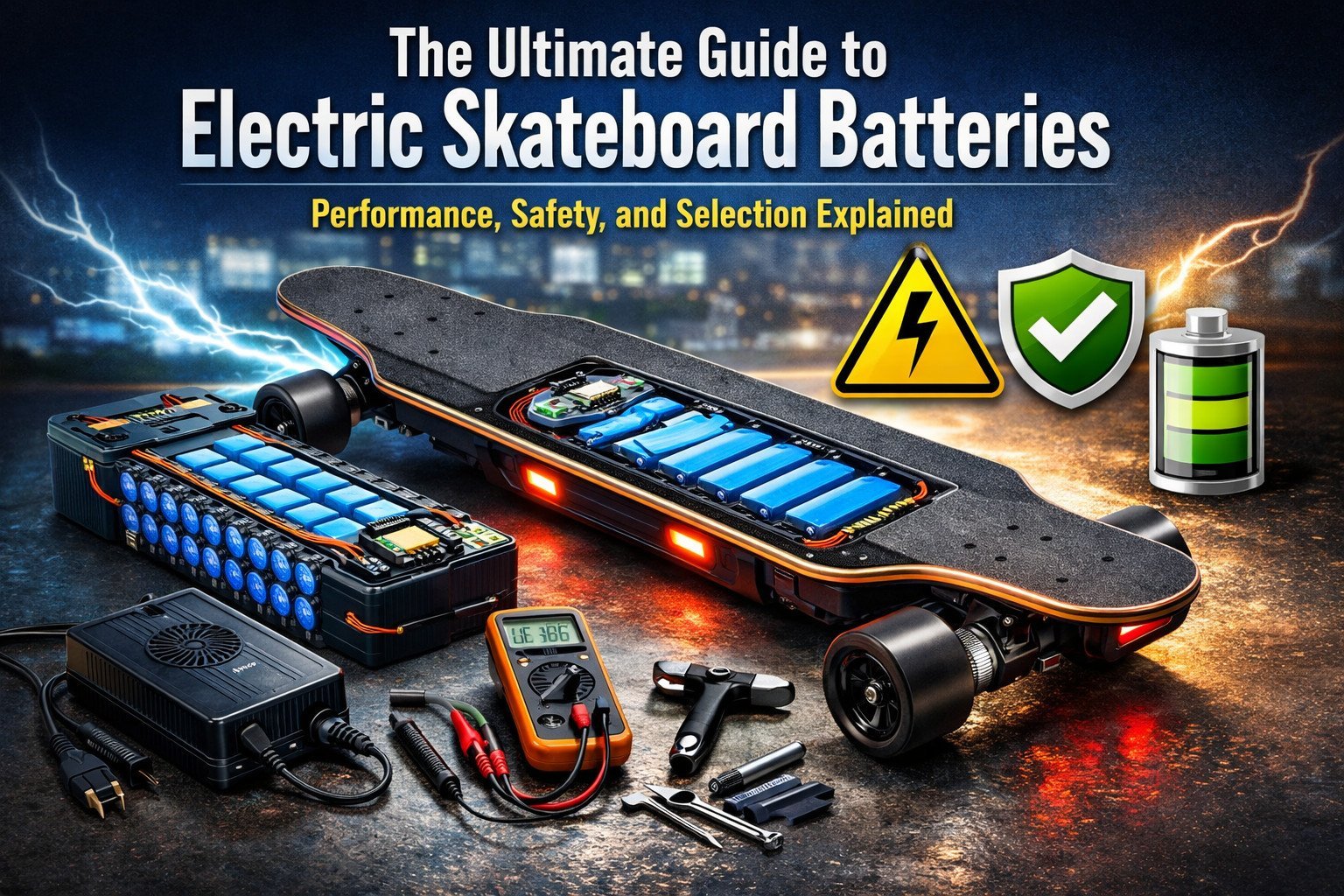
Part 1 .Why do Electric Skateboards Have Higher Battery Requirements?
Compared to electric bicycles, electric skateboards are smaller and lighter, but they have more demanding requirements for battery performance:
High instantaneous current discharge (starting, climbing hills, acceleration)
High energy density to ensure range
Strict size and weight limitations
High safety requirements due to close proximity to the user
Therefore, electric skateboard batteries must strike a balance between power, range, safety, and structural design.
Part 2 .Common Electric Skateboard Battery Types Explained
1. Lithium-ion Batteries (Li-ion)
Advantages: High energy density, good range performance
Modèles typiques : 18650, 21700
Applications: Mid-to-high-end electric skateboards
2. Lithium Polymer Batteries (LiPo)
Advantages: High discharge rate, strong power output
Disadvantages: Requires more sophisticated protection and management
Applications: High-performance, racing electric skateboards
3. Lithium Iron Phosphate Batteries (LiFePO₄)
Advantages: High safety, long cycle life
Disadvantages: Lower energy density
Applications: Custom or high-safety requirement projects
Part 3 . Key Parameters of Electric Skateboard Batteries Explained
1. Voltage (V)
Common voltage configurations include:
24V: Entry-level, light-duty skateboards
36V: Mainstream configuration, balancing performance and range
48V and above: High-performance skateboards
2. Capacity (Ah / Wh)
Capacity determines the range, and Wh (watt-hours) is usually a more meaningful reference.
3. Discharge Rate (C Rate)
Electric skateboards require support for instantaneous high-rate discharge; otherwise, power insufficiency or overheating problems may occur. 4. Battery Structure and Dimensions
The battery must match the height of the skateboard’s battery compartment, making the structural design particularly crucial.
Part 4. Safety Design Key Points for Electric Skateboard Batteries
Safety is always the primary consideration for electric skateboard batteries:
Smart BMS: Overcharge, over-discharge, overcurrent, short circuit, and temperature control protection
Cell consistency management: Avoids voltage imbalance
Shock-resistant structural design: To withstand road vibrations
Waterproof and dustproof design: Suitable for outdoor riding environments
Dongguan Yizhan Electronics provides multiple safety protection solutions for electric skateboard batteries, meeting different market and regulatory requirements.
Part 5.Electric Skateboard Battery Life and Maintenance Suggestions
Avoid long-term storage at full charge or complete discharge.
It is recommended to maintain a charge level of 40%-60% during storage.
Avoid exposure to high temperatures or charging at low temperatures.
Use a matching charger.
Regularly check the battery’s appearance and performance.
Proper use can significantly extend battery cycle life and reduce replacement costs.
Part 6. Advantages of Yizhan Electronics Electric Skateboard Battery Solutions
✅ Supports 24V / 36V / 48V electric skateboard battery customization
✅ Multiple cell options (18650 / 21700 / LiPo)
✅ High power output, compatible with brushless motors
✅ Smart BMS and waterproof structural design
✅ OEM/ODM customization services, supporting branded production
✅ Complies with UN38.3, CE, MSDS, and other export standards
We have provided stable and reliable battery solutions for multiple electric skateboard brands.
Part 7.FAQ: Common Questions about Electric Skateboard Batteries
Q1: Can the electric skateboard battery be upgraded to a larger capacity?
A: Yes, but ensure compatibility with size, voltage, and controller. Customization by a professional manufacturer is recommended.
Q2: Can batteries with different voltages be used interchangeably?
A: No, mismatched voltage may damage the controller and motor.
Q3: How long does an electric skateboard battery usually last?
A: Under proper use, the cycle life is typically 500-800 cycles.
Q4: Can the battery still be used after getting wet?
A: It is not recommended to continue using it. Immediately disconnect the power and have it professionally inspected.
Q5: Does Yizhan Electronics support small-batch customization?
A: We support sample and small-batch Personnalisation OEM/ODM services.
 English
  Chinese
  Japanese
  German
  French
  Korean
