
With the widespread use of electric bicycles in urban commuting, food delivery, and recreational riding, battery range, lifespan, and safety and stability have become one of the core concerns for both users and brands.
A truly “durable” electric bicycle battery doesn’t just depend on capacity, but is determined by the battery cells, structural design, BMS (Battery Management System), battery protection, and manufacturing process.
This article will provide a systematic analysis from a professional manufacturing perspective: how to choose an electric bicycle battery that truly stands the test of time and use.
Part 1: Choosing High-Quality Battery Cells is the Foundation of a Durable Battery
Battery cells are the “heart” of the battery, directly determining the rate of range degradation and cycle life.
1. Prioritize First-Tier or Stable Model Battery Cells
Durable electric bicycle batteries typically use:
High-consistency cylindrical battery cells (such as 18650 / 21700)
Or rigorously screened prismatic or pouch battery cells
High-quality battery cells have:
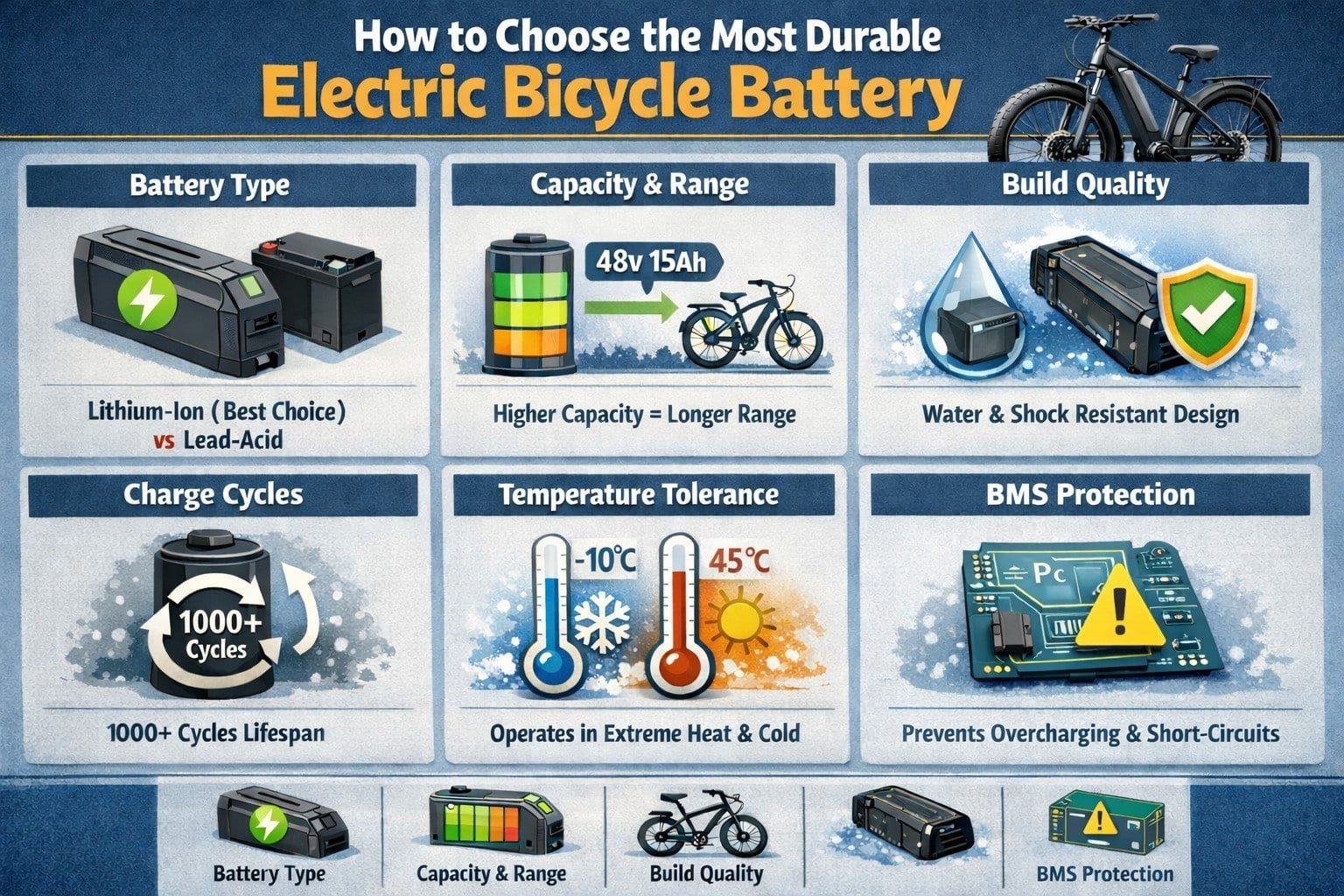
Higher cycle life (≥800–1000 cycles)
Lower internal resistance
More stable charge and discharge platform
Before mass production, all battery cells undergo capacity, internal resistance, and aging tests to ensure the consistency of the entire battery pack.
Part 2: Reasonable Battery Capacity ≠ Blindly Pursuing “Large Capacity”
Many users mistakenly believe that “the larger the capacity, the more durable,” but this is not entirely correct.
The key to durability lies in “matching”
When choosing battery capacity, you should consider:
Motor power (250W / 350W / 500W)
Actual usage scenarios (commuting / food delivery / mountain biking)
Required mileage per ride
If the capacity is constantly in a deep discharge state, it will accelerate battery aging.
In customized solutions, lithium battery manufacturers will use load calculations + usage scenario analysis to help customers choose a capacity configuration that is “not overloaded, not wasteful, and has a longer lifespan.”
Part 3: Battery Management System (BMS) Determines Long-Term Stability
A durable electric bicycle battery cannot do without a high-quality BMS. The Core Functions of a High-Quality BMS
Schutz vor Überladung/Überentladung
Überstrom- und Kurzschlussschutz
Temperature monitoring and abnormal shutdown
Cell balancing to slow down capacity degradation
Low-quality BMS often leads to:
Shorter and shorter battery life
Battery swelling and overheating
Significantly reduced cycle life
Part 4. Structural Design and Protection Level Directly Affect “How Long It Lasts”
In real-world usage environments, batteries need to withstand:
Rain and moisture
Dust and sand
Vibration and drops
High and low temperature changes
Key structural designs for long-lasting durability include:
Reinforced battery casing
Internal cushioning and fixing structures
High-level waterproof sealing (IP65/IP67)
Shockproof and anti-loosening design
Ensuring the battery remains stable and reliable in complex riding environments.
Part 5. Manufacturing Process and Consistency Determine Long-Term Reliability
Even with the same battery cells and design, batteries produced by different factories may have significantly different lifespans.
Manufacturing details that affect durability include:
Whether the spot welding process is stable
Whether the solder joints are firm and uniform
Whether the wiring harness layout is reasonable
Whether the entire battery pack undergoes aging testing
Reducing hidden faults from the source improves the consistency and lifespan of the entire battery pack.
Part 6. Choosing a Reliable Manufacturer is More Important Than Parameters
For brands and buyers, truly durable batteries come from:
Manufacturers with R&D capabilities
Long-term supply and after-sales support
Support for OEM/ODM customization
Familiarity with international market standards and application scenarios
Häufig gestellte Fragen (FAQ)
Q1: How many years do electric bicycle batteries usually last?
Under normal use and reasonable maintenance, high-quality lithium batteries typically last 3–5 years.
Q2: Is a higher cycle count always better?
The cycle count is an important indicator, but it needs to be considered in conjunction with cell quality, BMS, and usage conditions.
Q3: Does the waterproof rating affect battery life?
Yes. Good waterproof design can effectively reduce internal corrosion and short-circuit risks, significantly extending battery life.
Q4: Can I customize a battery according to my vehicle model?
Yes. Yizhan Electronics supports customized development of voltage, capacity, casing structure, interfaces, and BMS.



 English
  Chinese
  Japanese
  German
  French
  Korean
