
As new energy applications expand into outdoor,industrial,and high-demand environments,lithium battery packs are no longer just power sources.They are the core guardians of system safety,stability,and long-term reliability.
Rain,dust,salt spray,humidity,and high-pressure washdowns can all threaten battery performance.Ensuring stable operation in harsh environments requires a clear understanding of one critical standard:the IP protection rating.
Drawing on years of manufacturing expertise,Dongguan Yizhan Electronics Technology Co.,Ltd.provides this comprehensive guide to explain IP ratings,the differences between IP67,IP68,and IP69K,and the essential design principles behind high-performance waterproof lithium battery packs.

What Is an IP Protection Rating?
IP stands for Ingress Protection.The rating system was established by the International Electrotechnical Commission(IEC)to classify the degree of protection provided by enclosures against solids and liquids.
The standard format is:
IP+two digits
For example:IP65,IP67,IP68,IP69K
Meaning of the digits:
First digit(0–6):Protection against solid particles such as dust
Second digit(0–9K):Protection against water
Examples:
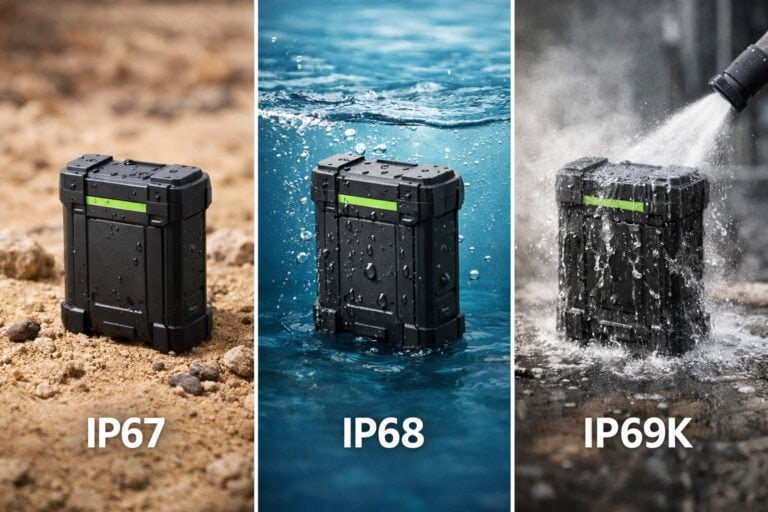
IP67=Complete dust protection+temporary immersion protection
IP68=Complete dust protection+long-term immersion protection
IP69K=Complete dust protection+resistance to high-temperature,high-pressure water jets
For lithium battery packs,the IP rating directly determines environmental durability,operational safety,and product lifespan.
What Is IP67?
IP67 is one of the most commonly specified protection levels for electric bicycles,scooters,AGVs,and light outdoor energy systems.
Technical definition:
Dust level 6:Completely dust-tight
Water level 7:Withstands immersion in 1 meter of water for 30 minutes
Typical Applications
Urban electric bicycles
Outdoor commuting devices
Equipment exposed to rain or accidental water splashes
Design Requirements
Fully sealed enclosure
Waterproof silicone gaskets
Sealed charging and discharge ports
Air-tightness testing
IP67 offers a practical balance between protection performance and cost,making it ideal for general outdoor use.
What Is IP68?
IP68 builds upon IP67 by offering enhanced immersion capability.
Technical definition:
Completely dust-tight
Suitable for continuous immersion beyond 1 meter(depth and duration defined by the manufacturer)
Examples may include:
2 meters for 1 hour
3 meters for 2 hours
Typical Applications
Marine battery systems
Outdoor energy storage units
Inspection robots
Coastal or high-humidity environments
Design Challenges
Sustained water pressure
Thermal expansion and contraction affecting seals
Internal and external pressure balance
IP68 battery pack design typically requires:
Die-cast aluminum housing
Epoxy resin potting
Pressure equalization valves
100%air-tightness testing
IP68 is ideal for long-term exposure to water or highly humid environments.
What Is IP69K?
IP69K represents one of the highest levels of ingress protection commonly applied in industrial environments.
Test conditions typically include:
Water temperature up to 80°C
Water pressure between 80–100 bar
Multi-angle high-pressure spray
Typical Applications
Industrial machinery
Food processing equipment
Engineering vehicles
Heavy-duty outdoor power systems
For lithium battery packs,IP69K signifies:
High-strength enclosure structures
Heat-resistant sealing materials
Industrial-grade waterproof connectors
Enhanced corrosion and impact resistance
IP69K protection is not just about resisting water;it is about surviving extreme industrial cleaning and operating conditions.
| Rating | Test Method | Water Pressure | Duration | Typical Use |
| IP67 | Static immersion | Low | Short-term | Urban outdoor |
| IP68 | Static deep immersion | Medium | Long-term | Marine/storage |
| IP69K | High-pressure spray | Very high | Dynamic spray | Industrial |
Key Distinctions
Different testing standards
IP67 and IP68 focus on immersion
IP69K focuses on high-pressure jet spraying
Structural complexity increases with rating level
Manufacturing cost rises with protection level
Application environment determines the appropriate rating
Selecting the right IP rating should be based on real operating conditions rather than pursuing the highest specification unnecessarily.
Key Design Principles for Waterproof Lithium Battery Packs
At Dongguan Yizhan Electronics Technology Co.,Ltd.,waterproof design is approached as a system-level engineering process rather than a simple sealing step.
1.Structural Optimization
Integrated enclosure design
Labyrinth sealing structures
Balanced mechanical stress distribution
2.Material Selection
High-strength aluminum alloys
Anti-aging silicone gaskets
Heat-resistant insulation materials
3.Sealing Technologies
Dual-component epoxy potting
Laser welding
Ultrasonic welding
4.Reliability Testing
Air-tightness testing
Immersion testing
Salt spray testing
High and low temperature cycling tests
Why Choose Dongguan Yizhan Electronics Technology Co.,Ltd.?
As a professional lithium battery pack manufacturer,we provide:
Customized IP67,IP68,and IP69K battery solutions
Integrated smart BMS protection systems
OEM and ODM services
Strict quality control processes
Comprehensive waterproof testing before shipment
Our battery packs are widely used in:
Electric bicycles
AGV robots
Energy storage systems
Marine power systems
Industrial equipment
Conclusion
In today’s demanding outdoor and industrial environments,IP protection ratings have become essential criteria when selecting lithium battery packs.
IP67 is suitable for general outdoor applications
IP68 is ideal for extended water exposure
IP69K is designed for harsh industrial environments
Dongguan Yizhan Electronics Technology Co.,Ltd.is committed to delivering high-reliability,high-safety waterproof lithium battery pack solutions for global customers.
Choosing the correct IP rating is not only about meeting standards.It is about ensuring long-term performance,durability,and operational confidence in every environment.
Frequently Asked Questions About IP Protection Levels for Lithium Battery Packs
1.Is a Higher IP Rating Always Better?
Not necessarily.
A higher IP rating provides stronger protection,but it also increases:
Manufacturing complexity
Structural weight
Production cost
For example:
IP67 is ideal for urban e-bikes and light outdoor use
IP68 suits marine or long-term immersion environments
IP69K is designed for industrial high-pressure washdown environments
Choosing the right IP level depends on actual operating conditions,not just the highest number available.
2.What Is the Difference Between IP67 and IP68?
Both ratings are dust-tight(level 6 for solids),but they differ in water protection:
IP67:Withstands immersion in 1 meter of water for up to 30 minutes
IP68:Designed for deeper or longer immersion(depth and duration specified by manufacturer)
IP68 offers stronger protection against sustained water exposure.
3.Can an IP67 Battery Be Used in Heavy Rain?
Yes.
IP67 protection ensures resistance to rain,splashing,and temporary submersion.For electric bicycles and scooters operating in heavy rain,IP67 is generally sufficient.
However,prolonged flooding or underwater use requires IP68-level protection.
4.What Does the“K”Mean in IP69K?
The“K”indicates a special high-pressure,high-temperature washdown test.
IP69K certification means the product can withstand:
Water temperatures up to 80°C
High-pressure spray(80–100 bar)
Multi-angle jet testing
This rating is commonly required in food processing,heavy machinery,and industrial environments.
5.Does IP68 Mean Completely Waterproof Forever?
No.
IP68 means the device can withstand immersion under specific tested conditions.It does not guarantee unlimited underwater use or protection against:
Seal aging
Mechanical damage
Extreme temperature fluctuations
Proper design,material quality,and maintenance remain critical.
6.How Is IP Waterproof Testing Conducted?
Testing varies by rating:
IP67:Static immersion test
IP68:Extended immersion test under defined depth/time
IP69K:High-temperature,high-pressure spray test
Professional lithium battery manufacturers conduct additional tests such as:
Air-tightness testing
Salt spray corrosion testing
Thermal cycling testing
These go beyond standard IP certification to ensure long-term reliability.
 English
  Chinese
  Japanese
  German
  French
  Korean
